
Accredited CPD for UK Counsellors: Training Guide

Article by
Martin Hogg
I help Private Practice counsellors in the UK set up and grow an ethical Private Practice they love, work with their ideal clients, and earn the income they deserve. All without guesswork and burnout. I have been a private practice counsellor myself for over 20 years, specialising in anger management. I set up a not-for-profit social enterprise, Citizen Coaching and Counselling, which delivers thousands of counselling sessions a year to adults and young people in Birmingham. I am a registered BACP Counsellor and the author of three books, My Anger Coach, My Anxiety Coach and My Relationship Coach. These are available on Amazon.
Most of the time we spend on professional development feels like a bit of a chore, a frantic dash to hit that 30-hour BACP target before the deadline looms. You shouldn't be spending your hard-earned money on courses just to keep a logo on your website, especially when there is so much confusion about what actually counts as accredited cpd for counsellors uk. It is frustrating to sit through a weekend workshop only to worry if the UKCP or NCPS will actually recognise the hours when your audit comes around.
I know that feeling of CPD fatigue well, where training feels like a box-ticking exercise rather than something that helps you get more clients. The right training shouldn't just satisfy your professional body; it should help you become the go-to expert in a specific niche. In this guide, I will help you clear up the jargon around endorsed versus certified terms and show you how to pick training that builds your confidence. We will look at the latest SCoPEd alignments and a strategy for meeting your annual hours while actually growing your private practice.
Key Takeaways
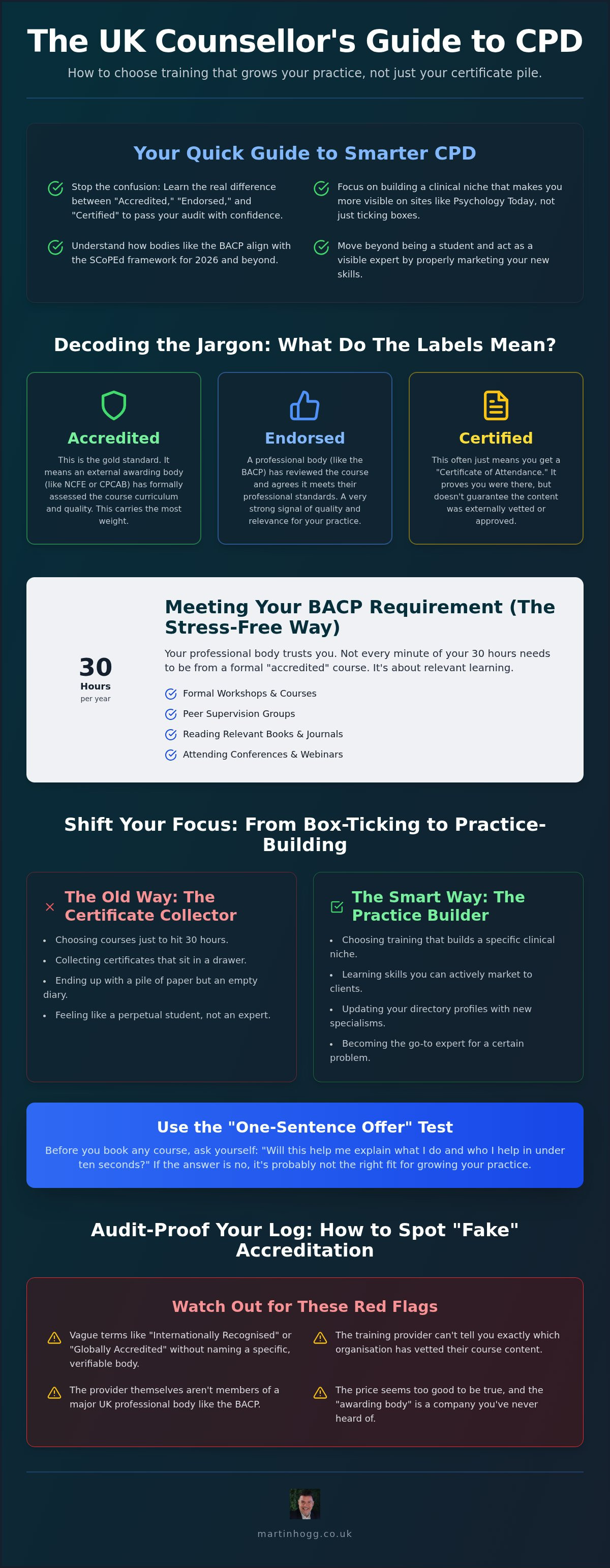
- Stop the confusion by learning the real difference between "Accredited" and "Endorsed" training so you can pass your professional audit with confidence.
- Get a clear view of the 2026 landscape and see how professional bodies like the BACP now align with the SCoPEd framework regarding accredited cpd for counsellors uk.
- Use the "One-Sentence Offer" test to ensure your next course helps you explain what you do to potential clients in under ten seconds.
- Shift your focus from simply ticking boxes to building a clinical niche that makes you more visible on sites like Psychology Today.
- Move beyond being a perpetual student and start acting as a visible expert by properly marketing your new skills to the people who need them.
What Does "Accredited CPD" Actually Mean for UK Counsellors?
I've spent years looking at training brochures that promise the world but leave you squinting at the small print. It's a bit of a maze. When we talk about accredited cpd for counsellors uk, we are essentially looking for a "stamp of approval" from someone other than the person selling the course. In 2026, accredited training for UK counsellors is defined as any learning activity that has been formally assessed and verified by an external awarding body or professional association to meet specific quality and educational standards.
You might feel a spike of anxiety when your annual renewal email drops into your inbox. I get it. The British Association for Counselling and Psychotherapy (BACP) requires a minimum of 30 hours of CPD per year. But here is the good news: not every single minute has to be "accredited" to count towards that total. Your professional body trusts you to pick training that is relevant to your practice. This could be anything from a peer supervision group to a formal workshop.
The Difference Between Accredited, Endorsed, and Certified
Let's clear up the jargon. A "Certificate of Attendance" just proves you were in the room without falling asleep. It doesn't mean the content was vetted. "Accredited" usually means an external body like the NCFE or CPCAB has checked the curriculum and the assessment. "Endorsed" is slightly different; it means a membership body like the BACP has looked at the course and agreed it meets their professional standards. I often suggest looking for BACP-endorsed workshops because they carry extra weight if you ever get audited.
Why Your Professional Body Cares About Accreditation
Your professional body cares about accreditation because it's a safeguard for public safety. It ensures we are maintaining high ethical standards rather than just following the latest social media trends. To make your training log for accredited cpd for counsellors uk truly audit-proof, I recommend keeping a simple digital folder of your certificates. Write a short reflection on how each course helped your clients. This shows you are an active, thoughtful practitioner, not just someone ticking a box to keep your membership active.
Decoding the UK Therapy CPD Landscape in 2026
The UK therapy world is a bit of a crowded room. You have the heavyweights like the BACP and UKCP, alongside the NCPS. Then you have the awarding bodies like NCFE or CPCAB who provide the academic framework for many courses. When you are looking for accredited cpd for counsellors uk, you need to know who is actually backing the training. It's easy to get lost in a sea of logos. Most therapists struggle to find the right balance between structured CPD, like formal workshops, and self-directed CPD, like reading or peer groups. I always suggest prioritising clinical relevance over just collecting certificates. If a course doesn't help you help your clients, it's just a piece of paper.
How to Spot "Fake" Accreditation
I've seen some shockers lately. Be very careful with providers who use vague terms like "internationally recognised" or "globally accredited" without naming a specific, verifiable body. If they can't tell you exactly which organisation has vetted their content, walk away. A good rule of thumb is to check the provider's own credentials. Are they BACP members themselves? Do they have a track record in the UK? If it looks too cheap and the certificate is issued by a company you've never heard of, it probably won't stand up to an audit.
Meeting Your 30-Hour Requirement (The Stress-Free Way)
Keeping up with the official BACP CPD requirements of 30 hours a year doesn't have to be a nightmare. I suggest using a simple Excel sheet or even a dedicated app on your phone to log things as you go. Don't wait until the end of the year to try and remember what you did in January. A rough and ready log that is updated monthly is far better than a perfect system that stays empty because it's too complicated to use. If you are feeling stuck on how to balance your clinical hours with business growth, you might find some inspiration in our Private Practice Success Membership where we talk about these practicalities every day.
Choosing CPD That Grows Your Practice (Not Just Your Certificate Pile)
I see too many counsellors collecting certificates like they are stamps. They have a pile of paper in a drawer but an empty diary. When you are looking for accredited cpd for counsellors uk, you should ask yourself the "One-Sentence Offer" test. If you finish this course, can you explain how you help someone in ten seconds? If the answer is no, it might be a nice bit of learning, but it won't pay the mortgage. You want training that makes you stand out on the Counselling Directory or Psychology Today.
Think about your Psychology Today profile. Most people have a generic "above the fold" intro. Adding a specific, accredited specialism like "Anger Management Specialist" transforms that profile from a vague promise into a client magnet. It changes your title tags from "Counsellor in Birmingham" to "Anger Management for Men in Birmingham." That is how you get found by people who are actually looking to pay for a solution.
Strategic Specialisms: Anger Management and Working with Men
I often talk about Anger Management and Working with Men as two of the best niches to build. They are under-served. When you have specific, accredited training in these areas, you aren't competing with every other therapist in a five-mile radius. You can find more detail on this in my guide to niche building for counsellors. These niches usually have lower competition and higher "private pay" potential because the need is so urgent.
The ROI of CPD: When Training Pays for Itself
You need to look at the return on investment. If a workshop costs you £200, it only needs to bring in one new long-term client to pay for itself ten times over. The CPD Standards Office notes that high-quality development is key for mental health professionals, but for us in private practice, "Practice Visibility" is the missing link. Without visibility, your accredited cpd for counsellors uk is just a secret you keep in a desk drawer.
Your Next Steps: From Box-Ticking to Practice Success
You have seen how to find accredited cpd for counsellors uk without getting caught in a jargon trap. Now comes the part where most people stumble. You have to actually do something with what you've learned. The journey is straightforward: check the accreditation, ensure it fits your niche, and then market it. Don't let that certificate just sit in a digital folder gathering dust. It needs to be working for you.
It is very easy to become a perpetual student. We often tell ourselves that one more course will finally give us the confidence to raise our fees or show our faces on video. The reality is that you are likely already a brilliant clinician. It is time to step out from behind the textbooks and start being a visible expert. Update your Counselling Directory profile. Tell people what you now know. When you finish a course, I want you to spend at least two hours marketing that new skill for every ten hours you spent learning it. This is how you turn a cost into an investment.
Join the Private Practice Success Membership
Bridging the gap between clinical excellence and business growth is hard to do alone. My membership on Skool is designed for exactly this. We help therapists who feel overwhelmed by the business side of things. Whether it is sorting your Canva graphics or finally getting your head around how to use Calendly, we do it together. We focus on practical action rather than abstract theory. Learn more about the Private Practice Success community.
Free Resources to Get You Started
If you want to keep reading before diving into a community, I have plenty of other guides available. You might find my thoughts on Marketing for Therapists in the UK particularly useful. It follows my favourite philosophy: rough and ready content beats polished every time. Don't wait for a perfect plan that never happens. Just start helping people and the rest will follow. Your accredited cpd for counsellors uk is the foundation, but your visibility is the house you build on top of it.
Time to Turn Your Training into Growth
I have spent over 20 years in the UK therapy sector. In that time, I've seen too many brilliant counsellors get stuck in a cycle of endless training without ever seeing their client numbers grow. We have covered why verifying your provider matters and how picking a strategic niche can make you a magnet for the right clients. Finding the right accredited cpd for counsellors uk is a vital first step, but the real progress happens when you stop being a perpetual student and start being a visible expert.
I use my experience as a BACP-endorsed workshop provider to help you bridge the gap between clinical skills and a busy diary. You don't need to figure out the business side of therapy alone. Our Practice Visibility Blueprint community is full of peers who are all working toward the same goal: a professional, sustainable practice that helps more people.
You have the skills and the heart for this work. Now it is time to make sure the people who need you can actually find you. I look forward to seeing you there.
Frequently Asked Questions
Does the BACP require all CPD to be accredited?
No, the BACP doesn't mandate that every single hour must be formally accredited. They expect you to undertake a variety of activities that are relevant to your clinical work and professional development. While accredited cpd for counsellors uk provides a solid paper trail for audits, you can also include self-directed learning like peer reflection or reading. The key is being able to show how the activity helped your clients.
What is the difference between BACP accredited and BACP endorsed?
"BACP Accredited" is a status for practitioners or core training courses, while "BACP Endorsed" applies to shorter CPD workshops. When a workshop is endorsed, the BACP has checked the trainer's credentials and the course content to ensure it meets their professional standards. It's a gold standard for short-term training. I find that choosing endorsed courses takes the guesswork out of your annual professional development log.
Can I count reading books or watching webinars as accredited CPD?
You can definitely count these, but they fall under self-directed learning rather than accredited training. For your annual return, you simply need to log the time spent and write a short reflection on what you learned. It's a great way to top up your hours without spending a fortune. Just make sure you balance these informal hours with some structured, high-quality workshops to keep your practice grounded.
How do I know if an online course is legitimately accredited in the UK?
A legitimate course will clearly name a UK awarding body such as NCFE or CPCAB, or show a professional body's endorsement. Legitimate providers of accredited cpd for counsellors uk will be happy to tell you exactly who has vetted their course. You can usually verify a provider's claims by checking the "find a provider" section on the awarding body's own website. It only takes five minutes.
How many hours of CPD do I need as a UK counsellor in 2026?
If you are a BACP member in 2026, you must complete at least 30 hours of CPD every year. UKCP registrants need a minimum of 20 hours annually, while the NCPS also sets the bar at 30 hours. I always recommend logging your hours as you go using a simple spreadsheet. It's much easier than trying to remember what you did twelve months ago when that renewal email finally arrives.
Disclaimer
The information provided on this blog is for general informational purposes only. It is also not intended to be a substitute for professional medical or mental health advice, diagnosis, or treatment. Reading this content does not create a therapist-client relationship.


