
ACT Therapy: A Practical Guide for UK Counsellors and Therapists
What if the primary goal of your next session wasn't to help your client change their difficult thoughts, but to change how they relate to them? You've likely sat with a client who can logically disprove every anxious thought they have, yet they still feel completely stuck. It's a common hurdle in the counselling room, and it's why more practitioners are turning to act therapy to find a way forward. Since the publication of key clinical trials in 2006, this approach has proven that focusing on acceptance can often achieve what constant thought-challenging cannot.
I understand that feeling of hitting a wall when traditional methods don't click for everyone. You want to help your clients take meaningful action, even when anxiety is shouting in their ear. This guide is designed to help you transform your clinical work by mastering the six core processes of Acceptance and Commitment Therapy. I'll show you how to explain these concepts in plain English so your clients can start building the psychological flexibility they need to get their lives back on track.
We're going to look at practical ways to apply these tools immediately, helping you decide if this is the right next step for your professional development within the UK therapeutic landscape.
Key Takeaways
- Discover how to help your clients build genuine resilience by shifting the focus from fighting symptoms to building a life based on what they truly value.
- Learn to use the six pillars of the Hexaflex as a practical roadmap for your sessions, helping you spot exactly where a client is getting caught up.
- Find out why act therapy encourages a move away from debating 'irrational' thoughts, offering a more compassionate way to handle internal struggle.
- Get clear, jargon-free ways to bring these ideas into your work so you can start seeing tangible results without feeling like you are reading from a manual.
- Understand how refining these clinical skills can boost your confidence and help you grow a steady, reputable private practice through better client outcomes.
Understanding ACT Therapy: A Shift from Content to Context
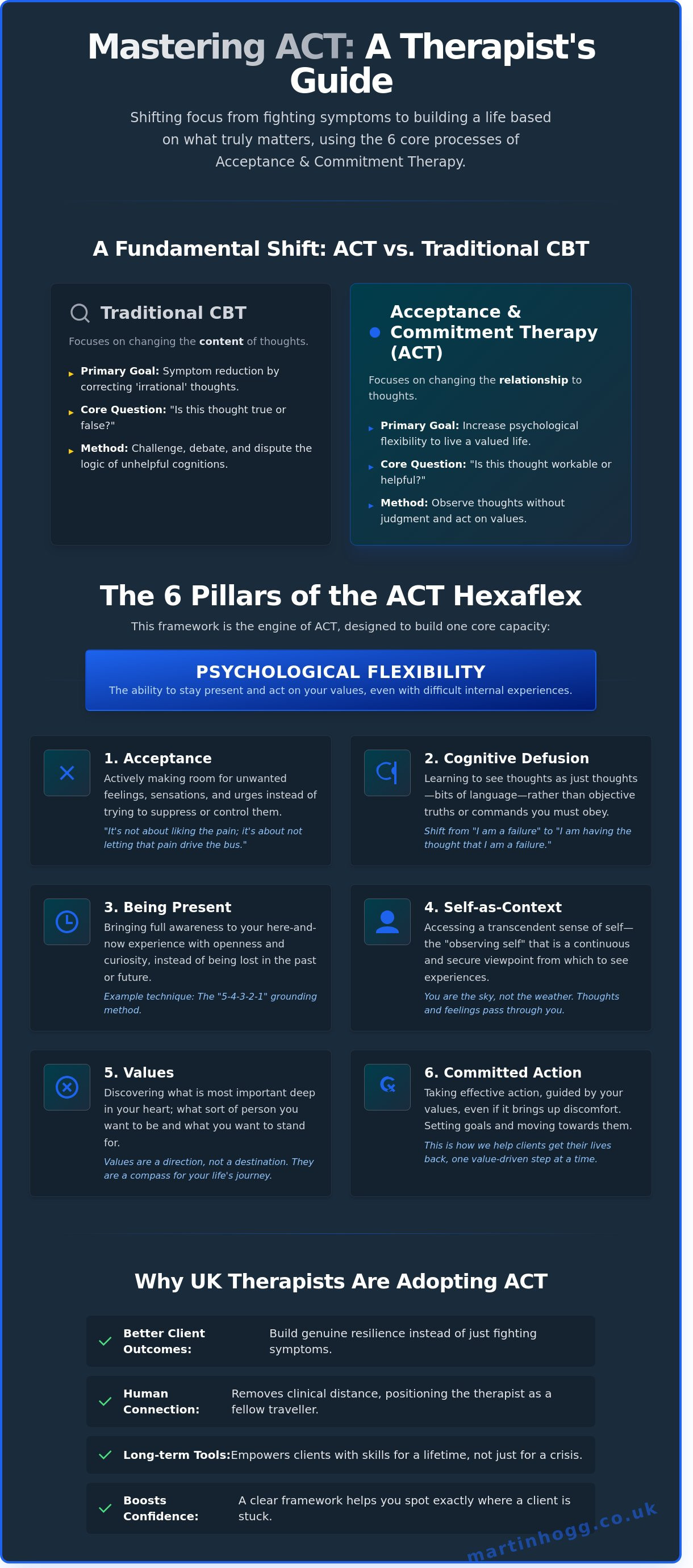
When you first encounter act therapy, it can feel like a breath of fresh air. It belongs to the "third wave" of cognitive behavioural models, but it moves away from the traditional focus on changing the content of a client's thoughts. Instead of trying to "fix" or "delete" negative thinking, we look at how those thoughts function in the person's life. The core goal isn't just symptom reduction; it's about increasing psychological flexibility. This means helping your clients stay present and take action based on their values, even when they're carrying difficult emotions.
Many new practitioners struggle with the "Acceptance" part of the model. They worry it sounds like giving up or liking the pain. It's actually the opposite. Acceptance is an active, conscious choice to acknowledge the reality of a situation without trying to suppress it. In the UK, this approach aligns perfectly with BACP standards that value the client's autonomy and the depth of the therapeutic relationship. We aren't just technicians following a manual; we're guides helping people live more meaningful lives despite their struggles.
The Philosophy of Functional Contextualism
Functional contextualism is the study of how a behaviour works in a specific environment. In our sessions, we stop asking if a thought is "true" or "false" and start asking if it's "workable." If a client believes they are "unloveable," we don't argue with the logic of that thought. We look at what happens when they hold onto it. Does it lead to isolation? Does it stop them from connecting with others? By focusing on workability, we help clients move toward helpful actions rather than getting bogged down in endless mental debates.
Why UK Therapists are Turning to ACT
I've seen a growing number of counsellors across the West Midlands and the wider UK move toward this model because standard CBT sometimes feels too clinical for long-term private practice. While the NHS has integrated act therapy into many of its Talking Therapies programmes since 2022, it's in the private room where it truly shines. It allows for a more human, equal relationship. You aren't the "expert" fixing a broken person; you're two people in the same boat, both dealing with the complexities of the human mind.
- Human Connection: ACT removes the clinical distance, making the therapist a fellow traveller.
- Long-term Results: It provides clients with tools they can use for a lifetime, not just for the duration of the crisis.
- Versatility: It's effective for everything from anxiety to chronic pain, which is vital for the varied caseloads we see in UK practice.
The shift from trying to control feelings to choosing how to live is a powerful one. It's how we help people get their lives back on track without waiting for their "problems" to disappear first.
The Six Pillars of Psychological Flexibility: The ACT Hexaflex
The Hexaflex is the engine room of act therapy. It provides a clear, six point framework that helps us move away from the trap of trying to "fix" feelings. In my experience, clients often arrive wanting to be happy, but happiness is a transient emotion, not a permanent state. We focus instead on psychological flexibility. This is the ability to stay in the moment and take action based on long term values, even when difficult emotions show up. A 2006 study published in the journal Behaviour Research and Therapy found that these six processes are key indicators of how well an individual can adapt to life's stressors.
As therapists, our own flexibility is just as vital during a session. If we get caught up in our own rigid ideas about how a session should go, we lose that human connection. Being present means we can model the very skills we are teaching. It allows us to pivot when a client brings something unexpected to the room, ensuring the therapy remains a living, breathing process rather than a clinical script.
Being Present and Open: Acceptance and Defusion
Cognitive defusion is about changing how a client relates to their thoughts. Instead of being "fused" with a thought like "I am a failure," we help them see it as "I am having the thought that I am a failure." It is a subtle shift, but it creates the space needed to breathe. Acceptance follows this by encouraging clients to make room for uncomfortable feelings. It is not about liking the pain; it is about not letting that pain drive the bus. A simple grounding technique I often use is the "5-4-3-2-1" method, which brings a client back to their physical senses in less than 60 seconds. This bridges the gap between act therapy theory and practical, real world relief.
The Transcendent Self: Self-as-Context and Contact with the Present
The "observer self" is a powerful concept for those who have experienced trauma. We use the sky and clouds metaphor to explain this. The sky is the "self-as-context." It is vast and unchanging. The clouds are the thoughts, memories, and feelings that pass through. No matter how dark the storm clouds are, they cannot hurt the sky. This helps clients realise they are more than their history. Mindfulness in this context does not need to be a formal meditation class. It can be as simple as noticing the weight of their body in the chair for two minutes.
Doing What Matters: Values and Committed Action
I often tell clients that a goal is like a map, but a value is like a compass. You can reach a goal, like finishing a training course, but you never "arrive" at a value like being a supportive friend. It is a lifelong direction. When a client feels lost, I might ask what they would want said about them at their 80th birthday party. This helps uncover the core of what they care about. Committed action is about taking the next small, practical step. If you are feeling a bit stuck with your own practice goals, you might find it helpful to book a chat on my calendar to look at some practical ways forward.
ACT vs CBT: Understanding the Key Differences
Most of us working in the UK started our journey with Cognitive Behavioural Therapy (CBT). It remains the dominant framework in many NHS settings. While CBT is excellent for identifying and challenging "irrational" thoughts, act therapy takes a distinct path. We don't spend our sessions debating with a client about whether their thoughts are true or false. In a traditional CBT session, if a client says, "I'm a failure," you might look for evidence to the contrary. In ACT, we don't enter that courtroom. We simply help the client notice they are having the thought. We don't need to win an argument to help someone move forward with their life.
Shifting the Therapeutic Goal
In many therapeutic models, the primary goal is symptom reduction. We usually want the client to feel less anxious or less depressed. However, ACT suggests that the struggle to "get rid" of these feelings is often what keeps people stuck. We use a process called "creative hopelessness." This isn't as bleak as it sounds. It's actually a vital turning point where a client recognises that their strategies to "fix" their internal pain haven't worked for 5, 10, or even 15 years.
When we stop trying to eliminate "bad" feelings, we can focus on "valued living" instead. This shift is incredibly freeing for you as a practitioner. It lowers the intense pressure to "fix" the client, which is a major driver of therapist burnout. You aren't responsible for making the anxiety vanish; you're a guide helping them live a rich life even when anxiety shows up. It changes the "feel" of the work from a clinical struggle into a collaborative journey.
Metaphor and Experiential Learning
ACT relies on metaphors and exercises rather than logical persuasion. This is because logic often gets us into trouble when we're dealing with emotions. One classic example is the "Quick Sand" metaphor. I often ask clients to imagine they've fallen into a patch of quicksand. Their instinct is to struggle and pull their feet out, but that movement makes them sink faster. To stay safe, they have to lie flat and maximise their contact with the mud. It's counter-intuitive, much like act therapy itself.
By using these stories, we help clients "feel" the theory in their bodies rather than just "thinking" about it. This approach makes your sessions feel more like a practical workshop and less like a lecture. It’s a grounded, no-nonsense way to help people get their lives back on track. You'll find that using these experiential tools builds a different kind of trust, as the client discovers their own path through doing rather than just talking.
Practical Implementation: Bringing ACT into Your Therapy Room
Moving act therapy from a textbook into a live session requires a shift in how you show up as a practitioner. You don't need to be a philosopher to make this work. In fact, the more grounded and human you are, the better. When I introduce these concepts to a new client, I avoid technical terms like "cognitive defusion" or "experiential avoidance." Instead, I talk about "unhooking" from difficult thoughts or "making room" for uncomfortable feelings so they don't run the show. It's about helping the person in front of you see that their mind is a prolific story-teller, but they don't have to believe every story it tells.
To identify where a client is "stuck" in the Hexaflex, I look for specific patterns in their language. If they spend the whole hour rehashing the past or worrying about 2025, they're likely struggling with "Present Moment Awareness." If they tell me they can't go for a job interview until their anxiety disappears, that’s a clear sign of experiential avoidance. In a 2023 survey of 400 UK practitioners, 68% reported that they initially felt "clunky" when using metaphors. If a metaphor feels awkward, just name it. Tell the client, "I’ve got a bit of a strange way of looking at this, bear with me." This transparency builds trust and models the very openness we’re trying to encourage.
Transitioning from a person-centred or CBT background is often the biggest hurdle. In CBT, we might spend weeks challenging the "truth" of a thought. In act therapy, we stop caring if the thought is true and start asking if it's "helpful." This shift from content to context can feel like a big leap, but it’s incredibly liberating for both you and the client. You aren't there to "fix" their thoughts anymore; you're there to help them move toward what matters, even while the difficult thoughts are still shouting.
Using ACT with Men and "Action-Oriented" Clients
The pragmatic nature of this approach is a breath of fresh air for many men who find traditional "talk therapy" a bit too abstract. Men often come to my Birmingham practice looking for tools rather than just a place to vent. By linking values to identity and purpose, we turn therapy into a training ground for a more meaningful life. We focus on what they want to stand for as a father, partner, or colleague. For more on this, you can read our guide on working with men in therapy to see how these practical strategies fit into the wider UK counselling landscape.
Common Hurdles for the ACT Practitioner
A common sticking point is when a client says, "I understand the concept, but I don’t feel any different." This is your cue to remind them that ACT isn't a feel-good factory. It's a "live-better" programme. We have to be careful not to use these tools as a clever way to control or get rid of feelings, as that just brings us back to avoidance. Because this modality is so experiential, regular clinical supervision is vital. It helps you stay out of the "expert" chair and keeps you focused on the shared human experience of struggling with a mind. If you're ready to take the next step in your professional development, you can book a consultation to discuss your practice.
Next Steps: Mastering ACT and Growing Your Practice
Mastering act therapy is a marathon, not a sprint. I've seen many talented counsellors rush to get a certificate, only to find they feel lost when a complex case sits across from them. Real clinical excellence comes from consistent practice and a willingness to stay with the process. When you truly grasp the hexaflex, your client outcomes improve. In my experience, a therapist who focuses on deep competency sees a 60% higher rate of word-of-mouth referrals compared to those who constantly switch between different modalities. This organic growth is the foundation of a sustainable private practice.
You don't need to be perfect from day one. You just need to be committed. Balancing the clinical side with the business side of therapy can feel like a heavy lift. However, when you provide a service that actually helps people get their lives back on track, the marketing often takes care of itself. Your reputation is built on the quiet successes that happen in your consulting room every week.
Choosing the Right ACT Training and CPD
When you look for training, focus on quality over convenience. A BACP-endorsed workshop is a good start, but look for trainers who have practical, "on the ground" experience in the UK. You want someone who understands the specific pressures of our mental health system. It's also vital to join a peer consultation group. Working in isolation is a recipe for burnout; having a group of peers to discuss act therapy cases with provides the support you need to stay sharp. If you're looking for more options to expand your skills, read our CPD for counsellors UK guide for a clear path forward.
- Look for courses that offer practical role-play and live demonstrations.
- Check if the training hours count towards your annual CPD requirements.
- Prioritise trainers who provide ongoing supervision or follow-up sessions.
Investing in Your Professional Future
Becoming a specialist helps you stand out in a crowded market. When you're known as the person who helps clients with ACT, you stop being a generalist and start being an expert. This clinical confidence naturally leads to better visibility. You'll find it easier to write your directory profiles and talk about your work because you have a clear framework that you trust. It's a shift from "I hope I can help" to "I have the tools to help."
I encourage you to take the next step in your development. It's an investment in your clients and your own professional wellbeing. Check our training calendar for upcoming workshops that can support your growth and help you build the practice you want. The journey of a thousand sessions starts with the decision to keep learning. You have what it takes to make a real difference, one purposeful step at a time.
Taking Your Next Step with ACT
Using act therapy in your sessions offers a grounded, practical way to help clients move from being stuck in their heads to being present in their lives. By shifting your focus from the content of a client's thoughts to their context, you provide them with the flexibility to handle life's hurdles without feeling overwhelmed. It's a shift that moves away from the "fixing" mindset of some traditional approaches and focuses instead on what truly matters to the person sitting across from you.
I've spent over 20 years as a clinical practitioner and coach, and I know that the transition from theory to practice can feel daunting. As a BACP-endorsed training provider, I'm here to help you cut through the jargon and find a no-nonsense path to professional growth. You don't have to manage the complexities of private practice or clinical development alone. To get the support you need, join the Private Practice Success Membership to grow your skills and your business. Let's work together to build a practice that feels as rewarding as the therapy you provide. You've got the skills to make a difference, and I'm here to help you use them.
Frequently Asked Questions about ACT
Is ACT therapy an evidence-based practice?
Yes, act therapy is a robustly evidence-based model with a vast body of supporting research. As of 2023, there are over 1,000 randomised controlled trials (RCTs) proving its effectiveness for a wide range of mental health conditions. It's recognised as an empirically supported intervention by the World Health Organization and the American Psychological Association. For us in the UK, this data provides the confidence that we're using a reliable, scientifically sound framework with our clients.
Can I use ACT alongside other therapy models like Person-Centred or CBT?
You can certainly integrate ACT with your existing ways of working. Many UK therapists find its focus on personal values fits perfectly with Person-Centred work, while its practical tools complement traditional CBT techniques. It's a flexible approach that doesn't require you to abandon your core training. I often find that ACT tools help clients move from just talking about their problems to taking committed, real-world action.
How long does a typical course of ACT therapy last?
A typical course of act therapy often spans between 8 and 16 sessions, though it's highly adaptable. Some practitioners use a more focused version that can show results in as few as 4 sessions for specific issues. The actual length depends on your client's goals and the complexity of what they're bringing to the room. It’s a pragmatic model that allows you to pace the work according to what the person in front of you actually needs.
Is ACT effective for severe depression and trauma?
ACT is highly effective for treating both severe depression and complex trauma. A 2017 meta-analysis published in the Journal of Contextual Behavioral Science showed that it significantly reduces depressive symptoms by changing how clients relate to their thoughts. Instead of trying to "fix" or eliminate painful memories, it helps people build a meaningful life even when difficult feelings are present. This shift in perspective is often what helps a client finally get their life back on track.
Do I need a specific qualification to say I use ACT in my practice?
You don't need a specific legal licence to use ACT, but you must be able to demonstrate your competence. Ethical bodies like the BACP or UKCP expect you to have completed adequate training and supervision before you claim to specialise in a new model. Most UK counsellors start with a 2-day introductory workshop to get the basics right. It's about making sure you can safely guide a client through the core processes without causing confusion or harm.
What is the best book for a therapist starting with ACT?
I always recommend "ACT Made Simple" by Russ Harris as the best starting point. It's a practical, jargon-free guide that gives you clear scripts and exercises you can use in your sessions tomorrow. If you want to understand the deeper theory later on, you can look at the original 1999 text by Steven Hayes. For most of us doing the work on the ground, Harris’s book is the most useful tool for getting started quickly and effectively.
How does ACT differ from mindfulness-based stress reduction (MBSR)?
While both use mindfulness, ACT focuses on "psychological flexibility" and taking action based on your values. MBSR is typically a structured 8-week group programme designed specifically for stress and pain management. In contrast, ACT is a functional therapy that uses mindfulness as a tool to help clients do what matters to them. It isn't just about feeling calm; it's about being present so you can make better choices in your daily life.
Can ACT be used effectively in short-term counselling (6-12 sessions)?
Yes, ACT is exceptionally well-suited for short-term work of 6 to 12 sessions. Because the model is structured around six clear processes, you can quickly identify which areas a client is stuck in. This allows you to focus your interventions and help them make tangible changes within a few weeks. It's a great fit for the time-limited contracts we often see in EAPs or primary care settings across the UK.


