
Anger Management CPD for Therapists: Choosing Training You Can Use

Article by
Martin Hogg
I help Private Practice counsellors in the UK set up and grow an ethical Private Practice they love, work with their ideal clients, and earn the income they deserve. All without guesswork and burnout. I have been a private practice counsellor myself for over 20 years, specialising in anger management. I set up a not-for-profit social enterprise, Citizen Coaching and Counselling, which delivers thousands of counselling sessions a year to adults and young people in Birmingham. I am a registered BACP Counsellor and the author of three books, My Anger Coach, My Anxiety Coach and My Relationship Coach. These are available on Amazon.
Useful anger management CPD for therapists is about more than collecting techniques. It can help you understand what anger may mean for a client and think carefully about how to respond. You want ideas you can take into sessions, not a checklist that treats anger as a simple behaviour problem. That’s a fair concern. Course descriptions can be brief, so it helps to look closely at what the learning actually covers.
I’d look for training that brings together an understanding of anger, ways to assess what’s happening for each client, and possible responses you can adapt with care. It should also leave room for reflection. A tool is only useful when you can judge whether it suits the person in front of you.
In this article, I’ll show you how to assess the relevance and depth of anger-focused CPD, what learning areas to look for, and how to think about applying new ideas responsibly in your practice. I’ll also introduce my Anger Management CPD for Professionals and explain how to decide whether it fits your learning needs.
Key Takeaways
- Anger management CPD for therapists is most useful when it helps you understand anger in context, rather than treating it as a behaviour to simply stop.
- Look for learning that connects assessment and formulation with motivation and possible interventions, so techniques make sense for the client in front of you.
- Before choosing training, identify your learning need and review the outcomes, depth and practical relevance. Accreditation, CPD recognition and fit with your work are separate considerations.
- My Anger Management CPD for Professionals is one option if you’re looking to develop your understanding and practice.
Anger management CPD for therapists: why understanding anger matters
Anger can be challenging to work with, particularly when a client talks about conflict, regret or feeling out of control. But a person isn’t defined by their anger, and the emotion itself doesn’t tell you the whole story. Anger management CPD for therapists is structured professional learning that can help you understand anger and consider ways of responding to it in therapeutic work.
Anger is an emotion; the behaviours that follow it are actions, and they’re not the same thing. That distinction leaves room to explore what the feeling means without excusing harm or treating every expression of anger as something to suppress. Anger may be why someone seeks therapy, or it may come up within a wider picture of relationships, stress, loss or other concerns. For a general overview, see Anger management as a psychotherapeutic program.
Why anger may need more than a simple coping strategy
A breathing exercise or a pause may be useful, but neither explains what anger means to a particular client. Context, personal experience and the way someone makes sense of an event can all shape how anger is expressed. I wouldn’t assume there’s one cause or that one intervention will suit everyone.
Hypothetical example: A client describes snapping at a colleague after repeated changes to their workload. You might explore the immediate trigger, then consider what the situation represents to them and what they want to do differently. The point isn’t to settle on a ready-made explanation. It’s to stay curious and build a clearer picture together.
What therapists may hope to gain from focused CPD
Good training can give you a stronger foundation for thinking about anger, help you decide what to explore, and give you space to reflect on your own responses. I’d treat it as professional learning, not a promise of particular client outcomes. Take ideas back to your work thoughtfully: consider their relevance, adapt them with care and keep your professional judgement in view.
What useful anger management CPD for therapists can cover
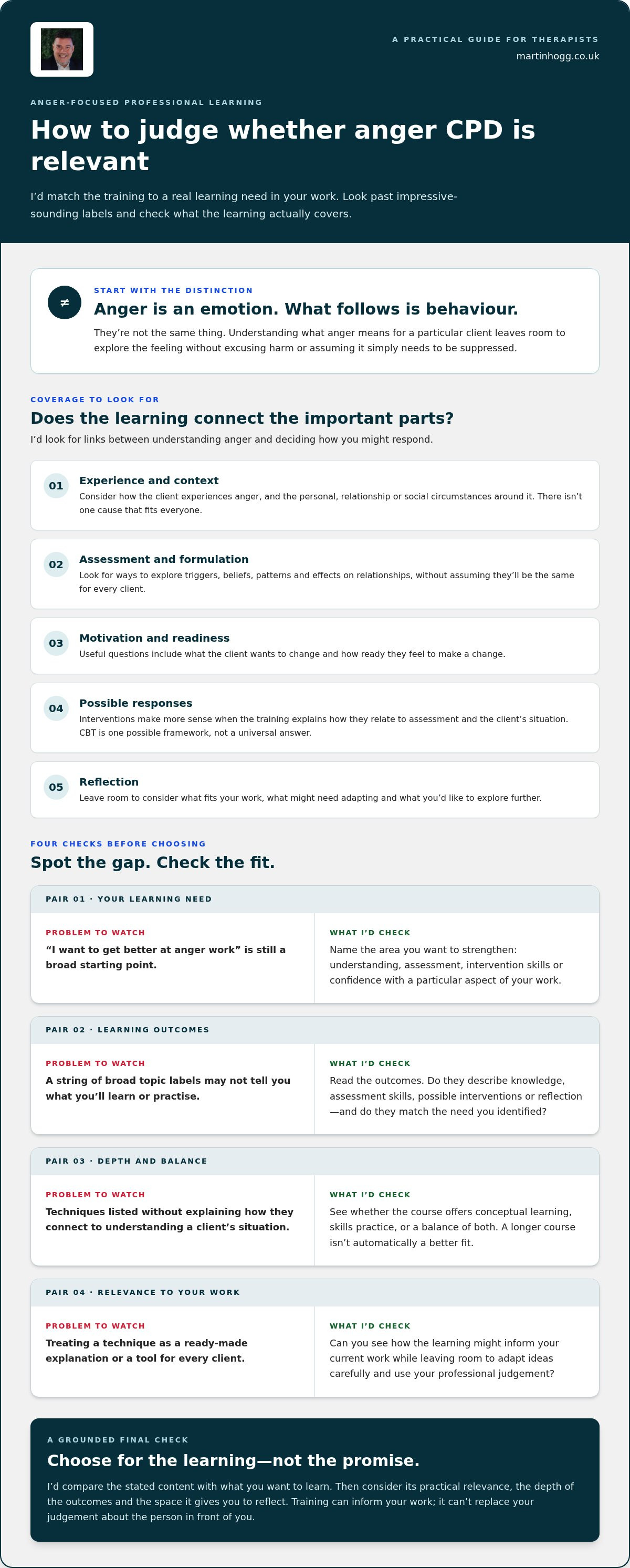
Useful anger management CPD for therapists connects ideas about anger with decisions you make in practice. A rounded learning plan might cover how anger is experienced, assessment, formulation, motivation and possible interventions. Well-rounded anger-focused learning links understanding, assessment, motivation and context with considered therapeutic responses.
Look for more than a list of techniques. Conceptual learning can help you make sense of what’s happening; skills practice may give you a chance to try different ways of responding. Some training puts more emphasis on one than the other. Compare the stated content with what you want to learn, rather than assuming every course offers the same balance.
From assessment and formulation to therapeutic response
Understanding how a client experiences anger can inform what you explore and how you respond. You might consider triggers, beliefs, patterns and effects on relationships, without assuming these look the same for everyone. CBT is one possible framework, not a universal answer. The American Psychological Association’s strategies for anger control include approaches such as relaxation, cognitive restructuring and communication skills. These are examples to consider, not tools for every client or circumstance.
When reviewing course content, look for a clear link between assessment and formulation, and the interventions discussed. If the description names techniques but doesn’t explain how they connect to understanding a client’s situation, you may not have enough information to judge whether the training meets your learning need.
Motivation, context and reflective learning
Anger-focused learning can prompt useful questions: what does the client want to change, how ready do they feel, and what social or relationship circumstances shape the concern? Questions like these keep practical ideas connected to the person, rather than turning sessions into a tick-box exercise.
I’d make space to reflect after training. What fits your work? What would need adapting? What would you like to explore further? If you value learning alongside other practitioners, the Private Practice Success community can support the business side of your ongoing professional development.
How therapists can judge whether anger CPD is relevant
Before booking, I’d match the training to a real learning need in your work. A useful course description should help you decide whether its content is relevant, not just sound impressive on a page. Try this quick check:
- Name your learning need. Are you looking to strengthen your understanding, assessment, intervention skills or confidence with a particular aspect of your work?
- Read the learning outcomes. Do they say what you’ll learn or practise, and does that match the need you identified?
- Look for depth. Is there enough detail to understand how the topics connect, rather than a string of broad labels? A longer course isn’t automatically a better fit.
- Consider practical relevance. Can you see how the learning might inform your current work, while leaving room for your own judgement?
These checks help you assess anger management CPD for therapists without treating the course description as a promise of what will happen in your sessions.
Questions to ask of the learning outcomes
Notice whether the outcomes describe knowledge, assessment skills, possible interventions or reflection. You may want a deeper understanding of a subject rather than a set of techniques. Or you may be looking for opportunities to practise. Ask yourself whether the stated outcomes match that aim. Course length alone won’t tell you.
Turning CPD learning into considered practice
After training, jot down one learning point, one question it raises and one possible application. Then consider whether that application fits the client and the situation. Keep a record of your learning in line with your professional body’s current guidance, and use your professional judgement as you put ideas into practice.
If the learning informs how you describe your work, building a counselling niche can help you think through that focus without letting a label do the thinking for you.
Anger management CPD with Martin Hogg: a thoughtful next step
You now have a practical way to judge whether training fits your learning needs. I provide Anger Management CPD for Professionals for counsellors and therapists who want to develop their professional understanding of anger. Before choosing any training, consider what you want to learn and how it relates to your work.
I won’t promise that a course will produce a particular result for your clients. CPD can support your professional understanding, but applying what you learn still calls for reflection, attention to each client’s circumstances and your own professional judgement. That’s the work after the course, not a box to tick on the way out.
Who may find focused anger CPD useful
Focused learning may be worth considering if you want to strengthen your understanding of anger in your client work. Perhaps you want to think more clearly about how anger is described, what questions you bring to sessions or how you decide what to explore next. The aim is professional learning, not placing a label on a client. Your learning need matters more than whether you describe yourself as an anger specialist.
Connect clinical development with a sustainable practice
Professional learning is one part of running a practice. There’s also the everyday work of building and sustaining it, which can take a fair bit of attention in its own right. My Private Practice Success Membership offers a community focused on private practice growth. It can sit alongside your clinical development, without suggesting that one kind of support replaces the other or guarantees a particular result.
If you’re weighing up how to make time for both, the Private Practice Success community brings together practice owners for growth-focused support and learning.
Choose a next step that fits your practice
Your next step doesn’t need to be a grand plan. Choose one learning need, then consider whether anger management CPD for therapists fits that need and the clients you currently see. Keep your expectations grounded: training can inform your thinking, but it can’t guarantee a particular clinical result. If a course mentions accreditation or BACP endorsement, make sure the claim applies to that specific course.
Give yourself time to put the learning into perspective. Note what you want to explore, what feels relevant to your work and where you need further thought. Professional development is most useful when it becomes part of an ongoing, considered approach, not another certificate filed away and forgotten.
Support with the wider business side of private practice can sit alongside your clinical learning. The Private Practice Success community is one place to explore that kind of practice-development support.
Keep going at a pace that works for you. Thoughtful steps count, and your practice can grow alongside your professional confidence.
Frequently Asked Questions
What does anger management CPD for therapists usually cover?
Anger management CPD for therapists may explore how anger is understood, assessed and formulated, alongside motivation, context and possible responses. I’d look beyond the course title: the same label can cover different learning. Read the stated outcomes and consider what you want to take from the training. You’re looking for a useful fit with your development needs, not a ready-made answer for every client.
How can I tell whether an anger management CPD course is suitable for my practice?
I’d start with a real question from your current work. Perhaps you want to think more clearly about anger arising during conversations about relationships or family life. Compare that need with the course topics and learning outcomes. Does it focus on understanding, practical skills or both? You can then judge whether it suits your work without expecting it to guarantee a particular result for clients.
Does anger management CPD count towards BACP CPD requirements?
I wouldn’t assume that a course title alone tells you how to record the learning. Check the current BACP CPD guidance that applies to your membership, and keep the course information with a note of what you learned and how it relates to your practice. I’d also treat course accreditation, endorsement and personal relevance as separate considerations.
Is anger management CPD only useful for therapists who specialise in anger?
No, you don’t need to call yourself an anger specialist to consider focused learning. You may encounter anger while working with concerns such as relationship strain or family conflict, even if it isn’t the main reason someone comes to therapy. I’d weigh the subject against your role, experience and learning aims. Choose training that fits your work, rather than expecting one course to suit every practitioner.
How can I apply anger management CPD learning in sessions?
I’d begin by asking what the learning changes in your understanding, rather than reaching straight for a technique. In a session, that might mean pausing to explore what the client wants to be different before considering possible responses. Treat any idea as something to reflect on, not a script. Note what seems relevant, what doesn’t fit and what you want to think through further.
Disclaimer
The information provided on this blog is for general informational purposes only. It is also not intended to be a substitute for professional medical or mental health advice, diagnosis, or treatment. Reading this content does not create a therapist-client relationship.


