
Anger Management CPD for Therapists: Practical Skills

Article by
Martin Hogg
I help Private Practice counsellors in the UK set up and grow an ethical Private Practice they love, work with their ideal clients, and earn the income they deserve. All without guesswork and burnout. I have been a private practice counsellor myself for over 20 years, specialising in anger management. I set up a not-for-profit social enterprise, Citizen Coaching and Counselling, which delivers thousands of counselling sessions a year to adults and young people in Birmingham. I am a registered BACP Counsellor and the author of three books, My Anger Coach, My Anxiety Coach and My Relationship Coach. These are available on Amazon.
Anger management CPD for therapists is most useful when it helps you turn understanding into practical work with clients. Good training explores anger, irritability, violence and underlying triggers, then considers approaches you can use in sessions. The aim isn’t to make anger disappear, but to help clients respond to it more constructively.
Anger rarely arrives on its own. It can sit alongside frustration, fear or a sense of being unheard, and each client’s experience is different. That can make it hard to know where to begin, especially when someone’s anger feels intense or difficult to discuss.
This article looks at what relevant CPD can cover, from understanding patterns and triggers to practical ways of supporting adults and young people. It also explains how approaches such as DBT can inform the work, and what to look for in training that offers useful ideas to bring into your practice.
Key Takeaways
- Look beyond the certificate: useful CPD materials should help you translate the learning into decisions you can use in sessions.
- Explore how a client’s anger developed and what it may be communicating before settling on an approach.
- Use logs and awareness of physical cues to help clients notice patterns that can be hard to spot in the moment.
- Choose practical strategies that help clients respond to anger constructively, rather than treating its complete absence as the goal.
CPD certificate and presentation slides
A certificate is useful evidence of learning, but the number of hours alone tells you little about the course. The Working with Anger Problems course carries 14 CPD hours and is approved by the British Psychological Society through its Quality Mark Scheme. Separately, the online anger management course is accredited by the UK CPD Accreditation Service. These are distinct course details, not interchangeable claims. I would look at the named course and awarding body before drawing conclusions about its recognition.
Presentation slides can make learning easier to revisit after a busy day of client work. Look for material that sets out key ideas clearly, uses practical examples and prompts reflection on how an approach might fit your practice. For instance, a slide showing a trigger, a physical response and a client’s reaction can provide a useful prompt for later reflection. Slides should support the teaching, not replace discussion or your clinical judgement.
Keep the certificate with your CPD record, and note the course name, provider, date and hours shown. Then add a brief reflection: what insight stood out, and how might it shape your work? A short note about adapting a question or exploring stress responses gives the learning context. Follow the record-keeping approach used in your professional practice rather than assuming a certificate tells the whole story.
CSAM certification and CPD are not the same thing. A CPD certificate documents learning or participation; by itself, it does not establish a separate CSAM credential. If CSAM is relevant to your professional development, review the credential’s own requirements as a separate pathway. Keep your claims precise: record the CPD hours earned, and describe certification only if that credential has been awarded. This distinction helps you explain your training accurately to clients and colleagues.
Understanding anger, irritability and violence
Anger is an emotion; violence is behaviour. Keeping that distinction clear helps you avoid treating a feeling as proof that someone is dangerous. Irritability may appear as snapping, impatience or a shorter fuse, while anger can show up as withdrawal or confrontation. In assessment, ask what happened before the response, what the person felt and what they did next. These questions build a more useful picture than a label alone.
Anger-related difficulties can begin in childhood and develop over many years, but that doesn’t mean every angry response has one cause. Explore the client’s account, including early experiences, current relationships and pressures they identify. For example, someone who becomes angry after feeling dismissed may want help recognising that pattern, rather than simply being told to calm down. Listening and careful questioning can help uncover what sits beneath the immediate reaction.
Useful treatment planning starts with the person’s circumstances, goals and the effects of their behaviour. Ask about the impact on relationships, work and daily life, while distinguishing an angry feeling from threats or physical acts. The client’s own explanation matters, as does the pattern over time. CPD should offer strategies for exploring these areas without treating irritability, anger and violence as interchangeable.
Dialectical behaviour therapy (DBT) was initially developed to treat people with borderline personality disorder. It combines cognitive-behavioural techniques with mindfulness, balancing acceptance with change. In anger work, DBT-informed skills can help clients notice triggers, regulate emotional responses and build healthier relationships. The aim is not to erase anger, but to strengthen a person’s ability to respond constructively and reduce harm.
UK courses may be delivered online, in person or in a hybrid format; delivery varies by programme. Costs depend on the course format, duration, teaching and materials, with pricing provided after a quote request.
If you’re considering how professional development fits your practice, you can explore support for private practice counsellors.
Anger triggers, logs and physiological monitoring
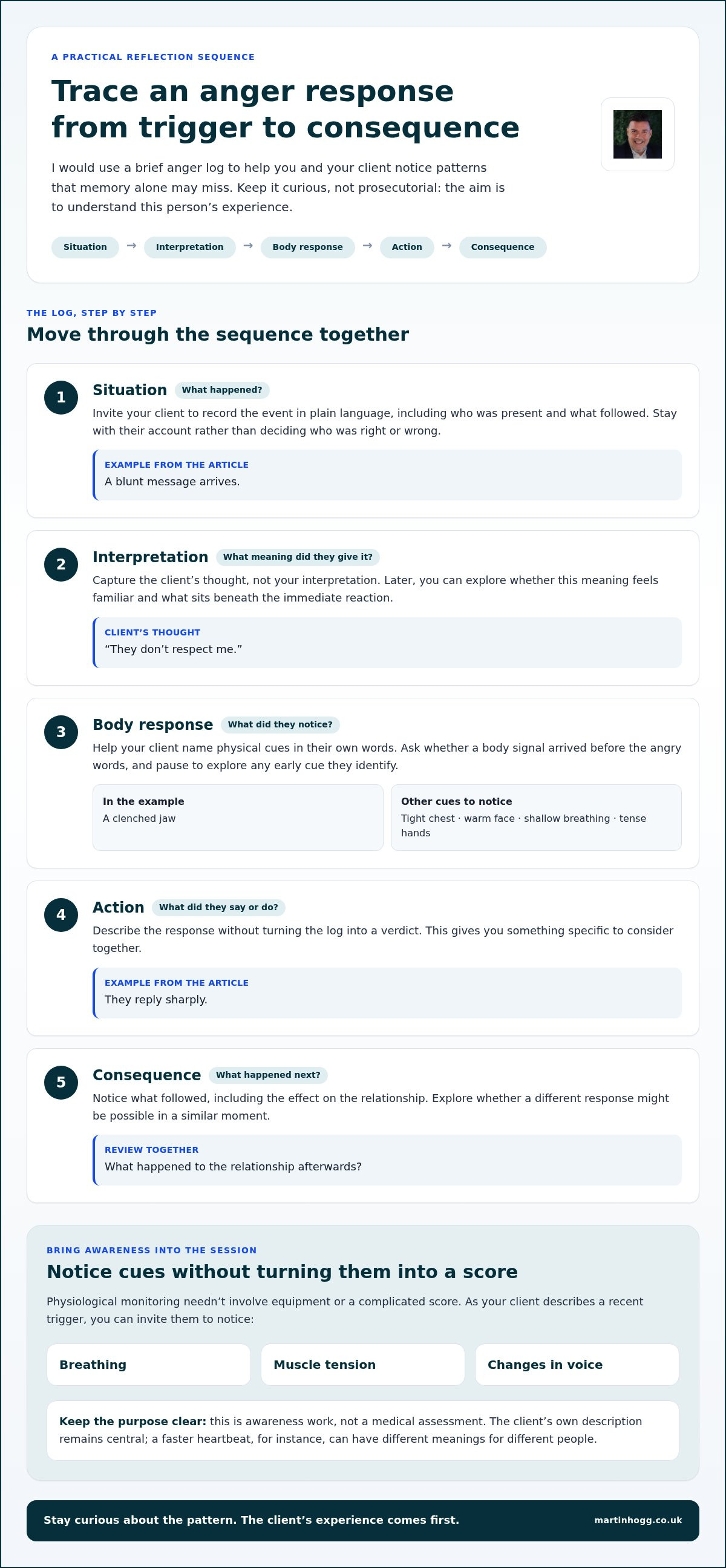
A brief anger log can help you and your client spot patterns that memory alone may miss. Keep it curious, not prosecutorial. After an incident, invite the client to note what happened, who was present, what they noticed and what followed. A disagreement with a partner, for example, may differ from frustration during a difficult commute. The aim is to understand this person’s experience, not to prove they were right or wrong.
Use a simple sequence during review: situation, interpretation, body response, action and consequence. A client might record receiving a blunt message, thinking, “They don’t respect me,” noticing a clenched jaw and replying sharply. That sequence gives you specific points to explore. Was the interpretation familiar? Did the body signal arrive before the angry words? What happened to the relationship afterwards? These questions can build insight into moments when a different response might be possible.
- Situation: Record the event in plain language, such as a cancelled plan.
- Thought: Capture the meaning the client gave it, rather than your interpretation.
- Body: Note sensations such as a tight chest, warm face, shallow breathing or tense hands.
- Response: Describe what the client said or did, and what happened next.
Physiological monitoring needn’t involve equipment or a complicated score. In session, ask the client to notice their breathing, muscle tension and changes in voice as they describe a recent trigger. Pause when they identify an early cue, then explore what helps them regain choice. This is awareness work, not a medical assessment. The client’s own description remains central; a faster heartbeat, for instance, can have different meanings for different people.
Review the log together and look for recurring contexts, interpretations and early body cues. A pattern around criticism might suggest a useful therapeutic question, not a complete explanation. Agree on one technique to practise between sessions, such as noticing jaw tension before replying. At the next meeting, discuss what they observed and what made the technique easier or harder. This turns written evidence into practical learning without making the log another test to pass.
Practical approaches to working with clients’ anger
A practical session starts with the client’s current concerns and what they want to change. Distinguish the emotion from behaviour that affects other people. For example, a client may feel angry after a disagreement but want to understand why the same conflict keeps returning. That gives therapy a useful direction: explore what the conflict means to them and agree on what they want to approach differently.
To choose a course that suits your client group and practice, look for teaching that reflects the work you actually do. Training focused on adults may offer different examples from training that includes young people. Consider whether the course provides adaptable methods, space to reflect and realistic scenarios. A good fit helps you think clearly about your clients rather than promising one technique for every situation.
In practice, agree on a small experiment with the client and review it together. They might try naming the feeling before deciding how to respond, then notice whether that changes the conversation. At the next session, ask what felt useful, what felt awkward and what they would adjust. This keeps the work collaborative and lets the client build confidence through their own observations, rather than feeling they have been handed a rulebook.
Anger can involve risks for the client and other people, so assess specific behaviour rather than relying on the word “anger”. Ask about threats, physical actions, access to people affected and what has changed recently. Agree on how you will respond if risk increases, including the boundaries of your role and relevant safeguarding procedures. If a client describes immediate danger, prioritise safety and follow the appropriate procedures for your setting.
Martin Hogg Private Practice Success: Practice Visibility Blueprint
Martin Hogg, operating as Private Practice Success, offers the Practice Visibility Blueprint to help you make your private practice clearer and easier to find. If you’re building a practice around anger work, a focused message can help prospective clients understand whom you support and how you work. The Anger Management CPD for Professionals is the relevant training option for developing practical skills in working with clients’ anger.
Start with the basics: explain your client group, the problems you work with and what someone can expect when they enquire. A clear one-sentence offer can make your website and directory profiles feel more consistent. To explore the Blueprint or anger-focused CPD, visit martinhogg.co.uk.
Carry one useful change into your next session
Choose one idea from your learning and bring it into your next suitable session. You might ask a different question, make more room to explore what anger means to the client, or reflect on how you respond when the conversation becomes tense. Small, considered changes can help you connect training with the work in front of you.
Anger management CPD for therapists is most valuable when it supports your judgement rather than handing you a script. Keep noticing what helps each client understand their responses, and where you want to build your confidence or knowledge. Your next step might be more focused training or practical support with the wider demands of running a private practice. If that broader support is what you need, explore the Private Practice Success Membership.
You don’t have to change everything at once. A thoughtful next step is enough to keep your practice moving in the direction you want.
Keep learning at a pace that works for you, and use your next session to put one useful idea into practice.
Frequently Asked Questions
What anger management CPD courses are available for therapists in the UK?
Options include specialist training on anger in therapeutic work, alongside broader professional development to build skills for a particular client group. Martin Hogg, operating as Private Practice Success, offers anger-focused CPD for professionals. Before choosing, consider the situations you encounter in practice, such as recurring conflict or difficulty expressing frustration, and whether the course offers learning you can apply to those cases.
Which UK organisations provide accredited anger management CPD for therapists?
Martin Hogg, operating as Private Practice Success, offers anger-focused professional development, and the BACP provides professional development workshops. Accreditation applies to a particular course, so an organisation’s name alone doesn’t establish whether a specific programme is accredited. Look for the course’s own accreditation statement and make sure it refers to the training you intend to attend.
What qualifications or CPD accreditation should therapists look for in anger management training?
Choose training that clearly explains whom it is designed for, what you’ll learn and how the material relates to therapeutic practice. Check whether the course expects prior knowledge or experience, and whether its certificate records your participation. When comparing credentials, distinguish a course completion certificate from a professional qualification. They serve different purposes, and one shouldn’t be presented as the other.
How many CPD hours do anger management courses for therapists provide?
There isn’t one CPD-hour total that applies to every anger course. The amount depends on the specific programme, so use the hours stated for the course you’re considering. If you’re planning professional development across the year, record each course separately and note its learning focus. That makes it easier to see which areas of your work you’ve explored and where further learning may help.
What topics and therapeutic approaches are covered in anger management CPD training?
Training can examine how anger affects communication, conflict and a client’s sense of control. It may also help you adapt your therapeutic language when a client feels blamed or misunderstood. Look for opportunities to work through case examples and reflect on your own responses in sessions. These details can help you decide whether the approach fits your client group and way of working.
Disclaimer
The information provided on this blog is for general informational purposes only. It is also not intended to be a substitute for professional medical or mental health advice, diagnosis, or treatment. Reading this content does not create a therapist-client relationship.


