
Anger Management for Counsellors: A Practical UK Guide

Article by
Martin Hogg
I help Private Practice counsellors in the UK set up and grow an ethical Private Practice they love, work with their ideal clients, and earn the income they deserve. All without guesswork and burnout. I have been a private practice counsellor myself for over 20 years, specialising in anger management. I set up a not-for-profit social enterprise, Citizen Coaching and Counselling, which delivers thousands of counselling sessions a year to adults and young people in Birmingham. I am a registered BACP Counsellor and the author of three books, My Anger Coach, My Anxiety Coach and My Relationship Coach. These are available on Amazon.
What should anger management training teach you as a counsellor: a set of techniques, or a clearer way to understand what anger means for each client?
Anger management training for counsellors can be difficult to assess when search results include courses designed for the general public. You may want practical learning without a formula that treats anger as something to suppress or separates it from a client’s wider experience. That’s a sensible concern. Anger is an emotion; how someone responds to it is another matter, shaped by their circumstances and history.
I’m Martin Hogg, an MBACP (Reg.) counsellor and MBACP CPD presenter with 21 years of UK private practice experience. In this guide, I’ll look at what professional training can add to your work, how to judge whether a course fits your learning needs and scope, and how to reflect on what you learn. I’ll also suggest a realistic next step for your continuing professional development, without promising that a course alone will change client outcomes.
Key Takeaways
- See anger management training as professional learning, not a diagnosis or a universal counselling method.
- Use CPD to review your understanding while keeping your judgement and scope of practice central.
- Before choosing anger management training for counsellors, clarify what you want to learn and compare it with the course aims and intended audience.
- Plan how you’ll reflect on new learning. My Anger Management CPD for Professionals is one possible next step.
Anger Management Training for Counsellors: What Is It For?
Anger management training for counsellors is professional learning to help practitioners think carefully about anger in their client work. It isn’t a diagnosis or a method to apply whenever anger comes up. The aim is to develop your understanding while keeping your judgement, relationship with the client and scope of competence central.
You might look into this subject because a client describes conflict at home, frustration at work or reactions they later regret. Those situations don’t all call for the same response. Training can give you space to examine your assumptions and think about how you work with the subject, rather than reaching too quickly for a ready-made answer. For background, Anger management gives an overview of the term and its history. A general introduction, though, is different from learning designed for practitioners.
How is counsellor training different from anger management classes?
Participant-focused classes and programmes are for people seeking support with their own anger. Practitioner training is professional learning for counsellors considering how anger features in their client work. The formats have different audiences and purposes, so neither is automatically more valuable. Check who a course is designed for. If the description is aimed at participants, it may not answer your learning needs as a practitioner.
Why might anger feature in counselling work?
Anger can mean different things in different lives. One client may connect it with a particular relationship or situation; another may be trying to make sense of their responses under pressure. Those examples are not explanations in themselves. I would stay curious about what the client means, how anger affects them and what they want from counselling. Try not to treat it as a fixed personality trait or assume one account fits everyone.
It helps to distinguish the emotion from the behaviour that follows. That distinction can support exploration of a client’s experience without reducing the person to a label. Professional learning should inform your thinking, not replace it.
What can anger management CPD add to a counsellor’s practice?
CPD gives you a chance to revisit what you think you know and develop knowledge that relates to your work. It doesn’t need to hand you a script. I’d be wary of any training that suggests one approach will fit every client. Useful learning can help you pause, notice your assumptions and make more considered choices in the room.
Professional development can inform your practice, but it can’t promise a particular outcome for a client. What you take from anger management training for counsellors depends on how you reflect on it and apply it within your competence.
From concepts to reflective practice
After learning something new, ask yourself: where might this connect with my existing approach? What assumptions do I bring when a client describes anger? You might notice, for example, that you’ve focused on the immediate trigger for an argument, while the client wants to make sense of a longer pattern. That’s a reason to stay curious, not a conclusion about what is happening.
After a learning session, note one idea that stood out and consider how it relates to your work, without including identifying details about a client. The Mayo Clinic Anger Management Tips offer public-facing information that may prompt questions for your reflection. Treat outside reading as a starting point, not a substitute for professional learning or your judgement.
Where professional boundaries still matter
New knowledge doesn’t automatically expand what you’re competent to offer. Keep considering whether a client’s needs fit your experience and current scope. Make time for appropriate professional reflection when a situation feels uncertain. CPD is most useful when it sharpens your thinking, not when it encourages you to work beyond your limits.
If you’re also working on the business side of private practice, the Private Practice Success Membership offers separate support through online resources, live training and a community for counsellors and therapists.
How to assess anger management training for counsellors
You don’t need to choose a course simply because anger has come up in your client work. Start with the question you want your learning to address. A clear aim makes it easier to judge whether a course is relevant, rather than relying on a reassuring title or a vague promise to build confidence.
Start with your learning need
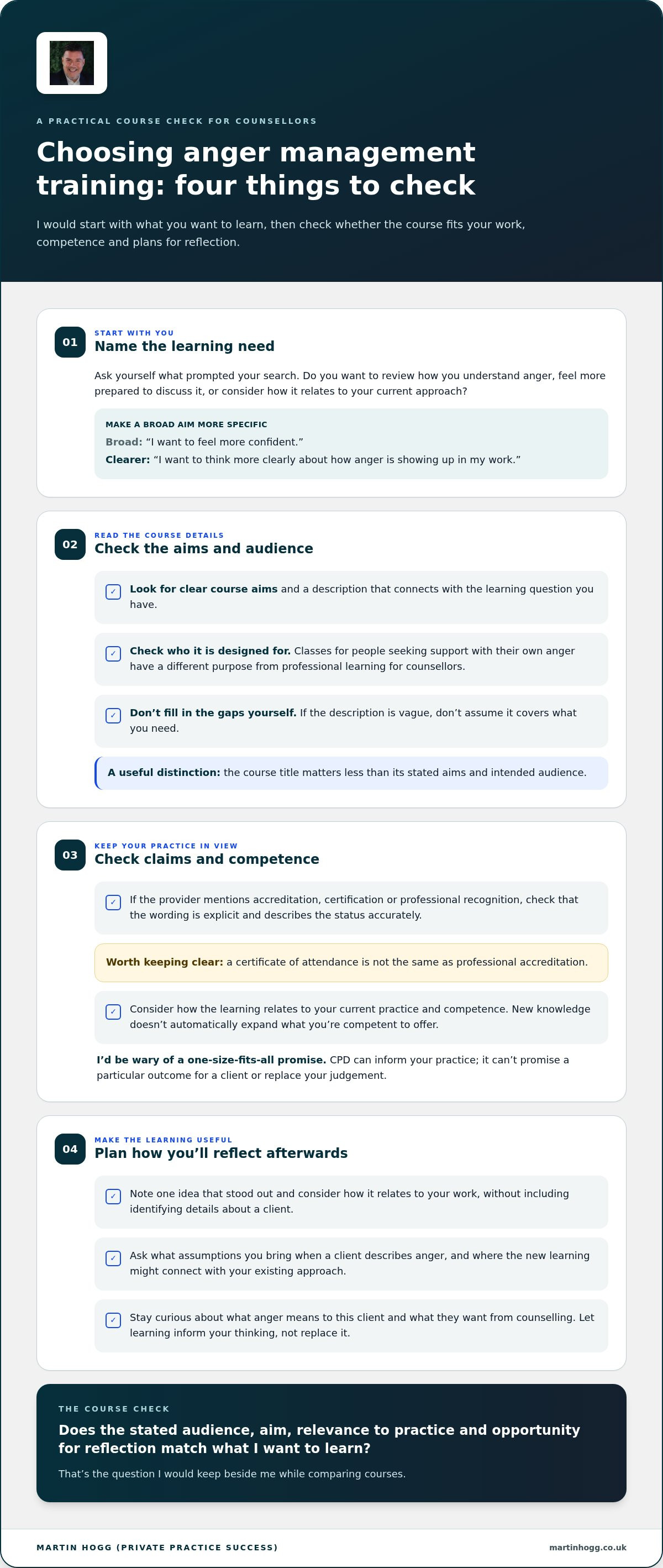
Ask yourself what prompted your search. Do you want to review how you understand anger, feel more prepared to discuss it with clients, or consider how it relates to your current approach? “I want to feel more confident” is understandable, but broad. Make it more specific: “I want to think more clearly about how anger is showing up in my work.”
Read course claims with care
Compare your learning priority with the published course information. I would look for clear aims, an intended audience and a description that relates to your work. Don’t fill gaps in the course description with assumptions. If a provider makes a claim about accreditation, certification or professional recognition, check that the wording is explicit and describes the status accurately. A certificate of attendance, for example, is not the same as professional accreditation.
Use this simple sequence to keep your decision grounded:
- Clarify the question or area of practice prompting your interest.
- Read the stated aims and intended audience carefully.
- Consider how the learning relates to your current practice and competence.
- Decide how you’ll reflect on what you learn afterwards.
A useful course check is: does the stated audience, aim, relevance to practice and opportunity for reflection match what I want to learn? That’s more helpful than choosing based on a bold claim or hoping training will remove every uncertainty. Assess anger management training for counsellors against your own priorities, not as a shortcut to a particular client outcome.
Support with the business side of private practice is a separate consideration. The Private Practice Success Membership is for counsellors and therapists who want help building their practice.
Anger Management CPD with Martin Hogg: a practical next step
If anger features in your client work and you’ve identified a learning question worth exploring, I offer Anger Management CPD for Professionals. It’s professional development for counsellors, not a licence to practise or a promise of client outcomes. Your judgement and how you apply what you learn still matter.
Choosing a realistic next step
Before choosing any CPD, write down one question you’d like your learning to help you consider. Keep it small and specific. It gives you a useful point of reference when reading course information and reflecting on what you’ve learnt. You can also explore the guide CPD for Counsellors UK: A Practical Guide to Professional and Practice Growth as you think about how professional development fits into your working life.
There’s no need to solve every uncertainty in one go. A focused question can help you choose a sensible next step and make your reflection more useful. It gives you something concrete to return to as you consider whether the learning connects with your practice and current competence.
When practice-building support is also on your mind
Clinical learning and building a private practice are different jobs. Anger management CPD relates to your professional learning; the Private Practice Success community is separate support for counsellors working on their practice. It isn’t part of the anger management CPD. Keep those needs distinct, so you can choose the support that fits the question in front of you.
If practice-building is your next priority, you can explore that support separately.
Take your next step at a steady pace
You don’t need to have every part of your professional development mapped out before you begin. I’d start by noticing what questions are coming up in your work, then choose learning that helps you think them through. That keeps anger management training for counsellors connected to your practice, rather than turning it into another box to tick.
Give yourself time to let new ideas settle. Keep what fits, question what doesn’t, and stay guided by the person in front of you. One considered step is enough for now.
If support with the business side of private practice is also on your mind, treat that as a separate next step.
Keep going at a pace that feels useful. You can build your practice and your learning one step at a time.
Frequently Asked Questions
What does anger management training for counsellors cover?
The content depends on the course, so read its stated learning aims rather than assuming every programme covers the same ground. Look for a clear description of the topics, intended audience and learning activities. These details help you judge whether the training matches the questions arising in your practice.
Is anger management training the same as anger management counselling?
No. Training is for practitioners who want to develop their professional understanding; counselling is support for a person bringing their own concerns. A client might seek counselling to explore anger alongside relationships, stress or other parts of their life. A training course doesn’t provide therapeutic support, and attending one doesn’t automatically mean you’re qualified to offer a specialist service.
Can counsellors use anger management training as CPD?
It may be relevant CPD if the learning connects with your work and professional development. Check your professional body’s current guidance, then keep a note of what you attended, what you learnt and how it may inform your practice. For a BACP member, the useful question isn’t simply whether a course has a certificate. Consider what you’ve learnt and can reflect on and record.
How do I choose anger management CPD that is relevant to my practice?
Start with a real question from your work, such as how you want to respond when a client describes anger affecting a close relationship. Compare that question with the course’s stated aims and intended audience. Check any claims about recognition, and don’t treat a certificate as proof of accreditation. Choose learning that fits your current role and gives you something meaningful to reflect on afterwards.
Disclaimer
The information provided on this blog is for general informational purposes only. It is also not intended to be a substitute for professional medical or mental health advice, diagnosis, or treatment. Reading this content does not create a therapist-client relationship.


