
Becoming a Thought Leader in Your Therapy Niche: A Practical Guide

Article by
Martin Hogg
I help Private Practice counsellors in the UK set up and grow an ethical Private Practice they love, work with their ideal clients, and earn the income they deserve. All without guesswork and burnout. I have been a private practice counsellor myself for over 20 years, specialising in anger management. I set up a not-for-profit social enterprise, Citizen Coaching and Counselling, which delivers thousands of counselling sessions a year to adults and young people in Birmingham. I am a registered BACP Counsellor and the author of three books, My Anger Coach, My Anxiety Coach and My Relationship Coach. These are available on Amazon.
You don’t need to become louder to become more visible. Becoming a thought leader in your therapy niche starts with a clear point of view, not a polished personal brand or a constant stream of posts. If putting yourself out there feels a bit too much like selling, you’re not alone. You want the right clients and colleagues to understand your work without sounding boastful or stepping away from your professional values.
Start by getting specific about who you help, what you understand about their concerns and how your approach supports your work with them. That gives your content a useful centre of gravity. You can share what you know with care, keep claims accurate and check current guidance from your professional body when you’re unsure.
In this guide, you’ll find ways to explain your specialist focus, shape ideas into credible content and build a manageable routine around it. The aim is to become more visible without making marketing your whole working week. A clear, useful post that gets published is more valuable than a polished draft that stays in your folder.
Key Takeaways
- Becoming a thought leader in your therapy niche means sharing useful perspectives grounded in your experience and professional competence, not performing expertise.
- Choose a focus by considering who you support, the questions they ask and the experience you can draw on. A niche helps clarify your communication; it isn’t a claim to treat every presentation.
- Build content around a few relevant themes. Clear, useful posts can be more valuable than polished content that never gets published.
- Try a simple first-month routine: choose a theme, draft, publish and review the response. Look for relevant conversations, not just follower counts.
What becoming a thought leader in your therapy niche really means
Wanting to be visible doesn’t mean you want to perform expertise online. That tension makes sense. Becoming a thought leader in your therapy niche isn’t about acting as if you have every answer or turning your working week into a content factory.
Thought leadership is sharing useful, considered perspectives within the limits of your professional knowledge and experience. The broader idea of a thought leader is someone whose ideas influence a field. For a therapist, that needn’t mean celebrity, constant posting or presenting personal opinions as universal clinical truths. Your online presence doesn’t prove your clinical skill or guarantee enquiries. It is one way to make your perspective easier to understand.
Thought leadership is contribution, not celebrity
A clear explanation can help a potential client recognise whether your work speaks to their concerns. It can also give professional peers a useful way to think about an issue. For example, if you work with anxiety, you might explain that it can show up differently from person to person, rather than reinforcing the assumption that it always looks like visible panic. Keep the point within your competence, and make clear when you’re sharing a perspective rather than a rule that applies to everyone.
Why a focused niche gives your voice direction
A defined audience and subject give you somewhere useful to begin. If you work with men dealing with anger, for instance, you can consider the questions and misunderstandings that arise in this area, then decide which you’re well placed to address. A niche is a focus for your professional communication, not a claim that you can treat every presentation. Use niche-building guidance for counsellors to clarify your focus before creating a broader marketing plan. A clearer subject makes it easier to choose what to say, and what to leave alone.
Choose a therapy niche and point of view you can stand behind
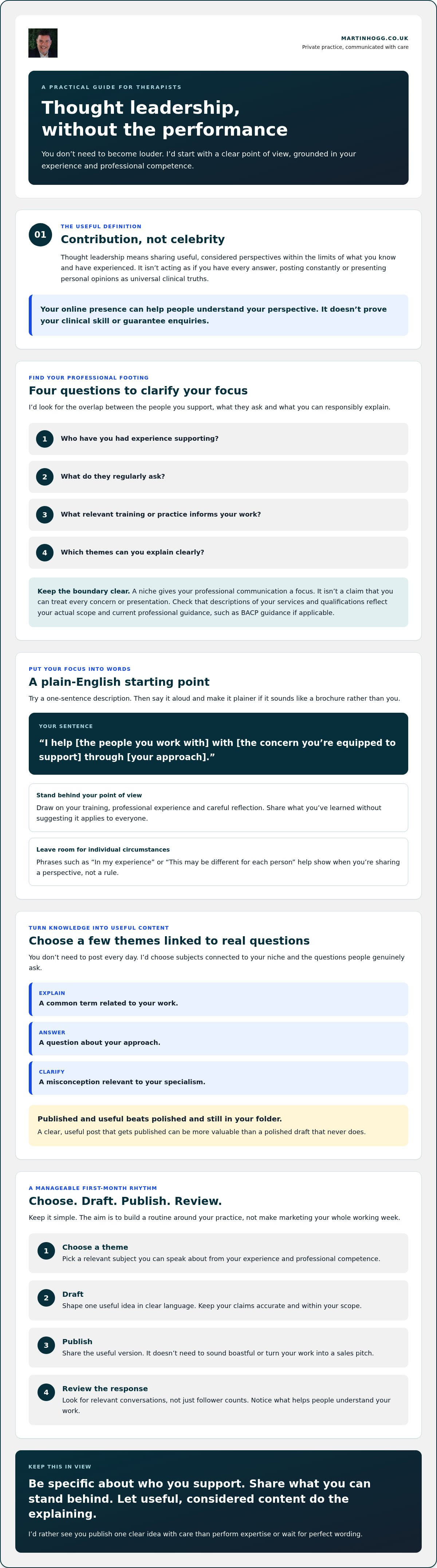
A useful niche isn’t plucked from thin air because it sounds marketable. Start with four questions: who have you had experience supporting, what do they regularly ask, what relevant training or practice informs your work, and which themes can you explain clearly? Look for the overlap. This helps you find a focus with a solid professional footing, rather than choosing a topic simply because it’s getting attention.
Your niche is a focus for how you describe your work. It isn’t a claim that you can help with every concern or presentation. Before publishing descriptions of your services or qualifications, check that your wording reflects your actual scope and current guidance from your relevant professional body, such as the BACP if applicable.
Find the useful question inside your specialism
Write down questions you can answer responsibly, based on your training and experience. Then separate them from subjects you’re interested in but haven’t worked with in depth. Interest can be a good reason to learn more; it isn’t, by itself, a reason to present yourself as a specialist.
Try drafting a one-sentence description: “I help [the people you work with] with [the concern you’re equipped to support] through [your approach].” Treat it as a starting point, not a magic formula. Say it aloud. If it sounds like a brochure rather than you, make it plainer. Check that each part is specific enough to help a reader understand who your work is for.
Make your point of view specific without overstating it
Your perspective can come from your training, professional experience and careful reflection. To differentiate yourself as a thought leader, share what you’ve learned without suggesting it applies to everyone. Phrases such as “In my experience” or “This may be different for each person” leave room for clients’ individual circumstances. That kind of careful wording is a strength, not a lack of confidence.
For more on setting your professional focus, see this guide to niche building for counsellors. If you’d like ongoing structure as you develop your practice, you can also explore the Private Practice Success Membership.
Share useful ideas consistently without turning therapy into a sales pitch
You don’t need to post every day to show people what you know. Choose a few themes linked to your niche and the questions people genuinely ask. For example, you could explain a common term, answer a question about your approach or clarify a misconception relevant to your work. This gives you a steady source of useful ideas without making your communication feel like a sales campaign.
Consistency means keeping a useful idea in circulation at a pace your practice can sustain. Choose clear and helpful over polished but unpublished. A simple Canva graphic or a Squarespace page can do the job, but neither is a prerequisite. The idea matters more than the software.
Use a small set of repeatable content formats
Try short explanations, answers to frequently asked questions or a thoughtful correction to a common misconception. One workable approach is to develop an idea into a fuller website article, then share its central point in a brief social post. For instance, an article answering a common question can become a short post that points readers to the fuller explanation. You don’t need to invent a fresh philosophy every week.
If you publish on your website, make the page easy to understand and navigate. Use a title and description tag that accurately describe the page, and make the main message easy to find near the top. A visitor shouldn’t have to rummage through your site like they’ve lost their keys.
Keep visibility respectful and manageable
Build content time around your existing work. You might set aside a regular slot to draft or review one useful idea, then publish it when it’s ready. Choose a rhythm you can maintain, rather than promising yourself daily posts and resenting your phone by Thursday.
Keep examples general. Don’t include identifiable client material, and check current guidance from your professional body if you’re uncertain about what’s appropriate to share. Becoming a thought leader in your therapy niche should help people understand your professional perspective, not turn their private experiences into content. For further structure as you grow your practice, explore the Private Practice Success Membership.
Turn your thought leadership into a sustainable practice-growth habit
A good idea is easier to act on when you give it a place in your working routine. Keep your first month manageable: choose one theme that fits your niche, draft a useful explanation, publish it in a format you can maintain, then review what happened. You’re building a habit, not auditioning for a content award.
- Choose: Pick one question your intended audience often asks.
- Draft: Explain your perspective in plain English and within your professional scope.
- Publish: Share it somewhere your audience can find it.
- Review: Note what people asked or discussed in response.
Review what is helping the right people understand your work
Look for relevant signals, not just follower counts. Did someone ask a thoughtful follow-up? Did a conversation connect with the area you want to be known for? Keep a brief note of those questions and enquiries. One post, or a short-term change in response, doesn’t prove a particular outcome is guaranteed. It gives you something to consider and can help you decide what to explain next.
If people seem unsure what you mean, revise the wording. Keep your voice recognisably yours. Becoming a thought leader in your therapy niche is not about sounding grand; it’s about making your professional perspective easier to understand.
Get support to keep building your visibility
You can start with the steps above and review your progress on your own. If you’d value some structure, the Private Practice Success Membership includes growth plans, live training and a peer community. The Practice Visibility Blueprint is another option for therapists looking for a structured system to build visibility and attract clients. These resources can help you turn good intentions into steady action without making visibility another full-time job.
Make your next step a useful one
Becoming a thought leader in your therapy niche doesn’t require you to become a different person online. It starts with a professional focus you can stand behind, a point of view grounded in your experience and useful ideas shared at a pace that fits your practice.
Keep your next step small. Choose one question your audience often asks, write a clear answer and notice whether it helps people understand your work. You’re not measuring your clinical ability by likes or follower counts. You’re making your perspective easier to find and consider.
Martin Hogg provides business coaching and CPD for counsellors and therapists. If you’d value structure for developing your practice visibility, the Private Practice Success Membership includes growth plans, live training and a supportive peer network. You can also begin with the practical steps in this guide and see what feels manageable.
You don’t need a grand plan to begin. One clear, helpful idea is a perfectly good place to start.
Frequently Asked Questions
What does it mean to be a thought leader in therapy?
It means sharing clear, useful perspectives in an area you know well. You might explain a common question, offer a considered view or help people understand your specialism. Becoming a thought leader in your therapy niche doesn’t mean being famous or claiming to have every answer. Keep your communication grounded in your experience and professional scope, while recognising that people’s circumstances differ.
How do I choose a therapy niche to become known for?
Start with the people you want to support, the questions you can answer responsibly, and the training or experience that informs your work. Look for the overlap rather than choosing a subject just because it seems popular. Then describe your focus in plain English. Check that your wording reflects your actual competence and current guidance from your relevant professional body, such as the BACP if applicable.
Can I become a thought leader if I am introverted?
Yes. You don’t need to enjoy public speaking, post every day or adopt a louder online persona. You could write thoughtful articles, answer common questions on your website or share a short explanation when you have something useful to say. Choose a format and pace that feel manageable, then focus on whether your ideas are clear and relevant. Quiet, considered communication still counts.
How often should therapists publish content?
There’s no single publishing schedule that suits every therapist. Choose a rhythm you can maintain alongside client work and other responsibilities. That might mean writing an occasional website article or sharing a clear explanation when you have one ready. Rushed posts produced to satisfy an arbitrary timetable rarely help. Review how your schedule feels, then adjust it to fit your practice and energy.
How can therapists share expertise without sounding boastful?
Focus on the reader’s question, not your status. Explain what informs your perspective, whether that’s your training, experience or reflection, and avoid promising particular outcomes. Aim to speak confidently while recognising that people’s experiences vary. If you’re unsure how to describe your professional role or boundaries, check current guidance from your relevant professional body. Clear, careful language doesn’t need to sound grand to be credible.
Disclaimer
The information provided on this blog is for general informational purposes only. It is also not intended to be a substitute for professional medical or mental health advice, diagnosis, or treatment. Reading this content does not create a therapist-client relationship.


