
Building Confidence as a New Therapist: A Practical UK Guide to Finding Your Feet

Article by
Martin Hogg
I help Private Practice counsellors in the UK set up and grow an ethical Private Practice they love, work with their ideal clients, and earn the income they deserve. All without guesswork and burnout. I have been a private practice counsellor myself for over 20 years, specialising in anger management. I set up a not-for-profit social enterprise, Citizen Coaching and Counselling, which delivers thousands of counselling sessions a year to adults and young people in Birmingham. I am a registered BACP Counsellor and the author of three books, My Anger Coach, My Anxiety Coach and My Relationship Coach. These are available on Amazon.
You’ve spent years training, thousands on fees, and hundreds of hours in your own therapy, yet you’re still terrified that a client might actually book a session and ‘find you out.’ It’s a strange irony that the more we learn, the more we often feel like frauds. Building confidence as a new therapist isn't about collecting another CPD certificate or memorising more theory. It is about getting your feet on the ground and realising that you already have what you need to help people right now.
I know how overwhelming it feels to stare at a blank Squarespace page or worry if your Counselling Directory profile sounds like a dry medical textbook. You want to feel steady in the therapy room and have a clear, simple system for finding clients without the marketing headache. In this guide, I’ll show you how to move past imposter syndrome and build a professional presence that feels as solid as your clinical training. We will look at why a rough and ready approach beats a polished one and how the skateboard model can get your practice moving without the usual panic.
Key Takeaways
- Understand why feeling like a fraud is a normal part of the transition to private practice and how to reframe this "wobble" as a sign of your professional integrity.
- Discover how building confidence as a new therapist is linked to your business setup, starting with a simple "skateboard model" website that gets you moving quickly.
- Recognise when you need practical business support rather than another advanced clinical qualification to feel secure in your professional role.
- Learn to write directory profiles on sites like Psychology Today that skip the jargon and use your own voice to build trust with potential clients.
- Shift from the overwhelm of marketing and admin to a clear, actionable system that helps you feel steady and validated in your clinical work.
Why Every New Therapist Feels Like a Fraud (and Why That’s Okay)
That cold sweat you feel before your first 9 am client isn't a sign that you're in the wrong job. It is actually a sign of professional integrity. If you didn't care about doing a good job, you wouldn't feel the "wobble." Most of us spend years under the protective wing of a training placement, only to find the transition to private practice feels like a psychological shock. Suddenly, there is no supervisor in the next room and no agency admin to hide behind. It’s just you, the chair, and a person looking for help.
For most of us, Impostor Syndrome is a natural growth phase rather than a clinical deficit. It occurs because your self-perception hasn't yet caught up with your clinical reality. I often see people try to "fake it till they make it," but that's terrible advice for counsellors. If you're wearing a mask of "perfect therapist," you aren't being congruent. Clients can smell a lack of authenticity a mile off. Building confidence as a new therapist comes from being honest about where you are, not pretending you're a 20-year veteran.
Recognising the Symptoms of the 'Newbie' Wobble
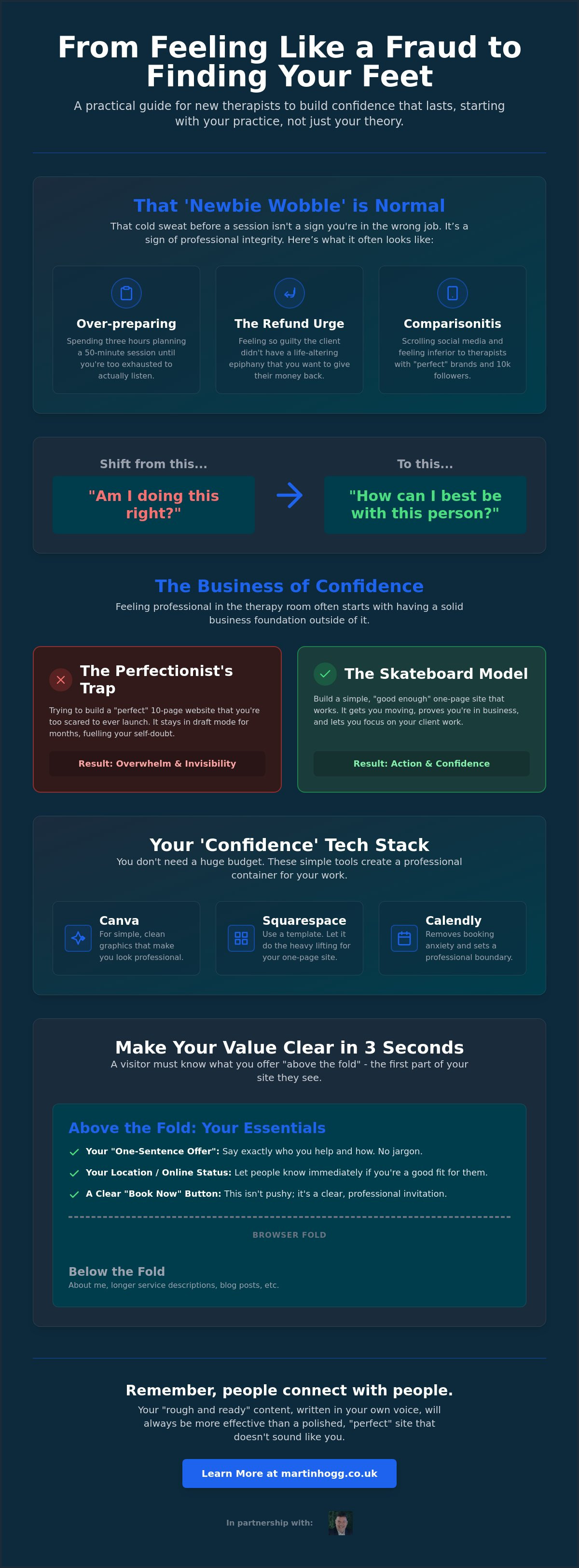
- Over-preparing: Spending three hours planning a 50-minute session until you're too exhausted to actually listen.
- The Refund Urge: Feeling so guilty that the client didn't have a life-altering epiphany in session one that you want to give their money back.
- Comparisonitis: Scrolling through Instagram and feeling inferior because another therapist has a "perfect" brand and 10k followers.
Reframing Nervousness as Professional Care
Your anxiety is actually data; it shows you value the client's wellbeing and take the responsibility of the work seriously. The goal isn't to get rid of the nerves entirely, but to move from asking "Am I doing this right?" to "How can I best be with this person?" When you stop trying to be the "expert" and start being the human in the room, the pressure drops. Confidence isn't about knowing all the answers; it's about being steady enough to sit with the questions.
The Business of Confidence: Why Your Website Impacts Your Clinical Work
It is hard to feel like a grounded professional in the therapy room when your business life is a chaotic mess of half-finished drafts and broken links. I've noticed that building confidence as a new therapist often starts outside the clinical space. When your website is invisible or looks like a relic from 1998, you carry that "amateur" feeling into your sessions. A clear, professional online presence isn't just about marketing; it is about creating a container for your work that feels solid to both you and your clients.
I always recommend the "skateboard model" for new practices. Instead of trying to build a 10-page Squarespace site that you're too scared to ever launch, build a one-page MVP site. A simple, functioning site that gets you moving is infinitely better than a "perfect" one that stays in draft mode for six months. This approach reduces the overwhelm and allows you to focus on your "one-sentence offer." Being able to say exactly who you help and how you do it builds a level of internal authority that no amount of theory can replace.
Remember, people connect with people. Using "rough and ready" content, like a simple video or a blog post written in your own voice, actually helps clients feel a connection to the real you. If you want to attract more clients with the Practice Visibility Blueprint, you need to stop hiding behind clinical jargon and start showing up as a human being. Perfectionism is just another way of staying invisible.
Practical Basics: The 'Confidence' Tech Stack
You don't need a huge budget to look professional. Tools like Canva are brilliant for creating simple, clean graphics, while Squarespace offers templates that do the heavy lifting for you. One of the biggest "easy wins" is setting up Calendly. It removes the exhausting back-and-forth email chains that fuel booking anxiety. When a client can see your availability and book a slot instantly, it creates a boundary that feels professional and secure for everyone involved.
Above the Fold: Making Your Value Clear
Your website needs to tell a visitor exactly what you offer within the first three seconds. This "above the fold" content is the most valuable real estate you own. If a client has to hunt for your location or your price, they will leave. Including a clear "Book Now" button isn't a pushy sales tactic; it is a clear boundary that tells the client you are open for business and ready to help. Making your value clear from the start is a massive part of building confidence as a new therapist because it proves to you, and the world, that you are a legitimate practitioner.
Clinical Easy Wins: Supervision, CPD, and Setting Boundaries
You can have the best website in the world, but if you feel like a fraud the moment a client asks for an invoice, your practice will struggle to grow. Building confidence as a new therapist requires more than just clinical skill; it requires a shift in how you value your own time. Many of us fall into the trap of "CPD-itis," believing that if we just collect one more certificate in a complex modality, we will finally feel "ready." In reality, you often don't need more clinical training. You might actually need business coaching to help you handle the practicalities of being a professional in private practice.
Setting boundaries is a clinical necessity, not just a business one. If you discount your fees because you feel "new," you are inadvertently telling the client that your support is worth less than a veteran's. This creates a power imbalance before the work even begins. That first invoice is always a bit awkward. I suggest practising your "one-sentence fee" in the mirror until it sounds like a grounded fact rather than a nervous question. When you are clear about your worth, the client feels more secure in your care.
Supervision as a Confidence Anchor
High-quality, BACP-standard supervision is your ultimate safety net. It is the one place where you can safely "offload" the fear of being found out without any professional repercussions. A good supervisor validates your early clinical decisions and helps you see that your "wobbles" are actually part of the process. If you aren't sure where to start, you can learn how to find a clinical supervisor in the UK who understands the specific pressures of private practice.
The Power of a Supportive Community
Isolating yourself in a home office is the fastest way to kill your professional self-esteem. Without peers to talk to, every difficult session feels like a personal failure. Finding a "tribe" of other practitioners helps normalise the struggle and reminds you that everyone else is figuring it out too. To get the support you need, consider joining the Private Practice Success Membership. Having a community behind you is a massive part of building confidence as a new therapist because it replaces isolation with shared experience.
Taking the Leap: From 'Newbie' to a Visible Practice
The hardest part of building confidence as a new therapist is moving from a mindset of "hiding" to one of "helping." When you are stuck in the hiding phase, you focus on your own fears, your lack of experience, or whether your office chair looks professional enough. When you shift to a helping mindset, you realise that there are people out there right now who are struggling and specifically need the kind of support you offer. Marketing isn't about bragging; it is about making sure the people who need you can actually find you.
In the UK market, people connect with people, not clinical qualifications. Your profiles on the Counselling Directory or Psychology Today shouldn't read like a dry academic CV. They should sound like a conversation. If you use your own voice, flaws and all, you build trust before the first session even begins. I suggest practising your "one-sentence offer" until you can say it without your voice wobbling. The more you say it out loud, the more your brain starts to believe it is true. Taking imperfect action is the only real cure for imposter syndrome. You can't think your way into confidence; you have to act your way there.
Your 30-Day Visibility Plan
- Step 1: Audit your directory profiles. Strip out the therapist-speak and replace it with "people-first" language that addresses your clients' actual pains.
- Step 2: Launch your "skateboard" website. Stop tweaking the font and just hit publish. It only needs to be "good enough" to get you moving.
- Step 3: Reach out to three local peers for a virtual coffee. Building a local network makes the private practice world feel much smaller and less intimidating.
The Long Game: Building Sustainable Authority
Consistency beats "polished" every single time. You don't need a high-end production studio to create content that resonates. A simple, honest post about a common struggle will do more for your practice than a glossy, corporate-looking advert ever could. Building confidence as a new therapist is a marathon, not a sprint. If you want to dive deeper into the practicalities of getting seen, check out this guide on marketing for therapists in the UK. Real growth happens when you stop waiting for permission and start showing up as the practitioner you already are.
Step Out of the Shadows and into Your Practice
You have done the hard work of training. Now it’s time to stop letting the "newbie wobble" keep you invisible. We have looked at why feeling like a fraud is actually a sign that you care, how a simple website can settle your nerves, and why solid boundaries are a clinical necessity. Real confidence isn't something you wait for; it is something you build through small, consistent actions and the right support.
Building confidence as a new therapist is much easier when you aren't doing it in isolation. You don't need another complex modality right now; you need a system that works and a community that has your back. Whether it is through our BACP-endorsed workshops or the step-by-step Practice Visibility Blueprint system, there is a clear path from feeling overwhelmed to feeling steady in your clinical work.
If you are ready to build a visible, confident practice, join the Private Practice Success Membership today. You will find a supportive UK therapist community waiting to help you find your feet and grow your practice. You already have the skills to change lives. It is time to let your future clients find you.
Frequently Asked Questions
How long does it take to feel confident as a therapist?
Most practitioners find it takes around two years of consistent clinical work, or roughly 500 to 1,000 hours, to stop feeling like a beginner. Building confidence as a new therapist is a gradual process of your self-perception catching up with your actual skills. It isn't a switch that flips; it is a slow sharpening of your internal compass as you see more varied clients. Don't rush the process, as those early nerves actually keep you sharp and ethical.
Should I offer lower rates when I'm just starting out to build confidence?
I strongly advise against offering "newbie" discounts or lower rates. If you charge significantly less than the local average, you are inadvertently telling potential clients that your support is less effective. It also makes it incredibly difficult to raise your fees later without losing your current caseload. Stick to a fair, professional rate that reflects your years of training and covers your essential overheads like BACP membership and insurance.
What should I do if I feel like I'm 'stuck' with a client in a session?
When you feel stuck, the most effective move is to name the experience in the room. You might say, "I'm feeling a bit stuck right now, and I wonder if you are feeling that too?" This often shifts the work from a search for "answers" to a deeper, more honest exploration of the relationship. You aren't there to fix the client or have all the answers; you are there to be a steady presence while they find their own way forward.
Is it normal to feel exhausted after every session as a new therapist?
It is completely normal to feel emotionally drained after sessions when you are first starting out. You are likely working much harder than you need to, trying to track every micro-expression and memorise every detail the client shares. As you gain experience, you will learn to sit back and trust the therapeutic process more. For now, ensure you have a 15-minute gap between clients to reset and clear your head.
How do I explain to clients that I am newly qualified without sounding incompetent?
You don't need to lead with your graduation date or apologise for how long you've been practising. If a client asks about your experience, focus on your credentials by saying, "I am a registered member of the BACP and have completed my clinical training." Clients care much more about whether you "get" them than how many years you've been in the chair. Building confidence as a new therapist involves realising that your recent training means your skills are fresh and evidence-based.
Disclaimer
The information provided on this blog is for general informational purposes only and is not intended to be a substitute for professional medical or mental health advice, diagnosis, or treatment. Reading this content does not create a therapist-client relationship.


