
Building Online Rapport: A Guide for Therapists

Article by
Martin Hogg
I help Private Practice counsellors in the UK set up and grow an ethical Private Practice they love, work with their ideal clients, and earn the income they deserve. All without guesswork and burnout. I have been a private practice counsellor myself for over 20 years, specialising in anger management. I set up a not-for-profit social enterprise, Citizen Coaching and Counselling, which delivers thousands of counselling sessions a year to adults and young people in Birmingham. I am a registered BACP Counsellor and the author of three books, My Anger Coach, My Anxiety Coach and My Relationship Coach. These are available on Amazon.
What if learning how to build rapport with clients online has less to do with perfect eye contact and more to do with how you respond when the screen gets in the way? A dropped connection or a slight delay needn’t undo the relationship you’re building.
I know video sessions can feel more distant. It isn’t always obvious how to adapt your listening and body language when you’re looking at a camera. You want clients to feel heard, not as if they’re talking to a very polite laptop. I’ll share practical ways to build connection while still sounding like yourself.
We’ll look at how to show you’re listening on screen, create a dependable session rhythm without sounding scripted, and handle technical hiccups calmly. You don’t need a flawless setup or a polished performance. You need a clear, human way to stay present, and to repair the moment when technology briefly gets between you.
Key Takeaways
- Learn how to build rapport with clients online through consistent communication, shared pacing and genuine attention.
- Show you’re listening with clear responses and an unhurried pace, rather than relying on constant eye contact.
- Use a simple session rhythm to help clients feel involved, from a brief check-in to a thoughtful ending.
- If connection feels strained, name what you notice gently and invite the client’s perspective instead of guessing how they feel.
What does building rapport with clients online actually involve?
Rapport isn’t a video call with perfect sound and a tidy background. It’s the sense that you and your client are working together, built through attention, consistency and honest communication. Online rapport is collaborative trust and connection, not simply a smooth call.
If you’re wondering how to build rapport with clients online, start by taking the pressure off the technology. A screen can make a session feel less personal, and it’s understandable to wonder whether you’re coming across as present. But rapport doesn’t depend on constant eye contact, polished equipment or an instant feeling of closeness. It grows through small moments when a client can tell you’re listening and taking their experience seriously.
What changes when counselling moves onto a screen?
The camera only shows part of the picture. A client’s hands, posture or small facial movements may be outside the frame, so you have less to work with than you would in the same room. Delays can complicate things too. A pause might mean someone is thinking, or the connection might have lagged. Rather than guess, I would check gently: “I noticed a pause there. What was happening for you?”
Can a real therapeutic relationship develop online?
Yes, connection can develop when you communicate your attention and work collaboratively. That doesn’t mean every client will find video comfortable, or that rapport will feel identical to meeting in person. It means the screen doesn’t decide whether a relationship can form.
For example, if a client becomes quieter, you might say, “I’m aware we’ve gone a little quiet. How is this feeling for you?” Then give them room to answer. You’re not deciding what the silence means. You’re showing curiosity and making space for their view. That steady, respectful exchange is more useful than trying to perform closeness for the camera.
How do presence and listening build online rapport?
On screen, presence isn’t about holding a steady gaze at the camera. It comes through in how you listen, respond and allow the conversation to take its time. If you’re thinking about how to build rapport with clients online, focus less on performing attentiveness and more on helping the client feel you’ve understood them.
How can you listen actively through video?
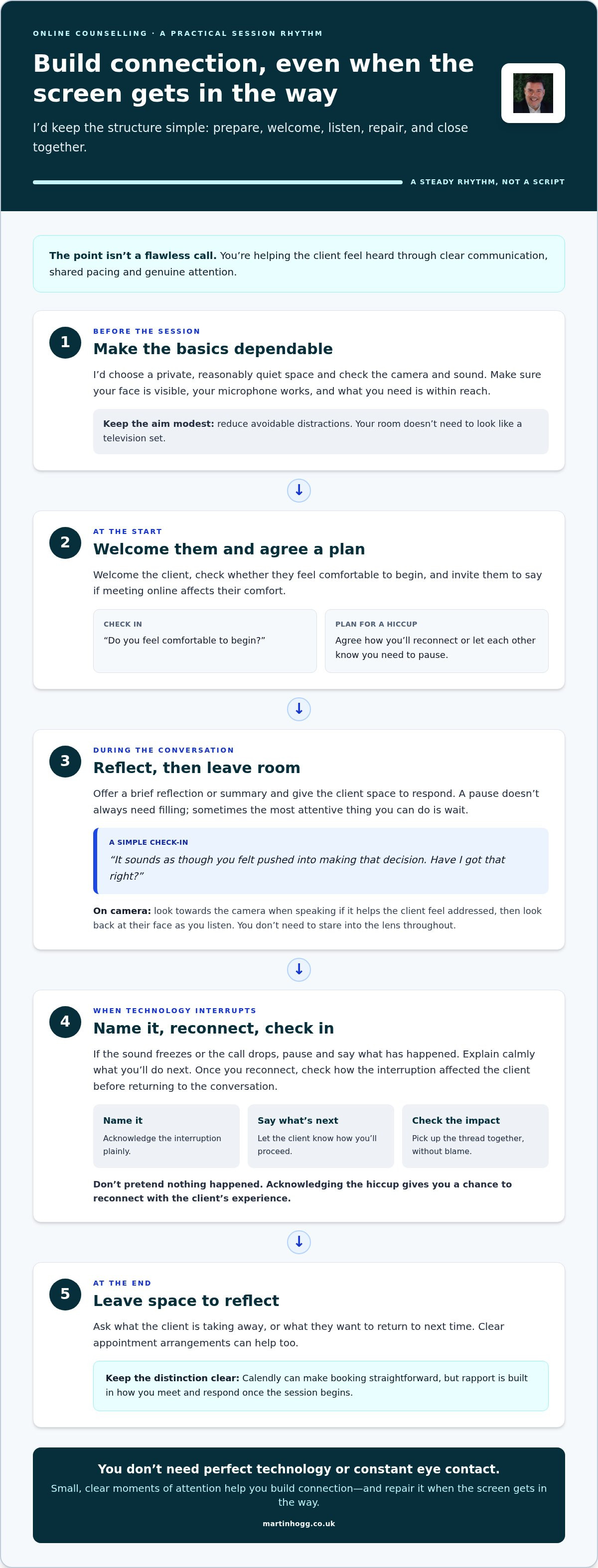
Offer a brief reflection or summary, then leave room for the client to respond. “It sounds as though you felt pushed into making that decision. Have I got that right?” is more useful than rushing to the next question. A nod can mean agreement, but it can also be a polite habit. Check rather than assume.
Verbal check-ins replace guesswork about screen-based cues with a chance for the client to tell you what’s really going on. You might say, “I noticed you looked away just then. I may have read that wrongly, but what was happening for you?” Keep your observation tentative and make it easy for the client to correct you. A pause doesn’t always need filling, either. Sometimes the most attentive thing you can do is wait.
How can you make your online presence feel more natural?
Set your camera at a comfortable height and keep avoidable distractions out of view. When you speak, looking towards the camera can help the client feel addressed. Then look back at their face on screen as you listen. You don’t need to stare into the lens throughout. That can feel more like a passport photo than a conversation.
If you need to glance at notes or adjust your screen, say so briefly instead of disappearing without explanation. For further reading, Nudge AI offers strategies for building therapeutic connection through telehealth. If you want steady support with the business side of private practice, you can also explore the Private Practice Success Membership.
What practical steps help an online counselling session feel connected?
You don’t need a studio setup to help a client feel welcome. I’d keep preparation simple: choose a private, reasonably quiet space, check your camera and sound, and have what you need within reach. Before the session, check that your face is visible and your microphone is working. The aim is to reduce avoidable distractions, not to make your room look like a television set.
How should you begin an online session?
Start with a straightforward welcome and ask whether the client feels comfortable to begin. Invite them to mention anything about meeting online that might affect their comfort. Then agree what you’ll do if the call drops or either of you needs a moment. For example, explain how you’ll reconnect, or how you’ll let each other know you need to pause.
Welcome the client, check their comfort, agree a plan for interruptions, then begin together. That small opening routine gives you a reliable structure without turning the session into a script. It also means you’re not trying to work out what to do while the call is breaking up.
How can you handle technical interruptions without losing connection?
If the sound freezes or the call drops, pause and name what’s happened. Say what you’ll do next, calmly and plainly. When you reconnect, check briefly how the interruption affected the client before returning to the conversation. Don’t blame them, and don’t pretend nothing happened. Acknowledging the hiccup can help you pick up the thread together.
At the other end, leave room to review the session. Ask what the client is taking away or what they want to return to next time. Clear appointment arrangements help too. A tool such as Calendly can make booking straightforward, but it isn’t a rapport technique. The relationship is built in how you meet and respond once the session begins. These repeatable habits can make it easier to think about how to build rapport with clients online without relying on perfect technology.
How can you repair distance and keep building online rapport?
A difficult moment doesn’t mean online work can’t build trust. Sometimes a client goes quiet, your responses miss the mark, or the conversation feels less connected than usual. I wouldn’t treat that as proof the relationship has failed. It’s a chance to slow down and find out what the moment means for the client.
What can you say when a client seems distant?
Keep your observation open, not certain. You might say, “I’m wondering if we’ve felt a little less connected today. How has this conversation been for you?” Then listen. If the client says they haven’t felt distant, resist the urge to defend your reading. Thank them for correcting you and stay curious.
You can explore together whether the pace, the online format or a technical issue affected the conversation. The aim isn’t to pin the awkwardness on someone. It’s to understand what happened and decide what might help now. Checking in is part of how to build rapport with clients online, especially when things don’t feel effortless.
How can you keep developing your online practice?
After a session, take a moment to reflect. What seemed to help the client engage? Was there a point where you felt unsure or a little stilted? What might you try differently next time? Keep the notes brief and focused on the relationship. This isn’t a performance score, and you don’t need to mark yourself out of ten.
For broader thinking about developing a sustainable practice, explore the niche-building guidance. If you’d value structured business support and a community of fellow practitioners, the Private Practice Success Membership offers support for practice growth, rather than clinical training in online rapport.
Keep building connection, one session at a time
Online rapport doesn’t depend on flawless technology or constant eye contact. It grows through attentive listening, clear check-ins and a steady session structure that helps clients feel involved. When a moment feels awkward or distant, name what you’ve noticed gently and make room for the client’s perspective.
I’d keep reflecting on what helped, what felt less natural and what you might try next time. You don’t need to get every moment right. Learning how to build rapport with clients online is an ongoing part of developing your practice. Small adjustments can make sessions feel more like a conversation and less like a screen doing its best impression of a wall.
If you’d value support with the business side of practice, the Private Practice Success Membership includes structured growth plans, live training and a supportive network of private practice owners.
Keep showing up with curiosity and care. Connection is built in the human moments, even when there’s a screen between you.
Frequently Asked Questions
Can you build rapport with clients online?
Yes, a genuine therapeutic relationship can develop online. Rapport grows through attention, clear communication and working collaboratively, rather than through the room you’re sitting in. If you’re considering how to build rapport with clients online, focus on checking what the client is experiencing instead of assuming a pause or expression tells you everything. The connection may feel different from meeting in person, and it can still be meaningful.
How do you make an online counselling session feel less awkward?
Make the start simple and give the conversation a moment to settle. Welcome the client, check they’re comfortable to begin and agree what you’ll do if the call drops. You don’t need to fill every pause or perform constant eye contact. Listen, reflect what you’ve understood and ask whether you’ve got it right. A little structure helps, but leave room for the session to feel like a real conversation.
What should a therapist do if the video call keeps breaking up?
Pause, acknowledge the disruption and explain the next practical step calmly. You could say, “The connection’s breaking up, so I’ll pause and try reconnecting.” Agree a plan with the client at the start, such as what to do if the call drops. Once you’re back, check whether the interruption affected them before carrying on. Don’t blame the client or rush past the disruption as if it didn’t happen.
Should therapists look directly at the camera during online sessions?
Looking towards the camera while you speak can help the client feel you’re addressing them, but constant eye contact with the lens isn’t necessary. It can feel unnatural, and you’ll also want to look at the client’s image while listening. I’d set the camera at a comfortable height and let your gaze move naturally. If you glance at notes or adjust your screen, a brief explanation can avoid confusion.
What can you do if a client seems less engaged online?
Describe what you’ve noticed tentatively and invite the client to explain it in their own words. For example: “I’m wondering if we’ve felt a little less connected today. How is this conversation for you?” They may disagree, and that’s useful information, not a cue to defend your impression. Stay curious about whether the pace, format or a technical issue is affecting the session, and consider together what might help.
Disclaimer
The information provided on this blog is for general informational purposes only. It is also not intended to be a substitute for professional medical or mental health advice, diagnosis, or treatment. Reading this content does not create a therapist-client relationship.


