
Business Coaching for Therapists: Growing a UK Practice Without Losing Your Soul

Article by
Martin Hogg
I help Private Practice counsellors in the UK set up and grow an ethical Private Practice they love, work with their ideal clients, and earn the income they deserve. All without guesswork and burnout. I have been a private practice counsellor myself for over 20 years, specialising in anger management. I set up a not-for-profit social enterprise, Citizen Coaching and Counselling, which delivers thousands of counselling sessions a year to adults and young people in Birmingham. I am a registered BACP Counsellor and the author of three books, My Anger Coach, My Anxiety Coach and My Relationship Coach. These are available on Amazon.
What if the reason your private practice isn't quite where you want it to be has nothing to do with your clinical skills and everything to do with the fact that you are trying to stay invisible? I know the feeling. Most counsellors I talk to find the idea of 'marketing' about as appealing as a cold cup of tea. You didn't spend years training just to feel like a pushy salesperson, which is why business coaching for therapists needs to be grounded in ethics rather than hype.
It's a common struggle, but building a practice shouldn't feel like a corporate takeover of your soul. I believe you can create a sustainable, visible business that respects your clinical boundaries and your bank balance at the same time. I'm going to show you how to use a practical mentor-led approach to fill your diary with private-pay clients without it taking 20 hours a week. We will look at the "skateboard model" for simple websites and how to nail your one-sentence offer so you can stop hiding and start helping more people.
Key Takeaways
- Reframe marketing as an act of service that helps people in pain find the right support, making the "commercial" side of your practice feel much more comfortable.
- Use the "Skateboard Model" to launch a simple, effective one-page website on Squarespace rather than wasting thousands on a polished site you don't need yet.
- Discover how business coaching for therapists can help you bridge the gap between clinical ethics and commercial sustainability without losing your soul.
- Learn why choosing a mentor who understands the UK therapy landscape and bodies like the BACP is essential for building long-term professional trust.
- Move away from the "feast or famine" cycle by setting up straightforward systems like Calendly to automate your bookings and create a steady stream of clients.
Why the "Business" Side of Therapy Feels So Uncomfortable (And Why That Is Okay)
Let's be honest. Most of us didn't enter this profession because we had a burning desire to study spreadsheets or SEO. You likely spent years honing your clinical skills; learning how to hold space for others and manage complex trauma. Then you qualified, opened a private practice, and realised that being a great therapist doesn't automatically mean you have a queue of people at your door. It's a bit of a shock to the system.
It feels uncomfortable to talk about money and marketing in the same breath as mental health. We worry about being "salesy" or breaching the BACP ethical framework by being too visible. But here is a shift in perspective. If you are the best therapist in your town for a specific issue but nobody can find you, you aren't being ethical; you're being invisible. This is where business coaching for therapists becomes useful. It isn't about turning you into a corporate shark. It's a form of practical mentorship that bridges the gap between your training and a sustainable income.
While business coaching is common in the corporate world, it's often viewed with suspicion in our field. We need to remember that marketing is simply an act of service. It’s about making sure that when someone is sitting at their kitchen table at 2 am searching for help, they find your profile instead of a dead end.
The Myth of the "Salesy" Therapist
You don't need to use high-pressure tactics to fill your diary. In fact, that usually backfires in our world. People connect with people. Effective marketing for a counsellor is about being findable when someone is already searching for a solution. There is a massive difference between "convincing" someone they have a problem and being the professional who shows up with a clear, calm offer when they need it most.
Overcoming the Isolation of Private Practice
Private practice can be incredibly lonely. While clinical supervision is vital for your client work, it rarely covers how to fix a broken link on your website or how to manage your tax return. Finding a community that understands the UK therapy landscape is essential. A coach provides the accountability that supervision doesn't, helping you move from feeling overwhelmed to feeling in control of your professional future.
The Skateboard Model: Building Visibility Without the Overwhelm
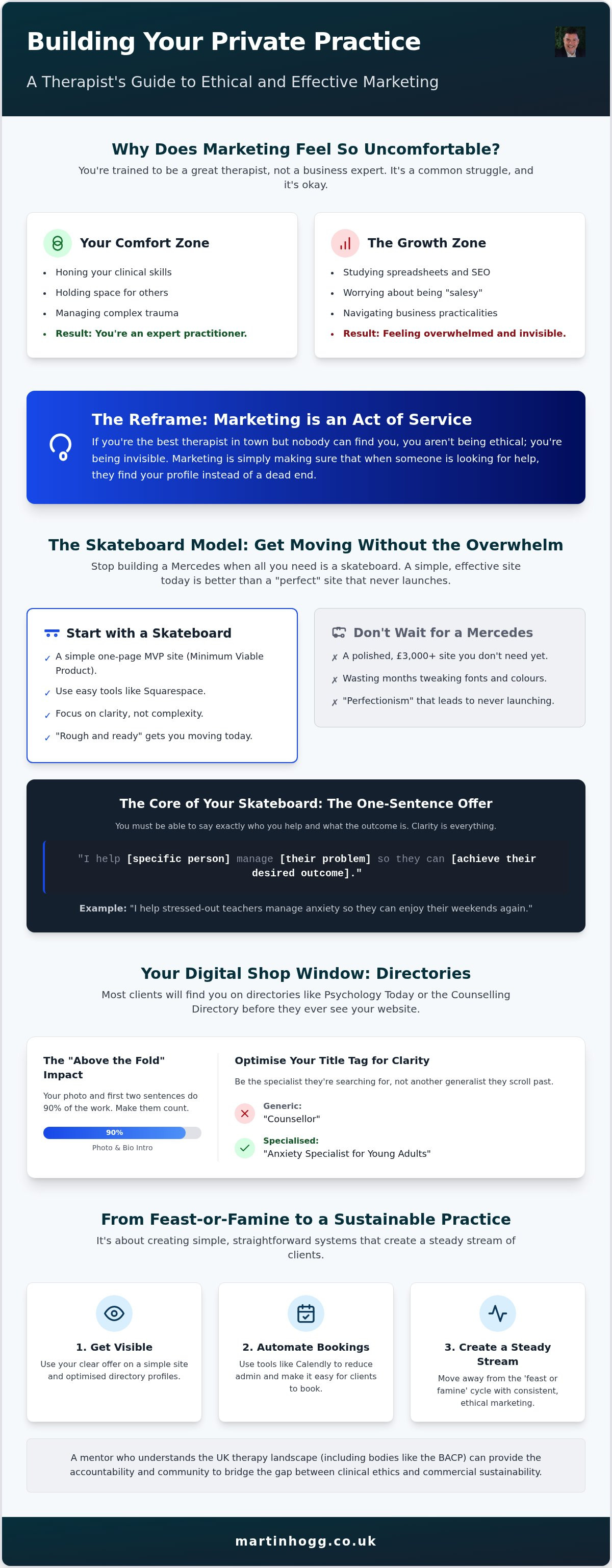
I often see therapists spending months, and sometimes thousands of pounds, on a "perfect" website before they've even seen their first private client. I call this building a Mercedes when all you really need right now is a skateboard. The Skateboard Model is about creating a one-page "Minimum Viable Product" site that gets you moving today. A simple, clear site on Squarespace or even a "rough and ready" landing page is far more effective than a £3,000 polished site that never actually launches because you're still tweaking the font.
The core of this model is your "one-sentence offer." You need to be able to say exactly who you help and what the outcome is for them. For example: "I help stressed-out teachers manage anxiety so they can enjoy their weekends again." This level of clarity is the secret to niche building on the Counselling Directory. When you try to help everyone, your message gets lost in a sea of generic profiles. You want to be the specialist they've been searching for, not another generalist they scroll past.
Directories: Your Most Important "Above the Fold" Real Estate
Most of your clients will find you through Psychology Today or the Counselling Directory before they ever see your own website. This means your directory profile is your primary shop window. Your photo and the first two sentences of your bio are doing 90% of the heavy lifting. This is your "above the fold" content. Ensure your title tags are specific. Don't just put "Counsellor." Try "Anxiety Specialist for Young Adults" to catch the eye of the right person immediately.
Content That Connects: Rough and Ready Wins
You don't need a marketing degree or a professional film crew to stay visible. A simple, helpful blog post written in plain English beats a "perfect" academic paper every time. People connect with people, not citations. Use Canva for basic graphics and keep your message grounded. If you're feeling stuck on where to start, joining a community like the Private Practice Success membership can help you get these basics right. This kind of practical, hands-on support is what effective business coaching for therapists is all about.
Choosing a Business Coach Who Understands the UK Therapy Landscape
I’ve seen too many therapists get burned by generic business coaches. They use high-pressure sales tactics that might work for selling software but feel completely wrong for a counsellor. You need someone who understands that we have "clients," not "customers," and that our work is governed by the BACP or NCS. If a coach doesn't understand the nuance of clinical ethics, they might push you to do things that put your professional registration at risk. Effective business coaching for therapists must respect the boundaries of our profession.
When looking for a mentor, prioritize experience over hype. Beware of the "gurus" promising six figures in six weeks using Americanised high-pressure tactics. It’s often just empty noise. Instead, look for someone who has actually built a successful practice here in the UK. I’ve been running Citizen Coaching and Counselling since 2005, so I understand the reality of the UK market, from the VAT threshold to the latest SCoPEd framework changes.
One-to-One vs. Group Coaching: Which is Right for You?
Choosing the right format depends on your budget and how you learn best. One-to-one business coaching for therapists is brilliant for bespoke strategy. It gives you a direct line to solve specific problems. However, the Private Practice Success Membership often provides the best of both worlds. You get the expert guidance you need alongside a community of peers who are facing the same hurdles.
The "Vibe" Check: Do They Speak Your Language?
Before you hand over any money, do a proper vibe check. Listen to their podcast or read their blog posts. Do they speak your language? You want practicality over "woo-woo" or corporate jargon. If they sound like a distant medical professional or a pushy car salesman, they probably aren't the right fit. You need a straight-talking mentor who values action and tangible improvement over abstract theory.
From Feast-or-Famine to a Sustainable Practice
Many therapists live in a state of constant anxiety about where the next client is coming from. One month you're full; the next, three people finish their work and your diary looks terrifyingly empty. Relying solely on word-of-mouth is what I call "hope marketing." It's stressful and unpredictable. To build a practice that actually lasts, you need to move toward simple, repeatable systems that work even when you're busy in the therapy room.
Start with the basics. Setting up a tool like Calendly for your initial consultations isn't just about saving time. It's about removing the friction for a person in distress who finally has the courage to reach out. If they have to wait two days for you to email back with your availability, they might find someone else. Using basic practice management software or a clear booking flow makes you look like the reachable professional you are. This is where business coaching for therapists helps you focus on "boring" consistency over "flashy" marketing campaigns.
The Practice Visibility Blueprint
I developed the Practice Visibility Blueprint to help you stop wasting time on things that don't work. Instead of trying to be everywhere at once, we focus on the "vital few" tasks that actually result in phone calls and emails. Your first step is to assess your current visibility and identify the biggest "leaks" in your funnel. Is your Psychology Today profile actually getting clicks? Does your "one-sentence offer" make sense to a layperson? When you have a structured system, you save yourself years of trial and error.
Taking the First Step
I know that putting yourself out there feels vulnerable. But remember; rough and ready content beats polished every time. "Done is better than perfect" should be your new mantra. You already have the clinical skills to change lives. You just need to be seen by the people who are looking for you. If you're ready to stop hiding, business coaching for therapists can provide the roadmap you need to move forward with confidence. You can start by focusing on your niche building to ensure you stand out for the right reasons.
Ready to Build a Practice That Works for You?
Building a practice shouldn't feel like you're selling your soul to a corporate machine. We have covered how visibility is actually an act of service and why the "skateboard model" prevents tech-induced meltdowns. You don't need a huge budget or a marketing degree to succeed. You just need a bit of grounded consistency and a one-sentence offer that speaks to people when they need it most.
Since 2005, I've been running Citizen Coaching and Counselling. As a BACP-endorsed workshop provider, I've seen that the right business coaching for therapists is about practical, no-nonsense strategies that work in the UK. It's about creating a bridge to a stable future where your diary stays full and your clinical ethics remain intact.
You already have the skills to help people change their lives. Now it's time to make sure those people can actually find you. Take that first step today. It's much easier than you think.
Frequently Asked Questions
Do I really need a business coach if I am a good therapist?
You don't need a coach to be a brilliant clinician, but you might need one to run a successful business. Clinical excellence and business management are two very different skill sets. Most counselling training in the UK focuses heavily on the therapeutic relationship but leaves you in the dark about tax, SEO, or how to actually get a Squarespace site to show up on Google. A coach helps you bridge that gap so you can afford to keep doing the work you love without burnt-out.
How much does business coaching for therapists typically cost in the UK?
The investment for business coaching for therapists varies depending on whether you choose one-to-one sessions or a group membership model. It is best to view this as an investment in your practice’s sustainability rather than just another monthly expense. I suggest comparing the cost to the income generated by just one or two new private-pay clients. If the coaching helps you fill those slots and keep them full, it usually pays for itself quite quickly.
Will marketing my practice make me look "unprofessional" to my peers?
Marketing only looks unprofessional when it is done badly or feels "salesy." If you focus on being helpful and findable, you are actually performing an act of service for people in pain. Your peers are often just as nervous about visibility as you are. By following BACP ethical guidelines and using grounded, clear language, you set a standard for professional practice that others will likely respect rather than judge.
How long does it take to see more clients after starting coaching?
You can often see an increase in enquiries within a few weeks if you focus on the "vital few" tasks first. For instance, fixing a "leak" in your Counselling Directory or Psychology Today profile can result in immediate phone calls. While long-term strategies like SEO or niche building take more time to mature, simple changes to your "above the fold" content often yield results much faster than you might expect.
Can business coaching help me with niche building and CPD?
Yes, narrowing your focus is often the fastest way to grow a sustainable practice. A coach helps you move away from being a generalist to becoming the "go-to" person for a specific issue. This process of niche building is a significant part of your professional growth. Many therapists also find that the time spent on business development and practice management counts toward their annual CPD requirements for their professional bodies.
Disclaimer
The information provided on this blog is for general informational purposes only. It is also not intended to be a substitute for professional medical or mental health advice, diagnosis, or treatment. Reading this content does not create a therapist-client relationship.


