
Client Retention Strategies for Therapists: Keep Therapy Ethical and Engaging

Article by
Martin Hogg
I help Private Practice counsellors in the UK set up and grow an ethical Private Practice they love, work with their ideal clients, and earn the income they deserve. All without guesswork and burnout. I have been a private practice counsellor myself for over 20 years, specialising in anger management. I set up a not-for-profit social enterprise, Citizen Coaching and Counselling, which delivers thousands of counselling sessions a year to adults and young people in Birmingham. I am a registered BACP Counsellor and the author of three books, My Anger Coach, My Anxiety Coach and My Relationship Coach. These are available on Amazon.
A client ending therapy isn’t automatically a retention problem. They may have made progress, found a better fit, or decided they’re ready to stop. Still, when someone disappears without a conversation, it’s natural to wonder whether anything could have been different. The best client retention strategies for therapists help you explore that question without treating continued attendance as the goal.
I know you want a sustainable practice and you also want clients to feel free to make their own choices. Those aims can sit comfortably together. In this article, I’ll look at how to distinguish avoidable disengagement from an appropriate ending, make it easier to raise concerns and review progress, and respond when a client’s needs or expectations aren’t being met. You’ll find practical ways to support engagement while keeping the focus where it belongs: on the client’s goals, not on keeping a slot filled.
Key Takeaways
- Use client retention strategies for therapists to support the work you and your client have agreed, not to maximise session numbers.
- Agree what the client hopes to get from therapy, then check plainly whether sessions feel useful and relevant.
- Set clear expectations before the first session and have a simple process for reviewing concerns and discussing next steps.
- Put client autonomy before caseload targets. Clear practice processes can support sustainability without promising continuity.
Client retention strategies for therapists start with one distinction: engagement is not dependency
In private practice, a client ending unexpectedly can unsettle you. You might replay the last session, wonder whether you missed a cue, or question whether the work was helping. Reflection can be useful, but a client’s decision to stop doesn’t, by itself, tell you what happened.
Ethical client retention strategies for therapists support the work you and your client have agreed, not more sessions for their own sake. A client may feel they’ve got what they needed, have a change in circumstances, or decide the fit isn’t right. An ending is not automatically a therapeutic failure; context and the client’s perspective matter.
When a client ending therapy is not a retention problem
A planned ending can be part of the work. You and your client review what’s changed, consider what support they may need next, and agree to finish. A client may also choose to pause or stop, even if you’d imagined continuing. Attendance duration alone can’t tell you whether therapy was helpful. A shorter piece of work isn’t automatically unfinished, just as a long one isn’t automatically successful.
When disengagement may be worth exploring
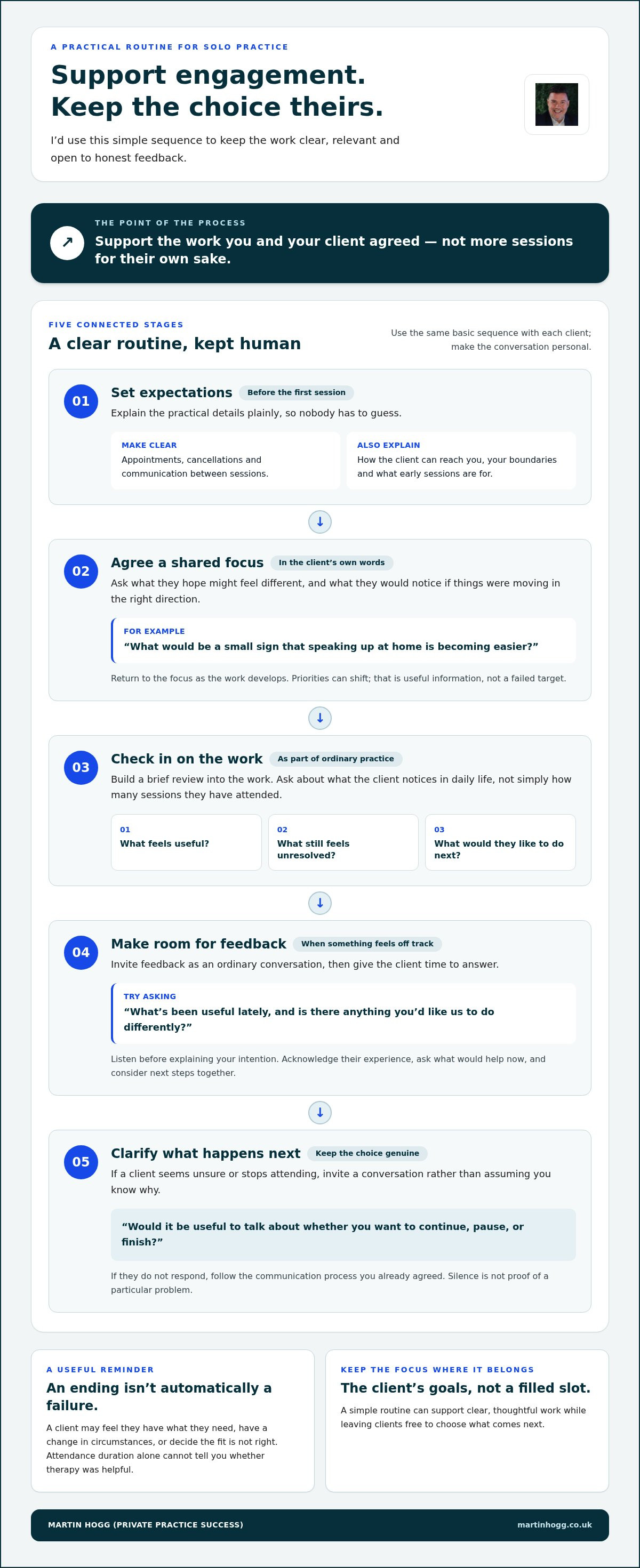
Missed sessions, uncertainty about goals, or a client seeming unsure whether the work is relevant are reasons to invite a conversation, not to assume you know why they’re pulling away. You might say, “I’ve noticed we haven’t met for a while. Would it be useful to talk about whether you want to continue, pause, or finish?” Keep the choice genuine. If they don’t respond, follow the communication process you’ve already agreed rather than treating silence as proof of a particular problem.
Curiosity leaves room for honest feedback. A client may tell you the pace doesn’t suit them, something feels difficult to raise, or life has simply got in the way. You can reflect on what they share without turning every ending into a verdict on your ability or a reason to persuade them to stay.
What helps clients stay engaged: shared goals, a strong alliance and room for feedback
Clients are better placed to judge whether therapy is useful when you have a shared idea of what they came to work on. That doesn’t mean setting targets like a work appraisal. It means having a reference point in the client’s own words, then checking whether it still matters to them. A goal might be “feel less overwhelmed at work” or “be able to speak up at home”.
A useful progress review is collaborative, specific and open to change. Ask what the client has noticed in daily life, not simply how many sessions they’ve attended. That gives you both a clearer sense of what is shifting, what feels stuck and whether the focus needs to change.
Agree goals without making therapy feel like a performance review
I’d start with the language the client uses, rather than translating it too quickly into clinical shorthand. Ask what they hope might feel different, and what they’d notice if things were moving in the right direction. For example, “What would be a small sign that speaking up at home is becoming easier?” You can return to their answer as the work develops. Priorities may shift, or the client may discover that the original concern isn’t the whole story. That’s useful information, not a failed target.
Respond to feedback and possible relationship ruptures
Make feedback part of ordinary conversation, not a special test the client has to pass. You might ask, “What’s been useful lately, and is there anything you’d like us to do differently?” Then give them time. If they say a question felt uncomfortable or the sessions seem off track, listen before explaining your intention. Acknowledge their experience, ask what would help now, and consider next steps together. They aren’t there to reassure you that you’re doing a good job.
This kind of steady check-in makes client retention strategies for therapists more about the quality and relevance of the work than keeping a diary full. If you’re also strengthening the business side of your practice, the Martin Hogg Private Practice Success membership offers practical resources and community support alongside your own clinical reflection.
Practical client retention strategies for therapists in a solo practice
In a solo practice, good intentions need a simple routine behind them. I’d use the same basic sequence with each client, while keeping the conversation personal: set expectations, agree a focus, check in, respond to concerns and clarify next steps. This is a practical way to use client retention strategies for therapists without turning sessions into a checklist.
Set expectations before the first session
Before you meet, explain the practical details in plain English: how appointments are arranged, how you handle cancellations, what communication between sessions looks like, and how the client can reach you. Be clear about your boundaries so nobody has to guess. You can also explain that early sessions are a chance to understand what’s brought them to therapy and what they hope to work towards. Keep it human, not a script read at speed.
Make review and follow-up part of ordinary practice
Build a brief review into the work rather than waiting until something feels wrong. You could ask, “What’s been useful so far, and what would you like us to focus on next?” If you want a simple structure, return to three points: what feels useful, what still feels unresolved, and what the client would like to do next. A short, regular check-in makes it easier to notice when the work needs adjusting and gives the client a clear opening to say that something isn’t landing.
If a client stops attending, stick to the contact approach you’ve already explained and agreed. A brief message can acknowledge the missed appointment and invite them to let you know whether they want to rearrange, pause or finish. Don’t keep chasing, and don’t read a lack of reply as a clear explanation. Keep a consistent, factual note of the contact and any agreed next steps, then return your attention to the clients you’re seeing.
That small bit of structure helps you offer care reliably without adding a complicated admin system to an already full working week.
Build a sustainable practice without turning client retention into pressure
I’ll put it plainly: client autonomy comes before your caseload targets. A client must be free to finish therapy when that’s right for them. No ethical retention plan should make someone feel they owe you another session. Session frequency or length, on its own, isn’t a measure of good work.
A sustainable practice comes from clear, reliable systems and honest visibility, not from stretching therapy beyond what the client wants or needs. Good processes can reduce confusion and make it easier for clients to raise concerns. They can’t guarantee that someone will continue, and that isn’t their job.
Separate practice sustainability from keeping every client
It helps to look at attracting clients and supporting engagement as different parts of your practice. Marketing helps the right people understand who you work with and how to take a first step. The work itself then needs to stay responsive to the person in front of you. Neither is a promise of ongoing sessions. I’d avoid judging your practice by whether every client stays; a planned ending can be a sound outcome.
Instead, review the parts you can influence: is your information clear, are your boundaries easy to understand, are appointment arrangements manageable, and do clients have a way to tell you when something isn’t working? These are practical questions, not a new set of numbers to fret over.
Choose a next step that fits your practice
Pick one point in the client journey that could be clearer or easier. Perhaps your pre-session information needs a plain-English edit, or you could make space for a regular check-in about how the work is going. Keep the change small enough to maintain when the diary gets busy. Then reflect on whether it helps clients understand their choices and helps you work consistently.
Peer learning and practical business resources can also support the running of your practice. They’re business support, not clinical advice, and they won’t promise that clients will stay. If that kind of support would be useful, you can explore Private Practice Success for UK counsellors and therapists.
Make your next practice decision a thoughtful one
Your practice will change as your experience grows. The clients you work best with, the questions that interest you and the shape of your working week may all shift over time. Let your approach to client retention strategies for therapists develop too. There’s no need to turn one set of habits into a rulebook for every client or every stage of your career.
I’m Martin Hogg, MBACP (Reg.), and I’ve spent 21 years in UK private practice. I’ve mentored over 1,400 UK therapists. I know that building a practice brings business questions alongside the clinical work. Private Practice Success offers practical resources, online training and community support for counsellors and therapists working on that side of practice.
If you’d like to explore that support, you can take a look at the membership.
Keep learning, keep reflecting, and let your practice grow in a way that feels like yours.
Frequently Asked Questions
Is it unethical for a therapist to want clients to stay in therapy?
No, the feeling itself isn’t unethical. What matters is how you handle it. If you notice that a client’s leaving feels especially worrying because of the gap in your diary, pause before raising continuation. I’d use reflective practice to separate the business worry from the client’s needs, then check that your words leave them genuinely free to decide.
What should I do when a client stops attending therapy?
First, separate what you know from what you’re guessing. A missed appointment tells you they didn’t attend; it doesn’t tell you why. Keep any record of the event factual and neutral, including what action you took. That can help you review your own process later without turning an unknown reason into a story about the client or your work.
Can a client benefit from only one therapy session?
Yes. One meeting might help someone put their concern into words, identify a question they want to think about, or decide what kind of help they want next. You don’t need to claim a particular outcome to recognise that a conversation can have value. If the client asks what you think, you can discuss their options without treating another appointment as the obvious answer.
How can therapists ask clients for feedback without putting them on the spot?
Give the client control over the timing as well as the answer. You might say, “I’d like to check how this is working for you. Would you rather talk about it now or have a think and come back to it?” That makes room for reflection, especially if feedback feels difficult. Avoid filling a pause too quickly; a moment of silence needn’t be repaired.
What is the difference between client retention and preventing therapy dropout?
Retention describes whether clients continue; it doesn’t explain whether continuing is right for them. “Dropout” can be a useful administrative label, but it isn’t a clinical conclusion about the client or the quality of therapy. In your own records and reflection, keep the observable event separate from your interpretation. That small distinction can make client retention strategies for therapists more thoughtful and less driven by assumptions.
Disclaimer
The information provided on this blog is for general informational purposes only. It is also not intended to be a substitute for professional medical or mental health advice, diagnosis, or treatment. Reading this content does not create a therapist-client relationship.


