
Common Mistakes New Therapists Make in Private Practice (and How to Fix Them)

Article by
Martin Hogg
I help Private Practice counsellors in the UK set up and grow an ethical Private Practice they love, work with their ideal clients, and earn the income they deserve. All without guesswork and burnout. I have been a private practice counsellor myself for over 20 years, specialising in anger management. I set up a not-for-profit social enterprise, Citizen Coaching and Counselling, which delivers thousands of counselling sessions a year to adults and young people in Birmingham. I am a registered BACP Counsellor and the author of three books, My Anger Coach, My Anxiety Coach and My Relationship Coach. These are available on Amazon.
What if I told you that being a brilliant therapist is actually the easiest part of running a successful practice? You've done the hard work, finished your training, and got your BACP accreditation sorted. Yet, here you are with a lovely website and an empty diary, wondering why the phone isn't ringing. It's incredibly frustrating when you feel like you have to choose between being a proper counsellor and being a salesy business owner. This tension often leads to the common mistakes new therapists make in private practice, like hiding behind clinical jargon or getting stuck in tech hell with your directory profiles.
I know that feeling of overwhelm well, and it's completely normal to feel a bit lost when the business side of things wasn't covered in your training. This guide will show you how to avoid the typical pitfalls that keep UK counsellors underbooked and exhausted. We're going to focus on practical, human-centred growth that builds your confidence and fills your diary with private-pay clients. I'll show you how to move from a place of rough and ready to a thriving, sustainable business that respects your boundaries and your bank account.
Key Takeaways
- Stop hiding behind endless qualifications and learn why your tenth diploma won't actually help a client who can't find your website.
- Identify the common mistakes new therapists make in private practice when using clinical jargon that makes potential clients click away from your page.
- Avoid the trap of being the cheapest counsellor in town by setting fees that protect your energy and prevent burnout.
- Learn how to use the "skateboard model" to launch a "rough and ready" website now rather than waiting months for a perfect version that never goes live.
- Shift from waiting for permission to be found to actively building your presence across platforms like Psychology Today and social media.
The "More CPD" Trap: Hiding Behind Qualifications
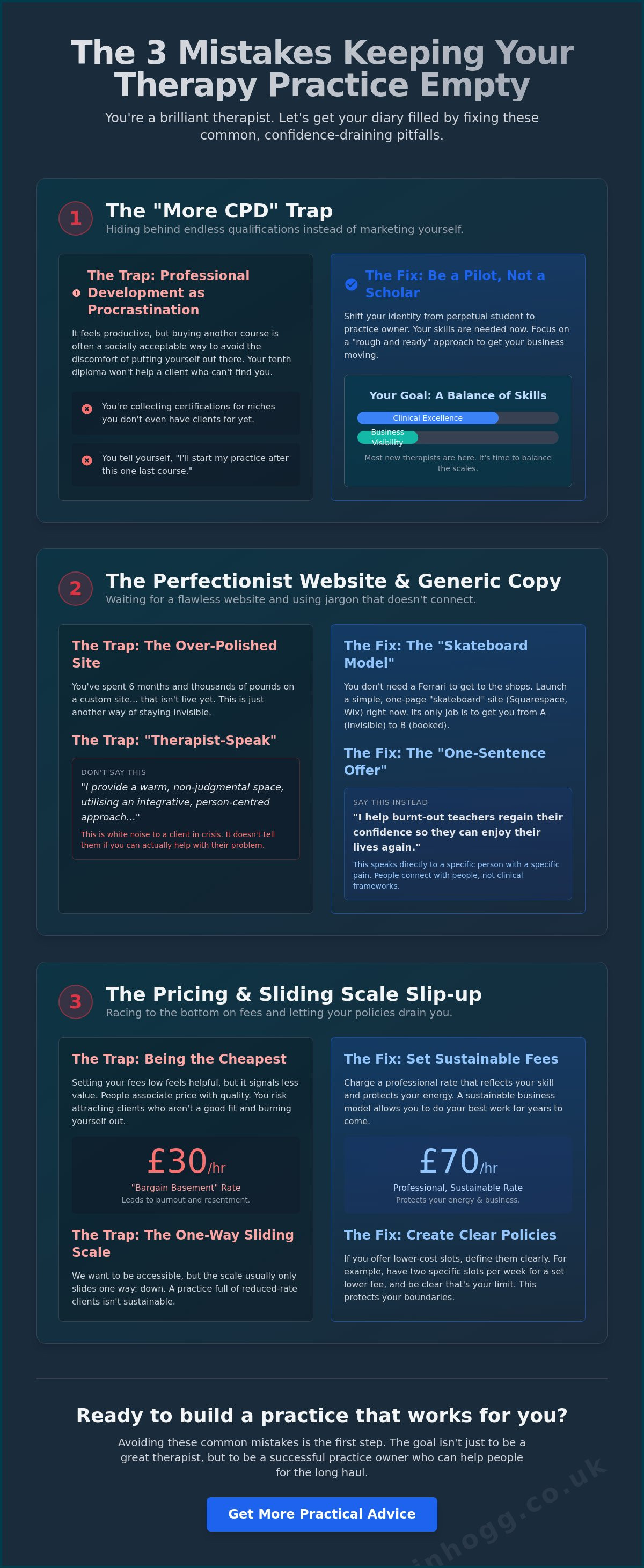
I see it all the time. A talented counsellor finishes their training, gets their BACP membership, and then immediately signs up for three more diplomas. They tell themselves they aren't quite ready to see private clients until they've mastered every nuance of trauma, attachment theory, or the latest somatic technique. This is one of the most common mistakes new therapists make in private practice. It's a way of hiding in plain sight. We buy more courses to avoid the discomfort of marketing ourselves.
The truth is that your tenth diploma won't help a client who can't find your website. While clinical excellence is the foundation of what we do, it isn't a marketing strategy. You could be the most skilled practitioner in the history of psychotherapy; but if your diary is empty, your skills are going to waste. You have to make the shift from being a perpetual student to being a practice owner. It’s a change in identity that feels uncomfortable, but it's necessary for survival.
When Professional Development Becomes Procrastination
Buying more training is often just a socially acceptable form of procrastination. It's much easier to sit in a workshop than it is to write a blog post or fix your profile on Counselling Directory. If you find yourself constantly looking for cpd for counsellors uk because you feel "unprepared," ask yourself if you're using learning as a shield against visibility. Here are a few signs you're in the trap:
- You're collecting certifications for niches you don't even have clients for yet.
- You tell yourself "I'll start my practice once I've finished this one last course."
- You spend more time on training than you do on your business visibility.
I want you to aim for a balance. Use a "rough and ready" approach to your business. Get your basic "one-sentence offer" sorted and your website live before you dive into the next big training programme. Your practice needs a pilot, not just a scholar. Don't let your desire for perfection keep you from being the help that someone is searching for right now.
The Perfectionist Website and the "Generic" Copy Problem
I’ve seen many talented counsellors spend six months and thousands of pounds on a website before seeing a single client. They worry about the exact shade of teal or whether their "About" page sounds academic enough. This is high on the list of common mistakes new therapists make in private practice. You don't need a Ferrari to get to the shops; you just need something that moves. Perfectionism here is just another way of staying invisible.
The Skateboard Model vs. The Over-Polished Site
I always recommend the "skateboard model." A skateboard is a simple, one-page site that gets you from A to B right now. You don't need a complex custom build that takes months to code. A basic Squarespace or Wix site is more than enough to get started. The most important part is your "above the fold" content. This is the text people see before they even start scrolling. If that headline doesn't tell them immediately that you understand their specific pain, they'll click away. If you're feeling stuck on how to present yourself, joining a group like our Private Practice Success community can help you get that clarity quickly.
Stop Writing Like a Clinical Textbook
The biggest mistake on these sites is "therapist-speak." Phrases like "I provide a warm, non-judgmental space" are everywhere. To a client in crisis, that sounds like white noise. People connect with people, not with clinical frameworks or your BACP-approved modality. They want to know if you can help them stop having panic attacks at work or save their marriage. They aren't looking for a professor; they're looking for a guide.
Try using a "one-sentence offer" instead. It’s a simple way to clarify what you actually do for people. For example: "I help burnt-out teachers regain their confidence so they can enjoy their lives again." This niche matters far more than whether you use CBT or person-centred techniques. Remember, rough and ready content that speaks to a human heart beats a polished site that says nothing every single time.
Pricing, Policies, and the Sliding Scale Slip-up
When you're starting out, there’s a massive temptation to set your fees as low as possible. You think, "I'll be the cheapest in my area just to get the phone ringing." This is one of the most common mistakes new therapists make in private practice. It feels like you're being helpful; but in reality, you're signalling to potential clients that your work has less value than the person charging a professional rate. People often associate price with quality. If you're the bargain-basement option, they might wonder why you're so much cheaper than everyone else on Counselling Directory.
Then there’s the sliding scale. We all want to make therapy accessible, but the scale usually only slides one way: down. If you have ten clients all paying a reduced rate, you'll quickly find yourself burnt out and struggling to pay your own bills. Resentment is a terrible thing to bring into the therapy room. You need a business model that sustains you so you can sustain your clients for the long term.
The Danger of Underpricing Your Expertise
Low fees don't just affect your bank balance; they affect your professional identity. You have to consider your "real" hourly rate. Once you've deducted your room hire, insurance, supervision, and tax, that £35 session looks more like £15. You can't run a sustainable practice on that. Setting a fair, professional fee from day one is an act of self-care. It allows you to show up fully for the people who need you without worrying about your own electricity bill.
Boundaries: Why Your Contract Protects the Therapeutic Work
I know it feels awkward to charge for a missed session. You might worry that enforcing a 24-hour cancellation policy will damage the relationship or seem "un-therapist-like." It's actually the opposite. Clear boundaries create a safe container for the work. A solid contract isn't a weapon; it's a professional agreement that respects both your time and the client's commitment. For more on building these foundations, have a look at my guide on counselling private practice uk.
Finally, stop the awkward cash handovers at the end of a session. It breaks the therapeutic flow and feels a bit "under the table." Use modern tools like Calendly or Stripe to take payments upfront or automatically. It’s cleaner, more professional, and it saves you from having to play debt collector. If you want a step-by-step framework for setting these systems up properly, come and join us in the Private Practice Success Membership.
The Visibility Fear: Waiting for Permission to be Found
One of the biggest hurdles I see is the belief that if you are a good enough therapist, the universe will naturally provide clients. It won't. Relying solely on a single profile on Counselling Directory and hoping for the best is another of those common mistakes new therapists make in private practice. It’s like opening a shop in a back alley and never putting a sign out on the main road. You are waiting for permission to be found, but in private practice, you have to give that permission to yourself. Visibility is an act of service; if they can't find you, you can't help them.
Directory Profiles That Actually Convert
Your directory profiles need to do more than just list your qualifications. On sites like Psychology Today, your title and description tags are your first digital handshake. Most therapists use this space to say "Accredited Counsellor," which is a bit like a restaurant putting "Food Seller" on their sign. It’s true, but it’s not helpful. Use that space to speak directly to the pain you solve. Also, please use a professional, human photo. A picture of a pebble, a flower, or a generic logo makes you look like a faceless agency. People connect with people; they want to see the face of the person they are going to share their deepest struggles with.
Building Your Practice Visibility Blueprint
Visibility doesn't mean you have to become a "salesperson" or a frantic social media influencer. It’s about being the logical conclusion to a client’s search for help. Networking for introverts is simply about building relationships with people who already talk to your ideal clients, like local GPs or HR managers. You aren't "selling" yourself; you are letting them know a reliable resource exists. Rough and ready content on social media, like a simple post explaining a common struggle, is always better than being invisible because you're waiting for a "perfect" marketing plan.
Stop doing "random acts of marketing" only when your diary looks a bit thin. You need a consistent, manageable system that works in the background while you focus on your clients. If you’re tired of trying to figure this out alone and want a clear path forward, come and join the Private Practice Success Membership for community support and practical tools. By moving past the common mistakes new therapists make in private practice and taking small, consistent steps, you can finally build the steady and sustainable practice you deserve.
Building a Practice That Works for You and Your Clients
Running a private practice is a journey of constant learning; but it shouldn't feel like you're wading through treacle. You've seen how easy it is to fall into the trap of endless training or the quest for a perfect website. Remember, your future clients aren't looking for a polished corporate brand. They're looking for a real person who can help them face their struggles. By avoiding these common mistakes new therapists make in private practice, you're choosing to prioritise your own well-being alongside your clinical work.
It’s time to stop guessing and start building with confidence. I’ve spent over 20 years helping UK therapists move away from "random acts of marketing" toward real, practical success. My approach is grounded in BACP-endorsed workshops and practical, "no-fluff" business coaching that focuses on what actually fills diaries. You don't have to figure this out in isolation.
Join the Private Practice Success Membership and stop guessing your way to a full diary.
You already have the clinical skills to change lives. Now, let’s make sure you have the business structure to match. It’s time to get your work out there where it belongs. You've got this.
Frequently Asked Questions
Is it normal to have no clients in the first month of private practice?
Yes, it is entirely normal to have an empty diary in those first few weeks. It takes time for the digital world to find you, especially if you're just getting your site indexed by search engines. Use this period to refine your "one-sentence offer" and check your "above the fold" content. Don't see it as a failure; see it as a quiet phase to sharpen your visibility before the rush begins.
Should I offer a sliding scale to every client who asks?
No, you shouldn't offer a reduced rate to everyone just because they ask. One of the common mistakes new therapists make in private practice is letting their sliding scale become a race to the bottom. Decide on a set number of low-cost slots that your business can actually afford. Once those are full, refer people to low-cost agencies so you can keep your own practice sustainable.
Do I really need a website, or is a directory profile enough?
A directory profile is a great starting point, but you really need your own website to stand out. Think of it as your digital home where you can show your personality without the constraints of a standard template. Using the "skateboard model" on Squarespace or Wix lets you get something live in a weekend. It gives you control over your SEO and helps you connect with people more deeply.
How do I deal with imposter syndrome when I first start out?
Imposter syndrome is almost a rite of passage, so try to treat it with a bit of curiosity rather than fear. It usually means you're stepping out of your comfort zone and actually care about doing a good job. Focus on the clinical hours you've already put in and your BACP training. You don't need to be a guru; you just need to be a safe, grounded human being for your client.
What is the most important piece of software for a new UK therapist?
A solid booking and payment system like Calendly or Stripe is probably the biggest "easy win" for your sanity. It stops the awkwardness of chasing fees and the endless email tennis of finding a session time. Automating these basics prevents the admin burnout that often leads to common mistakes new therapists make in private practice. It leaves you with more energy for the actual therapy, which is why you started this.
Disclaimer
The information provided on this blog is for general informational purposes only and is not intended to be a substitute for professional medical or mental health advice, diagnosis, or treatment. Reading this content does not create a therapist-client relationship.


