
Counselling Directory Profile Tips: Help the Right Clients Find You

Article by
Martin Hogg
I help Private Practice counsellors in the UK set up and grow an ethical Private Practice they love, work with their ideal clients, and earn the income they deserve. All without guesswork and burnout. I have been a private practice counsellor myself for over 20 years, specialising in anger management. I set up a not-for-profit social enterprise, Citizen Coaching and Counselling, which delivers thousands of counselling sessions a year to adults and young people in Birmingham. I am a registered BACP Counsellor and the author of three books, My Anger Coach, My Anxiety Coach and My Relationship Coach. These are available on Amazon.
What if your directory profile didn’t need to sound impressive, only clear enough for the right person to recognise themselves in it? If you’ve opened Counselling Directory and found yourself staring at a blank box, you’re not alone. Writing about your work can feel awkward when you want to be authentic, not sound like an advert.
The most useful counselling directory profile tips aren’t about promising more or finding a clever phrase. They’re about explaining who you work with, what they might bring to sessions and what someone can expect when they get in touch. I’d aim for language that feels like you, while giving a potential client enough detail to judge whether your practice might suit them.
In this guide, I’ll show you how to describe your work in clear, recognisable terms, make your profile easier to review and keep it current. We’ll also look at how to make your listing more specific when other profiles seem similar. A directory can support your visibility, but it’s one practical part of building a practice, not the whole marketing plan.
Key Takeaways
- Use these counselling directory profile tips to help potential clients quickly judge whether your practice may suit them.
- Shape your profile around the people you work with, the concerns they bring and how you approach your work.
- Check that your photo, profile details and preferred contact route still reflect your current practice.
- Offer a simple, pressure-free next step so interested readers know how to get in touch.
Counselling directory profile tips: start with the client’s point of view
Writing about yourself can feel oddly uncomfortable, especially if “selling yourself” makes you want to shut the laptop. I’d take the pressure off. Your Counselling Directory profile isn’t a sales pitch. Its job is to help someone recognise whether your work might be relevant, understand how you work and see how to take a next step.
What a potential client needs to understand
Start with the questions a reader may have: who do you work with, what concerns might they bring, and what is it like to work with you? Use everyday language. You might explain that you work with adults experiencing anxiety around work or relationships, then describe your approach in terms a reader can follow. If you use clinical terms, explain what they mean in practice.
Be specific without telling people what they feel or diagnosing them from a profile. A reader should be able to decide whether your experience sounds relevant to their circumstances. There’s a useful connection between understanding people and communicating clearly; the psychological study of marketing reflects that intersection. The practical lesson is simple: focus on what a reader needs to know, not on persuading them with grand claims.
Make the profile sound like you
Read your draft aloud. If you’d never say “I facilitate transformative personal growth” in a conversation, try a plainer version. For example: “I help people make sense of anxiety and find ways to manage it day to day.” It’s clearer, and it sounds like a person rather than a brochure.
These counselling directory profile tips are about making your work easier to recognise, not promising a stream of enquiries or a perfect client fit. A directory listing can support your visibility, but it’s one part of marketing for therapists. If you’re still shaping who you work with, my guide to niche building for counsellors can help you make that message more focused.
Write a counselling directory profile that explains your approach clearly
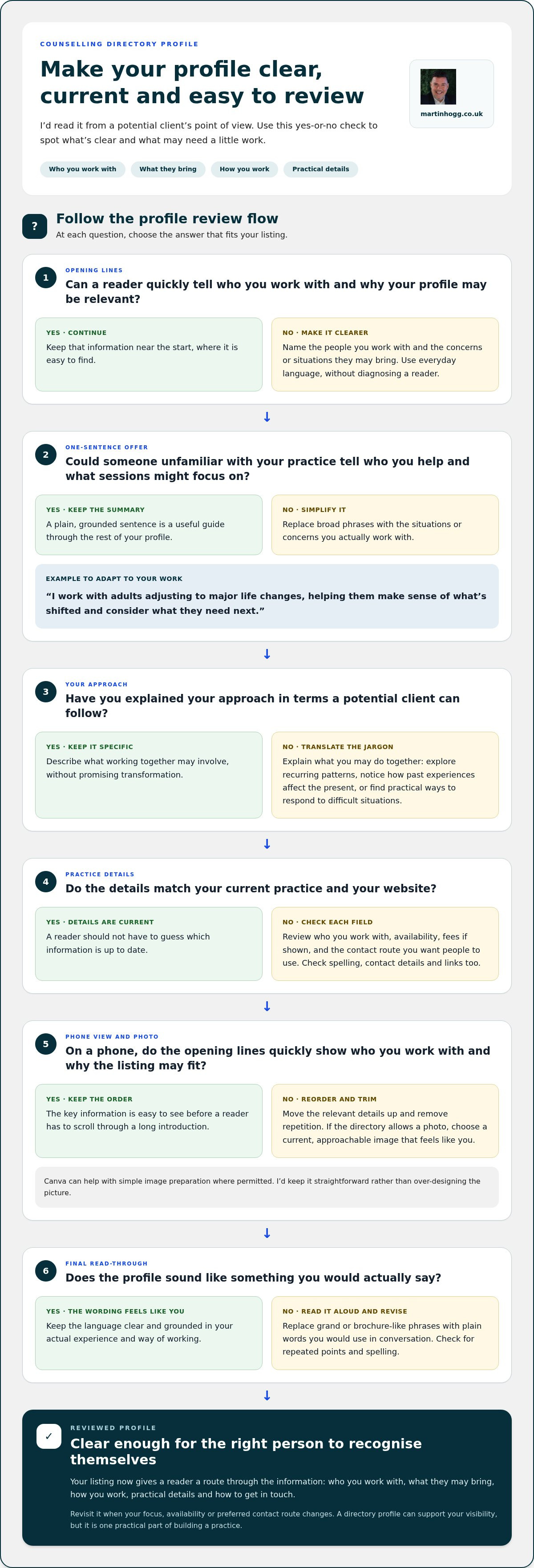
A clear profile follows a simple order: who you work with, what they may be dealing with, how you work, practical details and an invitation to get in touch. That gives a reader a route through the information, rather than a pile of qualifications and therapy terms to untangle. Before you write, jot down a few notes under each heading. That makes it easier to spot what’s missing and avoid repeating the same point in different words.
Build a clear one-sentence offer
Your one-sentence offer is a plain summary of whom you help and what they bring. For example: “I work with adults adjusting to major life changes, helping them make sense of what’s shifted and consider what they need next.” Treat this as a template to adapt, not a magic formula. Keep it grounded in your actual experience and way of working.
A useful profile summary is a concise statement of fit and approach. Read your sentence to someone unfamiliar with your practice. Can they tell who you work with and what sessions might focus on? If not, simplify it. Remove broad phrases such as “I help people reach their potential” and replace them with the concerns or situations you actually work with. If you’re still defining your focus, my guide to niche building for counsellors may help.
Explain your approach without jargon
Translate therapeutic language into what a client might experience. Instead of naming a modality and leaving it there, explain what you may do together: explore recurring patterns, notice how past experiences affect the present, or find practical ways to respond to difficult situations. Be specific, but don’t promise transformation. Your profile is there to help someone decide whether your approach sounds like a possible fit.
Keep your claims honest and proportionate. The US-based ACA Code of Ethics offers a reference point for thinking about professional responsibility in advertising, though it isn’t UK guidance. If you want ongoing support as you work on your practice visibility, the Private Practice Success Membership includes structured growth plans, live training and a community of private practice owners.
Improve your directory profile: photos, details and a practical review
A profile can be well written and still let you down if the details are out of date. I’d review every field against your current practice: who you work with, your availability, fees if shown, and the contact route you actually want people to use. Check your listing against your website too. A prospective client shouldn’t have to guess which version is current.
Review the profile before publishing
Read it as if you’ve never met yourself. Is anything repeated? Are there vague claims that could be more specific? Check spelling, contact details and links, then view the listing on your phone. On a phone, the opening lines should quickly tell a reader who you work with and why your profile may be relevant. Put that information first, rather than making someone scroll past a long introduction.
If the directory allows a photograph, choose a current, approachable image that feels like it belongs with the person speaking in your profile. Canva can help with simple image preparation where permitted, but don’t over-design it. The NASW’s US guidance calls marketing an essential function of a successful business and includes online directories. It’s a useful reminder that visibility is part of running a practice, though its guidance is not UK-specific.
Keep the listing useful over time
Revisit your Counselling Directory profile when your focus, availability or preferred contact route changes. You don’t need to keep tinkering for the sake of it; regular edits can’t guarantee enquiries or a better fit. These counselling directory profile tips are about keeping your information clear and accurate. For the wider picture, consider how your listing fits into your approach to getting counselling clients.
Turn a counselling directory profile into a clear next step
A reader may feel your profile sounds relevant and still hesitate over what to do next. I’d make the invitation plain and low-pressure: “If you’d like to ask whether working together might suit you, you’re welcome to get in touch.” It gives someone permission to enquire without suggesting they should book, creating urgency or claiming you’re the right counsellor for everyone.
Make it easy to enquire
Where the directory allows it, check that your preferred contact method works and that any link leads to a relevant, current practice page. The next step should match how you actually work and the boundaries you want to set. If someone does contact you, a short reply can acknowledge their message and explain what happens next, for example: “Thanks for getting in touch. I’ll reply with some information about arranging an initial conversation.” Adapt the wording to your real process, not an imaginary one borrowed from a marketing template.
These counselling directory profile tips can make one part of your visibility clearer, but a listing isn’t a whole marketing plan. You don’t need to launch every channel at once. Choose one manageable next step, such as checking your website contact page or making sure the message on your profile matches the work you want to be known for. Steady beats frantic.
Build visibility at a pace you can sustain
If you’d value ongoing help with practice growth, I run the Private Practice Success Membership. It includes structured growth plans, live training sessions and a community of private practice owners. You can work on your visibility at a pace that fits your practice, rather than trying to launch every idea at once.
Make your profile the start of a clearer practice plan
A useful directory profile doesn’t need to sound like an advert. It needs to help the right reader recognise that your work may suit them. Keep your description focused on who you work with, the concerns they bring and how you approach your work. Then check that your details and contact route are current, and make the next step easy to understand.
These counselling directory profile tips can help you make your listing clearer, but a directory is only one part of building visibility. I’d recommend choosing one practical improvement rather than trying to tackle every marketing channel at once. Make that change, then build from there.
If you’d like ongoing support, the Private Practice Success Membership includes structured growth plans, live training sessions and a supportive community of private practice owners.
Your profile doesn’t have to be perfect to be useful. Start with clear, honest words, then keep refining them as your practice grows. When you’re ready to build a steadier approach to practice visibility, explore the Private Practice Success Membership.
Frequently Asked Questions
What should I include in a counselling directory profile?
Include who you work with, the concerns they may bring, how you work, practical details and a clear way to get in touch. I’d suggest using everyday language and explaining any therapeutic terms rather than assuming readers know them. Check that your contact details match your current practice. You want someone reading your profile to understand enough to decide whether your work might suit them.
How do I make my counselling directory profile stand out?
Make it specific, not flashy. Describe the people you work with and the issues you have experience supporting, using words they might recognise from daily life. A current photograph and a clear account of your approach can help the profile feel personal. I’d focus on what makes your work distinct, rather than trying to outdo other listings with bigger claims. These counselling directory profile tips are about clarity.
How long should a counsellor directory profile be?
There isn’t one ideal length for every directory. I’d suggest checking the platform’s word limit, then using the space you need to explain your focus, approach and practical details. A concise, well-organised profile is better than one padded with repetition or unexplained qualifications. Read it on your phone, too. If you have to scroll to find the essentials, bring the most useful information closer to the start.
Should I include my counselling fees in a directory profile?
If the directory provides a place for fees, including your current fee can help a prospective client understand the practicalities before getting in touch. I’d keep it accurate and consistent with your website or other practice information. If your fees vary, explain that plainly so readers aren’t left guessing. You don’t need to justify your fee in the profile; clear, straightforward information is usually more helpful.
Do counselling directory profiles guarantee new clients?
No. A directory listing can help people find and understand your practice, but it can’t guarantee enquiries, bookings or a good fit. I’d treat your profile as one part of your visibility, not the whole plan. Whether someone gets in touch depends on what they’re looking for and whether your work seems relevant. Keep the listing clear and current, while building other manageable ways to share your practice.
Disclaimer
The information provided on this blog is for general informational purposes only. It is also not intended to be a substitute for professional medical or mental health advice, diagnosis, or treatment. Reading this content does not create a therapist-client relationship.


