
Counselling Private Practice UK: A Practical Guide to Building a Sustainable Practice
Why is it that we are trained to hold space for the most complex human emotions, yet the thought of sending a £60 invoice or updating a website makes us want to hide under the desk? Most therapists spend years honing their clinical skills, but my experience supporting practitioners since 2010 shows that many feel completely unprepared for the administrative reality of running a counselling private practice uk. You didn't enter this profession to become a marketing expert or an accountant. You are here because you care about people, and it's natural to worry that focusing on the business side might compromise your ethics or make you appear salesy.
I understand that tension because I have lived it. This guide is here to show you that building a sustainable practice isn't about cold corporate tactics; it's about creating a stable foundation so you can do your best work without burning out. You'll learn how to move from feeling isolated and overwhelmed to having a clear, ethical plan for attracting the right clients. We will look at everything from setting your fees with confidence to making sure your local community actually knows you're there to help.
Key Takeaways
- Understand the practical shift from being a therapist to being a business owner, ensuring your legal and ethical foundations are rock solid.
- Learn how to build a steady stream of the right clients for your counselling private practice uk by moving beyond a reliance on basic directories.
- Get clear on setting sustainable fees and managing payments so you can focus on your clients without financial worry.
- Discover how to protect your own energy with healthy boundaries and practical self-care habits that prevent professional burnout.
- Explore ways to grow your practice beyond one-to-one work, creating a more resilient and diverse income for the long term.
What Does Running a Counselling Private Practice in the UK Really Involve?
Many therapists I speak with imagine private practice as a simple extension of their clinical work. They see a quiet room, a steady stream of clients, and the freedom of being their own boss. While that freedom is real, the road to a sustainable counselling private practice uk involves wearing many hats you might not have worn in an agency or NHS setting. You're no longer just the person in the chair; you're the IT department, the bookkeeper, and the marketing manager.
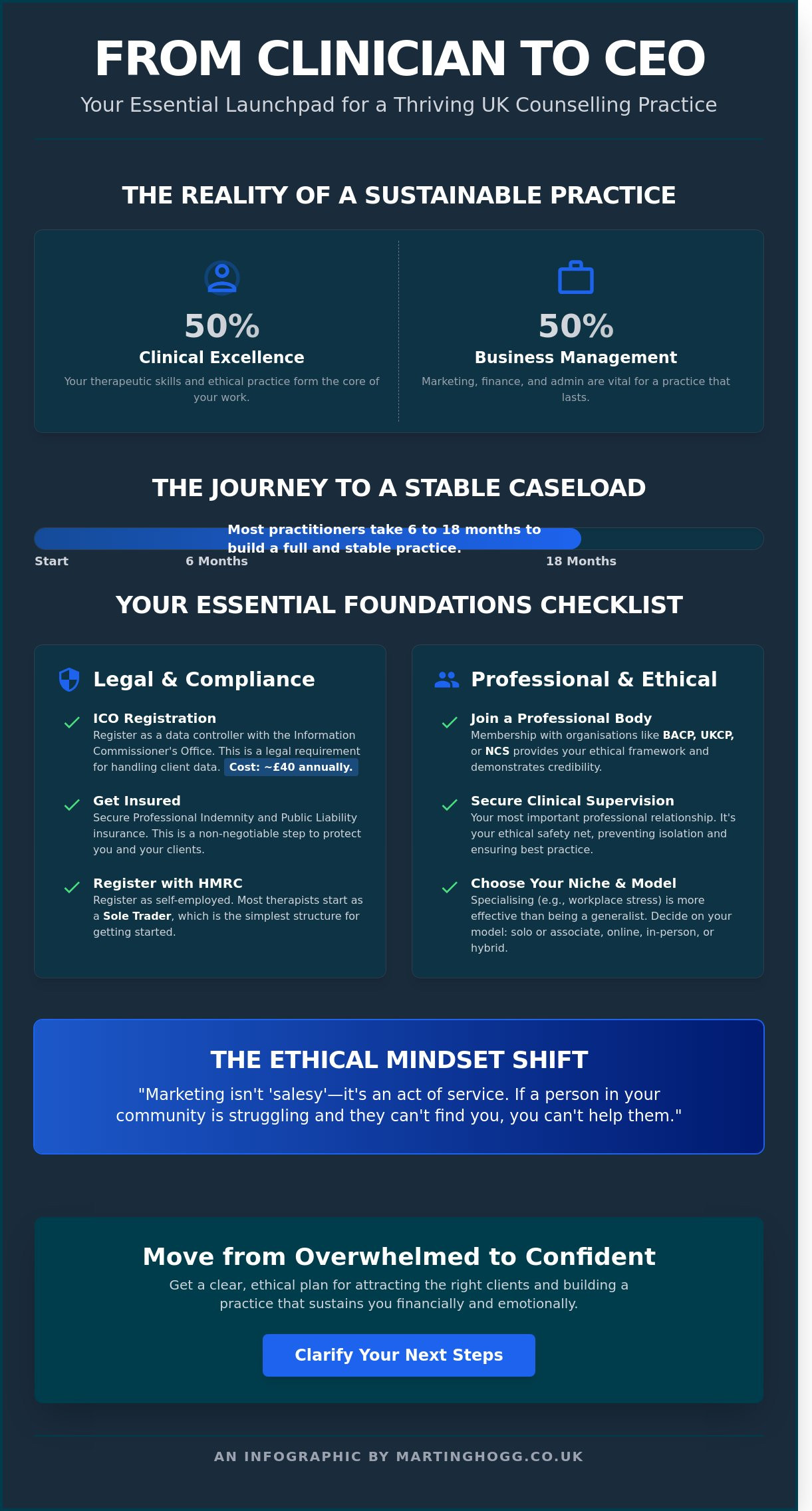
Transitioning from a structured environment like the NHS, which employs over 1.2 million people, into solo work can be a shock. You lose the ready-made referral pathways and the clinical safety net of a larger team. Clinical excellence is vital, but it's only about 50% of the battle. The other half is the practical side of running a business. There's a common myth that once you list yourself on a directory, your phone will ring instantly. In reality, most practitioners find it takes 6 to 18 months to build a truly stable caseload. If you're feeling overwhelmed by these logistics, booking a time to chat on my calendar can help clarify your next steps.
The Clinician-to-Business-Owner Mindset Shift
Marketing isn't about being pushy or "salesy". It's actually an act of service. If a person in your community is struggling and they can't find your website, you can't help them. You have to get comfortable with being seen. This shift is often where the most self-doubt creeps in. Remember that Counselling in the United Kingdom has a long history of professional standards, and your marketing should reflect that same integrity. Feeling like an "imposter" is a normal part of the journey, not a sign that you're failing.
Choosing Your Practice Model
You don't have to follow a one-size-fits-all approach. You might prefer a solo practice or joining an associate model where someone else handles the referrals. With over 60,000 members in the BACP alone, the market is busy. Standing out requires a clear specialism. Whether you offer online therapy, face-to-face sessions, or a hybrid mix, your model should fit your life, not the other way around. Specialising in a niche, such as men's mental health or workplace stress, often leads to a more sustainable counselling private practice uk than trying to see everyone for everything.
The Essential Foundations: Legal and Ethical Requirements
Setting up a counselling private practice uk involves more than just finding a quiet room and a comfortable chair. It requires building a sturdy safety net that protects both you and the people who come to you for help. I know the administrative side can feel a bit daunting, but these foundations are what allow you to focus on the therapeutic work without worrying about what might go wrong behind the scenes.
Your first step is joining a professional body such as the BACP, UKCP, or the National Counselling Society. These organisations provide the map you will follow throughout your career. Understanding the importance of ethical frameworks is vital; it ensures you are working to a standard that protects the public and your professional reputation. These frameworks aren't just rules; they are a set of values that keep our profession grounded in respect and safety.
There are also several practical legalities to tick off your list:
- ICO Registration: You must register with the Information Commissioner’s Office (ICO) as a data controller. For most sole traders, this costs £40 annually.
- Insurance: You cannot practice safely without professional indemnity and public liability insurance. Securing the right therapist insurance UK is a non-negotiable part of your setup.
- HMRC: You need to register as self-employed. Most therapists start as sole traders, but as your counselling private practice uk grows, you might consider the tax benefits of becoming a limited company.
Supervision and Professional Support
Clinical supervision is the most important relationship in your professional life. When you work for yourself, you don't have a line manager to check in with, so your supervisor becomes your primary source of guidance. It is helpful to understand how to find a clinical supervisor who doesn't just understand your therapeutic modality, but also the specific challenges of running a business. Peer support groups are also excellent for preventing the isolation that can sometimes lead to burnout.
GDPR and Client Paperwork
Your paperwork is the bridge between you and your client. A solid client agreement should clearly outline your fees, cancellation policy, and the limits of confidentiality. Since the Data Protection Act 2018, you must be transparent about how you store clinical notes. Whether you use a locked filing cabinet or an encrypted digital system, your clients need to know their data is safe. If you feel a bit stuck with the logistics of getting started, you can always book a short chat with me to help clear the fog.
Beyond the Directory: Creating Ethical Visibility for Your Practice
Relying solely on directories can feel like a safe bet, but it often leads to a "feast or famine" cycle that drains your energy. When you are just one of 500 profiles in a local search for a counselling private practice uk, you are essentially competing on price or your profile photo. In my experience, this leaves you at the mercy of an algorithm you cannot control. To build a practice that lasts, you need a Practice Visibility Blueprint. This is a deliberate plan to ensure you are found by the specific people you are best equipped to help, rather than trying to be everything to everyone.
Your website is the heart of this blueprint. Too many therapists treat their site like a digital CV, listing every certificate and training hour they have ever completed. Most clients visit your site while they are in deep distress. They aren't looking for a list of degrees; they are looking for hope. They want to know that you understand their specific pain, whether that is the weight of depression or the chaos of addiction. When your writing speaks directly to their struggle, you build trust before the first phone call. This shift from "me-focused" to "client-focused" content is what turns a visitor into a client.
Ethical Marketing for Therapists
Marketing doesn't have to feel like "selling." I prefer to think of it as making yourself findable for those who are already looking for help. Sharing helpful content through a blog is a powerful way to do this. By writing about practical ways to manage anxiety or how to improve communication in a marriage, you provide value upfront. It shows you are a grounded, capable guide. If you use social media, keep your professional boundaries firm. You don't need to be an influencer; you just need to be a consistent, helpful presence in your community.
Building Your Referral Network
A sustainable counselling private practice uk is built on a foundation of professional relationships. Your reputation is the most valuable marketing tool you own. Connecting with local GPs, charities, and other private practitioners creates a referral loop that can sustain your practice for years. These connections shouldn't feel forced. It is about building a network of colleagues who trust your work and your ethics. If a local GP knows you offer a no-nonsense, compassionate approach, they will feel confident recommending you to their patients. I encourage you to check our calendar for upcoming networking and training events where you can meet like-minded professionals and start building these vital links.
Managing the Daily Reality: Boundaries, Fees, and Self-Care
Running a successful counselling private practice UK isn't just about what happens in the therapy room. It's about how you manage the 163 hours of the week when you aren't with a client. If you don't get your boundaries and finances right, you'll soon find that the work you love starts to feel like a heavy burden. I've seen many talented practitioners give up because they didn't build a structure that supported their own lives as much as their clients' lives.
The Financial Side of Therapy
Many therapists feel a twinge of guilt when talking about money. However, your fee must cover more than just the 50 minutes you spend in a session. You need to account for room rent, which often ranges from £10 to £25 per hour in places like Birmingham, alongside professional insurance and your own supervision costs. If you charge £50 but spend two hours on admin and marketing for every client hour, your real wage is closer to £15 before tax. I recommend calculating your total monthly business costs first, then dividing that by the number of sessions you can realistically hold without feeling drained.
You also need to think about how do therapists take payment efficiently. Chasing bank transfers on a Friday evening is a quick way to lose your professional spark. Using automated systems or card readers helps keep the focus on the therapeutic relationship rather than debt collection. It keeps things clean and professional for everyone involved.
Clear boundaries are your best friend. I advise having a written contract that states a firm 48-hour cancellation policy. If you don't value your time, your clients won't either. Be clear about contact outside of sessions too. Unless it's a genuine emergency, emails and texts should stay strictly for scheduling purposes. This prevents the "therapeutic creep" that can happen when lines get blurred.
Protecting Your Own Wellbeing
Maintaining your own mental hygiene is vital. In my experience, a caseload of more than 20 clients a week often leads to trouble. It's much better to see 15 people and be fully present than see 25 and feel like a shell of yourself. You must watch for signs of therapist burnout, such as feeling dread when you see a name in your diary or struggling to switch off at night. Set a schedule that includes buffer time between sessions. This isn't just for writing notes; it's for you to breathe, stretch, and reset your mind.
It's easy to forget that you are the most important tool in your counselling private practice UK. If that tool is blunt or broken, you can't help anyone. Recognising compassion fatigue early means you can take a break before a crisis happens. Make sure your week includes time for rest and professional development that actually interests you, not just what fills a CPD requirement.
If you're feeling overwhelmed by the logistics of your practice, let's talk about how to get things back on track. Book a strategy session with me today to build a more sustainable way of working.
Growing Your Practice: From Solo Practitioner to Sustainable Business
There comes a point where trading your time for an hourly rate reaches a natural limit. Most therapists find that seeing 20 to 25 clients a week is the ceiling before fatigue sets in and the quality of care starts to dip. If you want to increase your impact and your income without burning out, you need to look at scaling a therapy practice beyond the traditional one-to-one model. This shift is what turns a job into a sustainable business.
Diversifying your income helps protect you from the inevitable ebbs and flows of client work. You might consider running small groups, delivering workshops for local businesses, or offering clinical supervision if you have the experience. These activities allow you to reach more people at once. For example, a three hour workshop for ten people can often generate the same revenue as a full day of individual sessions, but with a different kind of energy. It keeps your work varied and prevents the isolation that sometimes comes with a counselling private practice uk.
Joining a community like the Private Practice Success Membership changes everything. Isolation is the biggest enemy of the solo practitioner. When you're part of a group, you realize that your struggles with marketing or admin aren't unique. You get to share resources, ask "daft" questions, and stay motivated when things feel slow. It provides the accountability you need to keep moving forward.
Investing in Your Professional Growth
Growth isn't just about numbers; it's about your own development. Choosing the right CPD for counsellors UK is a strategic decision. Rather than just collecting hours, look for training that adds a specific "tool" to your kit. Developing specialized skills, such as Anger Management or trauma-informed coaching, helps you stand out in a crowded market. It makes your marketing much easier because you become the "go-to" person for a specific problem.
I've found that business coaching is often the fastest shortcut to success. We aren't taught how to run a business in our clinical training. A coach helps you look at your practice through a different lens, focusing on systems and strategy rather than just the next session. It's an investment that pays for itself by helping you avoid expensive mistakes.
Next Steps for Your Practice
Your first 90 days in private practice are about laying foundations. You've likely set up your website, found a room, and started seeing your first few clients. Now is the time to evaluate. Look at your data from the last three months. Where did your clients come from? Which marketing efforts felt natural and which felt like a chore? Use this information to adjust your strategy for the next quarter.
Building a counselling private practice uk is a marathon, not a sprint. There will be weeks when the phone doesn't ring and weeks when you're overstretched. That's normal. The key is to stay consistent and keep showing up. You've got the skills to help people change their lives. Now, you just need to give yourself the permission and the space to build a business that supports you while you do it. You don't have to do this alone.
Moving Forward With Your Private Practice
Building a successful counselling private practice uk involves more than just clinical skill. It requires a firm grip on legal foundations and the courage to be visible to those who need you. You don't have to manage the weight of these business responsibilities alone. I've spent over 20 years working within the UK counselling sector, and I've seen how the right support transforms a struggling practice into a thriving one.
Our community includes hundreds of UK therapists who are all working toward the same goal: a sustainable, ethical business. Through BACP-endorsed workshops and accredited training, I provide the practical tools you need to manage your fees and boundaries without the burnout. You can move past the self-doubt and start focusing on the work you love. It's about getting your practice on track so you can get back to what matters most.
Join the Private Practice Success Membership and start growing your practice today
Take that next step today. Your practice, and your future self, will thank you for it.
Frequently Asked Questions
Do I need a separate bank account for my counselling private practice in the UK?
Yes, you should open a dedicated business bank account to keep your professional income and expenses separate from your personal finances. HMRC requires you to maintain clear records for your self-assessment tax return, and a separate account makes this process much easier. It helps you track exactly how your practice is performing without the confusion of household bills getting in the way.
How much should I charge per session as a newly qualified therapist?
You should generally set your fees between £40 and £60 per session when you're starting out, depending on your location. Data from UK therapist directories in 2023 shows that practitioners in London or the South East often charge toward the higher end of that range. It's important to choose a rate that covers your costs and reflects your professional training while remaining accessible to the people you want to help.
Is it better to rent a therapy room or work from home?
Renting a room often provides a more professional boundary between your work and home life, which is vital for your own mental health. Many therapists in a counselling private practice uk pay between £10 and £15 per hour for room hire in established clinics. Working from home can save you money on travel and rent, but you'll need to check your mortgage agreement and ensure your space is completely private and safe for clients.
What insurance is mandatory for UK counsellors in private practice?
Professional Indemnity insurance and Public Liability insurance are the two essential covers you need before you see your first client. These policies protect you if a client makes a claim of negligence or if an accident happens on your premises. Most basic insurance packages for therapists in the UK cost between £60 and £90 per year, which is a small price for the security it provides your business.
How do I get my first 5 clients in private practice?
Signing up for a reputable directory like Psychology Today or Counselling Directory is usually the most effective way to find your first few clients. Industry figures suggest that around 80% of private clients find their therapist through these online platforms. You can also grow your counselling private practice uk by reaching out to local GP surgeries or fellow therapists who may have full waiting lists and need somewhere to refer new enquiries.
Do I need to be a member of the BACP or UKCP to work privately?
Membership isn't a legal requirement, but it's practically essential because most insurance companies and directories require you to be on an Accredited Register. Belonging to a body like the BACP, UKCP, or NCS shows your clients that you work to a high ethical standard. It builds trust quickly and gives you a professional community to lean on when you have questions about your practice.
How much should I budget for marketing and business expenses?
You should plan to spend roughly £50 to £100 per month on your basic running costs during your first year. This budget typically covers a directory listing at about £20 a month, your professional insurance, and basic website hosting fees. Keeping your overheads low at the start allows you to build your practice steadily without the pressure of high fixed costs weighing you down.


