
Counsellor Training Options in the UK: 2026 Career Guide

Article by
Martin Hogg
I help Private Practice counsellors in the UK set up and grow an ethical Private Practice they love, work with their ideal clients, and earn the income they deserve. All without guesswork and burnout. I have been a private practice counsellor myself for over 20 years, specialising in anger management. I set up a not-for-profit social enterprise, Citizen Coaching and Counselling, which delivers thousands of counselling sessions a year to adults and young people in Birmingham. I am a registered BACP Counsellor and the author of three books, My Anger Coach, My Anxiety Coach and My Relationship Coach. These are available on Amazon.
You don't need a PhD or a decade of savings to start helping people, but you do need to know which options to train as a counsellor in the UK in 2026 actually lead to a career rather than just an expensive hobby. It's completely normal to feel overwhelmed by the alphabet soup of BACP, UKCP, and the now fully-integrated SCoPEd framework. You might worry you're "too old" to start or that your academic days are too far behind you to manage a diploma. I've seen many brilliant potential therapists stall because they're terrified of picking the "wrong" course or wasting money on a qualification that isn't "real."
This guide is a straight-talking look at your training path, stripping away the clinical jargon to show you exactly what it costs and how long it really takes. We'll look at everything from £1,000 certificate courses to the £15,000 Master's routes, and why the "qualified but broke" trap is something you should plan for right now. I'll walk you through a clear three-stage plan to move from a curious beginner to a professional with a paid practice, ensuring you have the right tools to build a career that's both sustainable and fulfilling.
Key Takeaways
- Learn how to use the "skateboard model" to test your aptitude for the profession without committing to a multi-year degree right away.
- Understand the practical differences between university routes and FE college diplomas to find the best fit for your career goals.
- Get a realistic breakdown of the "hidden" commitments, including the 100-hour placement and why you need to spend time in personal therapy.
- Identify the most reputable options to train as a counsellor in the UK in 2026 to ensure you meet the new SCoPEd standards from the start.
- Find out why starting your business planning early helps you skip the "qualified but broke" phase and build a sustainable private practice.
The Three Stages of Counselling Training in the UK
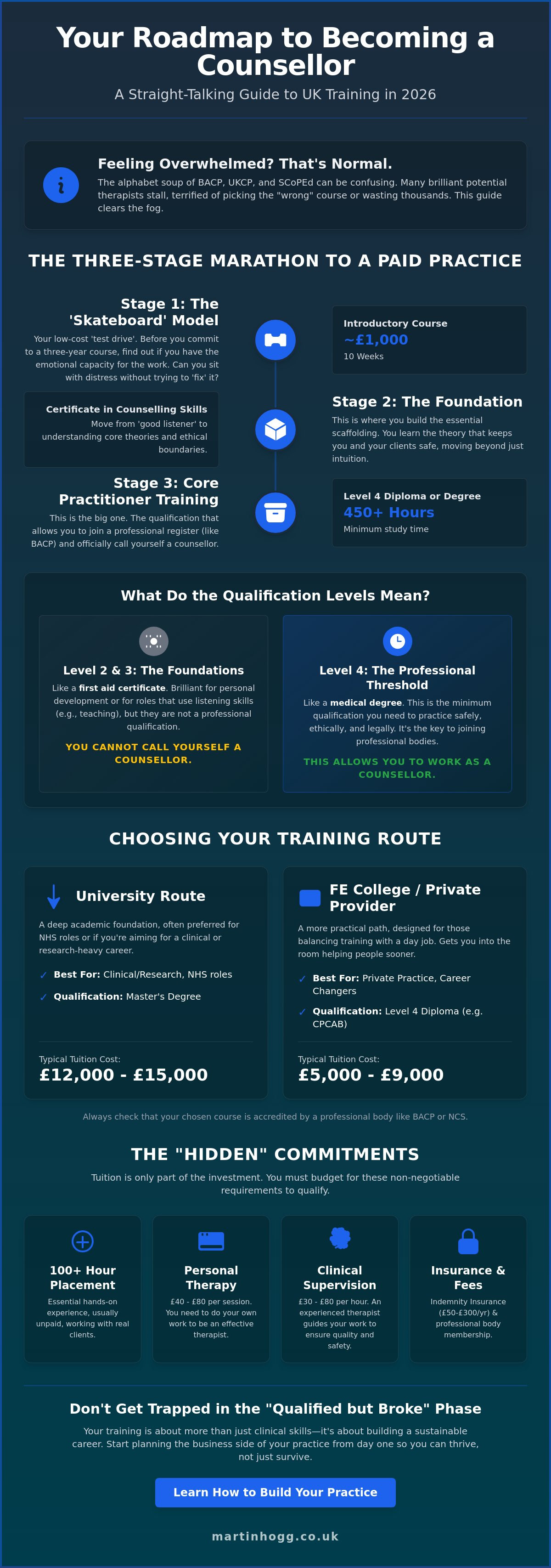
When you look at the various options to train as a counsellor in the UK in 2026, it helps to view the process as a three-stage marathon. You wouldn't try to run 26 miles without a decent pair of shoes and some practice laps, and training is no different. I always suggest the "skateboard model" for beginners. You start with a simple, low-cost introductory course to see if you actually like the work before you commit to the "Rolls Royce" of a multi-year Master's degree.
Stage 1 is that introductory course. It's usually about 10 weeks long and costs around £1,000. Stage 2 is the Certificate in Counselling Skills, where you move from being a "good listener" to understanding the core theories and the ethical boundaries that keep you and your clients safe. Stage 3 is the core practitioner training. This is typically a Level 4 Diploma or a degree that involves at least 450 hours of study. Most professional bodies for counselling in the UK require this level of training before you can even think about joining their register.
By 2026, we've seen a massive shift towards the "hybrid" student. You can't just be good in a room anymore; you need to be digitally competent. The best options to train as a counsellor in the UK in 2026 now bake online therapy skills into the curriculum from the very start, reflecting how most of us actually work in private practice today.
Level 2 vs. Level 4: What do the numbers actually mean?
The Regulated Qualifications Framework (RQF) is the system used by bodies like the CPCAB to rank courses. Level 2 and Level 3 are your foundations. They're brilliant for personal development or for people who use counselling skills in other jobs, like teachers or managers. However, you cannot call yourself a counsellor with these. Level 4 is the professional threshold. Think of it like this: Level 2 is the first aid certificate, but Level 4 is the medical degree that lets you perform the surgery. You need that Level 4 qualification to practice safely and legally.
Introductory courses: Is this career really for you?
Before you sign a contract for a three-year course, use your first 10 weeks to ask some hard questions. Can you sit with someone else’s distress without trying to "fix" it? Are you prepared to look at your own history and biases in a way that might feel uncomfortable? The primary aim of an introductory course is to discover if you have the emotional capacity for the work rather than to master the techniques. It's a "test drive" for your future career, and it's much better to find out now if it's not for you than two years down the line.
Choosing Your Training Route: University vs. College in 2026
Deciding between university and a local college is usually the biggest fork in the road for career changers. When exploring options to train as a counsellor in the UK in 2026, the "best" route depends entirely on your end goal. If you're aiming for a clinical or research-heavy career, the university route is a solid choice. A Master's degree typically costs between £12,000 and £15,000, providing a deep academic foundation that many NHS roles still prefer.
For those who want to get into the room and start helping people sooner, the Further Education (FE) college route is often more practical. These courses usually follow the CPCAB framework and are designed for people balancing training with a day job. Private providers also exist, offering intensive weekend modules, but you should check the National Careers Service guide to ensure these specific options to train as a counsellor in the UK in 2026 meet the standards of professional bodies like the BACP or NCS. Without that accreditation, you're just paying for a very expensive hobby.
The cost of qualifying: Budgeting for more than just tuition
Tuition is only the start of your investment. You'll need to factor in personal therapy, which often costs between £40 and £80 per session, and clinical supervision, ranging from £30 to £80 per hour. Don't forget professional indemnity insurance, which can set you back £50 to £300 a year. It's a significant financial commitment, but you can find "easy wins" by joining professional bodies as a student for a reduced fee. If you're worried about how to make the numbers work once you qualify, joining a supportive community for practitioners can help you plan the business side of your future practice early on.
Online vs. In-person: Can you train to be a therapist from your sofa?
The 2026 reality is blended learning. While you can do much of the theory and ethics work online, "skills practice" is non-negotiable. You need to be in a room with other humans to learn how to read body language and manage those heavy silences. Most reputable registers will only accept your training if a significant portion was delivered face-to-face. Don't be seduced by 100% online courses that promise a quick fix; they rarely lead to a professional career or a paid practice.
The "Hidden" Requirements: Placements, Supervision, and Therapy
Many people looking at options to train as a counsellor in the UK in 2026 forget that the diploma fee is only the entry price. The real work happens in the 100-hour placement. This is your first taste of the "therapy room" and it can be a shock. You will likely be working for a charity, for free, while paying for your own travel. It is a rite of passage, but it is where you learn if you have the stomach for the work. You will be dealing with real people and real pain, which is a world away from practicing with your classmates.
You also need clinical supervision. Think of this as your safety net. You never truly work alone, even later in private practice. Learning how to find a clinical supervisor who actually "gets" your way of working is a skill you should start honing while you are still a student. They are there to protect the client, but they are also there to protect your sanity.
Most reputable courses insist you have your own therapy. You need to be "on the chair" yourself before you sit in the therapist seat. It helps you understand what it feels like to be vulnerable and prevents you from bringing your own baggage into your clients' sessions. Check a counsellor job profile and you will see that emotional resilience is just as vital as any academic credit.
Securing your placement: Tips for the competitive student
Don't wait for your college to hand you a placement on a silver platter. Treat it like a job application. Use a "one-sentence offer" when contacting charities: "I am a Level 4 student looking to provide 100 hours of volunteer support for clients struggling with anxiety." A "rough and ready" volunteering role in a local community centre often beats waiting six months for a "perfect" clinical setting that never materialises.
The importance of therapist self-care from Day 1
It is easy to fall into the "saviour complex" early on. You want to help everyone, but that is the fastest route to exhaustion. Setting boundaries is a core part of the options to train as a counsellor in the UK in 2026. Reading a practical guide to therapist burnout now might seem premature, but it is the best way to ensure you are still in the profession five years from now. If you want to start building these professional habits early, joining the Private Practice Success community is a great next step.
From Student to Practitioner: Building Your Future Practice
Many students believe that once they receive their diploma, the phone will naturally start ringing with client enquiries. This is what I call the "Qualified but Broke" trap. While you are researching your options to train as a counsellor in the UK in 2026, you should also be researching your future clients. If you wait until graduation day to think about marketing, you are already six months behind. The transition from student to practitioner requires a shift in mindset from "being a student" to "running a small business."
Niche building is your secret weapon here. Trying to be a generalist who "helps anyone with anything" is the fastest way to stay invisible on platforms like the Counselling Directory or Psychology Today. People don't look for a generalist; they look for someone who understands their specific pain. While you are still in training, start drafting your Practice Visibility Blueprint. Focus on your "above the fold" content, which is what people see first on your website, and refine your one-sentence offer. For those looking to build a career that goes beyond just getting a diploma, joining the Private Practice Success Membership while you are still a student can give you a massive head start.
The 2026 Digital Toolkit for New Counsellors
You don't need to be a tech expert to get noticed. Use Canva to create simple social media posts and Squarespace to build a "skateboard model" website; a basic, functional one-page site that gets you moving. Integrate Calendly for your bookings to avoid the back-and-forth of "Are you free at 2 pm?". Remember that "people connect with people." Your future clients aren't looking for a polished corporate image; they want to see the human being behind the screen. Rough and ready content often beats a professional photoshoot because it feels real and accessible.
Your first year in private practice: What to expect
The first year is a steep learning curve. While the average self-employed therapist net income in June 2026 is around £34,988, it takes time to reach that level. You might start with just one or two clients a week as you build your reputation. This is where a one-to-one practice growth coach can help you skip the trial-and-error phase. For a deeper look at the practical steps involved, read my guide on Starting and Growing a Private Practice. Planning your business alongside your training is the best way to ensure your new career is both emotionally and financially sustainable.
Start Your Journey with a Clear Plan
Becoming a therapist is one of the most rewarding career shifts you can make, but it's a path that requires both heart and a bit of business savvy. We've looked at how the three-stage training model helps you test the waters and why choosing the right college or university route is vital for your future accreditation. You now know that the "hidden" costs of personal therapy and supervision are just as important as your tuition fees.
When you weigh up your options to train as a counsellor in the UK in 2026, remember that your diploma is the beginning, not the end. I've spent 20 years in UK private practice, and the biggest mistake I see is talented people waiting until they're qualified to think about how they'll actually find clients. You don't have to do this alone or figure it out by trial and error.
I've built the Practice Visibility Blueprint and BACP-endorsed workshops to help you bridge the gap between being a student and becoming a successful practitioner. If you want to start building a sustainable career from day one, join the Private Practice Success community to plan your career beyond the diploma. It's a big commitment, but with the right plan, it's entirely achievable. You've got this.
Frequently Asked Questions
How long does it take to train as a counsellor in the UK?
It usually takes between three and five years to become fully qualified. You'll typically start with a 10-week introductory course, followed by a year-long certificate, and finally a two-year Level 4 diploma. Some people choose the university route, which takes three years for a full-time degree. It's a marathon, not a sprint, and your own life experience often makes the training feel faster than it actually is.
Can I train to be a counsellor online?
You cannot qualify purely through online study if you want to join a professional register. While many options to train as a counsellor in the UK in 2026 offer "blended" learning for theory and ethics, the BACP and other bodies require face-to-face skills practice. You need to be in a room with other humans to learn how to read the subtle shifts in body language that a screen often misses. Don't be seduced by "sofa-only" courses that don't lead to a real career.
How much does it cost to become a qualified counsellor?
Expect to invest at least £10,000 overall, though the price varies depending on your chosen path. Certificate courses are around £1,000, while diploma courses range from £2,200 to £6,000 per year. You must also budget for "hidden" costs like your own personal therapy at £40 to £80 per session and clinical supervision. It's a significant financial commitment, so make sure you're picking a route that actually prepares you for the business of being a therapist.
Do I need a degree to be a counsellor in the UK?
No, you don't need a university degree to practice. A Level 4 Diploma is the professional minimum and is highly respected by employers and professional bodies alike. Many of the most successful therapists I know trained at local FE colleges while working other jobs. It's your emotional maturity and your ability to connect with people that matter more than having a gown and a mortarboard.
What is the difference between a counsellor and a psychotherapist?
The main difference lies in the length of training and the depth of the work. Psychotherapists usually train for four years or more and often work with more complex, long-term trauma. However, with the full implementation of the SCoPEd framework in 2026, these roles are now more clearly standardised based on specific competencies. When looking at options to train as a counsellor in the UK in 2026, a diploma is the most common entry point for those wanting to start a private practice.
Disclaimer
The information provided on this blog is for general informational purposes only and is not intended to be a substitute for professional medical or mental health advice, diagnosis, or treatment. Reading this content does not create a therapist-client relationship.


