
Counsellors in the UK: A Guide to Building a Meaningful and Sustainable Practice
The hardest part of being a therapist isn't the clinical work; it's the quiet moments when the phone doesn't ring. Many counsellors across the UK find themselves in this exact position, where years of training haven't yet translated into a steady diary. It's a frustrating gap. You've done the hard work of learning your craft, yet the business side of things feels like a foreign language that risks sounding "salesy" or unethical.
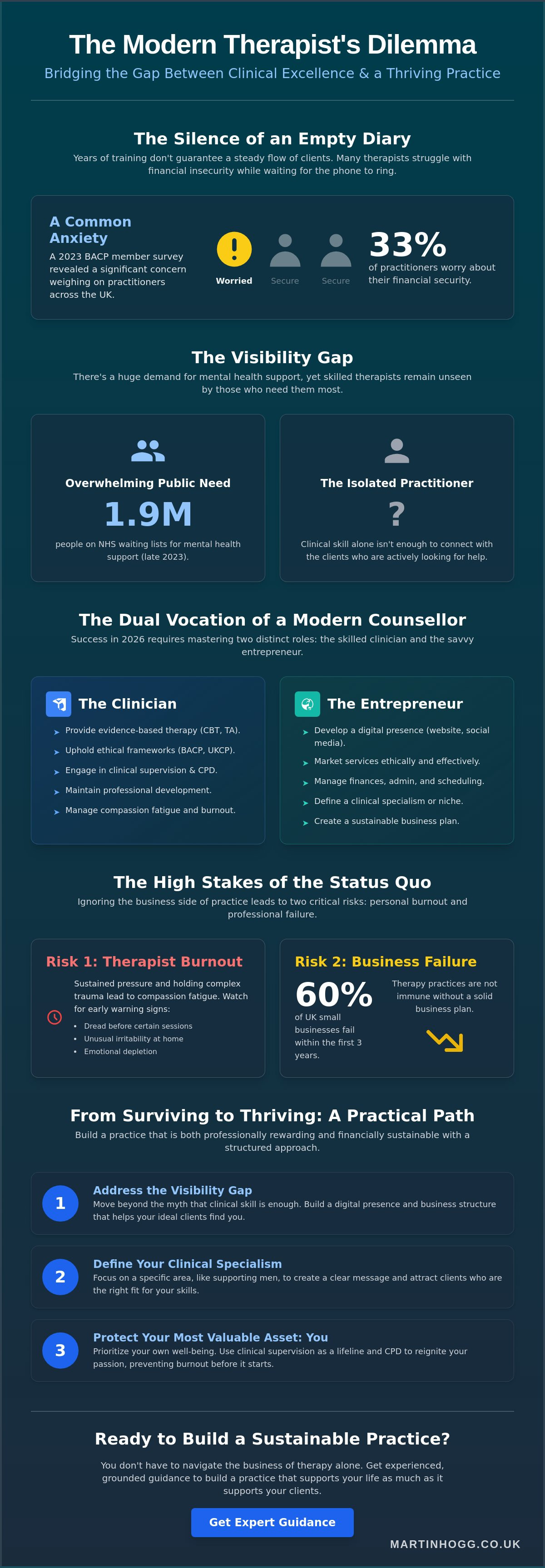
I understand that feeling of isolation that often comes with private practice. A 2023 BACP member survey found that 33% of practitioners worry about their financial security, which is a heavy burden to carry while holding space for others. You likely started this journey to make a real difference, not to spend your evenings wrestling with website technicalities or worrying about where the next referral is coming from. It's okay to admit that the business side is tough.
I want to show you that building a sustainable practice doesn't mean losing your professional soul. This guide offers a practical look at how you can bridge the gap between your skills and the clients who need them most. We'll explore how to define your clinical specialism, perhaps in areas like supporting men, and how to create a professional life that feels both meaningful and financially stable.
Key Takeaways
- Understand why your role involves more than just the therapy room and how to balance clinical excellence with the practicalities of a modern vocation.
- Learn to identify the early warning signs of burnout and compassion fatigue to ensure your career as one of the UK’s counsellors remains rewarding.
- Address the "visibility gap" by moving beyond the myth that clinical skill alone is enough to help your ideal clients find you.
- Discover how to build a digital presence and a business structure that works for you, giving you back your time and energy.
- Shift your focus from simply surviving each week to thriving in your profession with the help of experienced, grounded guidance.
What is a Modern Counsellor? Defining the Dual Vocation in 2026
Being a counsellor in 2026 is about more than just the fifty-minute hour. You're a vital part of a changing social fabric. The profession has moved away from clinical silos and into the heart of our communities. We've seen a shift in how Counselling in the United Kingdom is perceived; it's now a proactive tool for living well rather than a last resort. Modern Counsellors balance three distinct roles: the skilled practitioner, the community advocate, and the small business owner. It's a lot to carry. You're likely feeling the pressure of a system under immense strain. With nearly 1.9 million people on NHS waiting lists for mental health support in late 2023, the need for accessible care is urgent. You aren't just an observer of these struggles; you're a guide helping people get their lives back on track. This dual vocation requires us to be as proficient with a spreadsheet or a community workshop as we are with transactional analysis or CBT.
The Core Values of a Successful Practitioner
Professionalism is grounded in empathy, but it stays safe because of ethical frameworks. Whether you're following BACP or UKCP standards, these aren't just boxes to tick. They're the foundation of trust between you and the person sitting across from you. I've always believed that balancing your clinical intuition with structured professional development is what separates a good therapist from a great one. You need a practical, no-nonsense approach to your own growth to provide the best results. This means staying updated on evidence-based modalities while never losing the human connection that makes therapy work.
The Shift from Employment to Private Practice
This is why so many Counsellors are choosing the independence of private work. They want to escape the constraints of agency contracts and create something truly sustainable. The reality of the "solo-preneur" therapist is a mix of freedom and responsibility. While you gain autonomy, you also inherit the challenges of marketing and administration. Statistics show that roughly 60% of small businesses in the UK fail within their first three years, and therapy practices are not immune to these pressures without a solid plan. It's about moving from a job to a vocation that supports your life as much as it supports your clients. If you're thinking about how to structure your own path and want to discuss the practical steps, you can check my calendar for a chat.
In this evolving landscape, we must remember that mental health support should be a standard, accessible part of being a healthy member of society. This "citizen coaching" philosophy helps demystify what we do, making it easier for people, especially men who often face unique stigmas, to reach out and start their journey toward recovery.
The Human Side of the Profession: Burnout and Clinical Growth
I’ve sat in the chair for many years, and I know that being a counsellor is more than just a job; it’s a deep emotional investment that can sometimes leave us feeling depleted. We often talk about our clients' well-being, but we rarely give the same weight to our own health. It is a demanding path, and if we don't acknowledge the emotional cost, we risk losing the very empathy that makes us effective. Burnout is a systemic issue born from the sustained pressure of holding complex trauma, not a personal failing or a lack of professional competence. If you've started to feel a sense of dread before certain sessions or find yourself becoming unusually irritable at home, you might be seeing the first signs of compassion fatigue.
This is why clinical supervision is a lifeline. It isn't just a box-ticking exercise to satisfy the British Association for Counselling and Psychotherapy (BACP); it is your primary tool for staying safe and grounded. A good supervisor helps you process the "secondary trauma" that naturally accumulates over months of practice. Alongside supervision, continuing professional development (CPD) acts as a vital spark. When we learn new ways to help people, it reignites that original passion that brought us into this profession. It moves us from a place of survival back into a place of growth.
Addressing Therapist Burnout Head-On
Recovery starts with acknowledging that your capacity is finite. I’ve found that setting firm clinical boundaries, such as refusing to check emails after 6 pm or strictly limiting the number of high-intensity cases you take on, makes a massive difference to your longevity. If you feel like you are already hitting a wall, you can explore this Therapist Burnout Recovery Guide for practical steps to regain your balance. Taking a break isn't a luxury. It is a professional necessity to ensure you can continue serving your community for years to come.
Specialising to Serve: The "Working with Men" Framework
Many counsellors in the UK find it difficult to attract or retain male clients. This often happens because traditional, abstract talk therapy can feel intimidating or indirect to men who prefer a more goal-oriented approach. By specialising through focused CPD, you can transform your clinical confidence and carve out a distinct niche in the market. Men often respond better to direct, pragmatic communication that focuses on "getting life back on track" rather than just exploring feelings in isolation. When you speak their language, you'll find that counsellors who offer this level of clarity are in high demand across the West Midlands and beyond.
If you are looking to refine your practice or need a fresh perspective on your clinical goals, you’re welcome to book a brief chat on my calendar to see how we can work together.
The Visibility Gap: Why Clinical Skill Isn’t Always Enough
There's a common belief among many Counsellors that if you're excellent at what you do, the phone will just ring. We like to think that word-of-mouth is the only pure form of marketing. While referrals are the lifeblood of a mature practice, relying on them alone when you're starting out or trying to grow is a mistake. A 2022 industry survey found that 60% of private practitioners felt their initial training didn't adequately prepare them for the business side of running a practice. This lack of preparation often leads to a visibility gap.
The visibility gap happens when your skills are ready and your room is set up, but the person who needs you has no idea you exist. I often see talented practitioners hiding their light because they worry that "putting themselves out there" feels like bragging. It isn't. If you have a solution for someone's distress, keeping it a secret is a barrier to their recovery. You aren't selling a product; you're offering a bridge to a more functional and fulfilling future.
Reframing marketing as an ethical act changes everything. When someone reads the NHS guide to counselling, they're taking a brave first step toward getting their life back on track. If they can't find your profile, they might miss out on the specific expertise you offer, such as trauma work or addiction support. Imposter syndrome often whispers that you aren't "expert" enough to share your thoughts online. I've found that the most helpful voices aren't the ones with the most degrees, but the ones who speak with the most clarity and empathy.
Clinical Excellence vs. Practice Visibility
| Clinical Excellence | Practice Visibility |
|---|---|
| Ensures client safety and positive outcomes. | Creates the initial connection with a client. |
| Drives long-term retention and referrals. | Fills the initial gaps in your diary. |
| Built through CPD and supervision. | Built through authentic, human communication. |
Over-investing in clinical skills without visibility leads to a "starving artist" syndrome. You have the tools to help, but nobody to use them on. Conversely, high visibility with poor skills leads to a revolving door where clients leave as quickly as they arrive. You need both to build a sustainable practice.
Marketing Without Losing Your Soul
Authenticity is your greatest asset. You don't need to use "salesy" tactics or pushy language. You just need to talk about your work in a way that feels like a conversation over a cup of tea. When you speak directly to the struggles your clients face, they feel seen and heard before they even book a session. If you're feeling overwhelmed by the technical side of this, my guide on Marketing for Therapists in the UK provides a practical roadmap. You can also book a time on my calendar if you'd like to discuss how to make your practice more visible without losing your professional integrity.
Practical Steps to Growing a Sustainable Private Practice
Building a practice shouldn't feel like a second full-time job that leaves you drained. It's about creating a structure that supports your life, rather than one that consumes it. Many UK therapists find themselves caught in a cycle where they have too many clients one month and very few the next. Data from industry surveys suggests that client enquiries often drop by roughly 20 percent during the school summer holidays and the December festive period. Preparing for these natural ebbs and flows is essential for your financial and emotional peace of mind.
The modern UK therapy landscape requires a blend of clinical skill and a clear digital presence. You don't need to be a marketing expert, but you do need to be visible. When you're findable and clear about what you offer, the "feast and famine" cycle becomes much easier to manage. It's about building a bridge between your expertise and the people who are currently searching for help.
Foundations of a Visible Practice
Step 1: Clarifying your "Who and How." If you try to speak to everyone, you often end up speaking to no one. Be specific about who you help and the results they can expect. Whether you're supporting men with work-related stress or helping young people with social anxiety, clarity builds confidence in the person reading your profile.
Step 2: Optimising your online presence. Use the terms your clients are actually typing into Google. If someone is looking for "Counsellors in Birmingham" or "Counsellors for grief," you want your name to be part of that conversation. You can find a deeper breakdown of these strategies in this guide on How to Get Counselling Clients UK.
Step 3: Creating helpful content. Trust is the currency of therapy. By writing short, helpful articles or sharing practical tips on social media, you allow potential clients to get a feel for your approach before they even book a first session. It lowers the barrier to entry for those who might be feeling hesitant.
The Power of Professional Community
Working alone is perhaps the biggest threat to a private practitioner. It leads to isolation, which can quickly turn into burnout. I've seen many talented professionals struggle because they didn't have a "tribe" to lean on. Networking with other Counsellors isn't just about getting referrals; it's about having a group of people who understand the unique weight of the work we do.
Finding a community of like-minded professionals provides a safety net. When your practice is full, you can refer onwards to people you trust, and they will do the same for you. Joining a membership designed specifically for the UK market ensures you stay updated on local regulations and ethical standards while receiving the peer support you need to thrive.
If you're ready to move away from the stress of an unpredictable schedule and want to build a more stable practice, I'm here to help. You can book a time to chat about your professional goals on my practice development calendar.
Navigating Your Career Path with Expert Guidance
Building a practice isn't just about landing your first few clients. It's about staying the course without losing your passion or your health. Many counsellors start with a deep desire to help others, yet they often find themselves stuck in a cycle of survival mode. This is usually characterized by inconsistent income and the constant, quiet anxiety of where the next referral will come from. Moving toward a thriving practice requires a shift in mindset. You have to treat your career as a sustainable professional journey rather than a series of lucky breaks.
Having a mentor who understands the specific nuances of the UK market is invaluable. We operate in a unique environment with distinct ethical standards and public perceptions of mental health. The Practice Visibility Blueprint was designed to remove the exhausting guesswork from this process. Instead of wondering if your marketing is too much or if your fees are too high, you follow a proven structure. This respects your clinical integrity while ensuring you remain visible to those who need you most. It's about getting your life and your practice back on track with a clear, pragmatic plan.
Investing in Your Professional Future
Every practitioner needs a growth plan that balances clinical excellence with business sustainability. If you focus only on your CPD hours and ignore the health of your business, you won't be in a position to help anyone for very long. Bespoke coaching provides a mirror to your practice, helping you identify where you're playing small or where your systems are failing you. It’s about creating longevity. You can find practical tools and structured learning opportunities by checking the Martin Hogg Training Calendar for our latest workshops and sessions.
Joining the Private Practice Success Community
Isolation is one of the biggest hurdles for counsellors in private practice. When you're working alone, self-doubt can easily take root. Professional support and community connection are the best antidotes to that feeling of being overwhelmed. By joining a network of like-minded peers, you move from being a solo practitioner to part of a scaled, impactful movement. This transition isn't just about increasing your income; it's about increasing your capacity to do good work. It reduces the pressure and provides a safety net of shared experience.
The journey from training to a successful, sustainable practice is rarely a straight line. You'll face challenges that weren't covered in your diploma, from tax returns to digital marketing. I want you to remember that you don't have to carry the weight of your practice entirely on your own shoulders. There is a path forward, and it's much easier to walk when you have a guide who has been there before. Take that next step with confidence, knowing that the right support can turn your professional goals into a reality.
Taking the Next Step Toward a Sustainable Practice
Building a practice that lasts requires more than just clinical excellence. It's about finding a steady balance between your therapeutic heart and the practical realities of running a business in the UK. We've explored how modern Counsellors can bridge the visibility gap, manage the very real risk of burnout, and create a career path that feels both meaningful and manageable. You don't have to choose between being a great therapist and having a full diary.
I've spent over 20 years helping practitioners move past the overwhelm of private practice. Through BACP-endorsed workshops and my Proven Practice Visibility Blueprint, I provide the clear, grounded steps you need to get your professional life on track. You can grow your reach without losing your sense of self or your passion for the work. If you're ready to move from feeling invisible to feeling impactful, I'm here to guide you through it.
Join the Private Practice Success Membership and grow your practice with confidence
Your skills are needed now more than ever. With the right support, you can build a practice that serves your community and sustains you for years to come.
Frequently Asked Questions
Do I need to be a member of the BACP to work as a counsellor in the UK?
You don't legally need to be a BACP member to practice in the UK, as counselling isn't a state-regulated profession like nursing. However, 85 percent of private practitioners join a body like the BACP or NCPS to demonstrate their commitment to ethical standards. Most insurance providers and client directories require this membership before they'll work with you. It gives your clients peace of mind that you're part of a professional community.
How much do private practice counsellors typically charge per session?
Private practice fees usually range between £45 and £80 per session across the UK. In 2024, data from industry surveys shows that therapists in London often charge upwards of £90, while those in the West Midlands might set rates closer to £50. It's important to set a fee that covers your overheads and supervision costs while remaining accessible to your local community. Your rate should reflect your experience level.
What is the difference between a counsellor and a psychotherapist in the UK?
The main difference lies in the depth and length of training. Psychotherapists typically complete a four year postgraduate programme, while counsellors often qualify through a three year diploma. In practice, counsellors often work with immediate life challenges or specific symptoms. Psychotherapists might look at deeper, long term personality structures. Both roles are vital, and many professionals find their daily work overlaps significantly as they support people through change.
How can I get more clients for my private therapy practice without sounding salesy?
The best way to attract clients is to show up as a helpful human being rather than a salesperson. Focus on sharing practical insights through a blog or local networking that solve a specific problem. If you talk about how you help people get their lives back on track, you'll find that counsellors who lead with empathy naturally build more trust. It's about being visible in your community and showing you understand the struggle.
Is it possible to run a full-time counselling practice without burning out?
Yes, it's possible to sustain a full time practice if you set firm boundaries. Most experienced therapists limit their clinical hours to 20 or 25 sessions per week to prevent emotional exhaustion. I recommend scheduling regular breaks and sticking to your own supervision sessions. Remember, you can't pour from an empty cup. Taking care of your own mental health is a professional requirement, not a luxury for a busy practitioner.
What insurance do I need as a self-employed counsellor?
You must have Professional Indemnity insurance and Public Liability insurance to practice safely. Professional Indemnity covers you if a client claims your advice caused them harm, while Public Liability is essential if you see people in a physical office. Most basic policies for counsellors start at around £60 per year. It's a small price for the security of knowing you're protected against legal costs or compensation claims.
How do I choose the right CPD courses to grow my practice?
Choose CPD that addresses the specific hurdles your clients are facing right now. The BACP requires you to complete 30 hours of training every year to maintain your registration. Instead of just picking what's easy, look for evidence based tools like CBT or EMDR that provide tangible results. Ask yourself what skills would make you feel more confident in the room. Practical, results focused learning always beats abstract theory when growing a practice.
Can I offer online counselling to clients outside of the UK?
You can offer online sessions to international clients, but you must check your insurance policy first. Many UK policies exclude practitioners from working with clients in the USA or Canada due to different legal systems and licensing laws there. Always verify the regulations in the client's specific country before starting. It's often simpler to focus on UK based clients where you're fully protected and understand the local support networks available to them.

Article by
Martin Hogg
I help Private Practice counsellors in the UK set up and grow an ethical Private Practice they love, work with their ideal clients, and earn the income they deserve. All without guesswork and burnout. I have been a private practice counsellor myself for over 20 years, specialising in anger management. I set up a not-for-profit social enterprise, Citizen Coaching and Counselling, which delivers thousands of counselling sessions a year to adults and young people in Birmingham. I am a registered BACP Counsellor and the author of three books, My Anger Coach, My Anxiety Coach and My Relationship Coach. These are available on Amazon.
Disclaimer
The information provided on this blog is for general informational purposes only and is not intended to be a substitute for professional medical or mental health advice, diagnosis, or treatment. Reading this content does not create a therapist-client relationship.


