
CPD Courses for UK Counsellors: How to Choose Well in 2026

Article by
Martin Hogg
I help Private Practice counsellors in the UK set up and grow an ethical Private Practice they love, work with their ideal clients, and earn the income they deserve. All without guesswork and burnout. I have been a private practice counsellor myself for over 20 years, specialising in anger management. I set up a not-for-profit social enterprise, Citizen Coaching and Counselling, which delivers thousands of counselling sessions a year to adults and young people in Birmingham. I am a registered BACP Counsellor and the author of three books, My Anger Coach, My Anxiety Coach and My Relationship Coach. These are available on Amazon.
What if the most useful CPD course is not the one with the grandest certificate, but the one that helps you think differently about your next client session? Choosing cpd courses for counsellors uk can feel tricky when you’re balancing client work, limited time and course claims that don’t always make their value clear.
It makes sense to want learning that counts professionally, but the certificate alone won’t tell you whether a course is right for you. Start with the work in front of you: what questions are arising with clients, where would you value more confidence, and what do you want your practice to develop towards? A focused course, such as Anger Management CPD for Professionals or Working with Men CPD, may suit a particular learning need. Check the course details and what any accreditation or endorsement applies to before booking.
This guide explains how to weigh up relevance, practical learning, course claims and the time involved. It also covers how to reflect on useful ideas and decide what, if anything, to apply in your practice.
Key Takeaways
- Choose cpd courses for counsellors uk by starting with a learning need from your current client work or future goals.
- Before booking, check the learning outcomes, facilitator’s background and teaching approach, then verify any accreditation or endorsement claims.
- Compare online and in-person options by access, interaction and time for reflection. The format alone won’t tell you whether a course is useful.
- After learning, reflect on what you may apply thoughtfully. Anger Management CPD for Professionals and Working with Men CPD are examples focused on particular areas of work.
CPD courses for counsellors: what makes professional development useful?
Choosing from a long list of courses can feel like one more job squeezed into an already full week. Begin with what could make a difference in your work, rather than what looks impressive on a certificate. CPD, or continuing professional development, is planned learning that supports your professional development. It could be clinical learning related to issues clients bring, reflective work that helps you examine your responses, or practice-related learning that supports how you work. You can read a broad overview of what professional development is, but your own learning priorities are the most useful starting point.
Purposeful CPD starts with a learning goal. Collecting certificates without one can leave you with little to use in the room. Try this practical test: write down what you hope to understand or do differently, then check whether the course description says how it will help you work towards that goal.
How do I decide what I need to learn next?
Look for patterns in your current client work. What questions keep coming up in sessions? Is there a situation where you’d value more confidence, or a theme you want to understand better? You don’t need a grand plan. Before searching for cpd courses for counsellors uk, write down one specific learning question, such as, “How can I better understand men’s experiences of seeking support?” Use that question to compare course aims, rather than choosing on the title alone.
CPD requirements depend on your professional body
Don’t assume one organisation’s guidance applies to every counsellor. Check the current CPD guidance from the professional body you belong to, or the organisation that holds your registration. Look for its guidance on suitable learning and any record-keeping expectations. If a course provider says its training is accredited or endorsed, check exactly what that means with the provider and relevant body. A clear claim should identify what the status applies to and who recognises it.
How to assess CPD courses for counsellors before booking
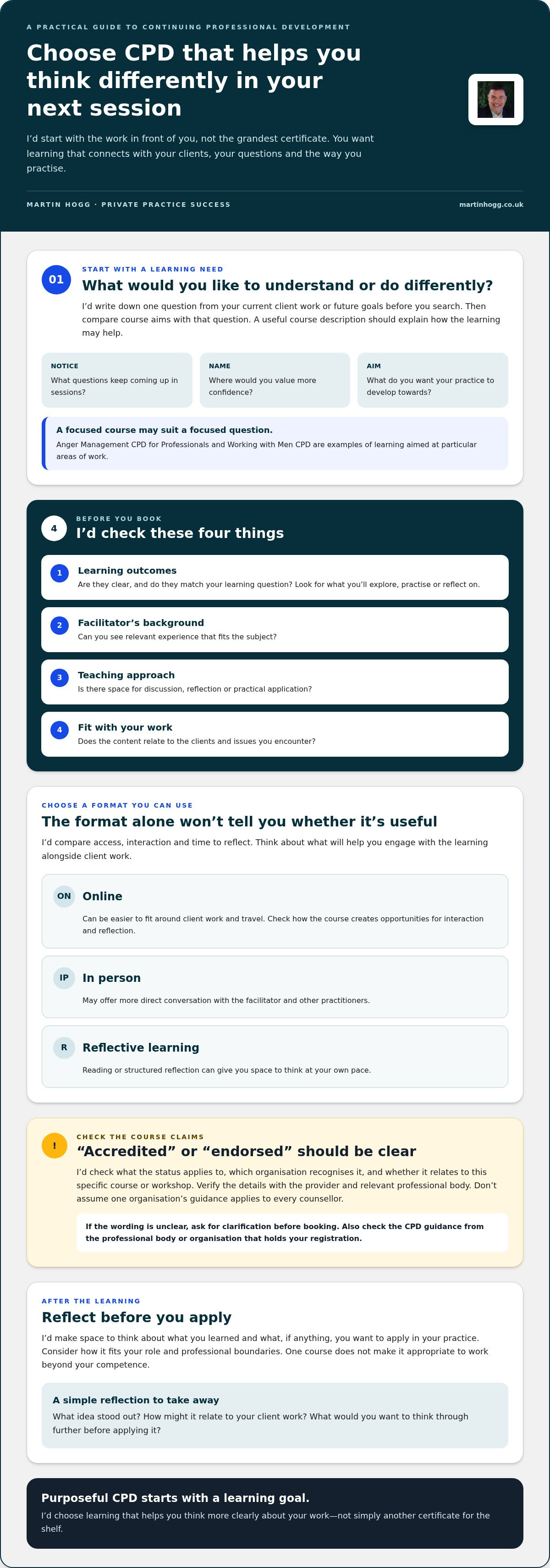
A course can sound appealing and still leave you unsure what you’ll take back into your work. Before booking, check four things: the stated learning outcomes, the facilitator’s relevant background, how the learning is taught, and how it connects with your client work. Look for more than a broad promise to “develop your skills”. Check what you’ll explore, practise or reflect on, and whether that matches the learning question you started with.
- Learning outcomes: Are they clear and relevant to your learning question?
- Facilitator background: Can you see experience that fits the subject?
- Teaching approach: Is there space for discussion, reflection or practical application?
- Fit with your work: Does the content relate to the clients and issues you encounter?
Think about professional boundaries, too. A useful course should help you consider how learning applies to your role, rather than imply that one training makes you qualified to work beyond your competence. If you’re comparing online options, the NCPS guidance on CPD can help you think about CPD and delivery. Still assess each course’s content, teaching approach and claims for yourself.
What should I check about accreditation and course quality?
Ask what “accredited” or “endorsed” means, which specific course or workshop the claim applies to, and which organisation recognises it. Check the details directly with the provider and relevant professional organisation. Don’t assume a provider’s general statement applies to every course it runs. If the wording is unclear, ask for clarification before you book.
Does this CPD fit the people I work with?
Compare the course aims with the client groups and issues you currently encounter. For example, if you want to better understand men’s experiences of seeking support, look for content that addresses that question in meaningful depth. Focused learning may also help you clarify your interests as you develop your practice. If your next step is practice growth rather than clinical learning, you can explore the Private Practice Success Membership as a separate source of ongoing support.
Online, in-person or reflective CPD: choose a format you can use
Online CPD can be easier to fit around client work and travel, while in-person learning may offer more direct conversation with the facilitator and other practitioners. Reflective activities, such as reading or structured reflection, can give you space to think at your own pace. Each format has trade-offs. Check whether the delivery suits what the course asks you to learn and practise, and whether you’ll have opportunities to ask questions or reflect.
Let your learning needs guide the format, not convenience alone. A convenient course still needs to give you room to engage with the material. A face-to-face day isn’t automatically more useful than a well-designed online session, either.
As you compare cpd courses for counsellors uk, look at what participants will actually do: listen, discuss, practise, reflect, or combine these activities. Consider the time you can realistically set aside around your professional responsibilities. There’s no benefit in booking more CPD than you can properly take in.
How can I make CPD manageable alongside client work?
Before you book, consider how the course fits around your sessions and other work. If you can, leave some breathing room afterwards rather than going straight from training into a packed day. Soon after the course, note the key takeaways while they’re still clear. Keep the notes focused on what you learned, what you want to consider further and any questions you still have.
How do I translate learning into practice?
Give yourself time to consider what feels relevant to your work, what needs more thought and what shouldn’t be rushed into a session. Choose one appropriate application to explore, keeping the client’s needs and your professional boundaries in view. If you’re unsure how to apply an idea, take it to appropriate professional consultation or supervision. CPD should inform careful practice, not replace ongoing reflection.
Choose CPD that supports your counselling work and next steps
Keep the decision simple: identify a learning need, check the course claims, choose a format that suits the learning, then make time to reflect afterwards. This gives you a consistent way to compare cpd courses for counsellors uk without being swayed by a certificate or compelling course title alone.
When might topic-specific CPD be a useful fit?
If a particular issue or client group is coming up in your work, focused learning may be more useful than a broad overview. Martin Hogg offers Anger Management CPD for Professionals and the Working with Men CPD Course as examples of topic-specific learning. Compare each course’s current aims with your learning question, then check its accreditation details directly before deciding. BACP professional development workshops are also offered, but that doesn’t mean every course or workshop is BACP-endorsed.
After completing a course, consider what you’ve learned, what you may apply thoughtfully and what needs more reflection. The aim isn’t to change your practice overnight. It’s to make a considered next step that fits your clients, your professional boundaries and your development goals.
Where can I find ongoing support for practice growth?
Clinical CPD and practice-growth support serve different purposes. A course may develop your understanding of an area of counselling work. Business support may help you think about the visibility and direction of your private practice. One doesn’t replace the other, so be clear about which kind of support you’re looking for.
If you’re looking for ongoing support with practice growth, explore the Private Practice Success Membership and consider whether it fits the next step you have in mind.
Make your next CPD choice a purposeful one
The best cpd courses for counsellors uk are those that connect with a real learning need, suit the way you learn and leave you with something to reflect on afterwards. Before booking, check the course aims and facilitator background, and verify any accreditation or endorsement claim with the provider and relevant professional body.
If a specific area of your client work is prompting questions, Martin Hogg offers Anger Management CPD for Professionals and the Working with Men CPD Course. BACP professional development workshops are also available. Check the current details of each course or workshop, and choose what fits your goals.
Clinical learning and practice-growth support do different jobs. If you’re looking for ongoing help with the business side of your practice, find out more about the Private Practice Success Membership.
You don’t need to plan every step of your development today. Start with one useful question, then choose your next step with care.
Frequently Asked Questions
What CPD courses are useful for counsellors?
Useful CPD depends on your learning needs and the people you work with. For cpd courses for counsellors uk, start with a question arising from your practice, then compare each course’s aims, facilitator information and teaching approach. You might need clinical learning, reflective development or practice-related skills. Check any accreditation or endorsement claim with the provider and relevant professional body, rather than assuming a course title tells you everything.
Do counsellors in the UK have to complete CPD?
CPD expectations depend on the professional body, membership category or registration route relevant to you. Don’t assume one figure applies to every counsellor. Check current guidance directly with your own organisation, including what activities it recognises and what records it expects you to keep. Choose learning that supports any applicable requirements as well as your own development. Another practitioner’s experience may not match your circumstances.
How do I know if a counselling CPD course is accredited?
Ask the provider what accreditation or endorsement applies, which particular course it covers and what evidence is available. Then verify the claim with the named professional organisation where appropriate. Be precise: accreditation of one course doesn’t automatically mean that provider’s other courses are accredited, and an endorsement may not cover every workshop. If the course information is vague, ask for clarification before booking rather than relying on the wording alone.
Is online CPD suitable for counsellors?
Online CPD can suit some learning aims and make it easier to fit study around your work. In-person learning may offer a different kind of interaction. Compare the course outcomes, teaching approach, chances to ask questions and time for reflection. The format alone doesn’t tell you whether a course is suitable. Choose the option that supports what you need to learn and gives you a realistic chance to engage.
How can I apply CPD learning to my counselling practice?
After the course, write down the main ideas and consider which ones are relevant to your current work. Give yourself time to reflect before changing your approach, particularly if the learning raises questions about your competence or professional responsibilities. You could discuss your thinking in appropriate supervision or consultation. Record what you’ve learned, what you may apply and any questions to explore further. Small, considered steps are often more useful than rushing to change your practice.
Disclaimer
The information provided on this blog is for general informational purposes only. It is also not intended to be a substitute for professional medical or mental health advice, diagnosis, or treatment. Reading this content does not create a therapist-client relationship.


