
CPD for Counsellors UK: A Practical Guide to Professional and Practice Growth
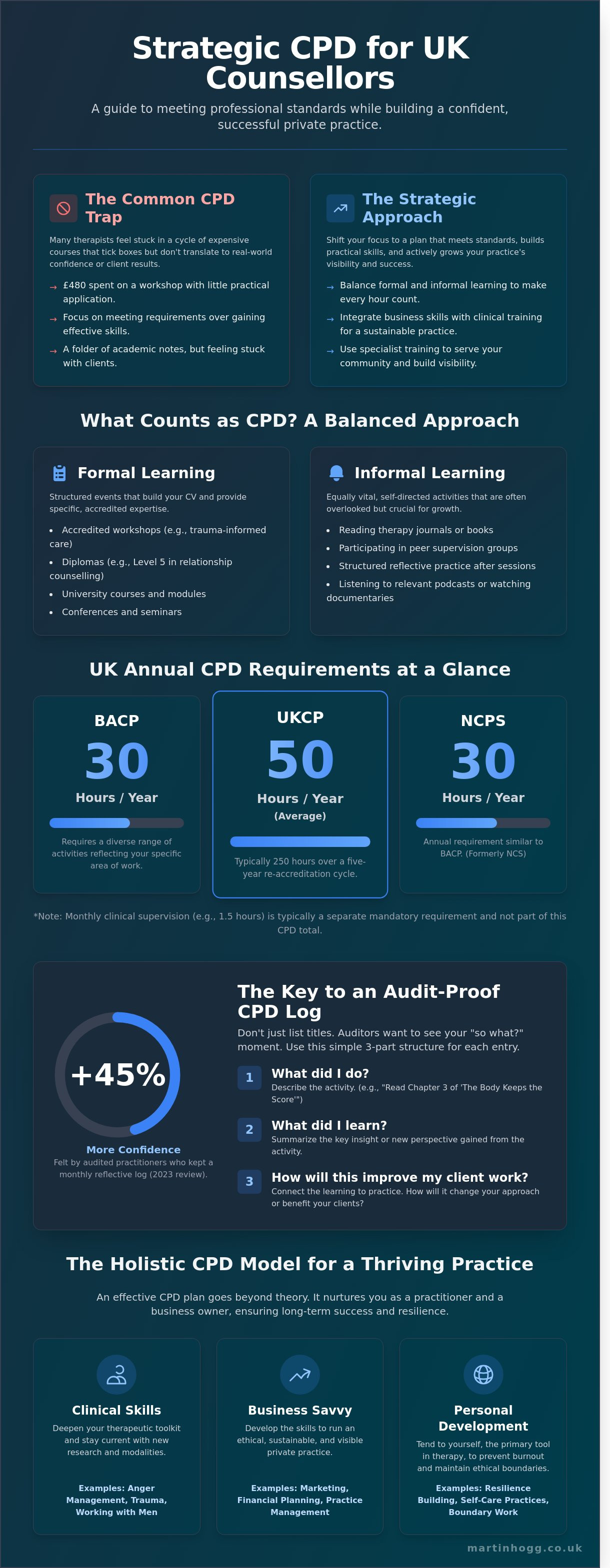
Last month, I spoke with a therapist in Birmingham who had just spent £480 on a three-day advanced theory workshop. She gained 21 hours of cpd for counsellors uk for her annual log, but she still felt completely stuck when a client struggled to open up about his trauma the following Monday. It's a common story. Many of us feel overwhelmed by the sheer volume of expensive courses, worrying more about meeting BACP or UKCP requirements than whether the training actually works in the real world. We often end up with a folder full of academic notes that don't help us solve the practical issues our clients face every day.
I believe your professional development should do more than just tick a box. In this guide, I'll show you how to plan your training so it meets every professional standard while helping you build a more successful, confident private practice. We'll look at the current 2024 requirements, how to gain specific skills for working with client groups like men, and a simple strategy to use your learning as a tool for business growth. It's time to stop just collecting hours and start gaining the tools that help your clients get their lives back on track.
Key Takeaways
- Learn how to balance formal courses with the informal learning you are already doing, ensuring every hour counts toward your professional growth.
- Get a clear breakdown of BACP, UKCP, and NCS standards, including why a reflective log is the real key to meeting your annual requirements.
- Discover why your cpd for counsellors uk should include business skills alongside clinical work to help you run a practice that is both ethical and sustainable.
- Use a simple self-audit to identify gaps in your knowledge and set three practical goals that actually move your practice forward this year.
- See how choosing specialist training, such as working with men or anger management, can help you build visibility and better serve your community.
What Counts as CPD? Understanding Professional Development for UK Counsellors
Continuing Professional Development (CPD) is the process of keeping your skills sharp and your practice safe. In the UK, professional bodies such as the BACP or the National Counselling and Psychotherapy Society (NCPS) expect us to engage in regular learning. It's more than just a box-ticking exercise for your annual renewal. It's a commitment to your clients and yourself that you won't stop growing. If we stop learning, our work becomes stagnant; that is often when mistakes happen or when we start to feel the weight of the room a little too heavily.
Effective cpd for counsellors uk should be a mix of gaining new clinical tools and tending to your own professional wellbeing. A proactive approach to learning acts as a shield against burnout. When you invest time in understanding new research or refining your technique, you bring fresh energy to your sessions. This prevents the "clinical drift" that occurs when a therapist relies on the same three interventions for every single client regardless of their specific needs.
Formal vs. Informal Learning
You don't always need a framed certificate to prove you're developing. Formal learning usually involves structured events like an accredited workshop on trauma-informed care or a Level 5 diploma in relationship counselling. These are excellent for building your CV and gaining specific expertise. Informal learning is equally vital but often overlooked. This includes activities like:
- Reading relevant therapy journals or books for 60 minutes a week.
- Participating in peer supervision groups to discuss complex cases.
- Engaging in structured reflective practice after a challenging session.
To ensure your informal learning stands up to an audit, you must document it clearly. Don't just list the book title. Write a short paragraph on how that reading changed your perspective or influenced a specific client interaction. A 2023 review of audited practitioners showed that those who kept a monthly reflective log felt 45% more confident during the re-accreditation process.
The Human Side of Development
We are the primary tool in the therapy room. If that tool is rusty, blunt, or exhausted, the work suffers. Personal development isn't a luxury; it's a core requirement for ethical practice. Staying curious about your own internal world prevents you from projecting your struggles onto the person sitting opposite you. I've seen many talented therapists hit a wall because they focused entirely on theory while ignoring their own emotional health. Use your cpd for counsellors uk hours to explore your own boundaries and resilience. It's the most practical way to ensure you can continue helping people for the next decade without losing your own sense of self.
Navigating the Requirements: BACP, UKCP, and NCS Standards
When you first look at the membership handbooks, the numbers can feel a bit daunting. But staying on top of cpd for counsellors uk isn't about jumping through hoops for the sake of it. It's about making sure we're safe and effective for the people who trust us with their stories. I've found that when we approach these requirements as a way to stay fresh rather than a chore, the anxiety around them starts to lift.
Annual Hour Requirements at a Glance
The British Association for Counselling and Psychotherapy (BACP) requires 30 hours of CPD each year. They don't just want to see 30 hours of the same thing; they look for a range of activities that reflect your specific area of work. The UKCP typically expects 250 hours over a five-year cycle, which averages out to 50 hours per year. If you're with the National Counselling & Psychotherapy Society (NCPS, formerly NCS), the requirement is also 30 hours annually. While your monthly 1.5 hours of clinical supervision is the backbone of your practice, most bodies view this as a separate mandatory requirement rather than part of your 30-hour learning total.
The Reflective Log: Making It Useful
A list of dates and certificate titles won't satisfy an auditor. They want to see your "so what?" moment. If you've attended a workshop on trauma, the log should record how that training changed your approach in the room. I suggest using a simple three-part structure for your entries: What did I do? What did I learn? How will this improve my client work? This keeps your cpd for counsellors uk grounded in reality. It moves the focus from "where I went" to "how I've grown." This reflection is actually a key part of the BACP Ethical Framework, specifically Clause 13, which links our ongoing learning directly to our competence to practice.
If you're feeling a bit stuck with your planning or need a sounding board for your professional development, you can always book a time to talk on my practice calendar. We can look at what you need to keep your practice moving forward without the overwhelm.
Audits happen to roughly 5% of BACP members every month, and they are usually random. If you're selected, you'll typically have 28 days to submit your records. Staying prepared isn't about being perfect; it's about being consistent. If you update your log once a month after your supervision session, you'll never have to panic when that email arrives. It turns a potential crisis into a simple administrative task, leaving you with more energy for your clients.
Clinical Skills vs Business Savvy: Why Your CPD Needs Both
Many of us fall into the trap of thinking our training ended the day we received our diploma. We spend years chasing the next big modality, thinking that one more certificate in a complex theory will finally make us feel like an expert. While deepening your clinical skills is vital, focusing only on the therapy room is a common mistake that leads to professional burnout. I have seen many talented therapists who are brilliant in the chair but struggle to keep their lights on. This creates a hidden layer of anxiety that your clients can eventually sense.
Learning how to run a practice is actually an ethical obligation. If your business isn't stable, you can't provide a consistent, safe space for the people who rely on you. A 2023 report on the UK counselling sector indicated that 42% of private practitioners feel moderately to highly stressed about their business sustainability. Investing in cpd for counsellors uk that covers practice management helps you find the sweet spot where your clinical expertise meets a sustainable career. It reduces the financial pressure that often clouds clinical judgement.
The Case for Clinical Specialisation
Being a generalist is often exhausting and counterproductive. When you try to help everyone with every possible issue, your marketing feels vague and your own confidence can waver. Specialising in high-demand areas, such as anger management or trauma, makes your professional life much easier. It allows you to focus your learning and speak directly to a specific person's pain. When you are a specialist, you don't have to shout to be heard; you simply need to be visible to the right people. This clarity allows you to do your best work because you are operating within your zone of genius.
The Business of Being a Therapist
We need to break the starving artist myth in our profession. There is nothing noble about being a struggling counsellor who cannot pay their bills. Marketing, SEO, and practice management are not dirty words. They are the tools that allow you to reach the people who are currently suffering in silence. If you want to see how these practical steps fit into your schedule, you can check my calendar for upcoming sessions. Professional visibility ensures that when someone in your community searches for help, they find a professional who is grounded and capable of helping them get their life back on track. This is the core of what I call Citizen Coaching; making sure quality support is accessible and sustainable for everyone involved.
How to Build a CPD Plan That Actually Serves Your Practice
Many of us treat professional development like a tax return. It becomes a frantic, last minute scramble to tick boxes before a membership renewal deadline. I've seen too many talented practitioners fall into this "March madness" trap, where they book the first available course just to make up the hours. This approach doesn't help you grow; it just drains your bank account. A solid plan for cpd for counsellors uk should feel like a roadmap for your future, not a chore to be endured.
I suggest starting with a simple self-audit every six months. Look at your diary and your bank balance. If you've had to turn away three clients in the last quarter because they presented with complex trauma you didn't feel equipped to handle, your clinical gap is clear. Similarly, if you're excellent in the room but your practice is only 40% full, your learning gap isn't clinical; it's business. Set three clear goals for the year: one clinical skill to master, one personal boundary to strengthen, and one business process to improve.
Identifying Your Learning Gaps
Review your current caseload and be honest about where your confidence dips. Perhaps you feel a slight internal "cringe" when a client brings up a specific topic like disordered eating or neurodiversity. That's your growth area. Don't ignore the business side either. If you procrastinate on updating your website or managing your accounts, you likely need some practical training there. Your supervisor is a great resource here. Ask them directly where they see your "blind spots" during your next session.
Strategic Course Selection
Choose training that aligns with the clients you actually want to work with. If you want to support men's mental health in Birmingham, look for workshops that offer practical, solution-focused tools. Aim for high-quality, accredited sessions that offer more than just theory. You can check the Martin Hogg training calendar for upcoming sessions designed to give you skills you can use the very next day.
Budgeting is where most plans fall apart. I recommend putting aside 5% of your gross monthly income into a dedicated "growth fund." This ensures you can afford that high-level certification without stress. Finally, evaluate the impact of every course you take. Ask yourself: did this change how I work in the room, or did it help more of the right people find me? If the answer is "neither," it's time to adjust your strategy.
Ready to move beyond box-ticking and start growing your practice? View our upcoming practical training sessions here.
Strategic CPD with Martin Hogg: From Clinical Skills to Practice Visibility
I believe your professional development should do more than just satisfy a requirement. It should give you the confidence to help more people and the tools to build a life you enjoy. Over the last 15 years, I’ve developed specific cpd for counsellors uk that addresses the real-world challenges we face in private practice. This isn't about dry theory. It's about practical, lived experience that helps you get your life, and your clients' lives, back on track.
Specialist Clinical Training
Traditional therapy approaches don't always resonate with everyone. For example, men made up only about 36% of referrals to NHS talking therapies in 2022/23. This gap exists because many men find standard "talk therapy" styles off-putting. My "Working with Men" course provides a practical, goal-oriented framework that bridges this gap. It works because it respects the unique stigmas men face while offering direct solutions.
Similarly, becoming an expert in Anger Management allows you to serve a client base that is often neglected. In 2023, data suggested that 1 in 10 people in the UK struggle to control their anger. By mastering this niche, you provide a vital service that is constantly in high demand. These courses aren't just for learning; they provide "Monday-morning ready" tools you can use with your very next client.
- Practical Frameworks: Move beyond "how does that make you feel" to active problem-solving.
- Niche Expertise: Stand out in the West Midlands and beyond by offering specialist support.
- Immediate Impact: Use specific worksheets and interventions the day after your training.
Building a Visible, Sustainable Practice
Being a brilliant therapist doesn't matter if nobody can find you. Many of us struggle with the idea of "marketing" because it feels at odds with our therapeutic values. The Practice Visibility Blueprint changes that. It moves you from being an invisible solo practitioner to a recognised practice leader. You don't need to be a tech expert; you just need a clear, ethical system to get found by the people who need you most.
You don't have to do this alone. Through the Private Practice Success Membership, I offer direct coaching to help you manage the transition from therapist to business owner. We focus on tangible improvement rather than abstract ideas. If you are looking for quality cpd for counsellors uk that covers both clinical excellence and business growth, you can find my upcoming training dates on my official calendar. Join a community of therapists who are growing together and making a real difference in their communities.
Taking the Lead in Your Professional Journey
Effective cpd for counsellors uk involves more than just ticking boxes to satisfy a professional body. It's about finding a balance between deepening your clinical expertise and building the visibility your practice needs to thrive. You've seen how BACP or NCS requirements provide a useful framework, but your growth shouldn't stop at the minimum hours. Real progress happens when you combine therapeutic skills with the practical business tools that help you reach more people.
I've spent over 15 years helping therapists move past the fear of being seen and the overwhelm of running a business. As the founder of Citizen Coaching and Counselling, I've designed our BACP-endorsed workshops to be grounded in reality rather than just theory. You don't have to figure this out on your own. We focus on tangible results that help you get your life and your practice back on track.
If you're ready to build a plan that serves your needs as much as your clients, I'd love to support you. View our upcoming CPD workshops and practice growth events to find your next step. You've got the skills to change lives; let's make sure you have the platform to do it.
Frequently Asked Questions
How many CPD hours do I need for the BACP each year?
You must complete at least 30 hours of CPD every year to maintain your BACP membership. This requirement applies to all individual members, whether you're a registered member or an accredited one. I suggest spreading these hours across the 12 months so you aren't rushing to find courses in the final week of your renewal period. It's about keeping your practice safe and your skills sharp for the people who trust you with their care.
Does clinical supervision count towards my CPD hours?
Clinical supervision doesn't count towards your 30-hour annual CPD total for most UK professional bodies. While supervision is a mandatory part of your practice, the BACP and NCPS view it as a separate requirement for ethical working. However, if you attend a specific training session or group workshop within your supervision that focuses on a new skill, you can often record that specific learning time separately. Just make sure you document the specific learning outcomes achieved during that hour.
Can I count business marketing training as CPD in the UK?
You can count business marketing training as CPD if it directly improves your professional service or helps more people access your support. Learning how to reach clients effectively is a vital part of cpd for counsellors uk because it ensures your practice remains sustainable and professional. I often tell therapists that if a course helps you run a better, more ethical practice, it's a valid part of your professional growth. It’s about being a professional who is also a capable business owner.
What is the best way to record my CPD for an audit?
The most effective way to record your learning is to use a simple digital log or the BACP's own online template immediately after completing an activity. Don't just list the title of the workshop; you must write a brief reflection on how the learning will change your work with clients. If you're audited, the BACP looks for these reflections rather than just a collection of certificates. Keeping a folder with your 30 hours of evidence saves a lot of stress when that email arrives.
Are online webinars as valid as in-person workshops for CPD?
Online webinars are just as valid as in-person workshops for your annual requirements, provided they offer relevant learning. Since the 2020 pandemic, the BACP and other bodies have fully embraced digital learning as a standard way to stay updated. I find that online sessions often make it easier to access specialist training from experts who aren't local to Birmingham or your specific area. This makes your learning more diverse without the need for travel costs or time away from your room.
What happens if I don't meet my annual CPD requirements?
Failing to meet your CPD requirements puts your professional registration at risk and could lead to your removal from the BACP Register. If you're selected for an audit and cannot provide evidence of your 30 hours, you'll usually be given a set period, like 6 months, to rectify the deficit. It's a stressful situation that's easily avoided by setting aside just 2.5 hours every month for your professional development. Consistency is much kinder to your nerves than a last-minute scramble.
How do I know if a CPD course is high quality or accredited?
You can identify high-quality cpd for counsellors uk by checking if the provider offers clear learning outcomes and a certificate of completion. While "accredited" is a popular term, the BACP doesn't actually formalise or approve specific CPD courses. Instead, you should look for trainers with a solid reputation and courses that offer practical tools you can use in your next session. I recommend checking reviews from other therapists and looking for 3 or 4 specific takeaways you can apply immediately.
Can I count personal therapy as part of my CPD?
Personal therapy isn't counted towards your 30 hours of CPD, even though it's incredibly valuable for your self-awareness. Most UK professional bodies view therapy as personal development rather than professional training. It's an essential part of looking after yourself as a therapist, but you'll still need to find other ways to meet your formal learning requirements. Think of it as the foundation for your work, while CPD is the ongoing maintenance of your professional skills and knowledge.


