
CPD for Counsellors UK: How to Turn Your Learning into a Thriving Practice

Article by
Martin Hogg
I help Private Practice counsellors in the UK set up and grow an ethical Private Practice they love, work with their ideal clients, and earn the income they deserve. All without guesswork and burnout. I have been a private practice counsellor myself for over 20 years, specialising in anger management. I set up a not-for-profit social enterprise, Citizen Coaching and Counselling, which delivers thousands of counselling sessions a year to adults and young people in Birmingham. I am a registered BACP Counsellor and the author of three books, My Anger Coach, My Anxiety Coach and My Relationship Coach. These are available on Amazon.
Most counsellors treat their annual 30-hour requirement like a tax return. It's something you endure rather than enjoy. You might find yourself sat in a draughty community hall or staring at a Zoom screen on a Saturday, just to get that certificate for the BACP or NCPS. It often feels like a chore, especially when that training doesn't actually help you get more clients. Wasting money on courses that leave your diary half-empty is a frustration I hear about all the time.
I know you want to feel more confident and visible in the market, but the sheer volume of cpd for counsellors uk can feel overwhelming. I promise to show you a better way. We'll look at how to select training that helps you build a specific niche, such as Anger Management, so you can stop being a generalist and start being the specialist people are actually searching for. It's about moving from box-ticking to building a practice that sustains you.
In this guide, I'll explain how to align your learning with the new 2026 ethical requirements while ensuring every hour you spend training is a practical investment. We'll explore how to choose the right courses, overcome the fear of specialising, and turn your new skills into a thriving, busy practice.
Key Takeaways
- Stop treating your 30-hour requirement as a chore and start using cpd for counsellors uk as a strategic tool to build a niche that actually fills your diary.
- Learn why becoming a specialist in areas like Anger Management makes you more visible on the Counselling Directory and Psychology Today than staying a generalist.
- Discover how to apply the "skateboard model" to your practice, focusing on manageable, rough-and-ready progress rather than waiting for perfect, polished results.
- Understand that professional development includes practice management and coaching, helping you balance clinical excellence with a sustainable business.
- Find out how to view your learning as a genuine investment that protects you from burnout and provides a tangible return on your time and money.
Why CPD for Counsellors Often Feels Like a Box-Ticking Exercise
I see it every year. It's late October, the BACP deadline is looming, and you're scouring the internet for any webinar that fits your budget and schedule. You end up watching a three-hour video on a topic you'll never actually use, just to get that certificate. In the UK, registered members are expected to undertake at least 30 hours of Continuing professional development (CPD) annually. If you're just picking random courses to hit a number, you're doing it backwards.
CPD stands for "Continuing Professional Development." The clue is in that middle word. Development implies growth, movement, and becoming more than you were yesterday. If your learning doesn't make you a more capable practitioner or a more visible one in a crowded market, it's just a chore. It becomes another bill to pay rather than an investment in your future. You deserve more than just a PDF certificate for your hard-earned money.
There is also a hidden hurdle: imposter syndrome. I've coached many talented therapists who complete brilliant courses but never mention them on their Psychology Today profile. They feel they need "just one more" certificate before they can claim to be an expert. This hesitation keeps you invisible. It's time to stop collecting badges and start using your cpd for counsellors uk to actually build something. You have the skills; you just need to tell people about them.
The difference between Maintenance and Growth CPD
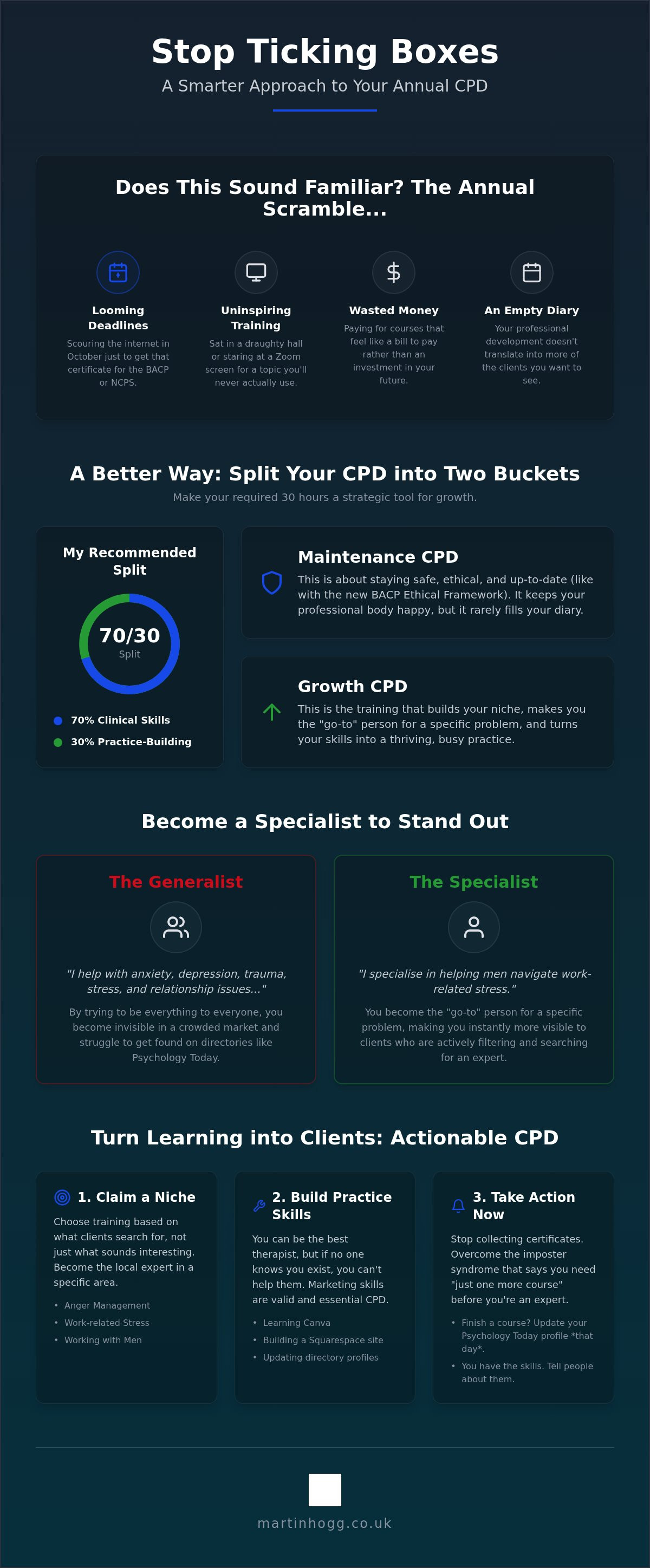
I like to split your learning into two distinct buckets. Maintenance CPD is about staying safe, ethical, and up to date with the latest standards. This includes the new BACP Ethical Framework coming in November 2026. This is essential for your registration. It keeps your professional body happy, but it rarely fills your diary. It's the baseline of your practice.
Growth CPD is different. This is the training that helps you build a niche and makes you the "go-to" person for a specific problem. If you specialise in something like Anger Management, you stop competing with every other generalist in your town. I usually recommend a 70/30 split. Spend 70% of your time on clinical skills and 30% on practice-building skills. You can find more about this in my niche building secrets guide. You need both clinical excellence and business savvy to survive in private practice.
Choosing Your CPD Topics: Building a Niche That Attracts Clients
You can't be everything to everyone. If you try to market yourself as a therapist who handles "anxiety, depression, trauma, and everything else," you end up being invisible. Generalists often struggle to find enough clients because they don't stand out in a crowded search result. Most cpd for counsellors uk is chosen based on what sounds interesting on a Tuesday night, but the most successful practitioners choose based on what their future clients are actually typing into Google.
Strategic learning is the secret to getting found on directories like Psychology Today or the Counselling Directory. When a potential client visits these sites, they don't just browse; they filter. They look for specialists in "Anger Management" or "Work-related stress." By choosing your training specifically to claim a niche, you move from the back of the pack to the very first page. Think about the clients you actually enjoy working with. What do they need more of? That's where your next training budget should go.
Why "Working with Men" is a powerful CPD niche
Men are often underserved in the therapy world. Many feel that traditional counselling isn't "for them" or worry about being judged. If you have specific training in this area, you become a beacon for a demographic that is actively looking for a therapist who "gets it." It isn't just about the clinical work; it's about how you talk about that work on your website. You can find more about how to position yourself as an expert in my niche building secrets guide.
Clinical excellence vs. Practice Visibility
You can be the most talented, empathetic therapist in the UK, but if nobody knows you exist, you can't help anyone. This is why your professional development plan needs to include more than just theory. It's perfectly valid to count time spent learning Canva or Squarespace as part of your growth. If you're feeling a bit stuck on how to bridge the gap between being a great therapist and running a busy practice, you might find our Private Practice Success community a helpful place to start. Building a thriving practice requires you to be as comfortable with your "one-sentence offer" as you are with your clinical frameworks.
How to Balance Clinical Learning with Practice Management
I'm a big believer in the "Skateboard Model". If you want to get from A to B, you don't wait for a Rolls Royce to be built. You start with a skateboard. It's rough, it's basic, but it moves. Your cpd for counsellors uk should work the same way. You don't need a three-year master's degree to start helping a specific group of people. Sometimes, a focused coaching session or a short course is exactly the "skateboard" you need to get your practice moving forward today.
I often tell my Practice Visibility Blueprint members that marketing is actually a clinical skill. Think about it. If you can't communicate what you do clearly, you can't reach the people who are in distress. Learning how to write a clear "one-sentence offer" or setting up a Calendly link isn't "selling out". It's removing the barriers between a person in pain and the help you provide. If you communicate better, you reach more people.
The "Rough and Ready" approach to CPD
The "Rough and Ready" approach to cpd for counsellors uk means you stop overthinking and start doing. Don't wait for the "perfect" course or for your imposter syndrome to vanish. Start reading, watching, and implementing what you learn immediately. To keep the stress levels down, I suggest using a simple spreadsheet or the counsellor efficiency bundle to track your hours as you go. This stops the end-of-year panic and keeps your focus on useful growth rather than just hitting a number.
Using BACP Professional Development Workshops effectively
When you attend BACP Professional Development Workshops, don't just be a passive listener. Aim to take away one specific action point from every session. If you learn a new technique for working with anxiety, go home and update your "above the fold" content on your website to mention it. When you write your reflective piece for your log, focus on how this new knowledge will help your practice grow. A reflective piece that leads to a change in your business is far more valuable than one that just sits in a folder.
Making Your Professional Development Sustainable and Profitable
Professional development is often seen as a drain on your bank account. I want you to flip that thinking. Every hour you spend on cpd for counsellors uk should be an investment with a measurable return. If you spend money on a course, it should eventually result in more clients, higher fees, or a more efficient way of working. It's not just about learning; it's about building a sustainable career that lasts for decades rather than years.
A profitable practice isn't a luxury. It's a necessity for your well-being. When you aren't constantly worried about the mortgage, you can afford higher-quality training and take proper breaks. This is the best way to avoid therapist burnout. As you move from "Solo to CEO," your CPD should help you scale. This might mean learning how to run groups or offer supervision to other therapists. Your plan for 2026 should be written down now, not scrambled together during the Christmas break.
How to plan your CPD year in 5 steps
Don't wait for the deadline to start thinking about your hours. Follow this simple process to make your learning work for you:
- Audit your current client list: See which cases you enjoyed most and which ones felt like a struggle.
- Identify the "gap": Find the specific skill that would have made those difficult cases easier.
- Set a budget: Decide what you can realistically invest in your growth this year.
- Schedule the dates: Put the training in your diary now so it doesn't get pushed aside by other tasks.
- Update your website: As soon as you finish, update your title tags and "above the fold" content to reflect your new expertise.
I find that therapists who join a community like the Private Practice Success Membership stay much more consistent with their goals than those trying to do it all alone.
The ROI of specialised training
Specialists don't just get more clients; they get better-suited clients. You'll spend less on generic advertising because people will seek you out for your specific expertise in areas like Anger Management or Working with Men. People connect with people, not clinical robots. Let your training reflect the real you. When you are the "go-to" person for a niche, your practice becomes both profitable and deeply fulfilling.
Start Building Your Future Practice Today
Choosing your cpd for counsellors uk shouldn't feel like a last-minute scramble to keep the BACP happy. It's about deciding what kind of therapist you want to be and who you want to help. By focusing on a specific niche and treating your marketing as a vital clinical skill, you move from being a generalist to a sought-after specialist. I've spent over 20 years in UK private practice, and I've seen that the most successful counsellors are those who invest in growth, not just maintenance.
I bring a practical, no-nonsense British approach to every coaching session and workshop I lead. Whether you're attending my BACP-endorsed workshops or building your niche from scratch, the goal is always the same: a thriving, sustainable practice that lets you do your best work without the constant worry of an empty diary. You have the clinical talent; now it's time to give it the visibility it deserves.
It's time to stop ticking boxes and start building a practice that actually works for you. You don't have to figure this out on your own. Let's get to work.
Frequently Asked Questions
How many hours of CPD do I need for the BACP in 2026?
You need to complete a minimum of 30 hours of professional development every year to maintain your BACP registration. This requirement stays the same for 2026. It is important to remember that these hours should be spread across the year rather than crammed into a single weekend. You also need to provide a rationale for your ethical decision-making as part of the updated 2026 framework.
Does reading a book or listening to a podcast count as CPD for counsellors?
Yes, personal study like reading professional journals or listening to therapy-focused podcasts counts as "unstructured" learning. The BACP and NCPS recognize that learning happens in many ways outside of a formal classroom. The key is to keep a brief reflective note on what you learned and how it applies to your work. If a specific book changed how you approach a client's struggle, it is valid development.
Can I count business coaching or marketing training as CPD?
You can certainly count business coaching or marketing training as part of your cpd for counsellors uk. Managing a private practice is a professional skill that requires ongoing development. If you are learning how to use Canva for your social media or Squarespace for your website, you are developing your professional reach. Just ensure you can explain how this training helps you provide a more accessible service to your clients.
What is the best way to record my CPD hours for an audit?
The best way to record your hours is to keep a running log throughout the year. Don't wait for an audit letter to start digging through your emails for old receipts and certificates. Use a simple spreadsheet to note the date, the activity, and a few sentences of reflection. Keeping your records updated as you go makes the process of cpd for counsellors uk much less stressful when the deadline approaches.
Should I focus on clinical skills or business skills for my CPD?
I usually recommend a 70/30 split between clinical skills and practice-building skills. You must stay safe and ethical to protect your registration, but you also need a practice that is financially sustainable. If you are already a highly experienced therapist but your diary is half-empty, focus your next few training hours on visibility. Finding a balance is the secret to avoiding burnout and building a thriving career.
Disclaimer
The information provided on this blog is for general informational purposes only. It is also not intended to be a substitute for professional medical or mental health advice, diagnosis, or treatment. Reading this content does not create a therapist-client relationship.


