
Creating a Group Practice in the UK: A Practical Step-by-Step Guide

Article by
Martin Hogg
I help Private Practice counsellors in the UK set up and grow an ethical Private Practice they love, work with their ideal clients, and earn the income they deserve. All without guesswork and burnout. I have been a private practice counsellor myself for over 20 years, specialising in anger management. I set up a not-for-profit social enterprise, Citizen Coaching and Counselling, which delivers thousands of counselling sessions a year to adults and young people in Birmingham. I am a registered BACP Counsellor and the author of three books, My Anger Coach, My Anxiety Coach and My Relationship Coach. These are available on Amazon.
What if adding therapists makes your practice harder to run, rather than easier? If you’re creating a group practice in the UK, success is less about adding names to a website and more about getting the people, business model and everyday systems right.
It makes sense to feel pulled in different directions. You might be weighing up employed practitioners, associates or shared rooms, while wondering how you’ll fill diaries, handle admin and protect time for your own clinical work. Clients still need a clear, consistent experience, whoever they see.
I’d start with a structure that fits your current stage and the responsibility you want to take on, rather than trying to build the biggest practice you can. In this guide, I’ll help you compare models, set clear expectations and build workable client and admin systems. The aim isn’t to make the business more complicated. It’s to create a practice that works well for clients, colleagues and you.
Key Takeaways
- Understand the difference between sharing rooms and building a practice with a shared identity, and consider how your role will change as you take on leadership.
- Compare room-sharing, independent practitioners under one name and a founder-managed team to find a model that fits your appetite for coordination and responsibility.
- Agree who handles enquiries, matching, appointments, payments and handovers so clients know what to expect.
- Approach creating a group practice uk in stages. Review demand, cash flow and your capacity to manage before deciding to grow further.
Creating a group practice in the UK: what changes when you grow beyond solo work?
A group practice is a counselling business where practitioners work under a shared identity and agree how to handle the client experience. Sharing rooms alone doesn’t make it one. That shared identity might be light-touch, or it might involve leading a team and coordinating how the practice runs.
Consider the difference between renting a room alongside another counsellor and presenting your services together under one practice name. In the second arrangement, clients might use a shared website or enquiry process. You’ll need to agree what the practice promises and how colleagues work together. General practice in the UK offers a broad comparison for thinking about how a professional service can operate as a group, though counselling practices have their own models and needs.
Is a group practice the right next step for your counselling business?
I’d look beyond a packed diary. A busy spell may ease, but managing practitioners and practice systems will still be part of the job. Ask yourself whether client demand is consistent, whether you have the time and energy to lead, and whether you want to support colleagues as well as see clients. You don’t need to expand to prove your practice is successful. Make a deliberate choice that fits your capacity and the work you want your week to contain.
What kind of group practice do you want to build?
There isn’t one correct arrangement. You could share rooms while each counsellor runs an independent practice. You could build a shared practice identity, with practitioners working independently but presenting services together. Or you could lead a team and take more responsibility for coordination and how the practice operates. Each option brings a different balance of independence, shared processes and leadership.
As you consider building a group practice in the UK, start with the experience you want clients and practitioners to have. Then ask how much responsibility you’re willing to carry to make that experience consistent. Your answer will help you choose a starting model, not lock you into one forever.
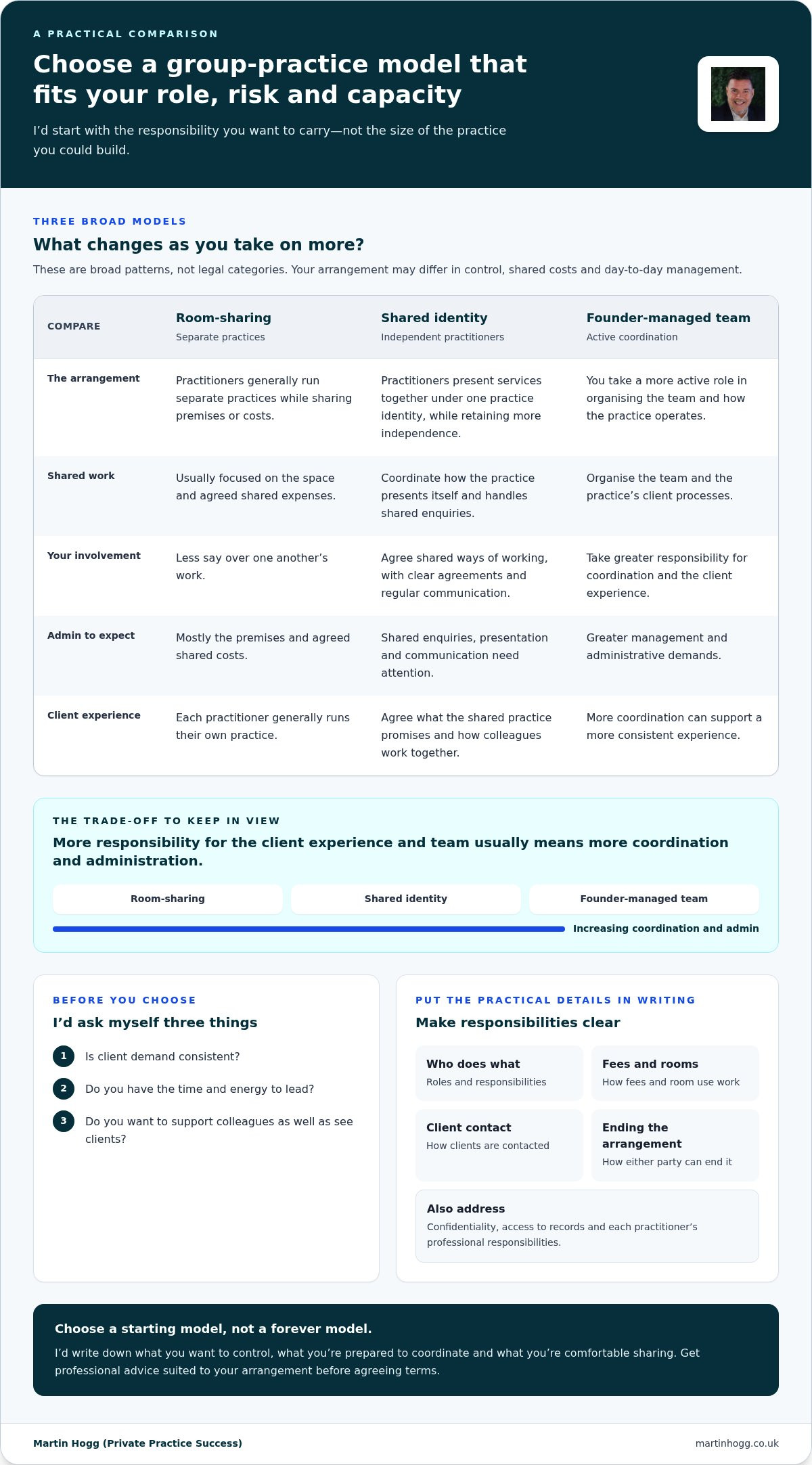
Choose a group-practice model that fits your role, risk and capacity
Once you know what you want to build, compare the practical trade-offs. A model that looks simple on paper can still involve plenty of coordination if clients, rooms or decisions are shared.
In short, the more responsibility you take for the client experience and team, the more coordination and administration you’re likely to take on.
Room-sharing: You and the other practitioners generally run separate practices while sharing premises or costs. You have less say over one another’s work, and admin is mostly about the space and agreed shared expenses.
Independent practitioners under a shared identity: You coordinate how the practice presents itself and handles shared enquiries, while practitioners retain more independence. This calls for clear agreements and regular communication.
Founder-managed team: You take a more active role in organising the team and the practice’s client processes. That can create a more consistent experience, but it also brings greater management and admin demands.
These are broad patterns, not legal categories. Associates, employees and room-sharing arrangements can involve different expectations around control, shared costs and day-to-day management. Before agreeing terms, get professional advice suited to your situation. For a wider example of an independent healthcare organisation, Practice Plus Group healthcare services shows how group provision can take different forms. Your counselling model should reflect your own aims and capacity.
What should your practice agreement make clear?
Put the practical details in writing: who does what, how fees and room use work, how clients are contacted, and how either party can end the arrangement. Give careful attention to confidentiality, access to records and each practitioner’s professional responsibilities. A generic template can help you identify questions, but it can’t replace advice tailored to your arrangement.
Choosing a group-practice model involves more than picking a label. I’d write down what you want to control, what you’re prepared to coordinate and what you’re comfortable sharing. If you’re developing the wider business skills behind that decision, the Private Practice Success Membership offers structured growth plans, live training and a peer community.
Build the people and systems that make a group practice work
Good systems don’t have to make every practitioner work in the same way. They should make the shared parts of the service clear, while leaving room for each counsellor’s professional judgement and individual style.
Clear shared processes make a growing practice easier to manage. Everyone knows what happens next and who is responsible for it.
How can a group practice create a consistent client experience?
Map the client journey from first enquiry to ongoing communication. Decide who replies, how you describe each practitioner’s availability, and how you match an enquiry to someone’s approach and experience. Then agree how appointments are arranged, what clients are told about payments, and what happens if their contact person changes. Consistency means clear, reliable steps, not identical therapy. The NHS website’s patient information is a useful reminder to use language people can understand.
What admin needs attention before the team grows?
Start by defining responsibilities. Agree who handles scheduling, payment administration, records and routine messages, and what practitioners manage themselves. Next, settle the shared processes. Only then choose tools that fit how your practice works. A calendar or booking system can help, but buying software before deciding who updates availability is a reliable way to create a more expensive muddle.
Review the system with the people using it. Are enquiries reaching the right person? Are appointments and payments being handled as agreed? Do practitioners know what information to pass on during a handover? Make small adjustments where the process creates confusion, while keeping professional responsibilities clear. If you’re reviewing routine admin as part of creating a group practice uk, the counsellor efficiency resource may help you decide what to simplify.
Launch your UK group practice in stages, then grow at a sustainable pace
You don’t need every detail settled before you begin, but I wouldn’t build the whole structure on optimism alone. Take it in stages: define why you want a group practice, assess your readiness, choose an arrangement, prepare the practical systems, then review what you learn from running it.
Keep the review grounded. Look at the enquiries you’re receiving and whether they suit the practitioners you have. Consider appropriate space, the time needed to manage the team, and whether your cash flow can handle costs and quieter periods. A full diary this month is encouraging, but it doesn’t prove demand will stay high.
What should you review before bringing in another practitioner?
Before adding someone, ask whether you can respond to enquiries, arrange appointments and manage routine admin without squeezing out your clinical work. Check that you have suitable space if your model needs it, and enough time to support the person joining. Set a review point once the arrangement has been running for a while. Use what you learn to adjust the pace, rather than adding more people by default.
How can you keep visibility and growth manageable?
Give the practice a clear shared message: who it helps and how clients can get started. Then let each practitioner explain their own specialisms and approach. Your website and directory profiles should make both levels easy to understand, without asking everyone to sound like the same person. If you’re refining the practice’s positioning, my niche-building guidance for counsellors can help you think it through.
Creating a group practice is a business decision as well as a clinical one. Keep checking whether your model supports clients, your team and the working life you want. If you’d like structured practice-growth learning and a community of private practice owners alongside that work, you can explore the Private Practice Success Membership.
Take your next step at a pace that fits
There’s no prize for building the biggest practice fastest. Choose a next step you can support with the time, energy and attention you have, while staying connected to the clinical work that matters to you. If creating a group practice uk is on your mind, let your plan grow from what you’re learning, not pressure to expand for its own sake.
I provide specialised business coaching for UK counsellors and therapists. The Private Practice Success Membership offers structured growth plans, live training and a supportive community of counsellors and therapists working on their practices. It gives you a place to work through your next steps with structure and peer support.
You don’t have to have every decision mapped out today. Start with the next useful one, then build from there. A practice that supports both your clients and your own wellbeing is worth growing thoughtfully.
Explore the Private Practice Success Membership to find structured growth plans, live training and a community of private practice owners.
Frequently Asked Questions
Can a group practice include therapists with different specialisms?
Yes. A group practice can bring together therapists with different specialisms, provided clients can understand who offers what. Your team might include practitioners who focus on anxiety, bereavement and relationship concerns. Make each profile clear about the practitioner’s experience and areas of work, and avoid presenting the team as interchangeable. A shared practice identity can sit alongside distinct professional voices.
Can I start a group practice while keeping my own counselling caseload?
Yes, you can keep seeing clients while developing a group practice, but protect time for leadership and business tasks too. I’d block out regular time for team communication, reviewing enquiries and making decisions, rather than squeezing everything between sessions. If your clinical diary is already full, decide which existing tasks you can delegate, reduce or schedule differently.
How do I know whether there is enough demand to bring in another therapist?
Look for a pattern in actual enquiries, not just a hopeful forecast. Keep a simple record of how many people contact you, what support they’re seeking and whether your current availability meets their needs. If enquiries are sporadic or don’t match a potential colleague’s work, pause before making a commitment. Creating a group practice in the UK is easier to plan when your decisions reflect real demand.
Can a group practice offer both online and in-person counselling?
Yes, a practice can offer both if its arrangements make each option clear and workable. Explain which practitioners offer online sessions, which see clients in person, and how people can enquire or book. Think through practical details such as whether the room is suitable and how each practitioner manages their session setup. Don’t assume every colleague will offer both formats. Describe each person’s options accurately.
What if a practitioner decides to leave the group practice?
A practitioner leaving needn’t throw the whole practice into a flap if you’ve agreed a process in advance. Clarify how clients will be informed, what happens to future appointments and how outstanding administration will be handled. Discuss continuity with the practitioner and affected clients, respecting professional responsibilities and confidentiality. Keep the practice’s public information up to date so prospective clients aren’t enquiring about someone who has moved on.
Disclaimer
The information provided on this blog is for general informational purposes only. It is also not intended to be a substitute for professional medical or mental health advice, diagnosis, or treatment. Reading this content does not create a therapist-client relationship.


