
Creating a Paperless Therapy Office for UK Counsellors

Article by
Martin Hogg
I help Private Practice counsellors in the UK set up and grow an ethical Private Practice they love, work with their ideal clients, and earn the income they deserve. All without guesswork and burnout. I have been a private practice counsellor myself for over 20 years, specialising in anger management. I set up a not-for-profit social enterprise, Citizen Coaching and Counselling, which delivers thousands of counselling sessions a year to adults and young people in Birmingham. I am a registered BACP Counsellor and the author of three books, My Anger Coach, My Anxiety Coach and My Relationship Coach. These are available on Amazon.
Ditching your physical filing cabinet is not just about clearing desk clutter; it is an ethical boundary upgrade for your practice. If the thought of creating a paperless therapy office makes you worry about failing an ICO audit or wrestling with confusing software, I completely understand. Most counsellors I work with feel buried under physical clinical notes, signed contracts, and receipts, but they worry they are not tech-savvy enough to make the leap safely.
You trained to sit with clients, not to spend your evenings drowning in paperwork or fretting over UK data protection laws. In this guide, I will share a realistic, step-by-step roadmap to ditch the physical filing cabinets, protect your client records, and cut your weekly admin right down. We will explore how to choose the right tools, keep clinical notes strictly separate from your billing, and stay firmly aligned with BACP standards.
Key Takeaways
- Discover why creating a paperless therapy office serves as an essential ethical boundary that protects client confidentiality under UK GDPR and eases administrative burnout.
- Learn how to choose between dedicated practice management systems and simple modular software, keeping your data protected on secure UK or EU servers.
- Follow a practical step-by-step process to audit your existing paperwork and set up an organised cloud filing system using anonymised client ID codes.
- Safeguard your practice for the future with quick weekly digital housekeeping habits and a clear data access plan for your clinical will.
Why Creating a Paperless Therapy Office Matters for UK Practitioners
Physical paperwork carries a subtle, exhausting mental load. That locked metal cabinet in the corner of your consulting room does not just take up physical floor space; it acts as a constant psychological anchor. Many practitioners worry that going digital makes the work feel clinical or detached. In reality, creating a paperless therapy office is an ethical boundary upgrade that protects both your clients and your own energy.
A good digital setup removes the dread of misplaced session sheets or waterlogged files. It allows you to close your laptop at the end of the day and truly switch off. Reducing manual paperwork acts as a vital preventative measure against therapist burnout, keeping your head clear so you can focus on sustainable client work rather than endless administrative clutter.
Meeting UK GDPR and ICO Standards Without Panic
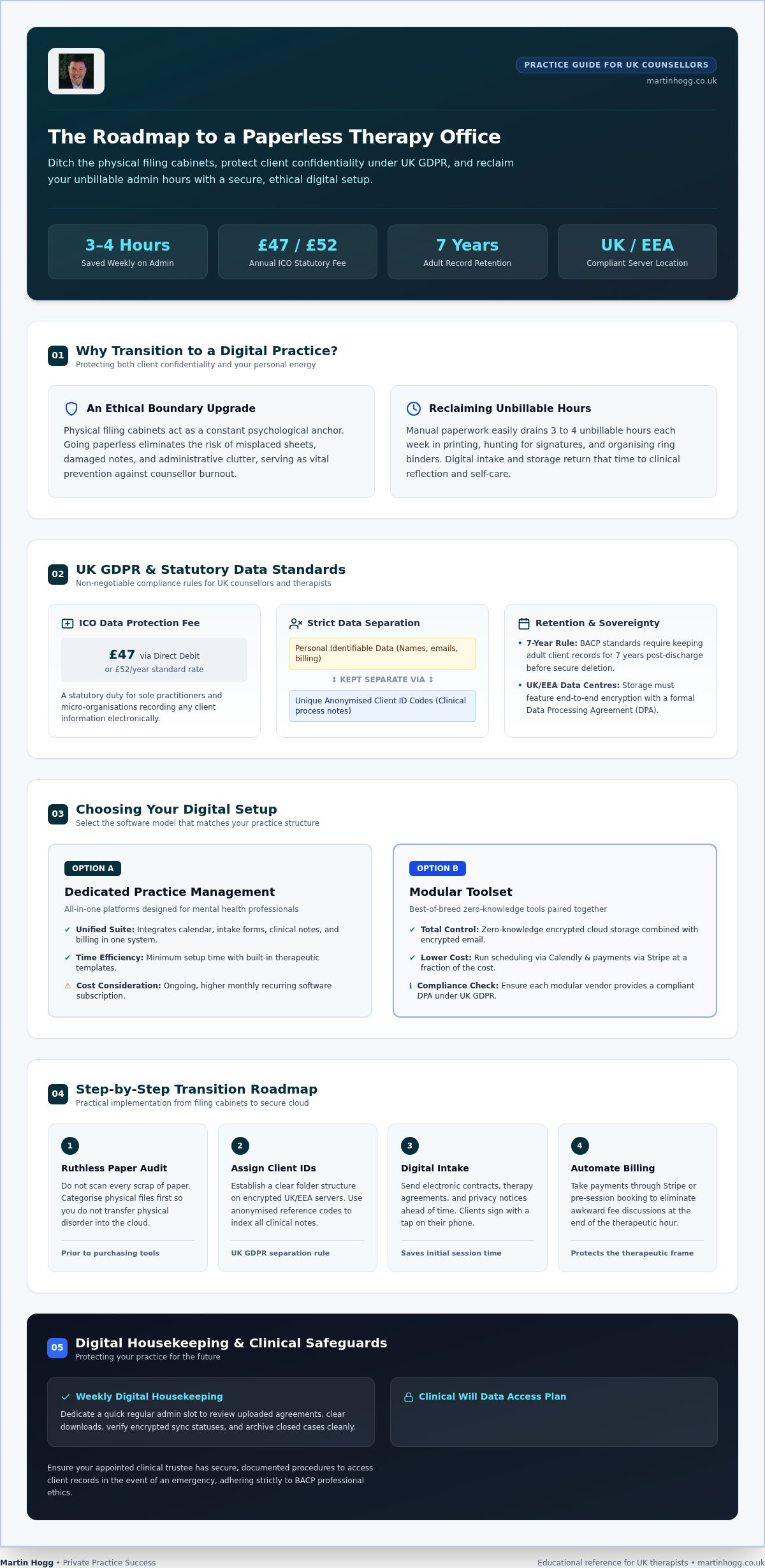
If you record client data electronically, paying the annual data protection fee to the Information Commissioner's Office (ICO) is a non-negotiable statutory duty. For sole practitioners and micro-organisations, this costs £52 per year, or £47 if you set up a direct debit. Compliance does not require complex IT skills, but it does require clear boundaries:
- Strict separation: Keep identifiable personal data (names, emails, payment records) completely separate from clinical process notes by using unique client ID codes.
- Retention periods: Most UK professional bodies, including the BACP, expect you to retain adult client records for at least seven years post-discharge before secure deletion.
The Time and Sanity Dividend of Digital Workflows
Manual filing easily drains three to four unbillable hours each week in printing, hunting down signatures, and re-sorting ring binders. Modern adoption of an Electronic Health Record (EHR) framework eliminates that friction entirely. Automated client onboarding sends privacy notices and intake questionnaires before the first appointment, freeing up valuable headspace for genuine clinical reflection.
Essential Tools for a Compliant, Paper-Free Therapy Practice
You do not need to spend a fortune on bloated software to run a clean digital practice. When creating a paperless therapy office, your setup should feel straightforward and sustainable. The golden rule is data sovereignty: any platform storing clinical information must offer end-to-end encryption and house its data centres within the UK or the European Economic Area.
Before entering any client information, ensure the vendor provides a formal Data Processing Agreement (DPA). Reviewing the official ICO guidance on health information helps clarify what counts as special category data under UK law.
Dedicated Practice Management Platforms vs Modular Setups
You face a clear choice between two routes:
- All-in-one platforms: Tools designed specifically for mental health professionals combine calendars, client notes, and billing. They save time but tie you to an ongoing monthly subscription.
- Modular toolkits: Pairing zero-knowledge encrypted cloud storage with tools like Calendly and an encrypted email provider gives you total control at a fraction of the cost.
Watch out for generic software that scans files for marketing data or lacks explicit UK GDPR contractual clauses.
Handling Digital Client Intake and Invoicing Efficiently
Collecting physical signatures during your first session eats into valuable therapeutic time. Modern digital form builders let you send electronic contracts, therapy agreements, and privacy notices securely ahead of your initial meeting. Clients sign with a tap on their phone, and the completed agreement files automatically into their secure folder.
Automating your fee collection through Stripe or pre-session booking removes awkward financial discussions at the close of fifty minutes. If you want ready-to-use templates to streamline these systems, take a look at our counsellor efficiency bundle. For ongoing peer feedback while testing new tools, many therapists connect inside our Private Practice Success community.
Step-by-Step Implementation: Transitioning from Filing Cabinets to the Cloud
Moving your practice online does not mean you have to scan every scrap of paper you have accumulated since qualifying. Creating a paperless therapy office works best when you start with a ruthless paper audit. Before purchasing any digital subscriptions, categorise your physical files so you do not simply transfer analogue clutter into digital disarray.
Create a logical folder structure inside your secure cloud drive. Never label folders with client names. Use unique reference codes instead, like "CL-104". Inside each folder, keep signed agreements, intake summaries, and brief session notes clearly dated. Update your privacy notice to explain where digital data lives and how it stays secure.
Managing Legacy Paper Records Safely
Do not scan everything. Use a sensible three-tier triage system for your paper backlog:
- Active clients: Scan current agreements and recent notes into their secure digital folders, then destroy the physical copies.
- Past clients within retention: Keep these in a locked box until their mandatory retention window closes. Scanning archived files is a waste of your valuable time.
- Expired records: Hire a certified confidential shredding service that provides a waste destruction certificate, or use a high-security cross-cut shredder at home.
Structuring an Unbreakable Digital Backup Protocol
Losing notes to a failed hard drive is every practitioner's nightmare. Protect yourself by applying the classic 3-2-1 rule: keep three copies of your data on two different storage types, with at least one offsite on an encrypted cloud server. Turn on two-factor authentication (2FA) across every account, phone, and laptop. If you want a complete operational framework, explore our comprehensive guidance on building your practice foundations.
Maintaining Your Digital Office and Scaling Your Clinical Work
Creating a paperless therapy office is not a one-off event. It requires light, consistent maintenance to keep your digital space as tidy as your consulting room. Set aside ten minutes on a Friday afternoon for digital housekeeping. Empty your downloads folder, file rogue session notes into their encrypted folders, and clear temporary files. A clean desktop brings immediate calm for your weekend.
The Clinical Will in a Paperless Practice
Every ethical practitioner needs a clinical will, but digital systems require careful thought. Your clinical trustee must be able to notify active clients and access emergency records without compromising client privacy during normal operations.
I recommend storing your master passwords, hardware recovery keys, and step-by-step system instructions inside a sealed envelope kept in a secure lockbox. Review these access protocols annually with your appointed trustee so they never have to guess under stress.
Leveraging Reclaimed Hours for Practice Growth
Ditching physical paperwork routinely hands you back two to three hours each week. Protect that recovered time fiercely. Rather than immediately filling every spare moment with extra appointments, channel that energy into building a sustainable practice.
Dedicate that freed-up space to reviewing your directory listings on Counselling Directory, polishing your website, or planning clinical CPD. Conduct an annual tech audit to ensure you are not paying for unused software features. If you want practical peer encouragement and operational templates from therapists walking the same path, connect with us inside the Private Practice Success community.
Reclaim Your Time and Protect Your Practice
Creating a paperless therapy office does not have to feel overwhelming or purely technical. It is a practical, grounded way to protect client confidentiality under UK data laws while ending administrative exhaustion for good. By setting up simple folder structures, separating identifying data from session notes, and keeping your clinical will updated, you build an efficient practice that genuinely supports your wellbeing.
Since founding Citizen Coaching and Counselling back in 2005, I have supported hundreds of UK counsellors through these exact operational shifts. You don't need fancy enterprise software to run an ethical, compliant business. You just need clear boundaries, simple tools, and a supportive community walking beside you.
Take it one drawer at a time. Your future, calmer self will thank you for making the shift.
Frequently Asked Questions
Is it legally permissible for UK counsellors to keep entirely paperless notes?
Yes, it is entirely legal for UK counsellors to keep digital records. UK GDPR and the Data Protection Act 2018 recognise electronic records, provided you handle the data securely. Professional bodies like the BACP support digital documentation as long as you maintain confidentiality and client privacy. When creating a paperless therapy office, ensure you register with the ICO as a data controller and implement robust encryption across all devices.
How long do I need to keep digital counselling notes under UK guidelines?
You should retain digital adult client records for at least seven years after therapy ends, mirroring standard UK paper retention rules and professional indemnity insurance requirements. For clients who were children or young people when seen, keep records until their 25th or 26th birthday depending on your insurer. After the retention window closes, securely and permanently purge digital files from your drives, cloud storage, and backup systems.
Do I need client consent before switching from paper to digital records?
You don't need formal consent just to change storage formats, but you must be transparent about where data lives. Under UK GDPR, lawful basis for processing health data is typically legitimate interests or contract, alongside health provisions. Update your client agreement and privacy notice to inform clients that their records are stored digitally, explaining the security measures and encryption methods you use to protect their confidentiality.
What happens to my paperless records if my computer or tablet breaks?
If your hardware fails, a proper backup system means you won't lose a single file. Hardware is just a window into your records; the data lives securely elsewhere. By using automated zero-knowledge encrypted cloud storage alongside an external encrypted drive, you can replace your device, log back in, and resume working within hours without compromising client confidentiality or losing historical records.
Can I take handwritten session notes on a tablet with a stylus?
Yes, using a tablet with a stylus is an excellent middle ground when creating a paperless therapy office. It keeps the tactile feel of handwriting without physical paper piles. Just ensure your chosen note-taking app stores data in UK or EU-compliant encrypted environments. Avoid keeping unencrypted notebooks synced to personal consumer clouds, and always protect the tablet with biometric authentication or a strong alphanumeric passcode.
Disclaimer
The information provided on this blog is for general informational purposes only. It is also not intended to be a substitute for professional medical or mental health advice, diagnosis, or treatment. Reading this content does not create a therapist-client relationship.


