Creating and Selling Online Courses for Therapists: The Practical UK Guide

Article by
Martin Hogg
I help Private Practice counsellors in the UK set up and grow an ethical Private Practice they love, work with their ideal clients, and earn the income they deserve. All without guesswork and burnout. I have been a private practice counsellor myself for over 20 years, specialising in anger management. I set up a not-for-profit social enterprise, Citizen Coaching and Counselling, which delivers thousands of counselling sessions a year to adults and young people in Birmingham. I am a registered BACP Counsellor and the author of three books, My Anger Coach, My Anxiety Coach and My Relationship Coach. These are available on Amazon.
What if the only way to help more people didn't involve drinking more coffee and skipping your lunch break? Most of us got into this profession to make a real difference, but there's a limit to how many 1:1 hours you can work before your own mental health starts to fray. If you've been looking into scaling a private practice uk, you've likely considered online courses but felt an immediate wave of nausea at the thought of complex tech or looking like a cringey wellness influencer. It's a common hurdle, and it often keeps brilliant clinicians stuck in the exhaustion of the hourly rate.
I'm here to tell you that you can package your clinical expertise into a scalable offer without the tech-induced migraine or compromising your professional ethics. You don't need a Hollywood film crew or a degree in software engineering to get started. In this guide, I'll show you how to use the skateboard model to launch a course that actually helps people while creating a sustainable stream of income. We'll walk through a clear, non-scary roadmap that keeps things practical, ethical, and grounded in the reality of the UK market.
Key Takeaways
- Break the link between your hours and your income by turning your clinical niche into a scalable psychoeducation or CPD course.
- Discover why scaling a private practice uk doesn't require a massive budget or complex tech if you use the "Skateboard Model" to launch a functional version first.
- Learn how to craft a "One-Sentence Offer" that clearly defines exactly who you help and the specific outcome your course provides.
- Build genuine trust with your audience by focusing on the "people connect with people" philosophy rather than hiding behind a corporate clinical logo.
- Validate your course idea and reduce financial risk by using a beta launch strategy to sell your content before you have even finished building it.
Scaling Beyond the Therapy Room: Why Courses are the Future for UK Practitioners
Most of us started our private practice with a simple goal: help people and earn a decent living. But you quickly realise that your income is tethered to your physical presence in the room. If you aren't sitting in that chair, you aren't getting paid. This "time-for-money" trap is the biggest barrier to scaling a private practice uk. There are only so many hours in a week before your empathy tank runs dry and you're just staring at the clock. Your energy is finite, but the need for your expertise is not.
An online course isn't about replacing the deep, relational work of therapy. It's about delivering psychoeducation or Professional Development (CPD) in a way that doesn't require you to repeat the same "Anxiety 101" speech for the thousandth time. While the history of distance learning shows we've been teaching from afar for decades, the technology now makes it possible for a solo practitioner anywhere in the UK to reach a global audience. It acts as a bridge for those who aren't quite ready for the vulnerability of 1:1 work or those who simply can't afford a full session rate during a cost-of-living crisis.
UK therapists have a massive ethical edge here. The online "self-help" space is currently an unregulated Wild West full of influencers making grand claims. As a qualified professional, your adherence to ethical frameworks like the BACP means your content is safer, more effective, and carries more weight than a flashy social media post. You aren't just selling "vibes"; you're selling evidence-based transformation.
Moving from 1:1 to 1:Many
Diversifying your income isn't just about the money; it's the best hedge against therapist burnout I know. When you have a course running in the background, you can afford to take a week off or reduce your caseload without your bank balance hitting zero. If you're looking for more ways to grow beyond your own four walls, check out my other guide on scaling a therapy practice for a broader look at business structures.
Addressing the Imposter Syndrome
You might think, "Who am I to make a course?" Well, if your clients keep asking you for the same advice on sleep hygiene, boundaries, or bereavement, you already have a curriculum. You don't need to be a "guru" with a million followers to be useful. Clinical experience beats marketing hype every single time. Your niche knowledge is a lifeline for people who can't access you directly.
The Skateboard Model: Building Your Course Without the Tech-Induced Migraine
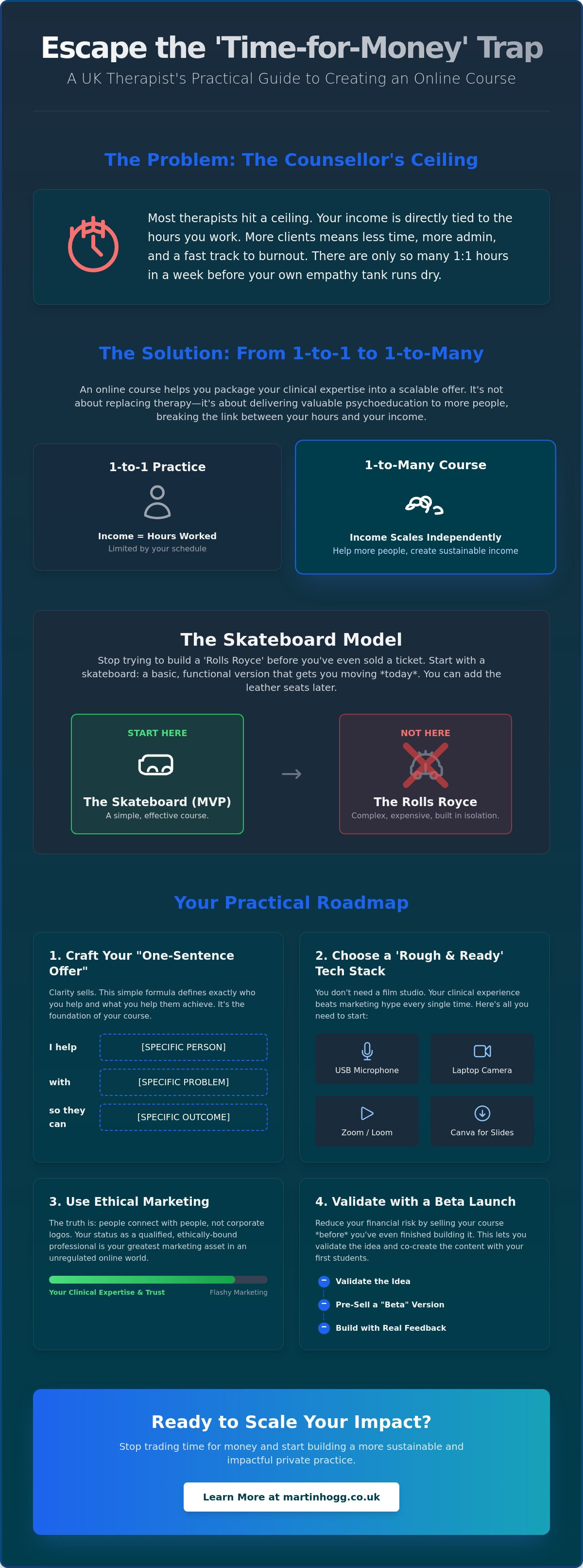
Most therapists I talk to get stuck because they think an online course needs to look like a Netflix documentary. It doesn't. When we look at scaling a private practice uk, the biggest mistake is trying to build a "Rolls Royce" course before you've even proven the idea. I call this the Skateboard Model. If you want to get from A to B, you don't spend two years building a car in your garage. You build a skateboard. It’s basic, it’s functional, and it gets you moving today. You can add the steering wheel and the leather seats later once you know people actually want to go where you're taking them.
Your "skateboard" starts with a One-Sentence Offer. It’s a simple formula: "I help [specific person] with [specific problem] so they can achieve [specific outcome]." This clarity is what sells, not your logo or your expensive lighting setup. In fact, "rough and ready" content often converts better in our world. People don't want a distant, polished corporate figure; they want a human being who understands their struggle. While you should be aware of the NICE Evidence Standards Framework for digital health, don't let it paralyse you. Your clinical expertise is the value, not the production quality.
Structuring Your Content for Success
Focus on an "Outcome-First" approach. Start with the final result your student wants and work backwards. What is the very first step they need to take? Keep your lessons bite-sized. Five-minute videos are far more effective than hour-long webinars. Busy adults don't have time to dig through fluff; they want a win "above the fold" within the first ten minutes of opening your course. Give them a quick victory early on to build their confidence.
Choosing Your 'Rough and Ready' Tech Stack
You really don't need a studio. A decent USB microphone, your laptop camera, and Zoom are enough to record your first modules. Use Canva for your slides and keep it simple. For hosting, I suggest moving away from lonely, traditional platforms where students just watch videos in a vacuum. Community-led spaces are much more engaging for scaling a private practice uk because they foster connection. If you want to see how this looks in practice, you can explore our community-led approach here.
Ethical Marketing: Building an Audience That Actually Trusts You
I've seen too many counsellors hide behind a corporate-looking logo or a wall of academic post-nominals. Here is the truth: people connect with people, not clinical brands. In the therapy world, trust is our primary currency. When you're scaling a private practice uk, your marketing shouldn't feel like a sales pitch. It should feel like an extension of your clinical work. I call this the relationship-first philosophy. You want your potential students to feel like they already know, like, and trust you before they ever see a "buy" button.
A great way to build this trust is by creating a lead magnet. This is just a fancy term for a freebie that actually helps someone. Don't overthink it. It could be a simple PDF worksheet, a three-minute grounding audio, or a checklist for managing panic attacks. You're solving a small piece of their puzzle for free to prove you know your stuff. You can even use your existing profiles on the Counselling Directory or Psychology Today to mention your free resource. It's a much softer way to lead people toward your course than a hard sell. For a deeper dive into these strategies, read my guide on marketing for therapists uk.
Simple Email Marketing
Social media algorithms are fickle and prone to changing overnight. Your email list, however, is an asset you actually own. It is the most reliable way to communicate with people who have already said "yes" to your freebie. When you launch your course, keep it low-pressure. You aren't a used-car salesman; you're a professional offering a solution to a specific problem. A simple series of three or four emails explaining who the course is for and what it achieves is often all you need.
Visibility Easy Wins
You don't need to be a tech genius to help the right people find you on Google. Simple things like updating your sales page title and description tags with your niche keywords make a huge difference. Also, don't be afraid of social proof. While we can't use testimonials for therapy, you can ethically collect and display feedback for your online courses and workshops. It helps potential students see the tangible value you provide.
If you're ready to stop guessing and start building with a supportive group of peers, I invite you to join our Private Practice Success community where we map out these steps together.
Launching and Scaling: How to Sell Without Feeling Like a Used-Car Salesman
Most therapists I work with feel a bit "icky" about the idea of selling. We're trained to be helpers, not hawkers. But if you've done the work of scaling a private practice uk, you know that selling is just another way of inviting someone into a solution. The best way to do this without the used-car salesman vibe is the Beta Launch. You sell the course before you've even finished recording it. You offer a lower "founding member" price to a small group in exchange for their feedback. This validates that people actually want what you're making and gives you the cash flow to build it properly.
Pricing is where many of us trip up. You don't want to be the "pound-shop" of therapy courses, but you want to be accessible. Avoid the race to the bottom. Your expertise, backed by years of clinical practice and BACP standards, is worth more than a £15 generic download. Find that sweet spot where the price feels like an investment for the student but a fair exchange for your years of training. When scaling a private practice uk, remember that your time is your most precious asset; don't give it away too cheaply.
Putting your expertise behind a paywall feels vulnerable. It's a different kind of visibility than sitting in a therapy room. You might worry about what colleagues think or if you're "expert enough." This is where staying grounded in your niche helps. You aren't trying to be everything to everyone; you're just helping one specific person solve one specific problem.
The Power of Community
Courses fail when people feel lonely. Static videos often sit unwatched on a hard drive because there's no accountability. By hosting your course inside a membership or a community-led space, you'll see student completion rates soar. People stay for the connection as much as the content. If you want a roadmap and a group of peers to keep you accountable, the Practice Visibility Blueprint is where we get this done together.
Refining Your Process
Once those first beta students give you feedback, you can start turning your Skateboard into a Bicycle. You'll learn what was confusing, what was helpful, and what was missing. Eventually, you'll have a "car" that runs smoothly while you sleep. The best time to start this journey was last year, but the second-best time is today.
Take Your First Step Beyond the Therapy Room
Moving from 1:1 work to a scalable model isn't just about increasing your income; it's about protecting your energy and reaching more people who truly need your help. We've covered how the skateboard model allows you to launch an ethical, high-quality course without getting lost in a maze of expensive tech. By focusing on a clear one-sentence offer and embracing "rough and ready" content, you can build a bridge for clients who aren't ready for the therapy room but desperately need your expertise.
If you're serious about scaling a private practice uk, you don't have to do it alone. I've spent years delivering BACP-endorsed workshops and practical, no-jargon coaching to help therapists find their feet in the digital world. Through the Practice Visibility Blueprint framework, we strip away the overwhelm and focus on the easy wins that actually move the needle for your business.
Join the Private Practice Success community on Skool to start building your course today. It is time to turn your clinical wisdom into a sustainable, scalable future. You've already got the skills, now let's build the platform.
Frequently Asked Questions
Is it ethical for a therapist to sell an online course in the UK?
Yes, it is perfectly ethical as long as you clearly distinguish between psychoeducation and a clinical relationship. Sharing your expertise through a course or CPD workshop is a valid way of making professional support more accessible. You just need to ensure your marketing is honest and your content stays within your area of competence. Most UK professional bodies, including the BACP, value the delivery of high-quality education as part of your professional development.
What platform should I use to host my online course for therapists?
I usually recommend starting with a community-led platform like Skool rather than a lonely, traditional learning management system. It is much easier to manage when you are scaling a private practice uk because it keeps your students engaged in one place. If you are following the skateboard model, you don't need anything fancy. You can even start by hosting your videos on a password-protected page on your existing Squarespace or WordPress website.
How much should I charge for my first online course?
Your pricing should reflect the value of the transformation you offer rather than the number of hours of video you record. Avoid the race to the bottom where you try to compete with cheap, generic downloads. A niche course that solves a specific, painful problem for a student is a high-value asset. I suggest starting with a lower "beta" price for your first ten students to validate the demand before moving to a full price.
Do I need to be tech-savvy to create a digital course?
You definitely don't need a degree in computer science or a Hollywood film crew to get started. If you can use Zoom for a client session and Canva to make a simple slide deck, you already have the necessary skills. Remember that "rough and ready" content often feels more authentic and human to your audience. Focus on the quality of your advice rather than trying to master complex editing software or expensive studio lighting.
How do I make sure my course does not count as therapy for insurance purposes?
You must include clear disclaimers stating that the course is for educational purposes only and does not constitute a therapeutic relationship. This is a vital step for scaling a private practice uk safely and ethically. Make sure your content focuses on teaching skills or providing information rather than clinical processing. It is also worth a quick call to your insurance provider to ensure your professional indemnity policy covers "training and education" activities.
Disclaimer
The information provided on this blog is for general informational purposes only and is not intended to be a substitute for professional medical or mental health advice, diagnosis, or treatment. Reading this content does not create a therapist-client relationship.


