
Email Marketing for Therapists: A Practical Guide to Growing Your UK Practice
You don't need a massive social media following or a "pushy" sales persona to fill your diary; you just need a way to stay in touch with people who already trust your voice. Most of us entered this profession to help people, not to become digital marketers, so it's natural to feel hesitant about email marketing for therapists. You might worry that sending regular updates feels intrusive, or perhaps you're just stuck on the technical hurdles of GDPR. I know how it feels to want to reach more people while keeping your professional integrity intact.
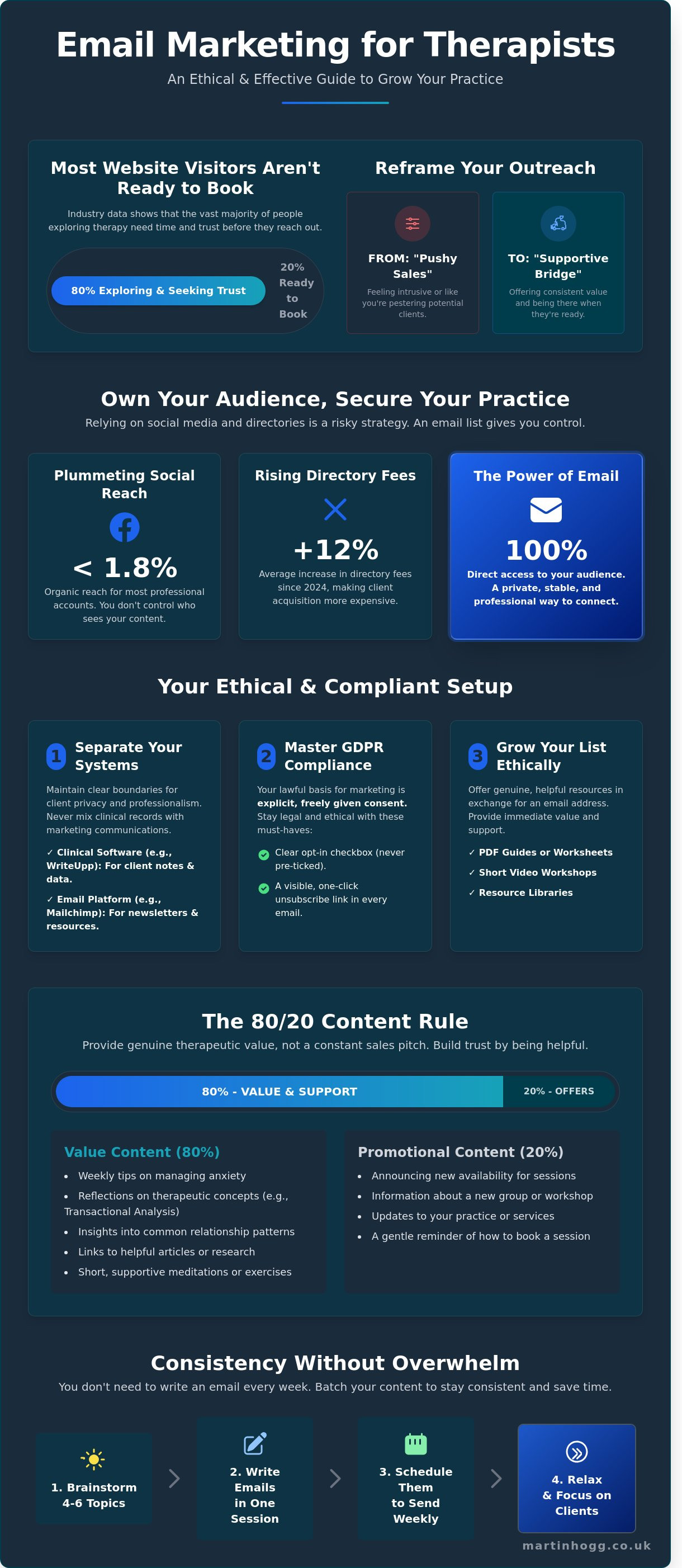
According to 2023 industry data, roughly 80% of people visiting your website aren't ready to book a session immediately. They're usually looking for a sign that you understand their struggle and have the practical tools to help. I'll show you how to build a simple, manageable system that keeps you connected with potential clients until they're ready to take that first step. We will cover everything from choosing the right UK-compliant platform to writing content that flows naturally. This guide will help you grow your practice and get your business on track without the technical overwhelm or the fear of being "spammy".
Key Takeaways
- Discover how to reframe your digital outreach as a supportive bridge between a client’s struggle and your professional expertise.
- Master the essentials of email marketing for therapists by selecting the right tools and ensuring your system is fully GDPR compliant.
- Apply the 80/20 rule to your writing to ensure your emails provide genuine therapeutic value rather than feeling like a sales pitch.
- Learn how to ethically grow your subscriber list by offering helpful resources that provide immediate support to those in need.
- Develop a sustainable plan to batch your content, allowing you to maintain a consistent connection without becoming overwhelmed.
The Ethical Case for Email Marketing in Private Practice
Many therapists I meet across the UK feel a genuine hesitation when it comes to promoting their services. You might worry that sending regular updates feels intrusive or "salesy," especially when you are dealing with sensitive mental health struggles. I want to challenge that perspective. Effective email marketing for therapists isn't about pestering people for bookings; it's about creating a consistent bridge between a person's current pain and the professional support you provide. It's about being there when they are ready.
Think of your email list as a "holding space." Data from 2025 suggests that roughly 72% of individuals struggling with their mental health will visit a therapist's website at least four times before making an enquiry. They aren't ready to talk yet, but they are looking for a sign that change is possible. When you ask, What is email marketing? in a clinical context, the answer is simple. It's a way to remain a calm, steady presence in their inbox until they feel brave enough to reach out. You aren't bothering them. You are offering a resource that validates their experience and offers a path forward.
Reframing Marketing as an Act of Service
Sharing your expertise for free is a profound act of service. Many people in your community won't ever be able to afford one-to-one therapy, or perhaps they aren't at a stage where they can commit to weekly sessions. By sending a weekly tip on managing anxiety or a short reflection on Transactional Analysis, you provide immediate value. This moves your practice from "selling" to "supportive visibility." I know the anxiety of putting yourself out there as a counsellor is real. However, your voice could be the one that helps a man in Birmingham finally understand why he feels so stuck. It's about being helpful, not being loud. You are simply letting people know that help is available when they need it most.
Why UK Therapists Need a Direct Line to Clients
The UK private practice market in 2026 is more competitive than ever. Directory fees have risen by an average of 12% since 2024, and relying solely on these platforms or social media is a risk you don't need to take. Organic reach on platforms like Instagram has plummeted to less than 1.8% for most professional accounts. If a platform changes its rules tomorrow, you could lose your connection to your audience instantly. This is why email marketing for therapists is so vital for long-term stability.
Building an independent list makes your practice "referral-proof." It gives you a direct line to people who have already expressed an interest in your work. Unlike the public nature of social media, an email is a private, intimate exchange. It arrives in a personal space, free from the noise of competing algorithms or distracting adverts. This privacy is essential for building the trust required for deep therapeutic work. When you control your list, you control the stability of your practice. You ensure that you can keep helping people get their lives back on track, regardless of what the big tech companies decide to do with their code.
Setting Up Your System: Platforms, Privacy, and GDPR
Setting up your system doesn't have to be a headache. You need a setup that works quietly in the background while you're in the therapy room. Successful email marketing for therapists relies on a clear boundary between your clinical records and your marketing list. Your clinical software, such as WriteUpp or Jane, is for sensitive health data and session notes. Your email platform is for helpful content, practice updates, and mental health resources. Keeping these separate ensures you aren't accidentally sending a general newsletter to a client who only wants to discuss their appointment times. It protects their privacy and your professional reputation.
I recommend using a dedicated platform for email marketing for therapists rather than your personal email account. Professional systems make it easier to manage subscriptions and stay compliant. If you send bulk emails from a standard @gmail.com or @outlook.com address, you risk your account being flagged as junk. In fact, research shows that nearly 20% of bulk emails sent from personal accounts for business purposes never reach the inbox. Using a professional tool makes you look like the expert you are and ensures your message actually gets read.
GDPR for Therapists: Staying Legal and Ethical
Under the UK Data Protection Act 2018, your lawful basis for sending marketing content to individuals is explicit, freely given consent. You must include a clearly visible link to your privacy policy on every sign-up form so people know exactly how you handle their data. If someone asks to be removed from your list, you have a legal obligation to honour this 'right to be forgotten' within 30 days. Following the UK GDPR and email marketing rules ensures your practice remains a safe, trusted space for everyone who interacts with you online.
Recommended Email Platforms for UK Private Practice
For most solo practitioners in the West Midlands and across the UK, MailerLite is a fantastic starting point. It's user-friendly and remains free for your first 1,000 subscribers. Mailchimp is another popular choice, though its paid plans often start around £11 per month and can scale up quickly as your list grows. If you plan to create more complex automated sequences or online workshops, ConvertKit offers powerful tools, though it usually requires a monthly investment of around £20. These platforms handle the technical side of GDPR for you, providing the necessary 'unsubscribe' links automatically.
When you set up your account, choose a 'sender' name that feels human and approachable. Instead of using 'Admin' or 'The Clinic', try 'Martin at Citizen Coaching'. This small change builds immediate trust. It reminds the person that there is a real, compassionate human on the other side of the screen. If you're feeling stuck on the technical setup, I offer practical support for therapists looking to grow their reach without the stress.
Always use a 'double opt-in' process. This means that after someone signs up on your website, they receive an automated email asking them to click a button to confirm their subscription. It might feel like an extra hurdle, but it ensures that every person on your list actually wants to be there. This practice protects your sender reputation and ensures your emails aren't marked as spam. It's about building a community based on genuine connection and mutual respect, which is the heart of any good therapy practice.
What to Write: Creating Content That Connects Without Selling
Successful email marketing for therapists relies on a simple ratio: 80% helpful insight and 20% practice updates. This balance prevents your list from feeling like a series of adverts. Your readers are often feeling overwhelmed. They don't want a sales pitch; they want to feel understood. Share content that demystifies the process. You might write about why we get stuck in old patterns or how a specific modality like transactional analysis helps clarify relationships. This approach positions you as a guide. It shows you have the tools to help them get their life back on track without the pressure of a clinical hard sell.
Handling replies requires a clear protocol. When a subscriber reaches out with a personal struggle, acknowledge their courage but stay professional. Remind them that email is for information, not intervention. If you're managing sensitive data, you must adhere to the ICO guidance on electronic mail marketing to stay compliant with UK law. This isn't just about ticking boxes. It's about protecting the vulnerable people who trust you with their contact details. Always include a clear disclaimer that your emails don't constitute a therapeutic relationship.
Your tone should be a bridge between expertise and everyday life. Avoid the coldness of clinical jargon. Instead of discussing "maladaptive cognitive schemas," talk about "the stories we tell ourselves that keep us unhappy." This humanises you. It shows you're a real person, not just a distant figure in a suit. People in Birmingham and across the UK value straight-talking, practical support. Use your emails to show that while the work of therapy is serious, it doesn't have to be intimidating or confusing.
The 'Holding Space' Content Framework
Educational emails break down complex theories into everyday language. You could explain what to expect in a first session or how EMDR processes trauma. Reflective emails offer a human moment, perhaps sharing how you manage stress during a busy week in the West Midlands. Practical emails are the most direct. Provide a 3-minute grounding exercise or a simple breathing technique. These small wins build significant confidence in your ability to help them achieve real results. It transforms your email from a notification into a valuable resource.
Crafting Subject Lines That Get Opened
Subject lines should feel like a warm invitation. Avoid spammy triggers like "limited time offer" or "urgent help needed," which can feel predatory in a mental health context. Instead, use empathy and curiosity. For an anxiety-focused practice, try "The quiet power of saying 'not today'." For trauma-informed work, "Why your body remembers what your mind tries to forget" is highly effective. These lines speak directly to the reader's internal struggle. They promise a safe space for exploration rather than just another item on a busy to-do list. Keeping them short, around 6 to 10 words, ensures they remain readable on mobile devices.
- Myths vs. Reality: Debunk the idea that you have to be "broken" to attend therapy.
- Behind the Scenes: Share a photo of your therapy room to reduce the fear of the unknown.
- Practical Tools: Offer a "Box Breathing" guide for immediate stress relief.
- Practice News: Mention if you have a new Saturday morning slot available in your clinic.
Growing Your List: From Website Visitors to Engaged Subscribers
Most people who land on your website aren't ready to book a session immediately. They're often "window shopping" for a solution to their pain, feeling their way through the darkness of anxiety or trauma. If they leave without giving you their contact details, you've likely lost them forever. Effective email marketing for therapists relies on capturing that interest before it fades. You need a way to stay in their orbit without being pushy or intrusive, providing a steady hand they can reach for when they're ready.
Creating a Lead Magnet Your Clients Actually Want
Think of a lead magnet as an "ethical bribe." You offer something of genuine value in exchange for an email address. Don't make the mistake of creating a 40-page ebook; nobody has the headspace for that during a crisis. According to 2024 industry data, short, punchy resources have a 15% higher completion rate than long-form guides. Your ideal client is likely feeling overwhelmed. Don't give them more homework.
- The First Session Survival Guide: A simple checklist to lower anxiety before that first call.
- 5 Minutes to Calm: A 1-page PDF of grounding exercises they can stick on their fridge.
- The Sleep Hygiene Audit: A 2-minute checklist to identify why they aren't resting.
Keep it practical. If you specialise in helping men, for example, your guide should be direct and solution-focused. Use language that feels like a conversation in a Birmingham coffee shop rather than a clinical lecture. When you implement email marketing for therapists, the goal is to lower the barrier to entry by proving you understand their specific struggle.
Strategic Placement and Offline Growth
Your sign-up form shouldn't be hidden on a "Contact" page. Place it in the top third of your homepage and at the end of every blog post. If you're active on LinkedIn or Facebook, use your bio link to drive traffic to your lead magnet. I've found that practitioners who place a simple "join my list" link in their email signature see a steady 3% growth in subscribers without any extra effort.
Don't ignore offline opportunities. If you're speaking at a local event or networking with GPs, use a QR code on your business cards. In 2023, UK practitioners using QR codes at live events saw a 22% increase in list growth compared to those relying on verbal mentions. It's a simple, no-nonsense way to move someone from a brief conversation to a lasting connection.
The Welcome Sequence: Your Automatic First Impression
The first five minutes after someone joins your list are critical. This is when their interest is at its peak. Your welcome email must arrive instantly. It needs to deliver the promised guide, introduce your philosophy, and set expectations. Tell them exactly how often you'll be in touch. Whether it's once a week or once a fortnight, consistency builds safety.
Use this space to humanise yourself. A short story about why you're passionate about mental health can reduce the fear factor of booking a session. Statistics show that welcome emails have an open rate of 82%, which is four times higher than a standard newsletter. Use that attention to show you're a guide who understands the weight of their experience.
If you want to move beyond abstract theory and start seeing tangible results in your practice, I can help you get your life back on track with a clear, practical strategy.
Consistency Without Overwhelm: Your Sustainable Email Plan
Many therapists I speak with feel a sense of dread at the thought of adding another "to-do" item to their week. You're already balancing clinical hours, supervision, and your own well-being. The secret to effective email marketing for therapists isn't high frequency, it's reliability. You don't need to write every day or even every week to see results. A monthly newsletter provides 12 meaningful touchpoints a year, while a fortnightly schedule offers 26. Pick the rhythm that feels like a gentle commitment rather than a heavy burden. If you're just starting, I suggest beginning with one high-quality email per month.
Batching is your best friend when it comes to staying consistent. Set aside one Tuesday afternoon, perhaps three hours, to write your content for the next 90 days. When you write three or six emails in one sitting, your voice remains consistent and your message stays focused. You also save yourself the 45 minutes of "blank page syndrome" that usually happens when you try to write on the fly. By the end of that 180-minute session, your marketing is done for the entire quarter. You can then return to what you do best: helping your clients get their lives back on track.
When you see an "unsubscribe" notification, your first instinct might be to take it personally. Don't. A 1% or 2% unsubscribe rate after a broadcast is actually a sign of a healthy, self-cleaning list. It means people who aren't a fit for your specific approach are moving on, making space for those who truly value your insights. Stop obsessing over a 25% or 30% open rate. Instead, look at the one or two direct enquiries that land in your inbox after you hit send. Those real-world connections and discovery call bookings are the only metrics that truly grow a UK practice.
Managing Your Time and Energy
A simple content calendar prevents the last-minute panic that leads to "ghosting" your subscribers. I recommend looking at the Martin Hogg training calendar to see how we plan our themes and events months in advance for inspiration. You can mirror this by choosing one central topic per month, such as managing anxiety in January or building resilience in February. Remember, a "good enough" email that actually reaches an inbox is infinitely more effective than a perfect one that sits in your drafts folder forever.
Next Steps for Your Practice Growth
The goal of email marketing for therapists is to move a person from being a passive reader to being a client in the room. You're transitioning from "emailing" to "inviting" them into a safe, therapeutic space. If you want to take the guesswork out of this, our Practice Visibility Blueprint helps you automate these systems so you can focus on your clinical work. To get the practical tools and community support you need, join the Private Practice Success Membership today. We'll help you build a practice that serves both you and your community with confidence.
Moving Your Practice Forward with Confidence
Building a sustainable practice doesn't happen by accident. It requires a reliable bridge between your clinical expertise and the people who need your help. By focusing on ethical connection rather than hard selling, you can turn a simple email list into a community of engaged subscribers who trust your professional voice. We've covered how to stay compliant with UK GDPR regulations while sharing content that reflects your therapeutic values without adding hours to your weekly workload. Effective email marketing for therapists is about being a consistent, helpful presence in a potential client's inbox.
I've spent over 15 years helping UK counsellors grow their practices through practical, no-nonsense coaching. As a BACP-endorsed workshop provider, I know that the technical side can feel daunting; however, it's simply a tool to help you get more people's lives back on track. You don't need to be a tech expert to see results. You just need a clear, actionable plan that respects your time and your ethics.
Start building your practice visibility today with our Blueprint
You already have the skills to change lives. Now it's time to make sure the right people can find you and start their journey toward recovery.
Frequently Asked Questions
Is email marketing GDPR compliant for UK therapists?
Yes, email marketing for therapists is fully compliant with UK law if you follow Information Commissioner's Office (ICO) guidelines. You must obtain clear, affirmative consent from every person on your list using a "double opt-in" process where subscribers confirm their interest via a follow-up email. Under the Data Protection Act 2018, you are also required to include a visible "unsubscribe" link in every message to give people an easy way to opt out at any time.
How often should I send emails to my list without being annoying?
Sending a newsletter once a fortnight or once a month is the ideal frequency for a private practice. Research from Mailchimp indicates that 69% of users unsubscribe because they receive updates too frequently. I recommend starting with a monthly update to ensure you can stay consistent without feeling overwhelmed. Regular, predictable communication builds trust and keeps you at the front of a potential client's mind without cluttering their inbox or becoming a nuisance.
What should I do if a client replies to a marketing email with a crisis?
You must immediately direct the individual to emergency services and your specific crisis protocol. Every marketing email should include a footer stating that your inbox isn't monitored 24/7 for urgent support. If a crisis reply arrives, send a template response pointing them to the Samaritans on 116 123 or NHS 111. Professional bodies like the BACP advise that maintaining these clear boundaries protects both you and the client when using digital tools.
Do I need a large list to see results in my private practice?
You don't need a massive list to see tangible results in your practice. A small, engaged group of 50 to 100 local subscribers is often more valuable than 1,000 random contacts from across the globe. If just 2% of a 100-person list books a session, that's two new clients from a single email. Focus on building deep trust with people in your local community rather than chasing high numbers that don't convert into actual therapy sessions.
What is the best email marketing platform for a solo counsellor?
MailerLite is often the best choice for a solo practitioner because it's intuitive and offers a free tier for up to 1,000 subscribers. It provides all the essential tools for email marketing for therapists, such as automated welcome sequences and GDPR-compliant sign-up forms. Mailchimp is another popular UK option, though their free plan became more restrictive in 2024. Both platforms allow you to create professional designs easily without needing any technical or coding skills.
Can I add my current clients to my email marketing list automatically?
You cannot automatically add current clients to your marketing list without their explicit permission. Clinical consent for therapy is legally distinct from marketing consent under UK GDPR rules. To stay compliant, ask clients to "opt-in" to your newsletter separately during their initial assessment or via a link in your email signature. This ensures that 100% of your subscribers actually want to hear from you, which reduces the risk of being marked as spam or facing complaints.
How do I come up with ideas for my therapist newsletter every month?
Focus on solving one specific problem your clients face, such as "3 ways to manage morning anxiety." I find that using the 80/20 rule works best: 80% helpful, educational content and 20% news about your practice. You can share book reviews, explain a concept like CBT in plain English, or offer a simple "thought of the month." This approach positions you as a practical, helpful guide rather than someone who is just trying to sell a service.
Should I share personal stories in my emails to clients?
Sharing personal stories can build a powerful connection, but they must always serve the reader's growth. I suggest using "judicious self-disclosure" where you share a struggle you've overcome to illustrate a practical point. For instance, mentioning how you used mindfulness to handle a stressful week makes you relatable and human. Avoid sharing raw, unresolved issues. Your emails should always feel like a safe, steady hand helping the reader get their life back on track.


