
Ethical Private Practice Marketing: Growing Your Therapy Practice Without the "Ick"

Article by
Martin Hogg
I help Private Practice counsellors in the UK set up and grow an ethical Private Practice they love, work with their ideal clients, and earn the income they deserve. All without guesswork and burnout. I have been a private practice counsellor myself for over 20 years, specialising in anger management. I set up a not-for-profit social enterprise, Citizen Coaching and Counselling, which delivers thousands of counselling sessions a year to adults and young people in Birmingham. I am a registered BACP Counsellor and the author of three books, My Anger Coach, My Anxiety Coach and My Relationship Coach. These are available on Amazon.
What if marketing your therapy practice wasn't a "necessary evil" but actually a clinical responsibility to the people who need you most? Most counsellors I talk to find the idea of self-promotion a bit distasteful. You probably worry about being seen as "unprofessional" by your peers or feel overwhelmed by conflicting business advice. You didn't train for years to spend your evenings agonizing over your visibility or feeling like a pushy salesperson.
The truth is that ethical private practice marketing is simply about making sure your help is findable. You can attract the right clients authentically while staying fully aligned with your professional values and the BACP Ethical Framework. With a new version of that framework arriving in Autumn 2026, it's the perfect time to ensure your practice growth is grounded in your clinical principles rather than cheesy sales tactics.
I'm going to show you how to move from feeling "icky" about business to having a full diary of best-fit clients. We'll explore how to build a marketing plan that feels as natural as a consultation, giving you financial sustainability without the burnout.
Key Takeaways
- Stop viewing marketing as manipulation and start seeing it as a clinical responsibility to help the right people find the support they need.
- Navigate the tricky waters of BACP and UKCP guidelines on testimonials by focusing on transparency and professional clarity instead of sales tactics.
- Master the basics of ethical private practice marketing by creating helpful content that answers the specific questions your potential clients are already asking.
- Discover how to move away from the "feast or famine" cycle by using a structured system like the Practice Visibility Blueprint to build a sustainable diary.
Why Marketing Often Feels "Wrong" for UK Therapists (and How to Fix It)
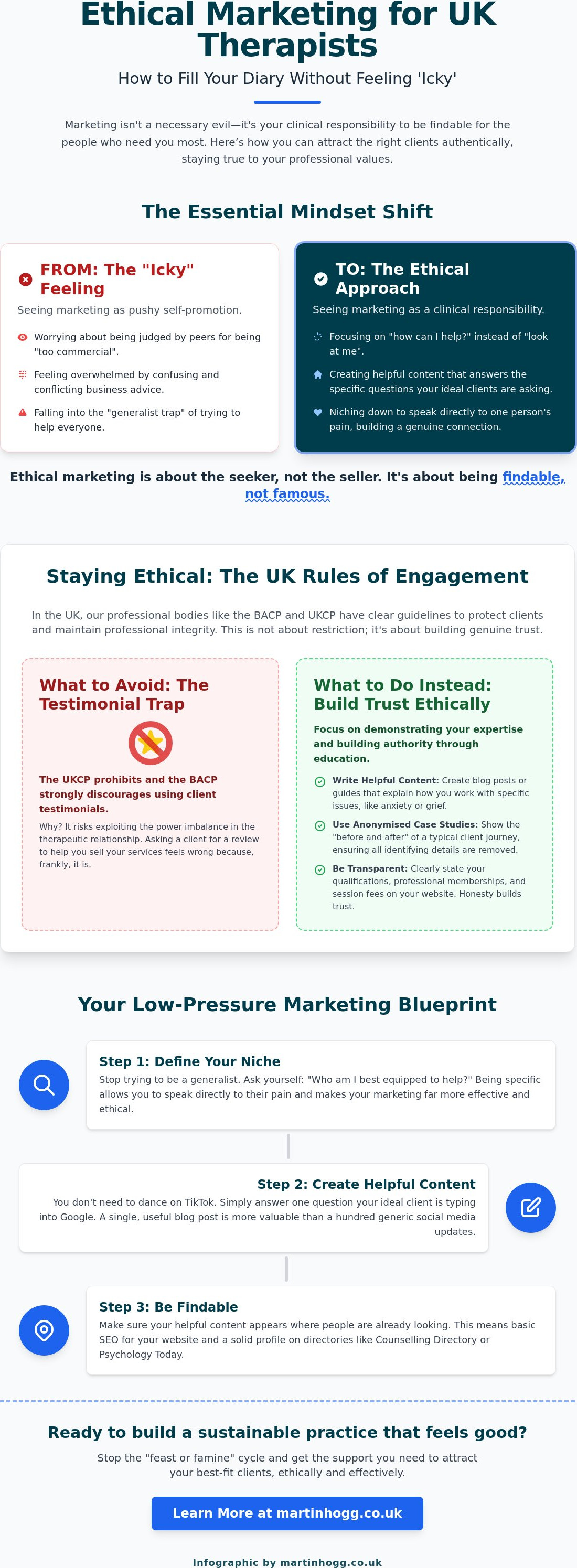
I get it. You spent years training to sit in a room and listen, not to shout about yourself on social media. To many of us, "marketing" feels like a dirty word, often conjuring up images of manipulation or high-pressure sales. This "ick" factor is real, but it usually comes from a misunderstanding of what we're actually trying to do. Marketing ethics in the counselling world isn't about tricking people into things they don't need. It's about being visible so that the person struggling at 2 am can actually find the help they need.
When we talk about ethical private practice marketing, we're shifting the focus away from "hustle culture" and onto helpfulness. Aggressive marketing is about the seller; ethical marketing is about the seeker. If you have a specific skill, staying hidden isn't humble; it's actually a bit of a disservice. If someone is looking for help with a specific issue you specialise in, you have a clinical duty to make sure your name pops up in their search results. It's about being findable, not being famous.
The Psychology of Visibility Fear
Most of us aren't actually afraid of clients; we're afraid of what other therapists will think. We worry about being judged by peers for being "unprofessional" or too commercial. This "who does she think she is?" syndrome keeps many talented practitioners from growing. To fix this, stop thinking "look at me" and start thinking "here is how I can help you." When your content focuses on solving a specific problem, the anxiety about visibility starts to settle. You're just being useful.
Moving Beyond the "Generalist" Trap
Trying to help everyone usually leads to a website filled with generic clichés that don't mean anything to a person in distress. By picking a niche, you're being more ethical, not less. You're being honest about who you are best equipped to support. It allows you to speak directly to one person's pain, which feels like a real conversation. If you want to explore how to do this properly, you can find more resources in our Private Practice Success Membership.
Navigating the Ethical Boundaries of Professional Visibility
In the UK, we don't have the same wild-west approach to reviews that you might see in other industries. If you've been looking at American marketing advice, you'll see a lot of talk about "social proof" through five-star reviews. However, the UKCP prohibits client testimonials, and the BACP strongly discourages them due to the power imbalance in the therapeutic relationship. Using a client’s gratitude to sell your services feels wrong because, frankly, it is. Ethical private practice marketing means finding ways to show you're competent without putting a client in an awkward position.
UK Ethical Frameworks and Advertising
Staying on the right side of the BACP Ethical Framework is about more than just avoiding trouble. It's about being clear, honest, and truthful in everything you put on your website. This includes being transparent about your session fees and your actual qualifications. The ASA (Advertising Standards Authority) is getting much stricter lately, using AI to spot misleading claims. Keeping your practice growth aligned with these standards is essential, and checking out some quality CPD for counsellors UK is a smart move to stay ahead of the Autumn 2026 framework updates.
Social Proof Without Testimonials
So, how do you prove you're good? You do it through authority and education. Instead of a star rating, write a piece of content that explains how you work with anxiety or what a first session actually looks like. You can use anonymised case studies to show the "before and after" of a typical client journey. This doesn't just show you're an expert; it helps the reader feel seen. It's much more powerful than a generic quote. People connect with people, and showing your thinking process builds deeper trust than a badge ever will.
Managing your digital boundaries is the final piece of the puzzle. You don't need to be a robot on social media, but you do need a policy for handling friend requests or comments from clients. Keep your marketing helpful and grounded, and you'll find it naturally attracts the right people. If you're feeling stuck on how to balance these boundaries while growing, our Private Practice Success Membership offers a safe space to figure it out with peers who get it.
Practical, Low-Pressure Strategies to Attract Your Ideal Clients
If the thought of dancing on TikTok makes you want to hand in your BACP membership, I have good news. You don't need to be a social media influencer to have a full diary. In fact, some of the most effective ethical private practice marketing happens away from the noise of the internet. It's about building genuine, human connections with people who are already in contact with your ideal clients. It's about being a person, not a profile.
Start with "non-salesy" networking. This isn't about handing out business cards like a deck of cards at a trade show. It's about reaching out to local GP surgeries or community organisations and letting them know you have space. You aren't "selling" therapy; you're offering a solution to their problem of long NHS waiting lists, which are currently sitting at 12 to 18 weeks in many areas. For a deeper dive into these tactics, take a look at my guide on how to get counselling clients uk.
Creating Content That Connects
Content marketing is simply answering a client’s silent questions before they book. When someone lands on your site from the Counselling Directory or Psychology Today, they're looking for a reason to trust you. Use your blog to address the specific anxieties they have about starting therapy. Don't worry about being perfect. Rough and ready content beats polished every time because it feels more human. Whether you use Squarespace or Canva to create, focus on being helpful rather than sounding like a clinical textbook.
The "Referral Loop" Strategy
You can also connect with "adjacent" professionals. These are people like nutritionists, HR managers, or even other therapists who work in a different niche. If a colleague is at capacity or sees a client who isn't a good fit for them, they need someone reliable to refer to. By nurturing these relationships, you create a steady stream of "best-fit" enquiries without the "ick" of traditional advertising. If you want a structured way to build these connections, join us in the Private Practice Success Membership where we map this out together.
Building a Sustainable Practice with the Practice Visibility Blueprint
Most counsellors I know go through a "feast or famine" cycle. One month you're turning people away; the next, your diary looks worryingly empty. This usually happens when we only think about marketing when we're desperate. Ethical private practice marketing isn't a one-off event or a panic response. It's a steady, quiet background process that ensures you're always visible to those who need you. Having a structured system like the Practice Visibility Blueprint removes the guesswork and the midnight anxiety about where the next enquiry is coming from.
Why a Blueprint Matters
I often see therapists falling into the trap of "random acts of marketing." You might post on LinkedIn once, fiddle with your Counselling Directory profile, and then do nothing for three months because you're busy or overwhelmed. It's exhausting and rarely produces results. A blueprint helps you move to a consistent, calm strategy. You can balance your clinical hours with small, manageable tasks that build your practice over time. It's about working in a way that feels natural, so you don't end up burnt out before you've even filled your diary.
Joining a Supportive Community
Growing a practice can be incredibly lonely. You're often working from a home office or a quiet consulting room with nobody to bounce ideas off or share a win with. This isolation is where imposter syndrome thrives. This is why I created the Private Practice Success Membership. It's a safe, grounded space for UK therapists to share what's working and support each other through the inevitable wobbles of business ownership. Peer support is the best antidote to the self-doubt that creeps in when you try to grow in isolation.
Your next step doesn't have to be a giant leap. Just take one small, ethical action today. Maybe that's finally updating your "above the fold" content on your website or refining your "one-sentence offer" so clients know exactly how you can help. Whatever it is, do it with the knowledge that making yourself findable is a kind, professional thing to do for the people who are currently searching for exactly what you offer.
Taking Your Next Step Toward a Sustainable Practice
Growing your practice doesn't have to mean compromising your integrity. By reframing ethical private practice marketing as a way to help seekers find your support, you remove the "ick" and replace it with purpose. We've looked at how to navigate professional guidelines without needing testimonials and why a structured system is the only way to stop the exhausting feast or famine cycle. You can be a brilliant clinician and a successful business owner at the same time.
I've spent over 15 years supporting UK therapists through social enterprise-led training. As a BACP-endorsed workshop provider, I understand the delicate balance between clinical standards and practice growth. You don't have to figure this out in isolation or guess your way through it. Ready to grow your practice authentically? Join the Private Practice Success community today.
Take one small, practical action today. Whether it's updating your directory profile or reaching out to a local colleague, you're building a bridge to the people who need you. You've got this.
Frequently Asked Questions
Is it ethical for a counsellor to market their services in the UK?
Yes, marketing is entirely ethical as long as your communications are legal, decent, honest, and truthful according to the CAP Code. The BACP Ethical Framework actually encourages being clear about what you offer so clients can make informed choices. Think of it as a signpost rather than a sales pitch. It is about making sure the people who need your specific skills can actually find you in a crowded market.
Can I use client testimonials on my therapy website?
You should avoid using client testimonials, as the UKCP code of ethics explicitly prohibits them and the BACP strongly discourages the practice. This is because of the inherent power imbalance and the risk of clients feeling pressured to provide a positive review. Instead, focus on building authority through educational blog posts or anonymised case studies. These methods show your expertise without compromising clinical boundaries or putting a client on the spot.
How much should I spend on marketing my private practice?
There isn't a single "correct" figure, but many therapists start with low-cost essentials like a professional directory listing and a simple website. You might spend roughly £80 a year on indemnity insurance and a small monthly fee for a site builder like Squarespace. The key is to avoid "shiny object syndrome" where you buy expensive ads before your basic "one-sentence offer" is clear. Focus on "easy wins" first to keep your overheads manageable.
Do I need to be on social media to get therapy clients?
No, you absolutely do not need to be a social media influencer to run a successful practice. While platforms like Instagram can work for some, many practitioners find them draining and unnecessary. Ethical private practice marketing often works better through SEO, local networking, or optimised profiles on the Counselling Directory. If you find social media stressful, don't do it. Your energy is better spent on strategies that feel natural and sustainable for you.
What is the most effective way to get new clients for a private practice?
The most effective way is to define a clear niche and then ensure you are visible where those specific clients are looking. A 2024 BACP survey found that attracting new clients is the biggest challenge for half of its members, often because they try to appeal to everyone. By specialising and using ethical private practice marketing, you become the obvious choice for a specific problem. Combining a solid Psychology Today profile with a helpful, search-friendly website is usually the fastest path to a full diary.
Disclaimer
The information provided on this blog is for general informational purposes only and is not intended to be a substitute for professional medical or mental health advice, diagnosis, or treatment. Reading this content does not create a therapist-client relationship.


