
Facebook Group Marketing for Counsellors: Grow Your UK Practice Without the Cringe

Article by
Martin Hogg
I help Private Practice counsellors in the UK set up and grow an ethical Private Practice they love, work with their ideal clients, and earn the income they deserve. All without guesswork and burnout. I have been a private practice counsellor myself for over 20 years, specialising in anger management. I set up a not-for-profit social enterprise, Citizen Coaching and Counselling, which delivers thousands of counselling sessions a year to adults and young people in Birmingham. I am a registered BACP Counsellor and the author of three books, My Anger Coach, My Anxiety Coach and My Relationship Coach. These are available on Amazon.
Most counsellors treat Facebook groups like a digital noticeboard, pinning up their flyers and wondering why the only response is a deafening silence. It is a bit like walking into a local community centre and shouting your price list at the back of people’s heads. If the thought of promoting your practice online makes you want to curl up in a ball, you are certainly not alone. Most of us entered this profession to help people, not to become social media influencers or pushy salespeople.
I know how exhausting it feels to be invisible on directories like Psychology Today while wasting hours scrolling through feeds without a single new enquiry. You want to grow your practice, but you want to do it with your integrity intact. This article will show you how to master facebook group marketing for counsellors by focusing on genuine connection rather than the hard sell. I am going to give you a clear, 20 minute daily plan to find your ideal private pay clients and build authority without the cringe. We will look at how to stay helpful, stay ethical, and finally start seeing those notifications turn into real world bookings.
Key Takeaways
- Stop shouting into the void of a dead business page and move into 'warm rooms' where your ideal clients are already talking about their struggles.
- Identify the right interest-based groups to join so you can escape the therapist echo chamber and meet people who actually need your specific expertise.
- Master the art of facebook group marketing for counsellors by leading with value and answering questions with clinical insight while keeping your professional boundaries firm.
- Learn how to use the 'skateboard model' to build your own small, focused community that feels safe for members and manageable for your daily schedule.
Why Facebook Groups Beat Business Pages for Finding Counselling Clients
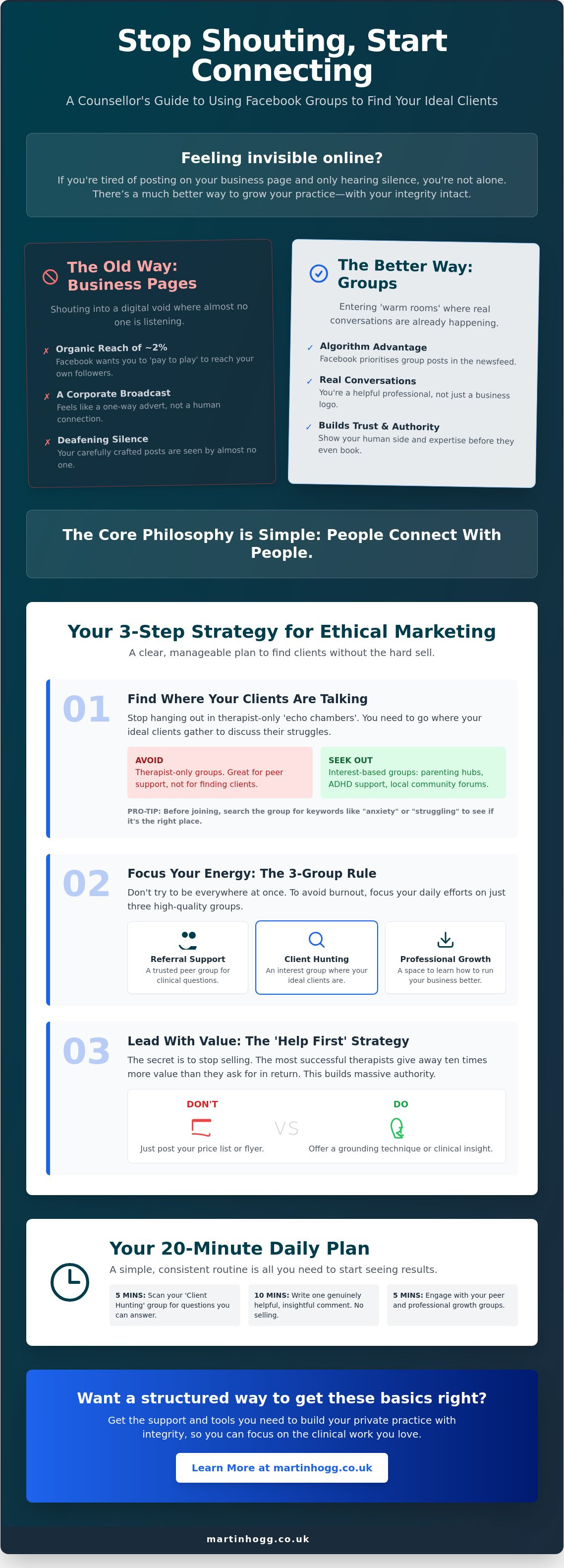
If you have spent hours crafting the perfect post for your Facebook Business Page only for it to be seen by your mum and one supportive colleague, you are experiencing the 'pay to play' reality. Current data suggests organic reach for business pages has plummeted to around 2%. Facebook essentially wants you to open your wallet to reach the people who already follow you. This is why facebook group marketing for counsellors is such a breath of fresh air. Groups are 'warm rooms' where people are already gathered to discuss their specific struggles, from parenting stress to local community issues.
The core philosophy here is simple: people connect with people. A business page feels like a corporate broadcast, but a group feels like a conversation in a community centre. It is the difference between standing on a soapbox with a megaphone and sitting down for a cup of tea. In a group, you aren't just a logo; you are a helpful professional who is part of the furniture.
The Algorithm Advantage
Facebook’s current algorithm is designed to prioritise 'meaningful social interactions'. This means group posts often land right at the top of a user's newsfeed, while business advertisements are frequently scrolled past. Effective social media marketing for therapists isn't about shouting into the void. It is about being present where the conversation is already happening. When you show up consistently in a group, you stop being a distant medical professional and start becoming the 'go-to' expert for your niche.
Building Trust Before the First Session
One of the biggest hurdles for new clients is the fear of the unknown. You can lower this barrier by using 'rough and ready' content that shows your human side. A quick, thoughtful reply to a struggling member or a short video sharing a simple grounding technique builds more trust than a polished, expensive advert ever could. Truthfully, a single helpful comment on a thread is often worth more than a £50 Facebook ad. It proves you are a real person who listens. If you want a structured way to manage this without the headache, my Private Practice Success Membership helps you get these basics right so you can focus on the clinical work you love.
Finding Your Niche: Where UK Therapists Should Actually Spend Their Time
It is very tempting to spend all your time in therapist-only groups. We feel safe there. We can vent about the BACP or ask for book recommendations. But here is the hard truth: hanging out in an echo chamber of your peers will not fill your diary. If you want to make facebook group marketing for counsellors actually work, you have to go where your ideal clients are already talking. This means looking for interest-based groups like parenting hubs, ADHD support circles, or local community forums.
Before you dive in, you need to vet the group. Use the search function to look for keywords like "anxiety," "struggling," or "recommendation." If you see people asking for help and getting thoughtful replies, you are in the right place. If it is just a wall of spammy adverts, move on. When you are joining these spaces, keep the NHS England social media guidance in mind to ensure your interactions remain professional and ethical. Your goal is to be a helpful presence, not a digital flyer-distributor.
Local vs. Niche Interest Groups
If you work from a physical room in a specific town, local community groups are your best friend. People love supporting local professionals. However, if you work online-only, national niche groups like 'Anxiety Support UK' allow you to reach people across the country. Choose the space that matches your practice model. Don't try to be everywhere at once.
The 3-Group Rule
To avoid burnout, I suggest focusing on just three high-quality groups. You can categorise them like this:
- Referral Support: A trusted group of peers for clinical questions.
- Client Hunting: An interest-based group where your ideal clients hang out.
- Professional Growth: A space to learn how to run your business better.
Focusing your energy this way keeps things manageable. If you are struggling to find your specific "client hunting" space, my Private Practice Success Membership offers a structured way to identify where your niche is hiding.
The 'Help First' Strategy: How to Attract Clients Without Sounding Like a Salesperson
The secret to effective facebook group marketing for counsellors is to stop trying to sell. It sounds counterintuitive, but the most successful therapists online are those who give away ten times more value than they ever ask for in return. If you see someone struggling with panic attacks in a local group, don't just post your price list. Offer a grounding technique. Explain why the body reacts that way. When you provide clinical insight for free, you aren't just being nice; you are building massive authority.
Managing self-disclosure is a tightrope walk. You want to show up as a real human, not a clinical robot. It is okay to say, "I've struggled with this too," but keep the focus on the solution. You are the guide, not the patient. If you turn a 'me too' comment into a helpful suggestion that points toward a useful resource on your website, you've done your job well. This approach shows you understand the weight of their experience without making the conversation about you.
The Ethics of Online Advice
We have to be careful not to stumble into accidental therapy sessions in public threads. Always stay within your professional boundaries. It is helpful to look at GMC ethical guidance for a solid perspective on maintaining professional standards online. Use disclaimers often. Remind people that your comment is information, not a replacement for a GP visit or a formal assessment. To keep things clear, develop a one-sentence offer. Something like: "I help stressed parents regain their calm through short-term CBT." It is direct, honest, and avoids the late-night infomercial vibe.
Converting Comments to Enquiries
Knowing when to suggest a private conversation is an art. If someone asks for a recommendation, that is your green light. You might say, "I'm a counsellor specialising in this area, feel free to DM me if you'd like to chat about how I work." Your personal profile then acts as your landing page. If they click your name, they should see a link to your practice and perhaps a mention of your Practice Visibility Blueprint. This naturally moves the conversation from a public space to a private enquiry without any high-pressure tactics. If you want to refine this process and build a steady stream of enquiries, you can grow my practice with a clear, step-by-step visibility plan.
Building Your Own Community: A Practical Roadmap for Private Practice Growth
Starting your own group often feels like a massive mountain to climb. You might worry about having to post every hour or managing a thousand members. I want to introduce you to the 'skateboard model'. In my world, a skateboard is the simplest version of a vehicle that still gets you from A to B. For facebook group marketing for counsellors, this means starting a tiny, highly focused community rather than a generic 'therapy' group. It is about being the leader of a small, safe space where you can show up as a helpful human.
To get people talking, you don't need a complex content calendar. Simple, regular interactions work best. You could try 'Tuesday Tips' where you share one small, actionable bit of advice. Polls are also fantastic; ask something like, "What is the hardest part of your morning routine?" This invites engagement without pressure. Eventually, this small community becomes the natural place for people to learn about your Private Practice Success Membership, as they already trust your expertise and your face.
The Skateboard Group Model
A group of 50 highly engaged people who actually share your niche is worth far more than 5,000 silent members. Choose a name that speaks to the solution you provide, not just your job title. If you specialise in work related stress, name your group 'The Burnout Recovery Hub' rather than 'Counselling with Sarah'. People join groups to solve a problem, and a specific name tells them they are in the right place immediately.
Practical Next Steps
Setting this up is a genuine easy win. Use Canva to whip up a professional looking banner in ten minutes; don't overthink it, because rough and ready content usually beats polished anyway. Make sure your 'About' section has your clear one-sentence offer and a link to your practice. If you want more visibility tips to help you grow, check out our guide on how to get counselling clients UK. Remember to set clear ground rules to keep the space safe and professional, ensuring you stay within your ethical boundaries while building your authority.
Start Turning Conversations into Consultations
Growing a private practice doesn't have to feel like you are selling your soul to an algorithm. By moving away from quiet business pages and into active 'warm rooms,' you can build authority simply by being helpful. Remember the golden rule: lead with value and keep your professional boundaries firm. Whether you are joining local hubs or building your own community using the skateboard model, the goal is to be a visible, human presence in a digital space.
Mastering facebook group marketing for counsellors is about consistency rather than complexity. It is an easy win that takes just 20 minutes of your day. I have spent over 20 years in the UK counselling sector, and as a BACP-endorsed workshop provider, I am passionate about giving you practical, jargon-free strategies that actually work. You don't need a polished marketing degree; you just need a clear plan and the confidence to show up.
If you are ready to stop scrolling and start seeing new enquiries, I can help you bridge that gap. Join the Practice Visibility Blueprint and start attracting more clients today. You already have the clinical skills to help people; now it is time to make sure those people can actually find you. You can do this.
Frequently Asked Questions
Is it ethical for UK counsellors to market themselves in Facebook groups?
It is entirely ethical to use facebook group marketing for counsellors provided you follow the BACP Ethical Framework. The secret is maintaining clear boundaries. You are there to provide information, not therapy. Always be transparent about your credentials and avoid making specific clinical judgements about a user's situation in a public forum. It is about being a helpful professional, not a distant medical authority.
Do I need a Facebook Business Page to participate in groups?
You don't strictly need a business page to join most groups, but it does help your professional image. Most therapists find that interacting through their personal profile feels more natural and human. However, your profile should act as a bridge to your professional world. It should clearly state what you do and link to your website or your "skateboard" landing page to help people find your practice.
How much time should I spend on Facebook group marketing each week?
I suggest spending about 20 minutes a day, which works out to roughly two hours each week. This is more than enough time to check your three chosen groups, answer a few questions, and share a helpful tip. Consistency is far more important than intensity. Showing up for a few minutes daily keeps you visible without causing the dreaded social media overwhelm or burnout.
What should I do if someone asks for clinical advice on a public thread?
You should never give specific clinical advice on a public thread. Instead, offer general information and signpost the person to formal help. You might say, "It sounds like you are carrying a lot right now. While I can't offer therapy here, many people find this specific technique helpful. It is always a good idea to speak with your GP or check the Counselling Directory for a local therapist."
Should I use my personal Facebook profile or a professional one for groups?
Using your personal profile is generally better for engagement because people connect with people. However, you must keep your personal and professional lives separate. Ensure your privacy settings are locked down for your private posts. Your public profile should look like a digital business card, featuring a clear one-sentence offer and a professional photo rather than your latest holiday snaps or political opinions.
Disclaimer
The information provided on this blog is for general informational purposes only and is not intended to be a substitute for professional medical or mental health advice, diagnosis, or treatment. Reading this content does not create a therapist-client relationship.


