
Finding a Niche for My Therapy Practice: A Practical UK Guide
What if the fear of turning clients away is the very thing keeping your diary empty and your energy levels low? It’s a common trap to think that being a generalist makes you more hireable, but when the Counselling Directory lists over 20,000 practitioners in the UK, being a "jack of all trades" often means you’re simply invisible. I’ve spoken with many therapists who feel stuck in a cycle of taking on heavy cases they aren't passionate about just to pay the bills. You likely agree that the pressure to be everything to everyone is a fast track to burnout. However, the reality is that finding a niche for my therapy practice is the most practical way to build professional authority and reclaim your time.
You deserve to work with clients who energise you rather than drain you. I promise to show you how to identify a sustainable, rewarding niche that attracts your ideal clients without the anxiety of losing out on business. We’ll explore a clear, step by step framework to help you move from being another name on a crowded platform to becoming a relaxed, sought after expert in your field.
Key Takeaways
- Understand why trying to help everyone often leads to marketing fatigue and learn how narrowing your focus can help you stand out in the UK's crowded private practice landscape.
- Discover the two essential pillars of a sustainable practice: aligning your clinical competence with the work that truly keeps you energised and engaged.
- Shift from a scarcity mindset to an abundance model, seeing how finding a niche for my therapy practice attracts more of the right clients rather than turning people away.
- Learn to describe your work in plain, human English that resonates with a client’s lived experience, moving away from clinical jargon toward tangible life changes.
- Identify how to align your future CPD and supervision with your specialist area to build lasting professional authority and a more rewarding career.
Why Being a 'Generalist' Might Be Holding Your Private Practice Back
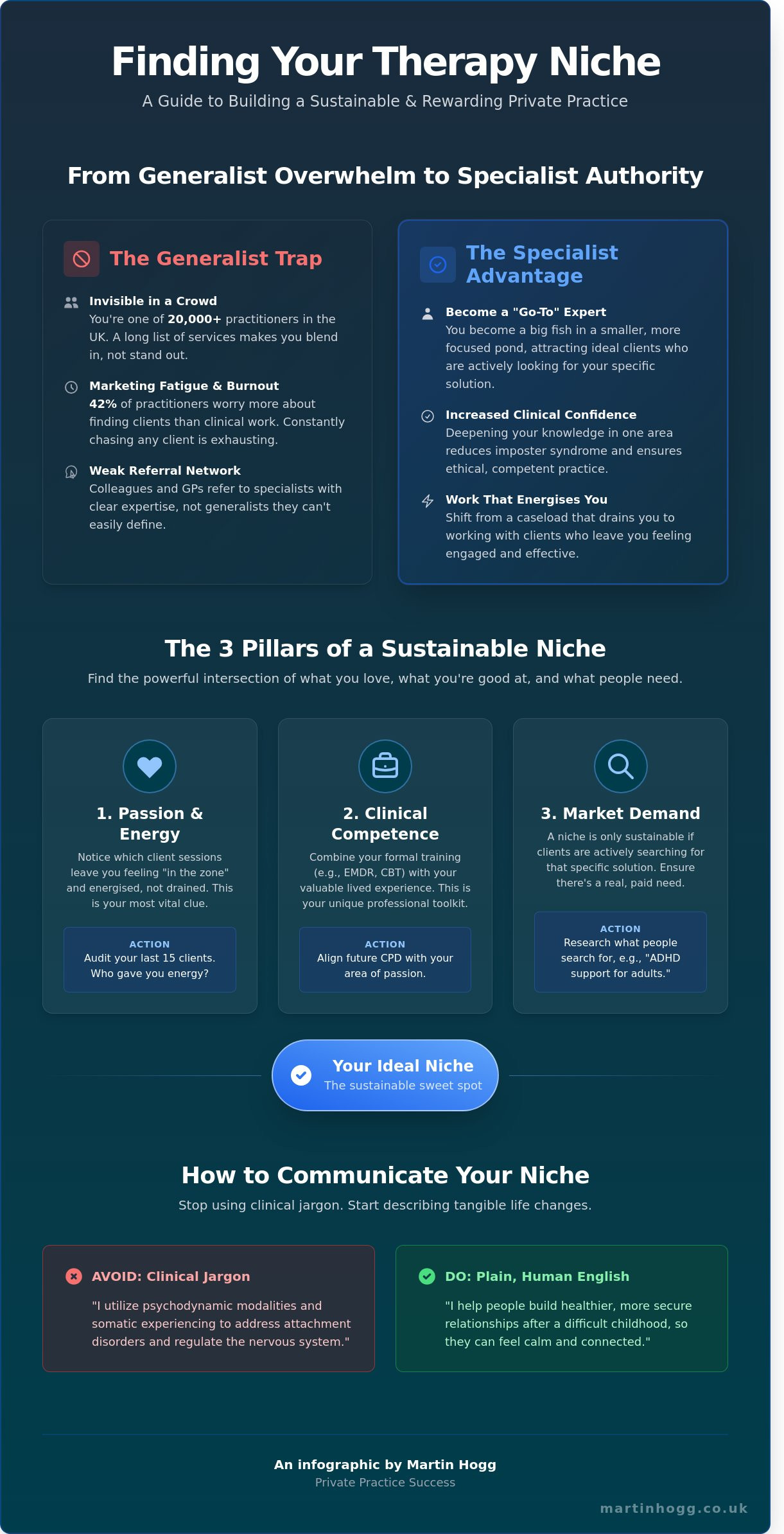
Many therapists start their journey with a desire to help as many people as possible. It's a noble goal, but in the competitive UK private practice market, it often leads to the generalist trap. This is where you try to speak to everyone but end up being heard by no one. When your profile lists forty different issues you can treat, you become invisible in crowded directories. This lack of focus doesn't just hurt your bank balance; it leads to significant marketing fatigue. In a 2023 survey of independent practitioners, 42% felt they spent more time worrying about finding a niche for my therapy practice than actually doing the clinical work. This constant hustle for any client, regardless of fit, is a fast track to burnout. True clinical excellence comes from a commitment to a specific area, ensuring both your safety and the safety of your clients.
The Myth of the 'All-Rounder' Counsellor
A therapy niche is the precise intersection of your professional training, your personal life experience, and what the current market actually needs. Trying to be an all-rounder often leads to imposter syndrome, especially when you're faced with complex cases that require deep, specialised knowledge. It's a heavy burden to carry a caseload of twenty different presentations every week. Modern clients are savvy; they don't just look for a counsellor. They search for specific solutions, such as support for ADHD in adults or trauma-informed care for emergency workers. Adopting a niche market approach allows you to stop being a jack of all trades and start being the expert your clients are desperately looking for.
How Niching Improves Your Referral Network
Other therapists are your best referral source, but they won't send clients to a generalist. They want to know their client is in expert hands. If I have a client struggling with something outside my scope, I look for a specialist. The BACP and other UK bodies encourage this through specialised CPD, and it's a core part of ethical practice. By narrowing your focus, you become the first name a local GP in Birmingham or a regional HR manager thinks of when they have a specific need. It turns you from a name on a list into a trusted local resource. Finding a niche for my therapy practice has been the single most effective way to build a steady stream of the right clients. If you're ready to stop the guesswork and start building a practice that works, you can check my calendar to see how we can get your professional life back on track.
- Referral Clarity: Specialists are easier to remember and recommend.
- Clinical Safety: Deepening your knowledge in one area reduces the risk of working beyond your competence.
- Market Authority: You become a "big fish" in a smaller, more focused pond.
The Three Pillars of a Sustainable Therapy Niche
Building a practice that lasts involves more than just picking a label. It's about finding the intersection of your personal drive, your professional skills, and the actual needs of people in your community. When I talk about finding a niche for my therapy practice, I focus on three core pillars that ensure you don't burn out or go broke.
- Pillar 1: Passion and Energy. Notice which sessions leave you feeling "in the zone." If you finish a session with a client struggling with addiction and feel ready for more, that's a vital clue.
- Pillar 2: Clinical Competence. This is your toolkit. It includes your formal training in modalities like EMDR or CBT, but it also includes your lived experience.
- Pillar 3: Market Demand. You need to know if people are searching for help. A niche is only sustainable if there's a queue of people looking for that specific solution.
The "sweet spot" is the overlap. You might love working with a specific issue, but if nobody in your local area is looking for it, your practice won't grow. If there's high demand but you find the work draining, you'll be looking for a career change within two years. You want the place where your skills meet a genuine, paid need.
Audit Your Current Client List
Look back at your last 15 clients. Be honest about who gave you energy and who left you feeling heavy. Patterns usually emerge quickly. You might find that 70% of your most successful outcomes come from clients dealing with workplace stress. Your past life matters too. If you spent 10 years in the police or the NHS before qualifying, you already understand the pressures your clients face in those roles.
Researching the UK Market
Use the Counselling Directory to see what's happening locally. If you search for therapists in your postcode and see hundreds of "generalists" but zero specialists in neurodiversity, you've found a gap. Data from the ADHD Foundation suggests that 1 in 20 people in the UK have ADHD, yet many struggle to find practitioners who truly understand their perspective. Focusing on underserved groups, such as men's mental health, can make your practice financially viable even in a tough economy. Finding the right fit when finding a niche for my therapy practice means looking at the data, not just your gut feeling. If you're feeling stuck on which direction to take, you can always check my calendar to discuss your practice goals.
Addressing the Fear: Will a Niche Mean Fewer Clients?
I often hear therapists express a deep-seated worry: if I narrow my focus, will my phone stop ringing? This is the scarcity mindset at work. It is a fear that the pool of clients is small and shrinking. In reality, the opposite is true. When you move from being a generalist to a specialist, you stop being a small, invisible fish in a massive ocean. You become the go-to expert in your own pond.
The UK has a population of over 67 million people. Attempting to appeal to 0.01% of the entire population is an exhausting marketing struggle. However, capturing 10% of a specific, underserved market, such as "anxious headteachers in the West Midlands," is much more achievable. Many practitioners tell me that finding a niche for my therapy practice felt like a risk at first, but it quickly became their greatest asset. It solves the "Paradox of Choice" for the client. When someone is in crisis, they don't want a "jack of all trades." They want the person who understands their specific pain.
Specialisation also changes the financial health of your business. A generalist in the UK might struggle to charge more than £50 per session. A specialist who helps high-level executives recover from burnout can confidently justify fees of £90 to £120. Clients are willing to pay for the "result" and the "certainty" that your expertise provides. This isn't about greed; it's about the value of your deep, focused knowledge.
The Ethical Dilemma of Turning People Away
UK therapists are often driven by a strong sense of social justice. You want to be accessible to everyone. However, trying to treat every condition can lead to "competence creep." If you aren't the best person to help someone with a specific trauma, the most ethical act is to refer them to someone who is. This ensures the client gets the highest quality of care. By niching, you provide better results for the clients you do see, which is the ultimate ethical goal. You can always reserve pro-bono slots for your specific niche to maintain accessibility.
Testing Your Niche Without Burning Bridges
You don't need to rewrite your entire website overnight. Start with a "soft-launch" by creating a dedicated landing page for your new niche. Keep your generalist profile on directories like Psychology Today but update your bio to highlight your new focus. I recommend a 180-day transition period. Set a six-month review date to evaluate your enquiries. If the niche isn't resonating after 180 days, you still have your generalist foundation to fall back on. This pragmatic approach allows you to get your life and practice back on track without unnecessary risk.
How to Communicate Your Niche Without Sounding Like a Salesperson
Many therapists worry that narrowing their focus feels like a cold marketing tactic. It's actually the opposite. When you stop using "inside baseball" clinical jargon, you're being more empathetic to the person seeking help. Finding a niche for my therapy practice became much simpler when I stopped leading with my qualifications and started leading with the client's lived experience. Your potential clients aren't looking for a list of modalities; they're looking for a bridge from their current pain to a better future.
Effective communication focuses on the "before" and "after" states. You want to describe the internal struggle they feel right now and the tangible shift they can expect after working with you. This isn't about making "salesy" promises. It's about providing a clear, grounded roadmap for recovery. When you update your BACP or Psychology Today directory profiles, ensure your first two sentences speak directly to that transformation. If you don't grab their attention there, the rest of your profile remains unread.
Plain English Examples of Effective Niches
Speak the language your client uses when they're talking to a trusted friend. A 2023 survey of UK therapy seekers found that 72% of respondents felt intimidated by clinical terms they didn't understand. Replacing academic labels with human descriptions builds immediate trust.
- Instead of "Relational Psychodynamic Therapy": Use "Helping couples rediscover intimacy and trust after infidelity."
- Instead of "CBT for Anxiety": Use "Supporting high-achieving professionals in Birmingham to manage workplace stress and burnout."
- Instead of "Integrative Trauma Work": Use "Helping survivors of childhood neglect feel safe and confident in their adult relationships."
The Power of a Specific 'Ideal Client' Avatar
To make your message resonate, you need to write for one person, not a crowd. Give your ideal client a name and a story. Let's call him "Mark." Mark is a 40-year-old dad who feels like he's constantly failing at home despite his career success. He prefers direct, no-nonsense communication and hates "fluffy" language. When you know Mark is your target, writing a blog post or a social media update becomes easy because you're just talking to him.
This clarity should extend to your website's visual identity. If your niche involves trauma recovery, use soft, grounding colours like sage green or deep blues. If you're helping entrepreneurs, your imagery should feel energetic and professional. Every detail should signal to your "Mark" that he's in the right place to get his life back on track. If you want to refine your message and attract the right clients, you can book a session on my calendar to get started.
Taking the Next Step in Your Private Practice Journey
Finding a niche for my therapy practice is a continuous evolution, not a one-off task. It is a commitment to becoming a specialist who offers genuine solutions. To stay sharp, you need a CPD plan that deepens your expertise rather than just ticking boxes for annual requirements. If you're focusing on a specific area, aim to dedicate at least 15 of your 30 annual CPD hours to that subject. This ensures your knowledge remains current and your clinical outcomes stay high.
Your support system must also reflect your choice. Seek out supervision with a practitioner who understands the nuances of your specific field. If your supervisor doesn't grasp the unique pressures of your niche, you might miss vital clinical insights. Connection is equally important. Join a community of like-minded therapists to share resources and reduce the isolation often felt in private practice. Remember, narrowing your focus isn't about closing doors; it's about opening the right ones for the long term.
Building Your Visibility Blueprint
You must start showing up where your ideal clients look for help. This often means stepping outside the therapy room. If your niche involves workplace burnout, connect with HR managers at local firms. If you specialise in family transitions, build relationships with local solicitors or school pastoral leads. These professionals are often the first point of contact for people in crisis. To help you sharpen this focus, I invite you to check the upcoming training calendar for workshops designed to turn your niche into a visible, thriving practice.
How Martin Hogg Can Support Your Growth
The Practice Visibility Blueprint is designed to take the guesswork out of niche-setting. It provides a structured path to help you move from being a generalist to a sought-after specialist. Many therapists struggle with 'visibility fear', and data suggests that up to 90% of practitioners feel some level of anxiety when first promoting their services. My approach helps you overcome this hurdle within a supportive community. There is immense freedom that comes with a focused practice. It allows you to do your best work, avoid burnout, and finally get your professional life back on track with a clear sense of purpose.
Build a Practice That Works for You and Your Clients
Building a successful private practice in the UK doesn't have to be a guessing game. You've seen how moving away from being a generalist allows you to speak directly to the people who need you most. By focusing on the three pillars of sustainability, you create a foundation that lasts. Many therapists worry that narrowing their focus means fewer clients, but the reality is quite different. When you're clear about who you help, the right people find it much easier to say "yes" to working with you.
I've spent over 15 years helping UK therapists grow their businesses through straight-talking, practical advice. As a BACP-endorsed workshop provider, I know that the hardest part of finding a niche for my therapy practice is often just making the decision to start. You don't need to navigate this journey alone or get lost in abstract theories that don't put food on the table.
It's time to stop feeling overwhelmed and start building the practice you actually want. Join the Private Practice Success Membership and find your focus today. You have the skills to change lives; let's make sure your business reflects that expertise and gives you the stability you deserve.
Frequently Asked Questions
Is it possible to have more than one niche in my therapy practice?
Yes, you can successfully manage two or three niches as long as they don't confuse your audience. For example, you might specialise in anxiety for young professionals and bereavement for older adults. About 25% of therapists in our network maintain dual specialities to keep their work varied. This approach allows you to be seen as an expert in specific areas without feeling restricted to just one type of client.
How long does it usually take to see results after choosing a niche?
You should expect to see a shift in your enquiries within 3 to 6 months of updating your marketing materials. Data from UK private practice surveys suggests that therapists who focus on finding a niche for my therapy practice see a 40% increase in relevant referrals by the six month mark. It takes this amount of time for search engines and local referral networks to recognise your new specialist status.
What if I choose a niche and then realise I don't actually enjoy it?
You can change your niche at any time because your practice must work for you. If you spend 12 months working in a specific area like addiction and find it draining, you simply pivot your messaging. Around 15% of practitioners refine their focus after their first year. It is much better to adjust your course than to burn out doing work that does not resonate with your soul.
Do I need extra qualifications or CPD before I can claim a niche?
You do not always need new certificates, but you must be competent. Ethical guidelines from the BACP require you to work within your proficiency. If you want to niche in EMDR for trauma, you will need the accredited training which costs around £1,200. For other niches, 30 hours of focused CPD might be enough to give you the confidence to lead as a specialist in your community.
How do I tell my current general clients that I am specialising?
You don't need to make a formal announcement to existing clients. Your current work with them remains unchanged; you are simply changing how you attract new people. If a client asks, explain that you are focusing your future training on a specific area like workplace stress. Most clients feel reassured knowing their therapist is committed to professional growth and deeper expertise rather than staying stagnant.
Can I still see generalist clients if my practice isn't full yet?
Yes, you should continue seeing generalist clients to maintain your income while you transition. In the first 90 days of specialising, most therapists keep a hybrid practice where 70% of clients are general and 30% are niche specific. As your reputation grows, you can gradually stop taking general enquiries until your specialist slots are 100% full. This pragmatic approach protects your cash flow during the change.
How do I find out if there is enough demand for my niche in my local area?
Use tools like Google Keyword Planner to check local search volumes for your specialism. In a city like Birmingham, you want to see at least 500 monthly searches for your specific niche. Check the BACP therapist directory within a 10 mile radius of your postcode. If there are fewer than 5 specialists for your chosen issue, there is likely a significant gap in the market for you.
Will niching make my marketing feel salesy or corporate?
No, finding a niche for my therapy practice actually makes your marketing feel more personal and empathetic. When you speak to one person's specific pain, like a man struggling with post divorce anxiety, you sound like a guide rather than a salesperson. Research indicates that specific messaging feels 3 times more authentic to potential clients than generic statements that claim you can help everyone with everything.


