
Finding Your Niche as a Therapist in the UK: A Practical Guide to Practice Growth

Article by
Martin Hogg
I help Private Practice counsellors in the UK set up and grow an ethical Private Practice they love, work with their ideal clients, and earn the income they deserve. All without guesswork and burnout. I have been a private practice counsellor myself for over 20 years, specialising in anger management. I set up a not-for-profit social enterprise, Citizen Coaching and Counselling, which delivers thousands of counselling sessions a year to adults and young people in Birmingham. I am a registered BACP Counsellor and the author of three books, My Anger Coach, My Anxiety Coach and My Relationship Coach. These are available on Amazon.
The most common fear I hear from counsellors is that picking a specialty will mean turning away work. It feels counterintuitive, but the truth is that trying to help everyone is the fastest way to stay invisible. If you are struggling with finding your niche as a therapist uk, your profile on Psychology Today likely looks like a long list of every issue from A to Z. This does not make you look versatile; it makes you look like a "jack of all trades" who is hard to find in a crowded market.
I understand the pressure you are under right now. With the 2026 SCoPEd framework changes now fully in place and the cost of BACP membership rising, the anxiety about keeping your diary full is very real. You want a practice that feels sustainable and rewarding, rather than a constant scramble for any client who clicks your link. This guide will show you how narrowing your focus actually expands your practice and makes you magnetic to your ideal clients. We will explore how specialist authority leads to higher confidence and the ability to command fees that reflect your expertise, moving you toward a more functional and fulfilling professional future.
Key Takeaways
- Learn why the "sea of sameness" on directories like Psychology Today is stalling your growth and how to stand out by solving one specific problem.
- Discover two clear paths for finding your niche as a therapist uk, using either your own lived experience or identified gaps in the current market.
- Use the "skateboard model" to test a new specialty safely, allowing you to build momentum without the need for a polished, expensive rebrand.
- Draft a powerful one-sentence offer that tells your ideal clients exactly who you help and the tangible results you can help them achieve.
- Optimise your "above the fold" content to ensure you make an immediate, human connection with the right people the moment they find you.
Why the Generalist Trap is Stalling Your UK Private Practice
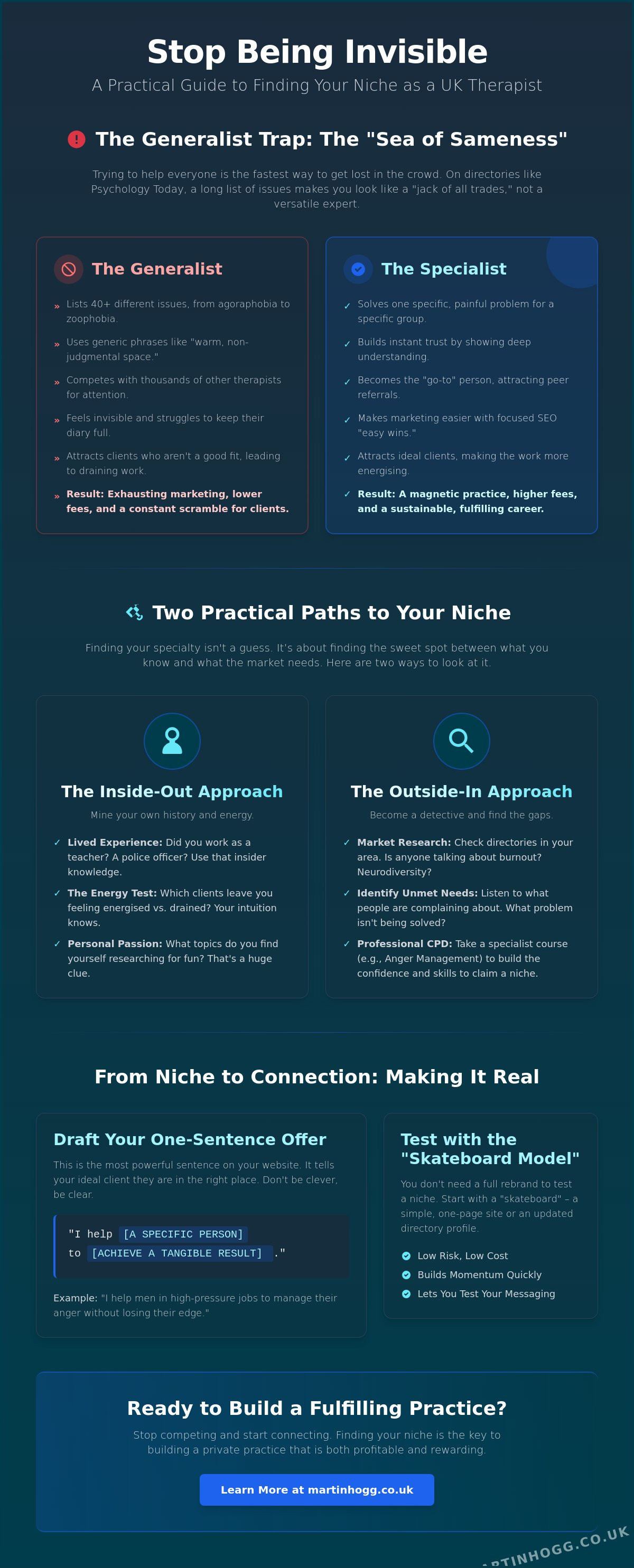
I see it every single week. A talented therapist sets up their private practice, joins the BACP, and then writes a directory profile that looks exactly like everyone else's. They list forty different issues they can "help" with, from agoraphobia to zoophobia. This is the generalist trap. In your effort to avoid missing out on clients, you've accidentally made yourself invisible. A true therapy niche isn't just a label. It's the intersection of your specific clinical skill and a specific, painful problem your client is facing.
Let's be honest about the "Directory Sea of Sameness." If your profile leads with "offering a warm, non-judgmental space," you are blending into the background. Every qualified counsellor offers that; it is the bare minimum of our profession, not a unique selling point. Since the SCoPEd framework transition ended in early 2026, the professional landscape has become more structured. Having a clear specialism builds a "moat" around your practice. It protects your business by establishing you as an expert in a specific column of care, rather than just another name in a long list of general practitioners.
The Psychology of the Searcher
When someone is in distress, they don't look for a "jack of all trades." If a person is struggling with the 62% of anxiety-related issues reported in recent BACP surveys, they want someone who understands their specific flavour of panic. A specific one-sentence offer builds instant trust because it proves you already understand the client's internal world before they've even booked a session. By understanding niche markets, you realise that being the "go-to" person for a small group is far more profitable than being a "maybe" for everyone.
Generalist vs. Specialist: A Financial Reality
Marketing a general practice is exhausting and expensive. You're competing with thousands of others for broad, high-cost search terms. Finding your niche as a therapist uk allows for "easy wins" in SEO. You can rank on the first page for specific terms that your ideal clients are actually typing into Google at 2:00 am. For more foundational advice on setting up, you can read my guide on Counselling Private Practice UK. Specialist authority doesn't just bring in more clients; it allows you to command the higher fees that reflect your deep expertise.
Two Practical Paths to Finding Your Niche as a Therapist UK
Picking a specialty doesn't have to be a shot in the dark. I usually suggest looking at it from two different angles: the Inside-Out approach and the Outside-In approach. When you're finding your niche as a therapist uk, the goal is to find that sweet spot between what you know and what the market is actually crying out for. It's about working smarter, not just harder.
The Inside-Out approach is about mining your own history. If you spent a decade in the police or worked as a teacher before training, you've already got a massive head start. You speak the language. You know the specific stresses that keep those people awake at 3:00 am. It's much easier to build trust when you don't have to ask a client to explain the basic mechanics of their job. I also suggest a "connection test." Think about your last ten clients. Which ones left you feeling energised and which ones left you drained? That's your intuition giving you a very loud hint about where your niche lies.
The Outside-In approach is more about being a bit of a detective. Have a look at your local area on the Counselling Directory or Psychology Today. If there are fifty people listed as generalists but nobody mentioning neurodiversity, GSRD, or burnout, you've found a gap. I'd also suggest looking at the official government guidance on business planning. It helps you shift from a clinical-only mindset to a practical practice-owner mindset.
The Power of Professional CPD
Sometimes you just need the right tools to claim your space. Taking a specific course like my Anger Management CPD gives you the clinical confidence to say, "Yes, I am the person for this." Peer referrals flow to the specialist, not the generalist. Other counsellors will happily pass you the "difficult" cases because they know you have the training they lack.
The "Working with Men" Example
Focusing on a specific demographic can completely transform the way you market your practice. For instance, my Working with Men CPD teaches you how to use language that resonates with men who might otherwise avoid therapy. They aren't looking for a "safe space" in the abstract; they want to know you understand their world and can help them get back on track. If you want to dive deeper into these strategies, come and join us in the Private Practice Success membership.
The Skateboard Model: Testing Your Niche Without the Risk
A common mistake I see is the "all-or-nothing" rebrand. Therapists decide on a niche, delete their entire website, and spend three months building a complex Squarespace masterpiece before they've even had one client in that category. This is a recipe for burnout and an empty bank account. Instead, I recommend the "skateboard model." If you want to build a car, you don't start with a steering wheel; you start with a skateboard. It’s a Minimum Viable Practice (MVP) that gets you moving immediately while you're still figuring out the engine.
The first step in finding your niche as a therapist uk is drafting your "One-Sentence Offer." It should follow a simple formula: "I help [who] with [problem] so they can [result]." For example, "I help stressed-out headteachers manage burnout so they can enjoy their weekends again." This clarity is much more magnetic than a list of modalities. Once you have this, run a 90-day pilot. Don't touch your main website yet. Just update one directory profile, perhaps on Psychology Today or the Counselling Directory, and see if the "connection rate" changes. Are the right people actually calling you?
While testing, keep your content "rough and ready." A simple, helpful graphic made on Canva or a short, unpolished video often performs better than a corporate-looking ad. People connect with people, not polished brands. You can find excellent case studies on this transition in the BACP Private Practice Journal, which often highlights the practicalities of shifting focus in the UK market.
The One-Page MVP Website
You don't need a ten-page site to be successful. A single landing page with clear "above the fold" content is often enough. Ensure your title tags and description tags explicitly mention your niche. This helps Google understand who you are and makes you appear in specific searches. If you're feeling overwhelmed by the technical side, joining a community like the Private Practice Success Membership can provide the step-by-step guidance you need to get your skateboard rolling.
Avoiding Perfectionism and Procrastination
Perfectionism is just procrastination in a fancy suit. I often hear therapists say they aren't "expert enough" yet to claim a specialism. This imposter syndrome is normal, but remember: you only need to be a few steps ahead of the person you are helping. Done is always better than perfect. Launch your pilot, gather data, and refine as you go. Your niche doesn't have to be a life sentence; it’s just the bridge to your next stage of growth.
Building Your Visibility Around Your Specialism
Visibility is often the part where therapists feel the most self-doubt. You might worry about being "too much" or coming across as "salesy." But if you have a solution for a specific person's pain, you have a duty to let them find you. This is why finding your niche as a therapist uk is only half the battle. You must then optimise your "above the fold" content. This is the first paragraph people see on Psychology Today or the Counselling Directory before they hit "read more." If those first two sentences don't speak directly to their problem, they will keep scrolling.
Remember the "People Connect with People" rule. Your profile shouldn't read like a clinical textbook. Use your niche to tell a human story. If you are specialising in burnout because you have been there yourself, say so. It builds a bridge of empathy that a list of qualifications never will. This approach turns your directory listing from a CV into a warm invitation for a specific person to reach out.
Don't forget the power of peer referrals. When you are a generalist, other therapists don't know when to send someone your way. When you are the "anger management specialist" or the "ADHD in women expert," you become the first person they think of when a client isn't the right fit for them. Tell your network exactly what you do. Use the "one-sentence offer" we drafted earlier in your networking emails or at local BACP meetings. It makes their lives easier and fills your diary with the right-fit clients.
Directory Mastery for Specialists
On directories, your headline is your most valuable real estate. Instead of "Counsellor in Birmingham," try "Helping New Parents Navigate Postnatal Anxiety." This is a simple but effective way to use keywords that your ideal clients are actually searching for. For a deeper dive into these technical tactics, check out my guide on Marketing for Therapists UK.
From Solo to Specialist CEO
Niching is the first essential step toward scaling a therapy practice. When you are the go-to expert, you stop chasing every lead and start managing a waiting list. You move from being a solo practitioner to a specialist CEO who can command higher fees and perhaps even bring on associates to handle the demand. If you want to keep this momentum going and build a practice that truly serves you, join us in the Private Practice Success Membership for ongoing support and practical next steps.
Your Path to a Sustainable Practice
Building a private practice in the UK doesn't have to feel like a constant battle against the directory algorithms. By moving away from the generalist trap, you are actually making it easier for the people who need you most to find you. Remember, finding your niche as a therapist uk is about creating that "skateboard" and testing your ideas in the real world before committing to a full rebrand. It is about speaking like a human and showing up as the specialist authority your clients are already searching for.
I've spent over 20 years in the UK private practice landscape, and I've seen how a clear focus transforms a struggling diary into a thriving business. You don't have to do this alone or guess your way through the marketing maze. My BACP-endorsed workshops and the Practice Visibility Blueprint system are designed to give you the exact steps you need to stand out and build a waiting list of right-fit clients.
If you are ready to stop being a "jack of all trades" and start building a practice that truly reflects your expertise, join the Private Practice Success community to find your niche and grow your practice. You have the skills to change lives; now let's make sure the right people can find you. You've got this.
Frequently Asked Questions
Is it better to have one niche or can I have two?
Start with one niche to avoid confusing your audience. If you try to market two different specialties at once, you end up splitting your visibility and confusing your potential clients. Think of it like a laser versus a floodlight. Once you have a steady stream of right-fit clients for your first niche, you can always use the skateboard model to test a second one. For now, keep it focused.
Will I get bored if I only work with one type of client?
No, you won't get bored because every client brings a unique story. Even if you only work with "stressed teachers," every person who sits in your chair has a different set of life experiences and challenges. A niche is a marketing bridge to help people find you, not a clinical prison. You will actually find more joy in your work because you aren't constantly scrambling to learn new protocols.
Do I need a separate website for my niche?
You don't need a separate website to start your transition. When you are finding your niche as a therapist uk, your first step should be a single landing page or even just a dedicated directory profile on Psychology Today. Use that "above the fold" space to speak directly to your target group. Don't let a complicated Squarespace project become a fancy way to procrastinate on actually getting clients.
What if there are already too many therapists in my niche on Counselling Directory?
Narrow your focus even further if a category feels crowded. Anxiety is over-saturated on every directory in the UK. However, anxiety for small business owners or parents of neurodivergent children is likely wide open. The more specific you get, the less competition you have. You aren't fighting for everyone; you are becoming the only logical choice for a very specific group of people who need your help.
How much experience do I need before I can call myself a specialist?
You only need to be a few steps ahead of your clients to claim a specialism. You don't need decades of experience to be a specialist. Taking specific training, like my Anger Management CPD, gives you the clinical foundation to claim that authority. When finding your niche as a therapist uk, remember that your ideal clients aren't looking for the most qualified person on earth. They want the person who understands their specific pain.
Disclaimer
The information provided on this blog is for general informational purposes only and is not intended to be a substitute for professional medical or mental health advice, diagnosis, or treatment. Reading this content does not create a therapist-client relationship.


