From Empty Diary to Waiting List: A Practical Guide for UK Therapists
You sit at your desk, refreshing your email one more time, but the only notification is a newsletter you forgot to unsubscribe from. It's a quiet, heavy feeling that many of us in private practice know all too well. When the enquiries don't come, it's easy to start questioning your clinical skills or feeling like a bit of a failure compared to others. You want to help people, yet the journey from empty diary to waiting list can feel blocked by a nagging fear that "marketing" somehow compromises your professional integrity.
I understand that tension deeply. I believe that an empty diary isn't a reflection of your ability as a therapist; it's simply a sign that your professional visibility needs a practical, ethical system. In this guide, I'll show you how to grow your practice by building a bridge between your expertise and the people who need it most. We will explore how to attract a steady stream of private pay clients and gain the security of a waiting list without resorting to pushy sales tactics. You'll discover the specific steps to grow your practice with confidence, ensuring you stay grounded in your values while finally achieving the professional stability you deserve.
Key Takeaways
- Reframe visibility as an ethical service that helps you reach the people who are currently searching for your specific support.
- Learn how to use the Practice Visibility Blueprint to build a practice based on credibility and genuine human connection.
- Find out the practical steps needed to go from empty diary to waiting list by refining your directory profiles and website.
- Prepare for a busier practice by learning how to set boundaries and manage your energy as your enquiry numbers grow.
- Gain the confidence to move away from the stress of an inconsistent income and towards a stable, private pay practice.
The Quiet Reality of an Empty Therapy Diary
Starting a private practice often feels like stepping into a void. After years of training and perhaps working in busy agency settings, the silence of an empty inbox can be deafening. It’s common to feel a sense of professional isolation, or even shame, as you look at a calendar that remains stubbornly blank. You might find yourself comparing your quiet room to the perceived success of others on social media, wondering if you’ve made a mistake. Please know that you aren't alone in this; a 2023 survey indicated that over 40% of private practitioners in the UK struggle with inconsistent income.
This transition from agency work to private practice is where many gifted UK counsellors stumble. In an agency or the NHS, the clients are provided for you. In private practice, you are suddenly responsible for the entire journey from initial enquiry to the final session. It's helpful to remember that this phase is a common, surmountable hurdle that most practitioners face in their first two years. The empty diary is a temporary gap between your clinical qualification and your business visibility.
Why 'Build It and They Will Come' Fails for Counsellors
There is a persistent myth in our profession that clinical excellence is the only tool you need to attract a full caseload. While understanding psychotherapy and maintaining high standards of care are foundational, they don't automatically translate into new enquiries. The UK therapy market has changed significantly in recent years. With the growth of online therapy and a 35% increase in NHS referrals since 2019, potential clients are searching differently than they used to.
Simply having a directory listing is no longer enough to move you from empty diary to waiting list. Potential clients are now more discerning and often overwhelmed by the sheer number of profiles they see. Relying on word of mouth before you have a solid client base is a recipe for anxiety. To grow, we have to bridge the gap between being a great clinician and becoming a visible professional. If you're feeling stuck in this quiet phase, joining a community like the Private Practice Success Membership can provide the practical support needed to start filling those gaps.
Shifting from Invisibility to the Practice Visibility Blueprint
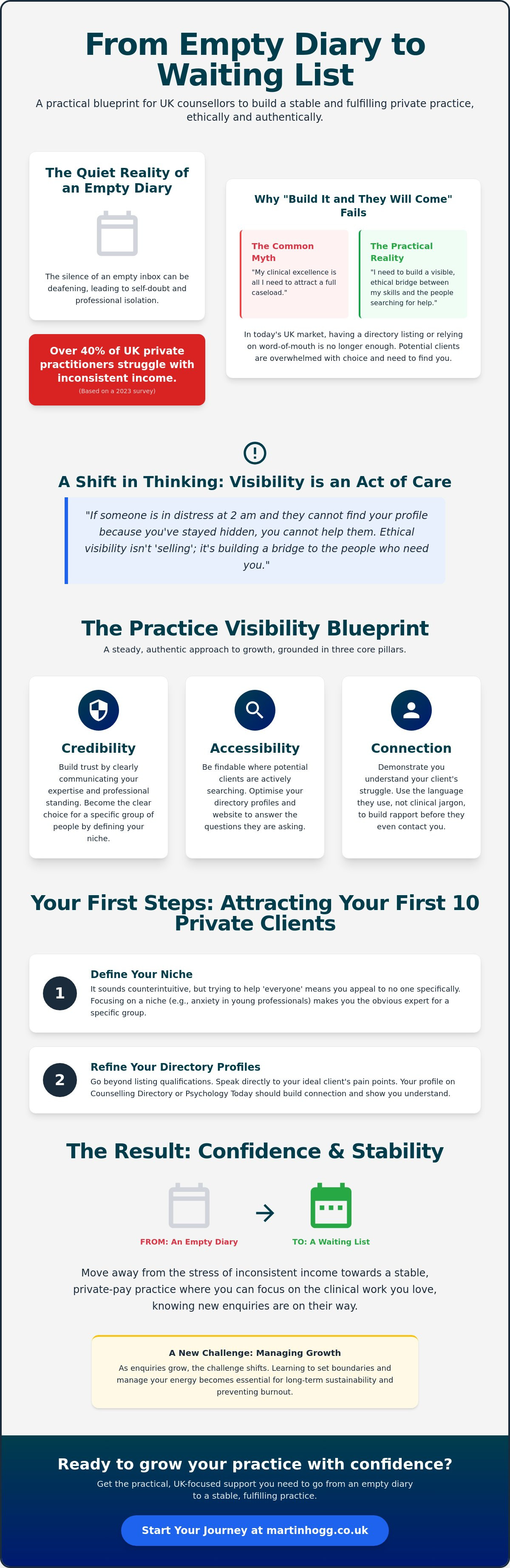
Many counsellors feel that talking about their services is somehow unprofessional or even a bit "bragging." I see it differently. Visibility is actually an ethical service to your potential clients. If someone is in distress at 2 am and they cannot find your profile because you've stayed hidden, you cannot help them. Moving from empty diary to waiting list isn't about luck; it's about building a bridge between your room and the people who need you most.
I focus on three grounded pillars for a sustainable practice: Credibility, Accessibility, and Connection. We don't need the loud, aggressive tactics often seen in Americanised business coaching. Instead, we use a UK-focused approach that respects the boundaries of our profession. By following a structured plan like the Practice Visibility Blueprint, you can grow your practice in a way that feels quiet, steady, and entirely authentic to who you are as a therapist.
Reframing Marketing as an Act of Care
When you write about your work, you aren't trying to "sell" a product. You are demonstrating that you understand a person's struggle and that you have the tools to help. This alignment with BACP's Ethical Framework ensures that your outreach remains rooted in integrity. Speak directly to the internal struggles your clients face. Use the language they use when they are sitting in your chair, rather than clinical jargon that creates distance. This approach builds trust before the first session even begins.
The Role of Niche in Filling Your Diary
It sounds counterintuitive, but being a generalist often leads to an empty diary. In a competitive market, trying to help "everyone" usually means you appeal to no one specifically. When you focus on niche building for counsellors, you become the clear choice for a specific group of people. Whether you work with anxiety in young professionals or support parents of neurodivergent children, having a clear niche makes you more visible and much easier to recommend. If you're ready to start this journey, the Practice Visibility Blueprint provides the exact steps to help you find your focus.
Practical Steps to Attract Your First 10 Private Clients
Getting those first ten clients is often the hardest part of the journey from empty diary to waiting list. It requires moving from passive waiting to active, intentional connection. Start by looking at your directory profiles on platforms like Counselling Directory or Psychology Today. Most therapists list their qualifications and modalities first, but your potential client wants to know if you understand their pain. Rewrite your bio to lead with the struggle they are facing today.
Your website doesn't need to be a masterpiece of complex design. It just needs to be clear and welcoming. Many therapists make the mistake of making the "About Me" page the most prominent part of the site, filled with academic jargon. A therapist's website should focus on the client's journey, not the therapist's qualifications. When a visitor lands on your page, they should immediately feel that you are a safe pair of hands who can help them reach a better future.
Don't forget the power of local connections within your UK community. Reach out to local GPs, wellbeing charities, or even other practitioners who might be at capacity and looking for someone to refer to. Building these relationships helps you effectively promote your counselling, coaching, or therapy practice. These personal links often provide the most consistent referrals in the early days of a practice.
Leveraging SEO and Content for Long-Term Growth
Writing simple, helpful blog posts is a fantastic way to build trust over time. Think about the common questions your clients ask in their first session and answer them clearly on your site. This is a core part of SEO for therapists. When you provide value for free, you demonstrate your expertise and empathy before a penny has even changed hands.
The Power of Specialised CPD
Sometimes, the quickest way to fill your diary is to offer a service that others don't. Gaining skills in specific areas, such as Working with Men, can naturally fill a diary because the demand often outweighs the number of specialised practitioners. By positioning yourself as an expert in a specific clinical area, you stand out from the crowd of generalists. If you want to refine your approach and get more support, consider joining the Private Practice Success Membership.
Managing the Transition to a Sustainable Waiting List
Once you've made the journey from empty diary to waiting list, a new set of challenges appears. It's a wonderful problem to have, but it requires a shift in how you manage your time and energy. When your diary is full, it's easy to stop the very activities that got you there. However, the 'feast and famine' cycle is a real risk for UK practitioners. If you stop being visible the moment you reach capacity, you might find yourself with a quiet diary again in six months when several clients naturally end their therapy at once.
Adopting a 'Waiting List' mindset is about more than just keeping a list of names. It involves communicating clearly and kindly with new enquiries. You aren't turning people away; you're ensuring that when you do have space, you can offer them your full presence and high-quality care. This is where setting firm boundaries becomes an act of professional integrity. If you're feeling overwhelmed by the logistics of a busy practice, finding community support through the Private Practice Success Membership can help you stay grounded.
Preventing Burnout as Demand Increases
Rapid growth is exciting, but it's also exhausting. It is vital to increase your self-care and perhaps your supervision hours as your caseload grows. Many therapists fall into the trap of over-working to meet the high demand, which quickly leads to exhaustion. You can read more about identifying the signs and finding a way back in my guide on therapist burnout. Taking care of yourself is the only way to ensure you can continue taking care of others.
Next Steps: Scaling Beyond the 1-to-1 Model
When your waiting list is consistently long, you might start thinking about scaling a therapy practice. This doesn't necessarily mean opening a large clinic, but it could involve moving from a 'Solo Practitioner' to a 'Practice Leader' role. Whether that's through group work or bringing on associates, scaling allows you to help more people without sacrificing your own wellbeing. The 'UK Private Practice Barometer 2026' report identifies a 'Danger Zone' for clinic owners with 2 to 5 staff members, who often earn less than solo practitioners due to scaling costs. Planning this transition carefully ensures your practice remains sustainable and your professional trajectory stays on track.
Building Your Sustainable Future in Practice
Building a practice that supports you financially and emotionally is entirely within your reach. It starts with shifting your focus from clinical theory to genuine human connection. By refining your visibility and committing to an ethical, client-focused approach, you create a business that serves both you and your community. Moving from empty diary to waiting list is a journey of small, consistent steps rather than overnight magic.
You don't need to navigate this path alone. I founded this community to provide the practical support I wish I'd had; drawing on over 20 years of UK practice experience and BACP-endorsed workshops. In our group, you'll find a supportive community of UK-based private practitioners who understand exactly what you're going through and are ready to share their own insights.
If you're ready for a more stable and fulfilling future, I'd love to help you get there. Join the Private Practice Success Membership and start filling your diary today. You already have the skills to change lives. Now, let's make sure the people who need you can actually find you.
Common Questions About Growing Your Practice
How long does it typically take to go from an empty diary to a waiting list?
Reaching a consistent waiting list usually takes between six and eighteen months of focused, steady effort. This timeframe depends on your niche and how much time you can realistically dedicate to your professional visibility each week. While you might see a few new enquiries within the first few weeks of optimising your directory profiles, building a sustainable reputation is a marathon rather than a sprint.
Is it ethical for a UK counsellor to use marketing to get more clients?
Marketing is entirely ethical as long as it remains honest, respectful, and focused on the client’s wellbeing. I view visibility as a professional duty; if someone is in distress and cannot find you, they miss out on the specific support you're qualified to provide. When you lead with empathy and stay within your professional body's guidelines, marketing becomes a genuine act of care.
Do I need a large social media following to fill my private practice?
You do not need to be a social media influencer to have a full diary. While platforms like Instagram can work for some, the majority of UK clients still find their therapists through search engines and professional directories. Focusing on a clear, welcoming website and strong directory profiles is often a much more effective use of your time than trying to gain thousands of followers.
What is the most effective directory for UK therapists to get enquiries?
Counselling Directory and Psychology Today remain the two most effective platforms for therapists in the UK. These directories have significant authority in search results, meaning they often appear at the top of the page when a potential client is searching for help. Optimising your presence on these sites is one of the most practical steps you can take on the journey from empty diary to waiting list.
Should I offer lower rates when I first start my private practice to fill the diary?
I generally advise against lowering your rates just to fill gaps, as this can quickly lead to resentment and professional burnout. Your fee needs to reflect your training, experience, and the actual costs of running a sustainable business. Instead of competing on price, focus on clearly communicating the value of your specific expertise and how you can help your ideal client navigate their current struggle.

Article by
Martin Hogg
I help Private Practice counsellors in the UK set up and grow an ethical Private Practice they love, work with their ideal clients, and earn the income they deserve. All without guesswork and burnout. I have been a private practice counsellor myself for over 20 years, specialising in anger management. I set up a not-for-profit social enterprise, Citizen Coaching and Counselling, which delivers thousands of counselling sessions a year to adults and young people in Birmingham. I am a registered BACP Counsellor and the author of three books, My Anger Coach, My Anxiety Coach and My Relationship Coach. These are available on Amazon.
Disclaimer
The information provided on this blog is for general informational purposes only and is not intended to be a substitute for professional medical or mental health advice, diagnosis, or treatment. Reading this content does not create a therapist-client relationship.


