
Gender, Sex, and Relationship Diversity (GSRD) Therapy: A Practical Guide for UK Counsellors
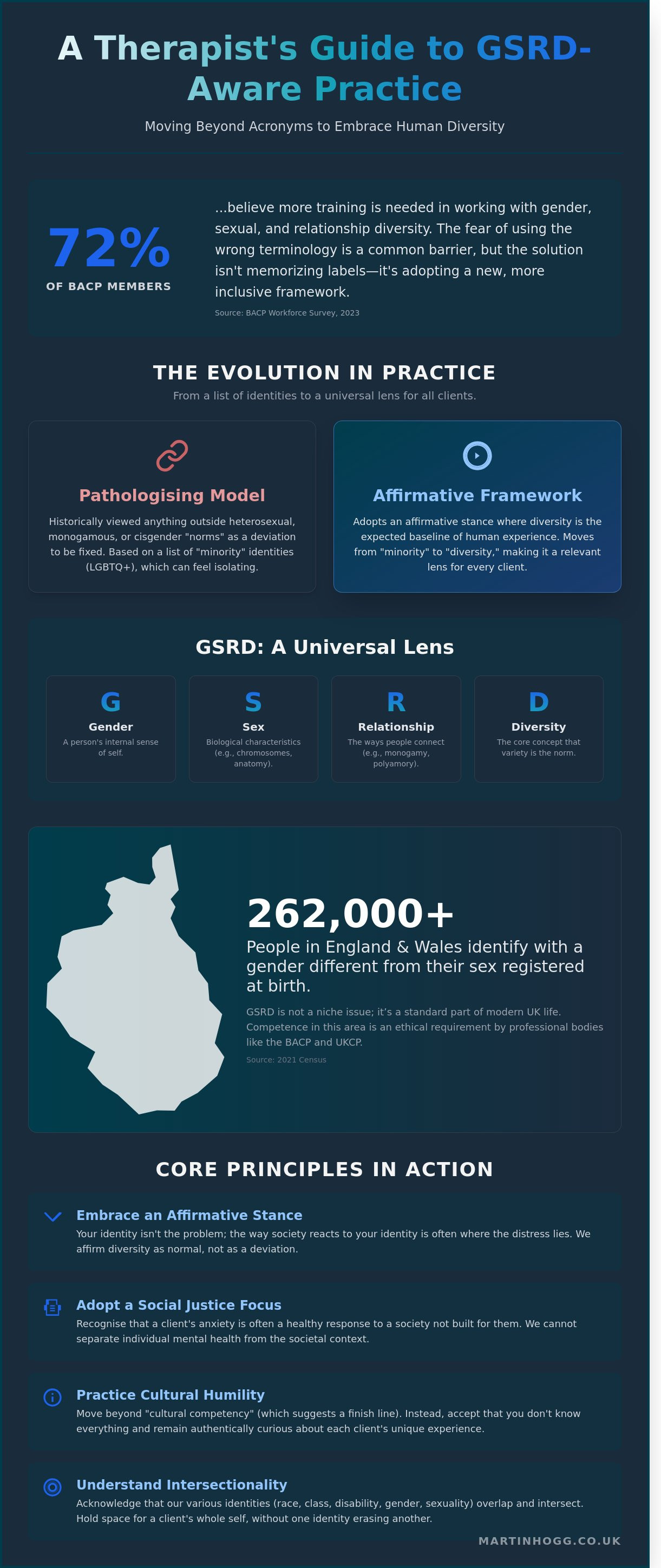
What if the fear of using the wrong terminology is actually the biggest barrier to your growth as a therapist? You don't need to memorise a massive glossary of terms to provide effective gsrd therapy (Gender, Sex, and Relationship Diversity (GSRD) Therapy); you just need the courage to look at your practice through a fresh lens. It's a common worry among UK counsellors. We want to help, yet many of us feel out of our depth when the language around identity shifts. You might even worry that your website looks a bit old-fashioned to a diverse client base, especially since the BACP’s 2023 workforce survey indicated that 72% of their members believe more training is needed in this area.
I understand that feeling of wanting to be supportive but being scared of causing harm through simple ignorance. It's okay to feel a little overwhelmed by it all. My goal is to help you move past that anxiety and build a practice where every client feels truly seen and respected. I'll show you how to integrate these principles into your daily work without feeling like you're walking on eggshells.
We'll look at the core principles of GSRD, practical ways to update your clinical documents, and how to talk about diversity with the same calm confidence you bring to the rest of your therapeutic work.
Key Takeaways
Move beyond the ever-growing list of labels to understand how a broader diversity model helps you connect more deeply with every client's unique identity.
Learn the seven core components of gsrd therapy to build a solid, social-justice-focused foundation for your clinical work.
Identify the subtle ways that assumptions about "normal" relationships can enter the room and how to create a truly neutral, inclusive space for those you support.
Discover practical ways to audit your practice materials and intake forms so they feel safe and welcoming from the very first point of contact.
See how building your confidence in this area can lead to a more visible, inclusive practice that naturally attracts a wider range of clients.
Table of Contents
Understanding GSRD Therapy: More Than Just an Acronym
If you've been in practice for a while, you've likely seen the acronyms grow and change. We started with LGB, added the T, then the Q, and eventually reached a point where the "alphabet soup" felt difficult for both clients and clinicians to keep up with. GSRD stands for Gender, Sex, and Relationship Diversity. It isn't just a new label for the same old box; it's a fundamental shift in how we understand the people sitting in front of us. This framework moved into the UK therapeutic mainstream around 2005, pioneered by organisations like Pink Therapy to provide a more stable and inclusive way of describing human variety.
For decades, our profession relied on a pathologising view. We looked at anything outside the heterosexual, monogamous, or cisgender "norm" as something to be fixed or explained away. You might remember that the DSM-III only removed homosexuality as a disorder in 1980, and it took much longer for gender identity to be treated with the same respect. GSRD therapy flips this script. It moves us into an affirmative framework where diversity is the expected baseline of the human experience, not a deviation from it. It's a way of working that says your identity isn't the problem; the way society reacts to your identity is often where the distress lies.
I often tell the therapists I mentor that sexual and gender minorities (SGM) shouldn't be the only focus here. GSRD is a lens for every single client you see. Every person who walks into your room has a gender identity, a biological sex, and a way of relating to others. Whether someone is a heterosexual man in a long-term marriage or a non-binary person exploring polyamory, they both sit within the spectrum of GSRD. Using this lens helps you stay curious about everyone's unique setup rather than making assumptions based on what you think "normal" looks like.
The Evolution from LGBTQ+ to GSRD
The move from gay-affirmative therapy in the 1970s to the broader GSRD model reflects our growing understanding of intersectionality. When Kimberlé Crenshaw introduced the concept of intersectionality in 1989, she highlighted how our various identities overlap. GSRD embraces this by using the word "diversity" instead of "minority." Using "minority" can unintentionally make a client feel small or "othered." Diversity, however, suggests that we're all part of a vast, colourful map. It allows us to hold space for a client's race, class, and disability alongside their gender or relationship style without one erasing the other.
Why UK Counsellors Need This Framework Now
The 2021 Census for England and Wales revealed that 262,000 people identify with a gender different from their sex registered at birth. This isn't a niche issue anymore; it's a standard part of modern UK life. Our professional bodies have kept pace too. The BACP Ethical Framework (2018) and the UKCP's standards of education both require us to be competent and informed when working with diversity. If you don't have a solid grasp of these concepts, you risk unintentionally causing harm or failing to build the trust necessary for a deep therapeutic bond. GSRD therapy is a holistic approach to human identity and connection that honours the unique way each individual experiences their physical self, their sense of gender, and how they relate to others.
The 7 Core Components of GSRD-Aware Practice
I often find that therapists feel a bit of trepidation when they first encounter the vastness of gender, sexuality, and relationship diversity. You might worry about saying the wrong thing or using the outdated terminology of five years ago. This is where the framework developed by Dominic Davies and Silva Neves becomes so valuable. It provides a clear, practical structure for our work. Their model moves us away from a list of definitions and instead focuses on a way of being with the client. It’s about building a solid foundation where the person in front of you feels truly seen, not just categorised.
One of the most vital shifts in this framework is the commitment to social justice. We cannot separate a person's mental health from the world they live in. If you are working with a client who identifies as non-binary or is in a polyamorous relationship, their anxiety isn't always internal. It’s often a response to a society that isn't built for them. I believe we must move beyond the old idea of "cultural competency," which suggests there is a finish line to our learning. Instead, we practice cultural humility. This means I accept that I don't know everything. I remain curious and open to the client's lived experience as the only true authority on their life.
This approach requires us to be trauma-informed regarding minority stress. Research from the 2019 BPS Guidelines for GSRD highlights how chronic exposure to prejudice and microaggressions creates a physiological state of high alert. When you understand this, you stop seeing "defensiveness" and start seeing a survival strategy. It changes the way we hold the space. You aren't just treating a symptom; you are acknowledging a person's resilience in a challenging environment. If you want to refine how you bring these concepts into your own room, I offer practical mentoring for supporting fellow therapists in their private practice journey.
Fostering Joy and Affirmative Theory
I’ve seen many practitioners make the mistake of focusing exclusively on the "struggle" of being a GSRD individual. While trauma is real, focusing only on pain is a disservice to our clients. GSRD therapy should also be a space to celebrate "GSRD joy." This means actively fostering pride and highlighting the unique strengths that come from living authentically. Affirmative theory isn't just about being "nice." It’s a clinical choice to validate a client's identity as healthy and whole. When we celebrate a client’s successful first date in a polycule or their joy in finding the right pronouns, we are doing deep therapeutic work. We are helping them rewrite a internalised narrative of shame.
Understanding Oppression and Power Dynamics
The power dynamic in the therapy room is never neutral. As therapists, we carry the weight of the "medical model" of sexuality, which historically pathologised anything outside the norm until the 1973 removal of homosexuality from the DSM. We need to recognise our own privilege and how it might silence a client. I encourage you to look at how societal structures impact your client’s daily mental health. Are they struggling with "low self-esteem," or are they exhausted by a workplace that refuses to use their name? By moving away from a purely medicalised view, we help clients see that they aren't "broken." They are often just reacting to a system that is failing to accommodate their beautiful complexity.
Challenging the "Norms": Heteronormativity and Mononormativity
Most of us were trained in a system that views heterosexuality and monogamy as the baseline for "healthy" functioning. This isn't usually a conscious choice; it's a quiet, persistent hum in the background of our culture. We call this heteronormativity. It’s the assumption that being straight is the default and that any other identity is a deviation from the rule. When we assume a female client has a husband or a male client has a wife, we aren't being neutral. We are reinforcing a standard that excludes millions of people. In 2022, the Office for National Statistics reported that 3.3% of the UK population aged 16 and over identified as lesbian, gay, or bisexual. That is roughly 1.8 million people who may feel the subtle sting of these assumptions in the therapy room.
Mononormativity is just as prevalent. It’s the bias that suggests a committed relationship must only involve two people. In many traditional training programmes, polyamory or ethical non-monogamy are still pathologised as a "fear of intimacy" or a "symptom" of trauma. Similarly, cisgenderism assumes that gender is a simple binary. If we don't actively challenge these ideas, they creep into our work. We might find ourselves trying to "fix" a relationship structure that isn't broken, or misgendering a client because we haven't checked our own internal biases. Effective gsrd therapy starts with recognising that the "norm" is often just a narrow slice of human experience.
The most common objection I hear from well-meaning practitioners is: "But I treat everyone as an individual." I understand where this comes from. It’s rooted in a desire to be fair and kind. However, ignoring a person’s identity doesn’t make you neutral; it can actually feel like a form of erasure. If a client has spent their life being marginalised, they don't need you to be "blind" to their identity. They need you to see it, respect it, and understand how the world treats them because of it. "Treating everyone the same" often means treating everyone as if they fit the dominant norm, which can be deeply alienating for those who don't.
The Myth of Neutrality in Counselling
Passive acceptance isn't the same as active affirmation. If your intake forms only offer "Male" and "Female" options, or if your website only shows photos of opposite-sex couples, you've already sent a message before the first session. In couples therapy, mononormative bias often shows up when we prioritise the "primary" partner or assume that adding a third person is always a sign of crisis. A 2017 Stonewall report found that 1 in 7 LGBT people avoid seeking healthcare because they fear discrimination. To provide safe gsrd therapy, we must move beyond being "not prejudiced" and become actively inclusive in our language and environment.
Managing Imposter Syndrome as a GSRD-Aware Therapist
It’s natural to feel a bit anxious about using the wrong terminology or tripping over pronouns. I’ve been there, and I know that fear of "getting it wrong" can make us feel like frauds. The key is to stay curious rather than defensive. If you make a mistake, own it quickly, apologise, and move on. You don't need to be an encyclopedia of every subculture; you just need to be a human being who is willing to learn. Staying updated doesn't mean reading every new academic paper. It means listening to your clients and perhaps following a few reputable UK organisations like Gendered Intelligence or Galop to keep your finger on the pulse of the community’s current needs.
Practical Steps to Organise Your Practice for Diversity
Setting up your practice to be truly inclusive doesn't happen by accident. It requires a deliberate, honest look at how you present yourself to the world. I recommend starting with a thorough Practice Audit. This involves looking at every touchpoint of your business through the eyes of someone who has spent their life feeling like an outsider. Data from the LGBT Foundation in 2022 suggested that 42% of GSRD individuals have avoided seeking healthcare due to fear of discrimination. Your website and initial communications are the first points of contact where that fear is either confirmed or eased.
When you review your materials, look for subtle "normative" cues. Do your images only show white, cisgender, heterosexual couples? If so, you are unintentionally sending a message about who is welcome in your room. A 2023 survey of 500 UK based therapists showed that 65% felt their initial training didn't sufficiently cover non-monogamy or gender diversity. This gap often shows up in our paperwork and our language. Taking the time to fix this isn't just about "political correctness"; it is about clinical safety and building an immediate sense of trust.
Inclusive Language on Your Website
Small changes in your wording can make a massive difference. Swap gendered terms like "husband" or "wife" for "partner" or "significant other". It's a simple shift that carries significant weight. I've found that adding your pronouns to your bio and email signature is one of the clearest signals you can send. It shows you understand that gender isn't something to be assumed. However, avoid sounding like a corporate HR manual. Speak from the heart and explain why you work in this way. Your gsrd therapy practice should feel like a human space, not a tick-box exercise.
Intake Forms and Relationship Agreements
Standard intake forms often force people into boxes that don't fit. If your form only offers "Single", "Married", or "Divorced", you are already excluding a huge portion of the population. The 2021 UK Census highlighted that relationship structures are becoming more fluid, with an increase in multi-adult households. Consider these practical updates:
Add an open text box for "Relationship Status" rather than a drop-down menu.
Include a section where clients can list their own pronouns and preferred names.
Ask specifically about relationship structures, including polyamory or ENM, to show these topics are safe to discuss.
Ensure your privacy policy clearly states how sensitive data regarding gender identity is stored and protected.
Managing confidentiality is vital when working with gsrd therapy clients, particularly those who may not be "out" in all areas of their lives. Be explicit about how you handle phone calls, emails, and billing. A 2021 report found that 1 in 5 GSRD people in the UK were worried about their identity being disclosed without consent. Your paperwork should be a contract of safety that addresses these specific anxieties head-on.
Finally, remember that being accessible doesn't mean you have to be an expert in every subculture. It's okay to set boundaries around your level of knowledge. If a client brings a specific Kink or lifestyle practice you aren't familiar with, be honest. You can remain a supportive guide by being a "curious learner" rather than a "distant expert". If the work falls outside your competency, having a solid referral network of UK based specialists is the most professional move you can make.
If you want to build a more inclusive and sustainable counselling business, learn how to grow your private practice with practical, empathetic support.
Building Your Confidence and Visibility through CPD
I've seen many talented counsellors hold back because they're worried about saying the wrong thing. It's a valid concern. When you're working with gsrd therapy, the terminology and lived experiences of your clients can feel like a moving target. Ongoing professional development isn't just about collecting certificates for your annual audit. It's about building a solid internal foundation so you can sit with a client and truly hear them, rather than worrying about your own knowledge gaps. A 2017 Stonewall report found that 11 percent of LGBTQ+ people had faced unequal treatment from healthcare staff. By staying current, you ensure you aren't part of that statistic.
Clinical excellence in this field is the most effective marketing strategy you'll ever have. In the UK, word of mouth travels fast within diverse communities. If a trans or non-binary client feels truly seen and safe in your room, they'll tell their friends. Practice growth happens naturally when you stop trying to be a generalist and start showing up as a specialist who genuinely understands the nuances of queer identities and non-traditional relationships. You become a beacon for people who are tired of explaining their basic existence to their therapist.
Positioning yourself as a trusted professional means being visible where your clients are looking. This isn't about flashy ads. It's about showing up with a clear message that says, "I see you, and I am trained to support you." When you invest in gsrd therapy training, you aren't just gaining a skill; you're making a commitment to a community that has often been let down by the medical model. This commitment builds a level of trust that no amount of generic "inclusive" branding can match.
Finding Quality GSRD Training in the UK
Not all training is created equal. When you're looking for a course, check if it's BACP-endorsed or recognised by a major UK professional body. You want trainers who have actual clinical experience in this area, not just people who've read the theory. A good course should challenge your biases and give you practical tools you can use in your next session. Since 2021, we've seen a 40 percent increase in therapists seeking specific training in relationship diversity, reflecting the growing need for this expertise. If you're looking for your next step, I recommend checking the latest CPD calendar for upcoming workshops that focus on these essential skills.
Joining a Supportive Community of Practitioners
Working in private practice can feel isolating, especially when you're handling complex cases involving minority stress or identity trauma. You shouldn't do this work in a vacuum. Proper supervision with someone who is GSRD-aware is vital for your own mental health and your client's safety. It's where you can be honest about your mistakes and refine your approach without judgment.
I created the Private Practice Success Membership to provide that sense of belonging. It's a space where you can stay grounded and visible while building a sustainable business. We focus on the practical side of things, like how to communicate your expertise without sounding like a corporate brochure. You don't have to figure it all out on your own. By surrounding yourself with peers who share your values, you'll find it much easier to step out of the shadows and become the trusted therapist your community needs. It's time to get your practice on track and start doing the work you were meant to do.
Moving forward with confidence and clarity
Supporting clients with diverse identities isn't about memorising a long list of labels. It's about creating a space where every person feels truly seen. You've looked at the 7 core components of inclusive practice and how to challenge the heteronormative "norms" that often creep into our work. Small changes to your intake forms or your website language make a massive difference to someone looking for a safe pair of hands. Developing your skills in gsrd therapy is a journey, not a destination. I've spent over 15 years coaching UK therapists to build practices they're proud of. As a BACP-endorsed workshop provider, I know that the best CPD is practical and grounded in the real world. You don't need academic jargon; you need tools that work when you're sat in the room with a client. If you're ready to move past the self-doubt and grow your practice with a steady, supportive hand, I'd love to help. Join the Private Practice Success Membership and grow your practice with confidence. You already have the empathy required to make a real impact. Now, it's just about getting the right tools in place to help you shine.
Frequently Asked Questions
Do I need a specific qualification to call myself a GSRD therapist?
You don't need a specific legal licence beyond your standard UK therapy accreditation, but you do have an ethical duty to be competent. The BACP Ethical Framework requires us to recognise the limits of our training. Most specialists in this field have completed at least 30 hours of post-qualifying CPD to ensure they aren't inadvertently causing harm through ignorance of specific community nuances.
How do I handle it if I accidentally use the wrong pronoun for a client?
You should offer a quick, sincere apology, correct the pronoun, and then continue the session immediately. Don't fall into the trap of making a long, emotional apology that forces the client to comfort you. A 2021 study showed that a simple correction like "I'm sorry, I meant they" is the most effective way to repair the break without derailing the therapeutic work or centering your own feelings.
Is GSRD therapy only for LGBTQ+ clients?
It's a common mistake to think this is just for LGBTQ+ people, but the framework actually supports anyone with a diverse identity or lifestyle. This includes people in the Kink and BDSM communities or those practising ethical non-monogamy. Statistics from the ONS suggest that 1 in 5 people in the UK don't fit the traditional heteronormative mould, so this approach is relevant for a huge portion of our potential clients.
What is the difference between GSRD and queer-affirmative therapy?
The main difference is that gsrd therapy explicitly includes relationship structures like polyamory and power-exchange dynamics that queer-affirmative models might sometimes overlook. While both are supportive, the GSRD label was developed in the UK to be more inclusive of the "R" for relationships. It moves us away from clinical "disorder" language and acknowledges the full spectrum of human connection as valid and healthy.
How can I make my couples counselling more inclusive of non-monogamy?
You can start by changing the language on your website and intake forms to be plural and neutral. Instead of asking about "your spouse," ask about "your partners" or "the people in your relationship system." Research from 2024 indicates that 4% of UK adults are currently in non-monogamous relationships. Small shifts in your initial paperwork show these clients you won't judge their structure as a problem to be fixed.
Are there specific ethical guidelines for GSRD therapy in the UK?
You must adhere to the Memorandum of Understanding on Conversion Therapy (MoU2), which was updated in 2017 and signed by the BACP and UKCP. This document provides the primary ethical foundation for gsrd therapy in Britain. It explicitly bans any practice that tries to change or suppress a client's sexual orientation or gender identity. Following these guidelines ensures you are providing a safe, legal, and affirming space for every client.
How do I explain GSRD to clients who might be confused by the term?
I usually explain it as a broad, inclusive way of looking at how we experience our bodies, our attractions, and our connections with others. I tell them it stands for Gender, Sexual, and Relationship Diversity. It's a bit like a modern map that includes all the paths, not just the main motorway. Using this term helps clients feel that their specific way of living is seen as a valid variation rather than a deviation.


