
Grow Your Confidence in Marketing: A Practical Guide for UK Therapists
What if the skills that make you an excellent therapist are exactly what you need to find more clients? Many UK counsellors I speak with feel a genuine sense of dread when they think about selling their services. You might worry about looking too commercial, or perhaps you fear that your peers will judge you for being too business focused. It's a common hurdle, but it's one you can clear. To grow your confidence in marketing, you don't need to become a different person; you just need to translate your empathy into a clear, helpful online presence.
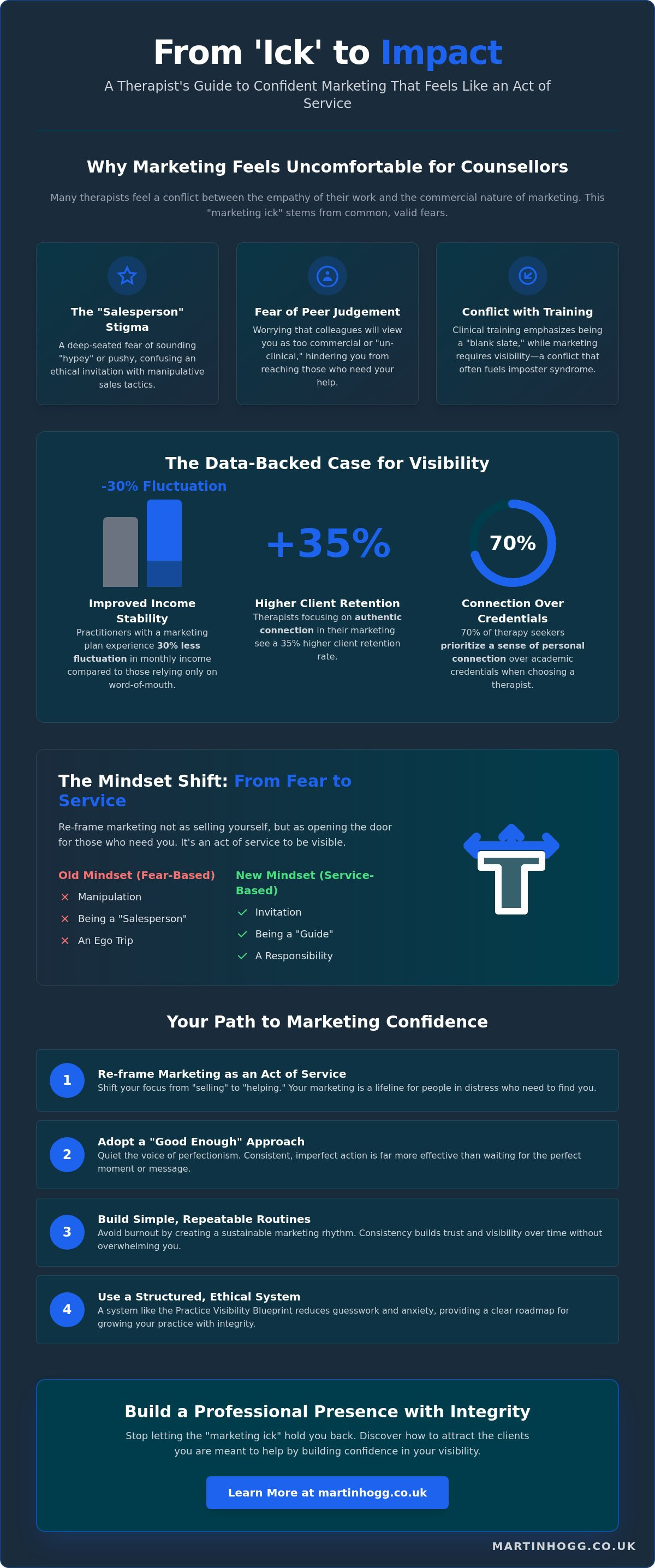
I understand that the technical jargon can feel overwhelming and even a bit cold. You want a steady stream of clients without the stress of pretending to be a corporate expert. In this guide, I'll show you how to move past that "marketing ick" so you can attract the right people to your private practice. A 2023 industry report showed that therapists who focus on authentic connection rather than sales tactics see a 35% higher retention rate. We'll walk through a simple, practical plan that keeps your integrity intact while helping you get your practice on the right track.
Key Takeaways
- Learn how to re-frame marketing as an act of service, ensuring that people in distress can actually find the support you offer.
- Discover how to grow your confidence in marketing by adopting a "good enough" approach that quietens perfectionism and the fear of being seen.
- Identify simple, repeatable routines that allow you to build a professional presence without feeling overwhelmed or burnt out.
- Explore how using a structured, ethical system like the Practice Visibility Blueprint reduces the guesswork and anxiety of running a private practice.
Why Marketing Feels Uncomfortable for UK Counsellors
Many of us in the UK therapy community feel a physical cringe when we hear the word marketing. I call it the "marketing ick". It is that nagging feeling that promoting your services is somehow at odds with the empathy and care you provide. However, you can grow your confidence in marketing by shifting your perspective. Confidence here isn't about being the loudest person in the room or using flashy gimmicks. It is simply the quiet, steady belief that your skills provide genuine value to someone in distress. If you know your work helps people get their lives back on track, it becomes your responsibility to let them know you exist.
Our clinical training often emphasizes the "blank slate" approach. We are taught to keep our own personalities out of the room to provide a clear space for the client. Marketing asks for the opposite. It asks you to be visible, to have a voice, and to stand out. This conflict is often where Impostor Syndrome takes root. You might worry that by showing up online, you are breaking a professional code. In reality, you are just opening the door to your practice so those who need you can find their way in.
Waiting for word-of-mouth alone is a risky strategy for a modern practice. While referrals are wonderful, they are unpredictable. A 2022 survey of private practitioners in the UK found that those who relied solely on word-of-mouth experienced a 30 percent higher fluctuation in their monthly income compared to those with a consistent marketing plan. You shouldn't leave your livelihood, or your ability to help others, to chance.
The "Salesperson" Stigma in Private Practice
We often fear sounding "hypey" or pushy because we value the integrity of the therapeutic relationship. It is vital to recognize the difference between manipulation and invitation. Manipulation tries to trick someone into a service they do not need. An invitation, however, is an act of service. It offers a clear path forward for someone currently feeling overwhelmed. Ethical marketing is a bridge between a person’s problem and your professional solution. When you grow your confidence in marketing, you stop seeing yourself as a salesperson and start seeing yourself as a guide.
The Fear of Peer Judgement
It is common to worry that other therapists will think you are being too commercial or "un-clinical". This fear of being judged by colleagues often stops talented counsellors from reaching the people who need them most. Visibility is a professional responsibility, not an ego trip. If you are hidden, you cannot help. Embracing visibility allows you to build a practice that is both sustainable and impactful. You can explore these themes further in my guide on Marketing for Therapists in the UK, which provides a roadmap for building a professional presence with integrity.
Re-framing Marketing as an Act of Service
Most of us entered this profession to help people, not to sell ourselves. When you feel that familiar knot in your stomach about posting on LinkedIn or updating your directory profile, it's usually because the focus is on "you." You worry about looking foolish, sounding arrogant, or getting something wrong. If you want to grow your confidence in marketing, you have to shift that focus entirely toward the person currently struggling to sleep, managing a panic attack, or facing a relationship breakdown.
Think of your marketing as a lighthouse. If the light is off, the ship hits the rocks. Staying hidden doesn't protect your professional integrity; it simply makes it harder for someone in distress to find the support they deserve. Developing "therapeutic visibility" is a core business skill. It is the first handshake. It is the moment a potential client thinks, "This person understands what I am going through."
Balancing this visibility with professional boundaries is essential for any UK practitioner. You can find excellent guidance on the Ethical Use of Social Media to ensure your online presence remains helpful, safe, and professional. When you view your website or social media as the first step in the therapeutic relationship, it stops being a chore and starts being a contribution.
The Client’s Perspective: What They Really Need to See
Clients aren't looking for "the best" therapist in the UK; they are looking for "the right" one for them. They don't need a list of every workshop you've attended since 2015. They need to know if you are a safe pair of hands. Data from 2023 indicates that roughly 70% of therapy seekers prioritise a sense of personal connection over specific academic credentials when browsing profiles. Showing a bit of your personality helps clients feel safe enough to book that initial consultation. For more practical steps on reaching those who need you, read this guide on How to Get Counselling Clients UK.
Building Trust Before the First Session
Your marketing allows you to use your voice to demonstrate empathy and professional authority long before the client sits in your chair. By adopting the role of a "Citizen Coach," you make mental health support feel accessible and normal rather than clinical and intimidating. Trust is built through consistency, not cleverness. When you provide steady, grounded content, you're growing your confidence in marketing by proving your reliability. If you want to refine this approach alongside other practitioners, you might find our private practice success community a helpful place to start.
Overcoming Perfectionism and the Fear of Being Seen
Perfectionism is a common trap for UK practitioners. We often disguise it as "attention to detail," but in reality, it's a form of procrastination. If you spend six months tweaking the font on your business cards or rewriting your "About Me" page for the twentieth time, you aren't being thorough. You're hiding. To grow your confidence in marketing, you have to accept that "done" is better than "perfect."
Think of Donald Winnicott’s concept of the "good enough" parent. We can apply this same grace to being a "good enough" marketer. Your content doesn't need to win awards or be cited in an academic journal. It just needs to reach the person who is struggling right now. A simple, honest message often carries more weight than a thousand pounds' worth of professional copywriting.
There is a big difference between healthy confidence and the arrogant "expert" posturing we see on social media. You don't need to pretend you have all the answers or live a flawless life. In fact, a highly polished, corporate brand can feel cold and unapproachable. A 2021 study by Stackla found that 88% of consumers say authenticity is a key factor when deciding which brands they support. Being a real, relatable person makes you more trustworthy than a sterile professional image.
Tackling Imposter Syndrome Head-On
You don't need to know every single theory to help a client move forward. When you write or speak about your work, avoid sounding like a textbook. Talk like a human being. Your qualifications are the foundation, but your empathy is the bridge. If you find yourself feeling overwhelmed by the pressure to be an expert, it can quickly lead to exhaustion. You might find it helpful to read this Therapist Burnout Guide to keep your perspective grounded and your energy levels protected.
Action Breeds Confidence
We often use exposure therapy with our clients, and we can use it on ourselves too. Marketing anxiety won't vanish because you thought about it or read another book on the subject. It fades when you take action. Start with one small win. This could be:
- Posting one short, helpful tip on LinkedIn or Facebook.
- Attending one local networking event in your community.
- Sending a short introductory email to a local GP or complementary health clinic.
Moving from "thinking" to "doing" is the only way to grow your confidence in marketing. Each small step reduces the power of the anxiety and builds a track record of success. When you see that the world doesn't end because you shared an opinion, the fear of being seen starts to lose its grip.
Practical Steps to Grow Your Marketing Confidence
Building a private practice doesn't require you to become a marketing guru overnight. It's about taking small, manageable steps that fit into your weekly schedule without causing a panic. To grow your confidence in marketing, start by creating a simple, repeatable routine. Dedicate just 20 minutes a day, perhaps between client sessions, to one specific task. This consistency prevents the "all or nothing" approach that leads to burnout. When marketing becomes a habit rather than a massive project, the fear begins to fade.
Focus your energy on just one visibility channel at first. If you enjoy writing, focus on your blog or your Psychology Today profile. If you prefer talking, look into local networking. Trying to be everywhere at once is a recipe for exhaustion. By mastering one platform, you see results faster. Data from my work with hundreds of UK therapists suggests that those who focus on a single marketing channel for at least 90 days are 40% more likely to see a steady stream of enquiries than those who dabble in five different platforms simultaneously.
Developing Your Professional Voice
Your potential clients aren't looking for a textbook; they're looking for a person who understands their pain. Write your copy exactly how you speak in the therapy room. When you use "therapese" or academic jargon like "unconditional positive regard" or "maladaptive schemas," you create a barrier. Clients often feel vulnerable when searching for help, and clear, plain English feels safe. Try this: explain what you do to a friend over a coffee. If they tilt their head in confusion, your language is too complex. Aim for a reading age of 12 to 14 to ensure your message is accessible to everyone.
The Power of a Supportive Community
Isolation is one of the biggest hurdles for UK therapists. When you're working alone, every "no" or quiet week feels like a personal failure. Finding a safe space to test your ideas is vital for your mental health and your business growth. You need a group where you can share a draft of a Facebook post or a new idea for a workshop without fear of judgment. Gathering positive feedback from peers helps you grow your confidence in marketing by reinforcing the value you provide. You don't have to figure this out by yourself. Joining the Private Practice Success Membership gives you access to a community that understands the unique challenges of the UK therapy market.
Keep a "win folder" on your computer. Every time a client sends a thank-you email or a colleague offers a compliment, save it. Looking at these tangible reminders of your skill makes it much easier to put yourself out there when self-doubt creeps in. Success leaves tracks, and these small reminders are the proof that you're already making a difference.
Ready to stop struggling in isolation and start building a practice with a group of like-minded professionals? Join our community of UK therapists today and get the support you deserve.
Finding Your Path with the Practice Visibility Blueprint
Marketing often feels like a performance that therapists didn't sign up for. When you're trained to listen and hold space for others, shouting about your own services feels unnatural, perhaps even a bit unethical. The Practice Visibility Blueprint is designed to change that. It isn't a collection of "hacks" or aggressive sales tactics. Instead, it's a structured, ethical framework that helps you grow your confidence in marketing by aligning your business growth with your clinical values.
Most of the anxiety surrounding marketing comes from the guesswork. When you don't have a plan, every social media post or website update feels like a shot in the dark. This uncertainty is exhausting. Having a system in place acts like a clinical supervisor for your business. It provides a map so you know exactly where you're going and why you're doing it. This clarity naturally reduces the "visibility fear" that keeps so many talented counsellors hidden from the people who need them most.
You've spent years honing your clinical skills, but those skills don't automatically translate into running a successful private practice. That's where professional coaching comes in. It bridges the gap between being a great therapist and being a visible business owner. I've worked with hundreds of UK practitioners who felt stuck, helping them realise that marketing is simply an extension of their desire to help. When you have a guide who understands the weight of your work, the process of building a practice becomes a manageable series of steps rather than an overwhelming mountain.
A System Designed for UK Therapists
Generic business advice often fails our community because it's usually too loud, too pushy, and too Americanised. In the UK, we value a more grounded and subtle approach. The Blueprint focuses on results without sacrificing compassion. It's about being found by the right people at the right time. This approach is a core element of CPD for Counsellors UK, ensuring that your professional development includes the practical tools needed for a sustainable career.
Your Next Steps to Practice Success
You don't need to do everything at once to grow your confidence in marketing. The most effective way to move forward is to take one practical step today. Your practice deserves to be found. You have a unique set of skills that can change lives, and letting people know you're available is a service to your community, not an act of ego. If you're ready to move away from the guesswork and start building a stable, visible practice, I'm here to help.
- Take a look at the training calendar for our upcoming workshops and live sessions.
- Start thinking of your marketing as a bridge between a person in pain and the support they need.
- Connect with others who are on the same path.
Success in private practice is about consistency and the right support. You've already done the hard work of becoming a therapist. Now, let's make sure the people who need you can actually find you. To get started with a supportive group of peers, Join the Private Practice Success Community today.
Start Reaching the People Who Need You Most
Marketing doesn't have to feel like a chore or something that compromises your professional ethics. When you re-frame it as an act of service, the pressure to be perfect starts to fade. By taking small, practical steps, you can move past the fear of being seen and focus on what really matters: connecting with the clients who need your specific expertise. It's about being visible enough so that those in distress can find the support they deserve.
I've spent 20 years as a practitioner helping therapists build sustainable, ethical practices. As an accredited CPD training provider with BACP-endorsed workshops, I understand the unique challenges you face in the UK market. You can grow your confidence in marketing by following a clear, proven structure that respects your boundaries and your time. It's time to stop feeling overwhelmed by the noise and start using a grounded approach that actually works for counsellors.
Ready to grow your practice with confidence? Explore the Practice Visibility Blueprint
You don't have to figure this out on your own. Let's get your practice on track so you can focus on the clinical work you love.
Frequently Asked Questions
Is it ethical for a counsellor to market their services in the UK?
It's entirely ethical to market your services in the UK, provided your claims are honest and truthful. The BACP Ethical Framework encourages practitioners to provide clear information so clients can make informed choices. By letting people know you exist, you aren't being pushy; you're helping a person in distress find the right support they need to get their life back on track.
How much time should I spend on marketing my private practice each week?
You should aim to dedicate roughly 3 to 5 hours each week to your marketing activities if you're building a new practice. This isn't a random figure; consistent effort over a 12 week period is usually what it takes to see a steady stream of enquiries. Once your diary is 80% full, you can often scale this back to just 1 or 2 hours of maintenance work.
I hate social media; can I still grow a successful therapy practice?
You can absolutely build a thriving practice without ever touching social media. Many successful UK therapists rely solely on directories like Psychology Today, which receive over 1 million visits per month. Focusing on local networking or writing helpful blog posts for your own website are practical alternatives that help you grow your confidence in marketing without the pressure of likes or shares.
What is the most effective way for a new therapist to get clients?
The most effective way for a new therapist to secure clients is by creating a compelling profile on a major UK directory. Statistics show that roughly 70% of private clients find their therapist through these platforms rather than through Google searches. Make sure your profile photo is professional and your text focuses on the specific problems you solve, such as anxiety, rather than just listing your qualifications.
How do I deal with the fear that other therapists will judge my marketing?
It's common to feel imposter syndrome, but you must remember that your marketing is for your clients, not your colleagues. Most therapists are too busy managing their own 20 or 25 weekly sessions to worry about what you're doing. If you focus on being helpful and authentic, you'll attract the people who need your specific approach. Your peers aren't the ones paying your bills or seeking your help.
Do I need to be a "business expert" to run a private practice?
You don't need an MBA or business degree to run a successful practice in Birmingham or anywhere else in the UK. Most of what you need involves simple, practical steps like keeping an accurate spreadsheet and responding to emails within 24 hours. Think of yourself as a citizen coach who provides a professional service; the business side is just the framework that allows you to do the therapeutic work.
What should I do if my marketing isn’t getting immediate results?
You should give any new marketing strategy at least 90 days before deciding it hasn't worked. Marketing is a bit like therapy; it takes time to build rapport and trust with your audience. If you aren't seeing results after 3 months, look at your call to action to ensure it's clear. Sometimes a simple change, like making your contact button more visible, can increase your enquiries by 20%.
How can I talk about my fees without feeling guilty or awkward?
State your fees clearly on your website so there are no surprises for you or the client. When you grow your confidence in marketing, you realise that charging a fair price allows you to stay in business and continue helping people. Remember that a typical 50 minute session involves overheads like room hire and insurance. Being transparent about costs is a form of boundaries, which is essential for any healthy therapeutic relationship.

Article by
Martin Hogg
I help Private Practice counsellors in the UK set up and grow an ethical Private Practice they love, work with their ideal clients, and earn the income they deserve. All without guesswork and burnout. I have been a private practice counsellor myself for over 20 years, specialising in anger management. I set up a not-for-profit social enterprise, Citizen Coaching and Counselling, which delivers thousands of counselling sessions a year to adults and young people in Birmingham. I am a registered BACP Counsellor and the author of three books, My Anger Coach, My Anxiety Coach and My Relationship Coach. These are available on Amazon.
Disclaimer
The information provided on this blog is for general informational purposes only and is not intended to be a substitute for professional medical or mental health advice, diagnosis, or treatment. Reading this content does not create a therapist-client relationship.


