
Handling Fee Objections: A Guide for UK Therapists

Article by
Martin Hogg
I help Private Practice counsellors in the UK set up and grow an ethical Private Practice they love, work with their ideal clients, and earn the income they deserve. All without guesswork and burnout. I have been a private practice counsellor myself for over 20 years, specialising in anger management. I set up a not-for-profit social enterprise, Citizen Coaching and Counselling, which delivers thousands of counselling sessions a year to adults and young people in Birmingham. I am a registered BACP Counsellor and the author of three books, My Anger Coach, My Anxiety Coach and My Relationship Coach. These are available on Amazon.
What if I told you that when a potential client says your fee is too high, they aren't actually talking about your bank balance? It's a common worry for many of us. You've spent years training, yet the moment you start dealing with client objections to fees, you feel like a bit of a fraud. I know that heart-sink feeling when someone on the Counselling Directory asks for a discount. You want to help, but you also need to keep your practice sustainable without burning out.
I agree that these money conversations can feel incredibly awkward, especially when you're trying to keep your "people-first" heart intact. These objections are rarely just about the pounds and pence; they're often a request for certainty. In this guide, you'll learn how to handle money talks with confidence and integrity, ensuring your fees reflect your value. I'll share practical scripts for those tricky moments and show you how to use your Visibility Blueprint to attract clients who truly value your work.
Key Takeaways
- Reframe your session fee as a professional boundary rather than a price tag to help you move past "therapist guilt" and stay grounded.
- Get practical scripts for dealing with client objections to fees, allowing you to stay compassionate while protecting your time and income.
- Learn how to use "Above the Fold" content on your website to filter for ideal clients and lead with a clear one-sentence offer.
- Discover how to automate your payments to remove the "cash in hand" awkwardness and build a practice that supports you for the long term.
Why Talking About Money Feels "Wrong" (and How to Change That)
Most of us didn't enter the world of Psychotherapy because we wanted to become accountants. We're here because we care about people. This "helper" identity often creates a nagging sense of guilt when we start dealing with client objections to fees. You might feel like you're putting a price tag on empathy, but that's a trap. It's a common hurdle, especially when you're first building your niche and finding your feet in private practice.
I would argue that your fee isn't a price; it's a boundary. It's the professional structure that allows the work to happen safely. When you discount your rate because you feel awkward, you're often undermining the therapeutic alliance. A client's financial commitment is often a mirror of their commitment to the process. If you undervalue the work, they might too. Remember, people connect with people. Your clients aren't just buying an hour of your time on a Tuesday; they are investing in your presence and your expertise.
The Ethics of Being Paid Well
There's nothing noble about a burnt-out therapist. If you can't pay your own bills, you won't have the mental space to hold someone else's distress. A sustainable practice is an ethical practice. Instead of the usual "non-judgmental space" clichés, think of your fee as the resource that keeps your door open. It's what allows you to maintain high professional standards and stay in the game for the long haul.
Moving from "Sales" to "Service"
Talking about money isn't "selling"; it's a service. Your fee reflects the years of BACP-standard training and ongoing CPD you've completed to be effective. It’s about the transformation you facilitate. Your fee is a professional investment in the client's personal trajectory toward a more fulfilling and functional future. When you stand firm on your value, you show the client that their progress is worth the investment.
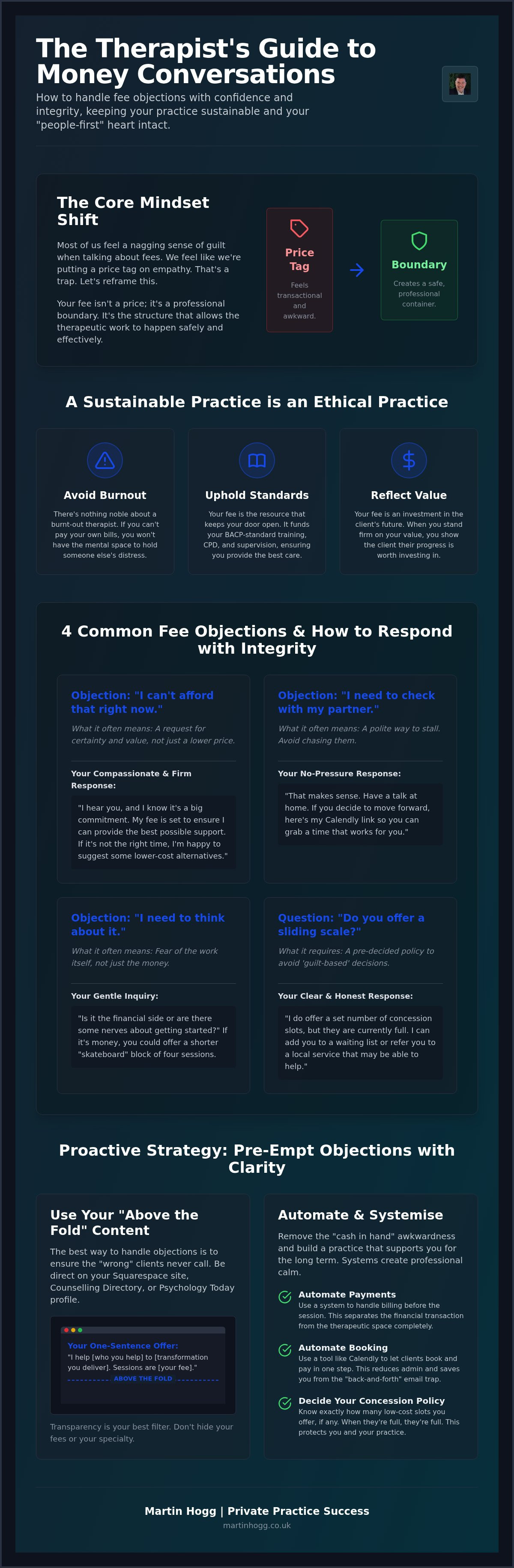
4 Common Fee Objections and How to Respond with Integrity
When a potential client says, "I can't afford that right now," it's tempting to panic and drop your price. Don't. Dealing with client objections to fees requires a steady hand and a bit of backbone. I would suggest a response like: "I hear you, and I know it's a big commitment. My fee is set to ensure I can provide the best possible support. If it's not the right time, I'm happy to suggest some lower-cost alternatives." This stays kind but firm.
If they need to "check with a partner," don't chase them. It's often a polite stall. Give them space. Say, "That makes sense. Have a talk at home. If you decide to move forward, here's my Calendly link so you can grab a time that works for you." This puts the ball in their court and saves you from the "back-and-forth" email trap. It also respects their autonomy.
When asked why you're more expensive than the therapist down the road, lean on your one-sentence offer. This is a clear statement of who you help and the transformation you deliver. When a client sees you as the specific expert for their problem, the price becomes secondary. If you're still feeling stuck with these conversations, you might find the Private Practice Success Membership helpful for some extra peer support.
The "I Need to Think About It" Response
Often, "thinking about it" is actually fear of the work itself. Ask gently, "Is it the financial side or are there some nerves about getting started?" If it's purely money, consider a "skateboard" version of your service. Offer a shorter, four-session block to see how they get on before committing to a longer term. This lowers the barrier to entry without devaluing your professional rate.
Handling the "Do You Offer a Sliding Scale?" Question
Decide your policy before the phone rings. I suggest having a set number of "concession" slots. If they're full, be honest. "I do offer a sliding scale, but those slots are currently taken. I can add you to a waiting list or refer you to a local charity." It stops you from making emotional, "guilt-based" decisions on the fly. Referring on gracefully is a professional service in itself.
Pre-empting Objections: The "Skateboard Model" for Practice Visibility
The most effective way to start dealing with client objections to fees is to ensure the "wrong" clients never pick up the phone in the first place. On your Squarespace site, your "Above the Fold" content, which is that first bit of text people see without scrolling, needs to be direct. If you hide your prices or your specific way of working, you're just inviting awkward conversations with people who aren't a good fit for your practice. Transparency is your best filter.
On your Psychology Today or Counselling Directory profile, lead with your "one-sentence offer." Don't try to be everything to everyone. When you position yourself as a specialist, the fee becomes a secondary thought because the client sees you as the specific solution to their problem. I'm a big fan of "rough and ready" video content for this too. A quick, unpolished video of you explaining how you help builds more trust than any amount of perfect, academic prose. It shows you're a real person, and people connect with people.
Transparency on Your Website
Hiding your fees usually backfires and creates more friction. It makes the initial contact feel like a high-stakes sales negotiation. I recommend using Canva to design a simple, professional "Working With Me" guide. This should clearly state your rates and your process. Sending this to prospective clients before the first call is a brilliant way of dealing with client objections to fees before they even arise.
The Power of a Clear Niche
When you specialise, perhaps as an Anger Management specialist, you move away from being a generic service. You become a specific expert. This authority is what we build in the Practice Visibility Blueprint. By narrowing your focus, you increase your perceived value and make the money conversation much easier for both parties.
Building a Sustainable Practice Where Fees Aren’t the Barrier
Dealing with client objections to fees isn't just about that first phone call. It's about how you run your practice every day. If you're still doing the "cash in hand" dance at the end of a session, you're making it harder for yourself. I would always suggest integrating automated payments via Stripe or a similar system. It removes the awkwardness and keeps the focus where it belongs: on the therapeutic work. Professional systems signal that you value your time, and your clients will follow suit.
Staying confident with your boundaries is much easier when you aren't working in isolation. This is why I created the Private Practice Success Membership. Having a community of peers who understand the specific pressures of the UK therapy market helps you hold your ground when things feel wobbly. You aren't just a therapist. You are a business owner providing a vital service; your sustainability is what allows you to keep helping people.
Raising Your Rates Gracefully
Raising fees for existing clients doesn't have to cause a mass exodus. I find it's best to send a simple, direct email. Focus on your continued professional excellence and the rising costs of running a high-quality practice. Timing these increases with your own CPD milestones or the start of a new financial year makes them feel logical rather than arbitrary. Most clients who value the work will understand and stay. I would use a clear line like: "To maintain the quality of support I offer, my fee will increase to [Amount] from [Date]."
Systems that Support Your Value
Your "business" side needs to look as professional as your clinical side. I recommend using the Counsellor Efficiency Bundle to streamline things like intake forms and contracts. When a client receives a polished, clear intake pack before their first session, it signals your value immediately. It shows you're organised and serious about your work. These small details do a lot of the heavy lifting for justifying your professional rates.
Taking the Next Step for Your Practice
I've spent over 20 years in the UK therapy world. I know how easily money talks can trip us up. Remember that your fee isn't just a price tag; it's the professional boundary that keeps your practice healthy. By using the Practice Visibility Blueprint and leading with a clear one-sentence offer, you'll find that dealing with client objections to fees becomes a much rarer occurrence.
You now have the tools to automate your payments and pre-empt those tricky questions on your website. My BACP-endorsed workshops are built on the idea that a well-paid therapist is a more effective one. Don't let "therapist guilt" stop you from building a service that lasts. You're doing vital work. You deserve a practice that supports your own life too.
Take that first step toward a more confident practice today. You've got this.
Frequently Asked Questions
How do I respond when a client says my therapy fees are too high?
I would suggest acknowledging their concern with empathy while staying firm on your professional rate. You might say that you understand therapy is a significant financial investment. Explain that your fee reflects the specialist nature of your work and the high professional standards you maintain. If they truly cannot afford your service, I would offer to point them toward lower-cost local charities or community mental health initiatives.
Should I offer a sliding scale or discounts to every client who asks?
I would recommend having a fixed number of concession slots rather than discounting on a whim. Dealing with client objections to fees is much easier when you have a clear policy in place. If your reduced-rate slots are already full, be honest about that. Having clear internal rules prevents you from making emotional, guilt-based decisions that can eventually lead to professional resentment and practice burnout.
Is it ethical for a counsellor to charge a premium for their services?
It is absolutely ethical to charge a fee that reflects your specific expertise and years of training. If you have invested in BACP-endorsed workshops or advanced CPD, your rate should reflect that value. Charging a professional premium allows you to maintain a sustainable practice and continue providing high-quality support. A burnt-out therapist who struggles to pay their own bills is rarely in the best position to help others effectively.
How can I mention my fees on my website without sounding pushy?
Transparency is a professional courtesy, not a pushy sales tactic. I would place your fees clearly on your Squarespace site, perhaps on a dedicated "Working With Me" page. Framing your rates as part of your professional boundaries helps potential clients make an informed decision before they even contact you. This acts as a helpful filter, ensuring that the people who do get in touch are already comfortable with the investment.
What should I do if I feel guilty about raising my rates for long-term clients?
Acknowledge the guilt but remember that your own costs and professional expertise increase over time. I would give long-term clients significant notice, perhaps two or three months, before the new fee takes effect. Dealing with client objections to fees from existing clients is about clear, respectful communication. Frame the increase as a necessary step to ensure you can continue providing the dedicated, high-level support they have come to expect from you.
Disclaimer
The information provided on this blog is for general informational purposes only. It is also not intended to be a substitute for professional medical or mental health advice, diagnosis, or treatment. Reading this content does not create a therapist-client relationship.


