How Counsellor Visibility Works in Ethical Practice: A UK Guide
What if being visible online wasn't a form of selling out, but actually a core part of your ethical duty to the clients who need you most? Many of us feel a natural hesitation when it comes to promoting our work. You might worry about peer judgement or feel anxious that marketing requires a level of self-disclosure that feels uncomfortable. It's a common struggle to balance the need to grow your business with the professional integrity we all value so highly. Understanding how counsellor visibility works in ethical practice is the key to bridging that gap without compromising your values.
I know how overwhelming the technical side can feel; but I promise that growing your practice doesn't have to mean losing your voice or your privacy. With the BACP releasing a new Ethical Framework in Autumn 2026, it's more important than ever to ensure your online presence is both effective and compliant. In this guide, I'll show you how to be found by the right clients using practical, grounded steps that keep your conscience clear. We'll explore how to build a confident professional presence that respects boundaries while reaching those who are actively searching for your support.
Key Takeaways
- Understand the vital difference between ego-driven self-promotion and a service-led professional presence that helps the right people find you.
- Discover how counsellor visibility works in ethical practice by aligning your marketing with BACP principles like beneficence and client autonomy.
- Learn how to project a warm, trustworthy image online while maintaining the firm professional boundaries necessary for your clinical work.
- Explore practical ways to handle the fear of being seen and how to use your existing professional support to grow your practice with confidence.
What is Ethical Visibility in Counselling Practice?
Visibility often feels like a hurdle we'd rather not jump. For many UK practitioners, the idea of 'getting out there' feels uncomfortably close to bragging. However, ethical visibility is simply the professional practice of being accessible to those seeking support. It isn't about ego or shouting the loudest; it's about ensuring that when a person in distress looks for help, they can actually find you. This is particularly vital in England, where one in six people report experiencing a common mental health problem in any given week. If we remain hidden, we inadvertently make it harder for those individuals to access the care they need.
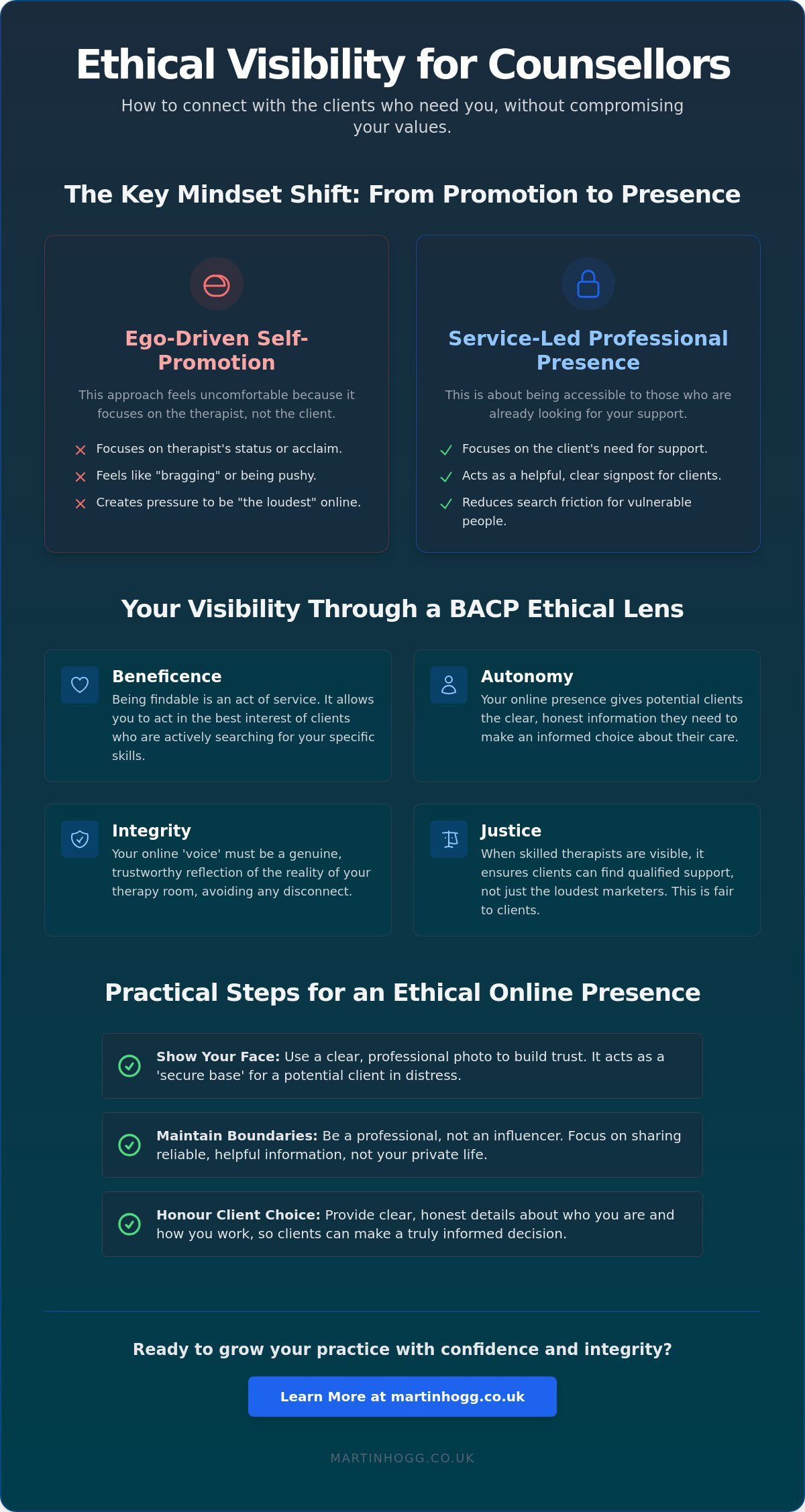
There is a clear line between 'self-promotion' and 'professional presence'. Self-promotion is ego-driven, focusing on the therapist's desire for status or acclaim. Professional presence, on the other hand, is service-driven. It focuses on the client. By being visible, you reduce the 'search friction' for vulnerable potential clients who may already feel overwhelmed by the process of seeking help. Understanding how counsellor visibility works in ethical practice means recognising that your online presence serves as a signpost in a crowded, often confusing market. This commitment to transparency is a cornerstone of ethical practice in psychotherapy, where the client’s welfare always comes first.
The Difference Between Marketing and Professional Accessibility
I know that 'marketing' can feel like a dirty word in our profession. It conjures up images of pushy sales tactics that feel entirely at odds with our clinical values. But if we reframe visibility as 'professional accessibility', the perspective shifts. We aren't trying to 'sell' a service to someone who doesn't need it. Instead, we are honouring the client's right to make an informed choice by providing clear, honest information about who we are and how we work. Ethical visibility is a bridge between a client's need and a therapist's expertise. It allows you to step out of the shadows with a clear conscience, knowing that your presence is a tool for connection rather than a display of vanity.
Aligning the BACP Ethical Framework with Your Visibility
When we look at the core principles of our profession, it is easy to see them as rules that only apply once the therapy room door is closed. However, these values should inform every part of your business. Understanding how counsellor visibility works in ethical practice starts with the principle of beneficence. This is our commitment to acting in the client's best interest. If you have the skills to help someone struggling with a specific issue, but they cannot find you because you are staying hidden, are you truly fulfilling that commitment? Being visible is an act of service to the people who are currently searching for the exact support you provide.
Autonomy is another vital pillar. For a client to make an informed decision about their therapist, they need clear, accessible information. Your website and online presence provide the data they need to exercise that autonomy. This leads naturally into the principle of integrity. Your online 'voice' must be a genuine reflection of the reality of your therapy room. If your website feels corporate but your practice is informal and warm, you create a disconnect that can damage trust before the first session even begins. Balancing these elements is a key part of your CPD for Counsellors UK journey, as you learn to merge professional growth with clinical standards.
Justice and Fairness in Clinical Visibility
There is an ethical problem with being a 'hidden' expert. If the most experienced and qualified therapists aren't visible, clients will simply find the people who are the loudest. This isn't fair to the client. By building a clear niche, you ensure you are working within your competence and reaching the right people. This focused approach to visibility is a core part of the Practice Visibility Blueprint, which helps you grow your practice while staying fully aligned with BACP's Ethical Framework. It is about being seen for the right reasons, by the right people, at the right time.
Practical Steps for Ethical Online Presence
Developing a professional voice online often feels like a balancing act. You want to sound warm and approachable, yet you must maintain the firm boundaries that keep the therapeutic relationship safe. One of the most effective ways to build trust before a client even picks up the phone is by showing your face. A clear, professional photo acts as a 'secure base'. It helps a person in distress feel a sense of safety and connection before they ever meet you. This is a core part of how counsellor visibility works in ethical practice; it's about making the transition into therapy as gentle as possible for the client.
When you use social media, remember that you are a professional, not an influencer. You don't need to overshare or blur the lines of your private life to be successful. Instead, focus on being a source of reliable, helpful information. Always follow the BACP guidelines for promoting your membership to ensure your advertising remains honest and decent. If you're looking for a broader look at building your reach, my guide on Marketing for Therapists in the UK offers more practical tips on this journey.
The Ethical Content Checklist
Before you hit 'publish' on any post or article, run it through this simple three-point check to ensure you stay on the right side of professional integrity:
- Service vs. Validation: Does this post genuinely serve a potential client, or am I seeking personal validation or 'likes'?
- Evidence-based: Is the information I'm sharing grounded in professional expertise and clinical reality?
- Confidentiality: Am I protecting client anonymity, even when using composite or anonymised examples?
SEO as a Tool for Ethical Matching
SEO isn't a dark art or a way to 'trick' the system. In our profession, it's a tool for ethical matching. It ensures that when someone searches for help using the words that describe their lived experience, they find a qualified professional who can actually help them. Using keywords that reflect how people actually talk about their pain is far more effective than sticking to clinical jargon. If you want to refine this process and grow your practice with a clear conscience, the Private Practice Success Membership provides the community and tools to help you get it right.
Overcoming the Fear of Being Seen
It is completely normal to feel a knot in your stomach when you think about putting yourself "out there." Most of us entered this profession to help people, not to become public figures. This often leads to a heavy sense of imposter syndrome. You might wonder if you're "expert" enough to share your thoughts or if your peers will judge you for being too visible. Understanding how counsellor visibility works in ethical practice is often as much about your internal mindset as it is about your external strategy. It’s about moving away from a need for perfection and focusing instead on professional reliability.
One of the most effective ways to manage this anxiety is to bring your visibility strategy into your supervision. While many view supervision solely for clinical casework, it is also a vital space for exploring the ethics of your professional presence. If a particular post or marketing idea feels "off," your supervisor can help you unpick whether that is a genuine boundary issue or just a fear of being seen. This ensures your growth remains grounded in clinical integrity. For a deeper look at this journey, you might find my guide on Starting and Growing a Private Practice helpful as you find your feet.
Building a Sustainable Visibility Plan
Ethical visibility is not about a sudden burst of "look at me" marketing. It is about building a consistent, quiet presence that reassures a potential client of your stability. Reliability is a professional trait. If your online presence is erratic, it can inadvertently signal a lack of consistency in your practice. A sustainable plan is one that feels manageable and doesn't lead to burnout or resentment.
You don't have to do this in isolation. Isolation often breeds self-doubt and perfectionism, which are the biggest barriers to growth. Connecting with a community of like-minded professionals can provide the reassurance you need to keep going. If you're ready to grow your practice alongside others who value integrity as much as you do, I’d love for you to join us in the Private Practice Success Membership for ongoing support and practical guidance.
Taking the Next Step in Your Practice Journey
Growing your private practice doesn't have to feel like a compromise. We have explored how visibility is actually a form of professional accessibility that honours the client's right to choose the right support. By shifting your focus from self-promotion to service, you can build a presence that feels authentic and safe. Understanding how counsellor visibility works in ethical practice allows you to step out of the shadows with a clear conscience; knowing that you are making it easier for someone in distress to find the help they deserve.
I've spent over 20 years providing UK-based expert guidance to therapists just like you. As a BACP-endorsed workshop provider, I offer accredited CPD training designed to help you grow without losing your professional integrity. You don't have to figure this out alone or feel overwhelmed by the technical side of things.
Ready to grow your practice ethically? Explore the Practice Visibility Blueprint and Membership for the community and tools you need. You have the clinical skills to make a real difference; now let's ensure the right clients can find their way to your door.
Frequently Asked Questions
Is it ethical to have a social media profile as a counsellor?
Yes, it is perfectly ethical to have a social media profile as long as it remains a professional space focused on service rather than personal sharing. Your presence should aim to inform and support rather than to seek attention for yourself. This is a clear demonstration of how counsellor visibility works in ethical practice; you are creating a digital signpost that helps people in distress find a qualified professional.
How do I deal with client boundaries on professional platforms like LinkedIn?
You should treat professional platforms like LinkedIn with the same boundary-awareness you use in your clinical work. Avoid accepting connection requests from current or former clients to protect the therapeutic frame. It's a good idea to mention this in your social media policy at the start of therapy so clients know your lack of engagement isn't a personal rejection, but a professional standard.
Can I use client testimonials to increase my visibility?
You should avoid using client testimonials because they can create an ethical conflict regarding the power imbalance in therapy. The BACP advises that marketing should be based on factual information about your services and qualifications. Instead of using reviews, try sharing evidence-based insights or explaining your therapeutic approach. This allows potential clients to see your expertise without compromising the confidentiality or well-being of those you've already helped.
Does the BACP Ethical Framework allow for paid advertising?
The BACP Ethical Framework does allow for paid advertising, as long as your adverts are decent, honest, and truthful. You must ensure that any claims you make about your success rates or expertise are grounded in reality and not misleading. Ethical advertising is a tool for professional accessibility; it ensures your niche expertise reaches the specific people who are looking for exactly the kind of support you provide.
What should I do if a client 'follows' my professional social media account?
If a client follows your professional account, the best approach is to maintain a professional distance and avoid following them back. You don't usually need to block them, but you should never interact with their personal profile. If their engagement becomes a regular occurrence, it is helpful to discuss this in supervision and potentially bring it into the therapy room to explore how it impacts the therapeutic relationship.

Article by
Martin Hogg
I help Private Practice counsellors in the UK set up and grow an ethical Private Practice they love, work with their ideal clients, and earn the income they deserve. All without guesswork and burnout. I have been a private practice counsellor myself for over 20 years, specialising in anger management. I set up a not-for-profit social enterprise, Citizen Coaching and Counselling, which delivers thousands of counselling sessions a year to adults and young people in Birmingham. I am a registered BACP Counsellor and the author of three books, My Anger Coach, My Anxiety Coach and My Relationship Coach. These are available on Amazon.
Disclaimer
The information provided on this blog is for general informational purposes only and is not intended to be a substitute for professional medical or mental health advice, diagnosis, or treatment. Reading this content does not create a therapist-client relationship.


