
How Procrastination Will Stop Your Practice Growing: A Guide for UK Therapists
What if the reason your diary remains half-empty has nothing to do with your clinical skills and everything to do with a hidden emotional shield? I've spoken with many therapists who feel a deep sense of failure when they aren't "busy enough," yet they spend three hours reorganising a bookshelf instead of writing a simple directory profile. The truth is that understanding how procrastination will stop your practice growing is the first step toward real change. It's rarely about being lazy; it's usually about the anxiety of being "seen" or the worry that marketing might somehow clash with the BACP ethical framework.
I know how heavy that pressure feels when you're trying to balance professional integrity with the need to build a stable income. You likely believe that if you were just more disciplined, your practice would thrive. This guide will show you why procrastination is actually an emotional hurdle rather than a time-management failure and provide practical steps to overcome the blocks holding you back. We'll look at how to start marketing without fear so you can finally create the sustainable, growing practice you deserve.
Key Takeaways
- Understand how procrastination will stop your practice growing by recognising it as an emotional safety strategy rather than a simple lack of discipline.
- Identify the "clinical trap" of productive procrastination, where reading another research paper feels safer than the vulnerability of marketing your services.
- Learn how to use the "5-minute rule" and implementation intentions to move past the dread of business admin and find your momentum.
- Address the specific emotional blocks around fee increases and financial management that prevent your practice from becoming truly sustainable.
- Discover why investing in business-focused CPD is just as essential for your long-term success as your clinical training.
Why Procrastination is a Silent Growth Killer for UK Therapists
In my experience supporting counsellors across the UK, I’ve noticed a recurring pattern. Procrastination isn't just about being lazy or unmotivated. In a business context, it's the painful gap between your intention to help more people and the actual actions you take to reach them. Understanding the psychology of procrastination helps us see it for what it really is: a coping mechanism for anxiety. When you delay updating your website or calling a potential referral partner, you're usually trying to protect yourself from the fear of rejection or failure.
Therapists are uniquely prone to "productive procrastination." You might spend three hours reading a new text on Transactional Analysis instead of writing a blog post that answers a client's question. While clinical CPD is vital, doing it to avoid marketing is how procrastination will stop your practice growing. If your diary stays stagnant, the result isn't just a quiet week. It leads to chronic financial stress and, eventually, the kind of burnout that forces good therapists out of the profession entirely. We must distinguish between genuine self-care, which restores your energy, and avoidant procrastination, which merely drains your future security.
The "Busy Fool" Trap in Private Practice
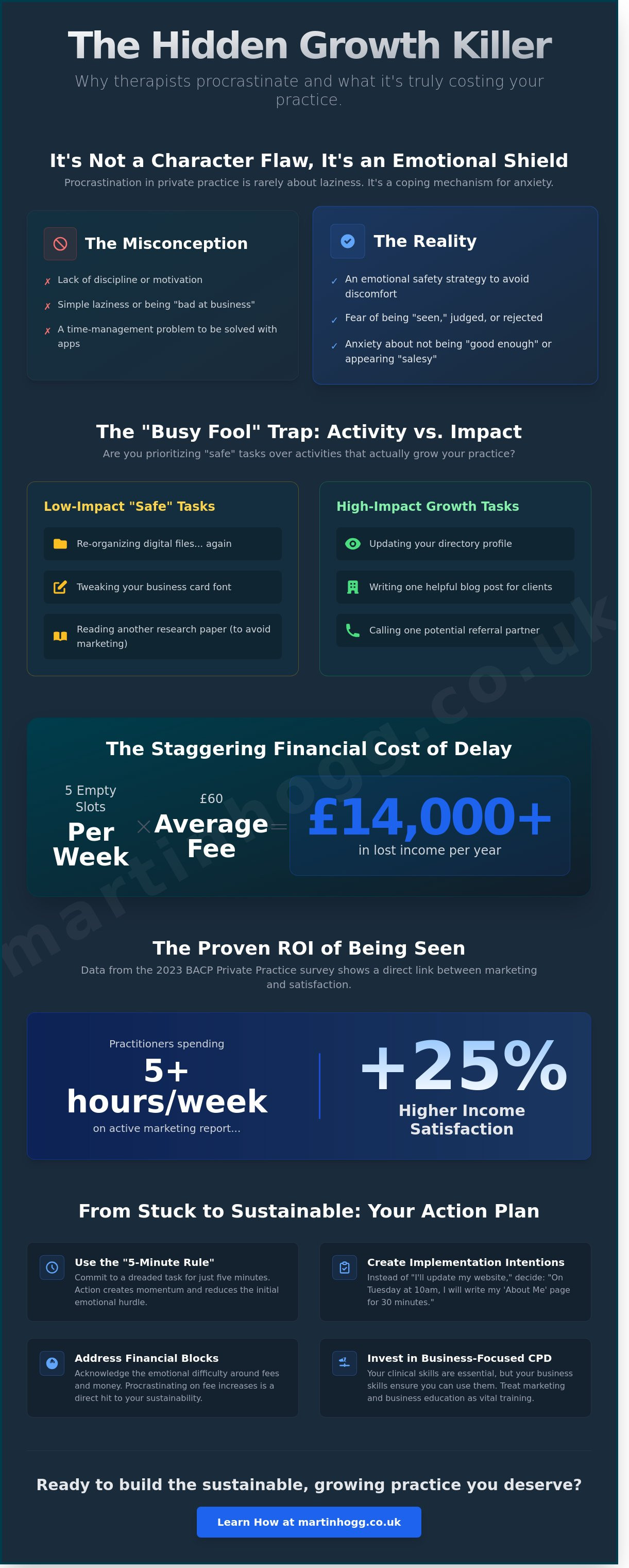
I often see practitioners falling into the "busy fool" trap. This involves spending your best hours on "safe" tasks like re-organising digital files or tweaking the font on your business cards for the tenth time. These tasks feel productive because they keep your hands moving, but they don't attract new clients. To grow, you must prioritise High-Value Activities (HVAs). Data from the 2023 BACP Private Practice survey suggests that practitioners who spend at least five hours a week on active marketing report 25% higher satisfaction with their income than those who rely solely on word of mouth.
The Financial Impact of the "Wait and See" Approach
Delaying your visibility creates a "feast or famine" cycle that is exhausting to manage. When you take a "wait and see" approach to referrals, you lose control over your professional stability. A half-empty diary isn't just a missed opportunity; it has a compounding effect on your pension and savings. If you have five empty slots a week at a rate of £60, the opportunity cost of a half-empty diary is £300 per week, which totals over £14,000 across a working year. This is exactly how procrastination will stop your practice growing and prevent you from building the stable, fulfilling life you deserve.
The Emotional Roots of Delay: Why Business Tasks Feel Threatening
We often beat ourselves up for being "lazy" when we put off marketing or administrative tasks. It's important to realise that procrastination isn't a character flaw or a lack of discipline. It's actually a strategy for emotional regulation. When you face a task like writing a blog post or raising your fees, your brain senses a threat. You aren't avoiding the work itself; you're avoiding the uncomfortable feelings of anxiety or self-doubt that come with it. Understanding research on procrastination antecedents helps us see that stress and the fear of failure are the real drivers behind our delay.
Many UK counsellors struggle with what I call the "Vulnerability of Visibility." We're trained to be the quiet observer in the therapy room, not the person in the spotlight. Stepping out to promote your services feels like exposing yourself to public judgment. This is specifically how procrastination will stop your practice growing. If you don't allow yourself to be seen, the clients who need your help simply won't find you. You might also worry about looking "salesy" or unethical. This clinical freeze happens when we mistake helpful marketing for pushy sales tactics, leading us to stall on essential business growth.
The Neuroscience of the Therapist’s Brain
Your limbic system is designed to keep you safe from harm. When you think about networking or launching a new service, this part of the brain can trigger a "fight or flight" response. It views a potential "no" as a social threat. Your prefrontal cortex, which is the part of your brain that understands you need more income, gets hijacked by this fear. You end up rationalising the delay by telling yourself you need to do more "research" or "prep" first. It's a sophisticated way to stay in your comfort zone while feeling like you're still working.
Perfectionism: The Handbrake on Your Growth
Perfectionism is often just a shield we use to protect ourselves against criticism. You might spend six months "tweaking" a website logo instead of making the site live. This "Not Ready Yet" syndrome is a common trap that keeps your practice stagnant. A 2022 survey of UK micro-businesses suggested that perfectionist tendencies can delay product launches by an average of 9 months. To build a sustainable business, you have to embrace the transition from "perfect" to "good enough."
If you're feeling stuck in this cycle of waiting for the perfect moment, it might be helpful to get a fresh perspective. You can book a brief discovery call with me to look at practical ways to get your practice moving again. Remember that how procrastination will stop your practice growing is usually through these quiet, emotional blocks rather than a lack of business knowledge.
Three Specific Areas Where Procrastination Stalls Your Practice
Procrastination rarely looks like sitting around doing nothing. For most of us in the counselling world, it looks like being incredibly busy with the wrong things. You might spend hours perfecting your clinical notes or reorganising your filing system while the tasks that actually drive growth stay at the bottom of the pile. Understanding how procrastination will stop your practice growing starts with identifying where you are hiding. Real progress in starting and growing a private practice requires you to face these three specific areas with a bit of courage.
Clinical boundaries are often the first casualty of delay. We often put off difficult conversations with clients, such as addressing a string of late arrivals or a missed payment. It feels like we're being "kind" or "therapeutic," but avoiding these moments is actually a form of procrastination that erodes the professional container. When you don't address a boundary breach immediately, it grows into a much larger problem that can eventually lead to burnout or a breakdown in the therapeutic relationship.
The Marketing Avoidance Cycle
Many therapists find the idea of marketing for therapists uk quite intimidating. There's a common myth in our profession that "good work is the only marketing you need." While being a great clinician is vital, relying solely on word-of-mouth is a slow way to build a business. We often postpone the "scary" stuff like SEO, social media, or networking because we're afraid of being seen or judged. You can break this cycle today by taking one small, non-scary step. Spend ten minutes updating your directory bio or send one introductory email to a local GP surgery. You don't need to be a marketing expert; you just need to be visible.
The "Money Block" in Private Practice
Delaying fee increases or chasing late payments is another classic sign of procrastination. Many UK counsellors struggle with a "martyr" complex, feeling that charging a professional rate somehow conflicts with their desire to help. However, a sustainable counselling private practice uk depends on a healthy relationship with your income. If you haven't reviewed your fees in the last 12 months, you're likely working for less than you were a year ago due to inflation. This isn't about greed; it's about ensuring you have the resources to stay in practice for the long term. Remember, how procrastination will stop your practice growing is often through the slow leak of financial neglect. Taking control of your finances is an act of self-care that allows you to show up fully for your clients.
Breaking the Cycle: Practical Strategies for the Overwhelmed Practitioner
Understanding the theory of why we delay is one thing, but taking action is where the real change happens. If you don't have a system to move past the initial resistance, how procrastination will stop your practice growing becomes a daily reality rather than a warning. The goal isn't to become a productivity machine. It's about finding practical ways to get the essential business tasks done so you can focus on the clinical work you love.
- The 5-Minute Rule: When a task feels too big, commit to doing it for just 300 seconds. Tell yourself you can stop after five minutes if you want to. Usually, the friction of starting is the hardest part, and once you've begun, the momentum carries you through the next hour.
- Implementation Intentions: This is a simple "If-Then" strategy. Instead of saying "I need to do admin," try "If it is 10:00 am on Tuesday, then I will sit at my desk and send three follow-up emails." This removes the need for willpower and makes the decision ahead of time.
- Body Doubling: Many counsellors find the isolation of private practice difficult. Try co-working sessions, either in person or via a video call, where you both work on your own admin in silence. Having someone else "present" creates a natural sense of accountability that makes the boring bits easier to finish.
- The 70/30 Split: Structure your week so that 70% of your time is for clinical excellence and 30% is for business growth. Without this deliberate boundary, the business tasks will always be pushed to "next week."
The Practice Visibility Blueprint Approach
Procrastination thrives in the face of vague goals. When you tell yourself you need "more clients," your brain doesn't know where to start. I prefer a structured blueprint that breaks growth into small, low-anxiety actions. By focusing on how to get counselling clients uk through consistent, manageable steps, you replace the fear of the unknown with a clear map. A structured plan is the best antidote to the paralysis that stops your practice from reaching its potential.
Self-Compassion as a Business Tool
Beating yourself up for a wasted morning only drains the energy you need for the afternoon. I often suggest using "gentle curiosity" instead of self-criticism. Ask yourself why you are avoiding a specific task. Is it a lack of information, or is there a fear of being seen? This approach is a vital part of therapist burnout prevention. When we treat ourselves with the same empathy we give our clients, we reduce the shame that fuels the procrastination cycle.
If you feel stuck in a cycle of "thinking" instead of "doing," let's find a way forward together. You can book a session on my calendar to discuss a practical plan for your practice.
Moving from "Stuck" to "Seen": Building a Sustainable Future
Procrastination often feels like a protective shield, but in reality, it's a barrier. I speak with talented therapists every week who provide life-changing support behind closed doors but remain invisible to the wider world. This silence is exactly how procrastination will stop your practice growing; it keeps your expertise hidden from the very people who are currently searching for help. Moving from being "stuck" to being "seen" isn't about a sudden burst of confidence. It's about building a structure that makes action easier than avoidance.
Building a successful practice isn't a solo sport. When you work in isolation, every administrative task or marketing hurdle can feel like a mountain. Community and mentorship change the energy of your work. They turn a lonely struggle into a shared journey. By connecting with others, you move from the mindset of a solo practitioner to that of a purposeful practice owner. This shift is vital for long-term sustainability and mental well-being.
Finding Your Growth Community
Peer support is essential because it provides the accountability that breaks the cycle of "I'll do it tomorrow." In a group setting, you realise that your fears about visibility or "sales" are shared by almost everyone in the profession. You can find this support by checking our training and events calendar for upcoming practice growth workshops. These sessions are practical and grounded, focusing on the real-world steps you need to take to reach more clients in the UK market.
Growth also requires you to broaden your definition of professional development. While clinical skills are the foundation of what we do, CPD for counsellors uk should also encompass the business skills necessary to run a healthy practice. Learning how to manage your time, understand your local market, or improve your digital presence is a legitimate part of your professional growth. It isn't a distraction from your "real" work; it's the engine that allows your real work to happen.
Your Next Steps for Practice Success
The most effective way to beat procrastination is to adopt a "done is better than perfect" culture. Perfectionism is often just procrastination in a smart suit. It tells you that you can't launch your website or post that blog until every comma is in place. I encourage you to break that habit today. Choose one task you've been avoiding, perhaps updating your directory listing or drafting a client newsletter, and commit to working on it for just 10 minutes. This small, imperfect action is enough to break the paralysis.
If you find that you're still struggling to make progress alone, you can access further support through the Private Practice Success Membership. We provide a clear roadmap and a supportive environment to help you get your practice on track. Remember, your future clients are already out there. They're waiting for you to find them, and every step you take today brings you closer to the people who need your support the most.
Taking the Next Step for Your Practice
Building a successful therapy business isn't just about your clinical skills; it's about managing the quiet resistance that shows up when it's time to grow. We've explored how these delays are often emotional responses to feeling overwhelmed rather than a simple lack of motivation. When you understand how procrastination will stop your practice growing, you can start to replace that "stuck" feeling with practical, manageable actions. It's about moving away from the fear of being seen and toward a sustainable future where your skills reach the people who need them most.
I've spent over 20 years working in UK private practice, and I know that the right support makes all the difference. Through Citizen Coaching, I provide BACP-endorsed workshops and no-nonsense coaching that cuts through the noise. You don't have to figure this out alone, and you certainly don't have to stay stuck in a cycle of delay. There's a way to get your business back on track so you can focus on what you do best.
Ready to stop stalling and start growing? Check our calendar for the next Practice Visibility Blueprint session. You have the expertise to help others; now let's make sure they can find you.
Frequently Asked Questions
Is procrastination a sign that I am not cut out for private practice?
No, procrastination is a common psychological response to the pressure of being your own boss. Many of the 30,000 counsellors registered with the BACP struggle with these same feelings of doubt. It doesn't mean you lack the skill to help people. It just means you're human and facing a steep learning curve. I've seen many excellent therapists thrive once they understand how procrastination will stop your practice growing if left unchecked.
How can I stop feeling "salesy" when I try to grow my practice?
You stop feeling salesy by shifting your focus from selling a service to offering a solution to someone in pain. Think of your marketing as an extension of your therapy. When you share a helpful post or update your directory profile, you're helping a potential client find the support they need. It's about being visible so that the right people can find you. This mindset shift helps you avoid the "pushy" feeling often associated with business growth.
What are the most common things therapists procrastinate on?
Most therapists I work with procrastinate on marketing tasks like writing blog posts or updating their website. Admin duties, such as bookkeeping or chasing invoices, also tend to fall to the bottom of the list. A 2023 survey of private practitioners found that 65% of respondents delayed tasks related to visibility because they feared being judged by peers. This avoidance creates a bottleneck that prevents your practice from reaching its full potential.
How do I know if I am procrastinating or if I am actually burnt out?
Procrastination usually involves avoiding specific, daunting tasks while still having the energy for other things, like seeing clients. Burnout is a deeper state of emotional and physical exhaustion where you feel finished with everything. If you find that you can't even focus on the work you usually love, it's likely burnout. Understanding how procrastination will stop your practice growing is important, but if you're burnt out, you need rest before you can take action.
Can better time management tools help me stop procrastinating?
Tools can provide structure, but they rarely solve the emotional reasons why we delay work. You can have the best calendar in the world, but if you're afraid of being seen, you'll still find reasons to avoid your marketing. Use tools like the Pomodoro technique or simple paper planners to manage your working week. However, real change happens when you address the anxiety or perfectionism that makes you put things off in the first place.
Why do I find it so hard to raise my fees even when my costs are rising?
It's hard to raise fees because therapists often link their price to their self-worth rather than the value of the service. With UK inflation hitting 11.1% in late 2022, many practitioners found their overheads increasing while their income stayed flat. You might worry that clients will leave, but most will understand a fair increase that reflects your experience. Setting a professional fee is a practical business decision that ensures your practice remains sustainable for the long term.
What is the "Practice Visibility Blueprint" and how does it help with procrastination?
The Practice Visibility Blueprint is a step by step framework I designed to help counsellors get their marketing done without the overwhelm. It breaks down complex tasks into small, manageable actions so you always know what to do next. By providing a clear path, it removes the decision fatigue that often leads to procrastination. This structured approach helps you build a steady stream of clients while keeping your professional integrity intact.


