How to Attract a Niche Therapy Client as a Counsellor in the UK
What if narrowing your focus was the very thing that finally filled your diary? It sounds counterintuitive, but trying to be everything to everyone often leaves you feeling invisible in crowded UK directories. Many of us worry that choosing a specialism means turning people away, but the reality is that clients are increasingly looking for specialists who truly "get" their specific struggle. Learning how to attract a niche therapy client as a counsellor isn't about becoming a pushy salesperson; it's about making it easier for the people who need you most to find you.
I know the "feast or famine" cycle of enquiries is exhausting, and the idea of marketing can feel a bit uncomfortable or even unethical. This guide is designed to move you past that anxiety with a practical, step-by-step approach tailored for UK private practice. We'll look at how to update your website and profiles so they speak directly to your ideal client, helping you build a practice full of people you actually enjoy working with. From refining your message to building your confidence as a specialist, here is how we can get your practice back on a fulfilling trajectory.
Key Takeaways
- Understand why trying to appeal to everyone often makes you invisible in busy UK therapist directories and how a narrow focus actually increases your visibility.
- Learn how to audit your current caseload and CPD history to identify a specialism that energises you rather than leading to professional burnout.
- Discover the practical steps on how to attract a niche therapy client as a counsellor by using clear, human language that speaks directly to their specific struggle.
- Find out how to structure your professional bio and website to build deep trust with potential clients without ever feeling like a pushy salesperson.
- Explore how a well defined niche allows you to set sustainable fees and build a supportive referral network with other practitioners across the UK.
The Generalist Trap: Why 'Talking to Everyone' Leaves Your UK Practice Quiet
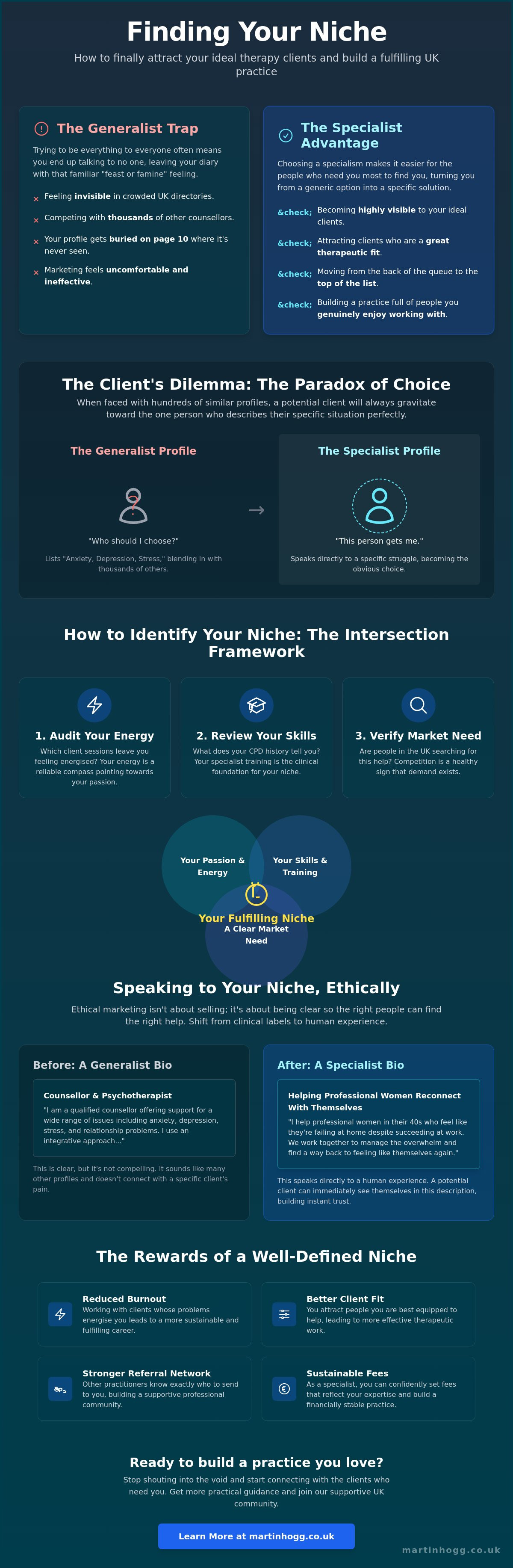
Many of us start our private practice with a "wide net" approach. We list every condition from A to Z on our profiles, hoping to catch anyone who needs help. But in a crowded market, trying to talk to everyone usually means you end up talking to no one. A therapy niche is essentially a niche market where your specific clinical skills meet a very particular client struggle. It's the difference between being a "counsellor" and being the person who helps retired men manage the transition out of the workforce.
If you're wondering how to attract a niche therapy client as a counsellor, you first have to face the "fear of exclusion." It's the nagging worry that by choosing a specialism, you're shutting the door on potential enquiries. In reality, the opposite happens. When you specialise, you stop being a generic option and become a specific solution. Clients in distress don't want a generalist; they want someone who understands their exact pain. This is the "Paradox of Choice." When faced with 500 identical profiles, a client will naturally gravitate toward the one person who describes their specific situation perfectly.
The Reality of the UK Directory Landscape
National platforms like Counselling Directory or Psychology Today are incredibly crowded. If your profile lists "Anxiety, Depression, and Stress" as your main areas, you're competing with thousands of other practitioners. These broad categories have become white noise. Generic profiles often end up buried on page 10, where they're never seen. To stand out, you need to move beyond these catch-all terms. Being a specialist isn't about limiting your practice; it's about making yourself visible enough to actually help the people you're trained to support. When you speak to a specific struggle, you move from the back of the queue to the top of the list.
Identifying Your Profitable Niche: Where Your Passion Meets Market Demand
Finding your niche starts with a simple audit of your current caseload. Take a look at your diary from the last month and be honest with yourself. Which sessions left you feeling energised, and which ones felt like heavy lifting? We often ignore these internal cues because we feel we "should" be able to work with everyone. However, your energy levels are a reliable compass for your specialism. If you find yourself consistently looking forward to working with clients facing redundancy or those struggling with new parenthood, you've already found the seeds of a niche.
Your previous training and professional development often hold the key to this process. For example, if you've completed a specific course on working with men, you've already started building the clinical foundation for a specialism. Choosing a niche isn't just about what you like; it's about where your skills meet a clear need in the UK market. You can read more about aligning your training with your goals in this guide to CPD for counsellors UK. This alignment is the most effective way to understand how to attract a niche therapy client as a counsellor without feeling like you're shouting into a void.
The Intersection Framework
To define your niche, try mapping your clinical skills against specific, underserved demographics. Instead of using a broad diagnosis like "Anxiety," define your ideal client by their specific pain points. A helpful sentence might look like this: "I help professional women in their 40s who feel like they're failing at home despite succeeding at work." This moves the conversation from a clinical label to a human experience. It's much easier for a potential client to see themselves in that description than in a list of academic qualifications.
Verifying the Niche
Once you have an idea, you need to verify that people are actually looking for help in that area. A quick search on UK therapist directories can tell you a lot. If you see other therapists already serving that niche, don't be discouraged. Competition is actually a healthy sign; it proves there is a demand for that specific type of support. If no one else is doing it, there might not be enough clients to sustain a full practice. Your goal is to be the person who offers a slightly different, more personal perspective on that shared problem.
If you're feeling stuck on which direction to take, joining a supportive group of peers can help clarify your thinking. You might find the encouragement you need within our Private Practice Success community, where we talk about these practical hurdles every day.
Communicating Your Specialism Without Sounding Like a Salesperson
Marketing often feels like a dirty word in our profession. We worry that being visible is somehow unethical or that we're selling ourselves like a consumer product. But ethical marketing is simply about being clear so that the right person can find the right help. When you understand how to attract a niche therapy client as a counsellor, your website stops being a list of your achievements and starts being a lighthouse for someone in distress. It's about being findable, not pushy.
The key is prioritising clarity over cleverness. Most clients don't care if you're integrative or psychodynamic until they know you understand why they can't sleep at 3 am. Moving from a generic statement like "I provide therapy for various issues" to something specific like "I help exhausted healthcare workers manage the weight of secondary trauma" makes you instantly recognisable to the person who needs that exact support. You aren't selling; you're offering a bridge to a more functional future.
I often suggest using a "Pain-to-Peace" narrative. This isn't about manipulation; it's about demonstrating deep empathy. You describe the specific struggle they're facing today, acknowledge the weight of it, and then show them what life could look like on the other side. This approach stays firmly within BACP and UKCP ethical frameworks because it's based on honesty and transparency. It avoids the exaggerated claims or testimonials that are prohibited by our professional bodies, focusing instead on your ability to understand and hold their specific experience.
Writing Your 'About Me' for the Client
Try following the 80/20 rule for your profiles. Your bio should be 80% about the client's experience and only 20% about your qualifications. While your diploma is vital for safety, it isn't what makes a client click "contact." They want to know you've seen people like them before and that you have a plan to help them move forward. For a deeper look at these techniques, check out this guide on marketing for therapists in the UK.
Refining your message takes practice, and it's much easier to do when you have feedback from others who understand the balance between ethics and business. You can join us in the Private Practice Success Membership to get clear, practical support on finding your voice as a specialist.
From Visibility to Authority: Building a Sustainable Niche Practice
Once you've decided on your focus, the shift from visibility to authority begins. This transition is where your practice becomes truly sustainable. When you specialise, you're able to provide higher-value care that justifies raising your fees ethically. You aren't just another generalist; you're the person who holds the specific tools for a specific problem. This expertise also opens doors to a referral network. Other therapists who don't work in your niche will naturally send clients your way; they know their clients are in safe, specialised hands.
Understanding how to attract a niche therapy client as a counsellor makes your ongoing marketing much simpler. Instead of wondering what to write about on social media or your blog, you have a clear theme. Your content becomes 10x easier to create because you're always speaking to that one person's struggle. Over time, you can slowly transition your caseload, taking on fewer general enquiries and filling those spaces with the specialised work that gives you energy.
Scaling Your Impact
A clear niche allows you to move beyond the traditional one-to-one model. You might choose to develop workshops or small groups, helping more people while protecting your own time. This sense of authority is a powerful tool in preventing therapist burnout. By working with clients who fit your skill set, the emotional labour of your day decreases, and your professional satisfaction grows. It's about restoring your personal trajectory so you can enjoy the work you were trained to do.
Your Practice Visibility Blueprint
Building this kind of authority doesn't have to be a lonely or overwhelming process. I've developed a structured system to help you become the go-to person in your field without the need for pushy sales tactics. You can join the Private Practice Success Membership to find your niche alongside a community of peers who are doing the same. If you're ready to stop feeling invisible and start building a practice you love, Explore the Practice Visibility Blueprint to attract your ideal clients today.
Take the Next Step Toward a Fulfilling Practice
Choosing a niche is one of the most compassionate things you can do for your potential clients. It moves you away from being a generic name in a directory and positions you as a specialist who truly understands their struggle. By focusing on a specific problem and speaking your client's language, you create a practice that is both sustainable and deeply rewarding. You've learned that learning how to attract a niche therapy client as a counsellor isn't about sales; it's about making professional support accessible to those who need your unique skills the most.
You don't have to do this alone. If you're ready to move past the "feast or famine" cycle, I can help you find your focus. As a BACP-endorsed training provider, I offer a proven system for UK private practice growth. You'll join a supportive community of over 500 UK therapists who are all working toward the same goal: a full diary of clients they enjoy working with.
Start attracting your ideal clients with the Practice Visibility Blueprint. Your expertise is needed; it's time to make sure the right people can find you.
Common Questions About Therapy Niches
Will I lose money by narrowing my focus to a niche?
No, you won't lose money; you'll likely increase your income over time by attracting more committed clients. While it feels risky to turn away general work, specialists often command higher fees because they provide a specific solution to a painful problem. In a busy UK market, being the go-to person for a particular issue makes you a far more attractive choice than a generalist who lists every possible condition.
Do I need a specific qualification to claim a therapy niche?
You don't always need a new diploma, but you must be ethically competent to work in that area. The BACP and UKCP require us to work within our proficiency. You can build a niche through targeted CPD, such as a course on working with men, or through your own lived experience. It's about being able to honestly say you have the clinical tools and understanding to help that specific person move forward.
How do I tell existing generalist clients that I am specialising?
You don't need to make a formal announcement that disrupts your current therapeutic relationships. Specialising is primarily a marketing shift for new enquiries, not a reason to end existing work that is progressing well. Continue your current sessions as usual. As your diary naturally fills with your new niche, you can simply stop taking on the generalist work that no longer fits your long term practice goals.
Can I have more than one therapy niche in my private practice?
Yes, you can have more than one niche, but it's best to keep them clearly separated on your website or directory profiles. If you try to talk to two very different groups on one page, you risk confusing both. Using separate landing pages is a great way to understand how to attract a niche therapy client as a counsellor for different demographics without diluting your message or your authority.
How long does it take to see results after picking a niche?
Most therapists see a noticeable shift in the quality of their enquiries within three to six months. It takes a little while for search engines and UK directories to index your updated profiles and for your new message to reach the right audience. Staying consistent with your new focus during this transition period is the best way to build the trust needed for a sustainable specialist practice.

Article by
Martin Hogg
I help Private Practice counsellors in the UK set up and grow an ethical Private Practice they love, work with their ideal clients, and earn the income they deserve. All without guesswork and burnout. I have been a private practice counsellor myself for over 20 years, specialising in anger management. I set up a not-for-profit social enterprise, Citizen Coaching and Counselling, which delivers thousands of counselling sessions a year to adults and young people in Birmingham. I am a registered BACP Counsellor and the author of three books, My Anger Coach, My Anxiety Coach and My Relationship Coach. These are available on Amazon.
Disclaimer
The information provided on this blog is for general informational purposes only and is not intended to be a substitute for professional medical or mental health advice, diagnosis, or treatment. Reading this content does not create a therapist-client relationship.


