How to Attract More Clients as a CBT Therapist: A Practical UK Guide
In 2022, the number of people waiting for community mental health care in England rose to 1.2 million. You know the demand for support is there, yet your own diary might still have gaps that feel heavy and discouraging. If you are currently trying to figure out how to attract more clients as a CBT therapist, it is easy to feel invisible on massive directories or worry that marketing is a word that simply doesn't belong in a clinical setting.
I understand that discomfort. You didn't train as a BABCP-accredited professional to spend your evenings wrestling with jargon or feeling like a pushy salesperson. It is frustrating to be a specialist while feeling like you are shouting into a void, but building a steady stream of private-pay clients does not require you to compromise your ethics. In fact, the most effective way to grow is to stay grounded in the same evidence-based clarity you provide for your clients.
Discover how to grow your CBT practice ethically and effectively using a structured approach that mirrors the clarity of your clinical work. This guide provides a practical path to creating a sustainable practice that feels like a natural extension of your professional identity rather than a source of stress.
Key Takeaways
- Learn why clinical excellence alone doesn't fill a diary and how to bridge the gap between being qualified and being visible to those who need you.
- Discover how moving away from a 'generalist' approach helps you stand out to the specific people who are searching for your expert support.
- Get practical steps to audit your directory profiles so they speak directly to a client's internal struggles rather than just listing your qualifications.
- Understand how to attract more clients as a CBT therapist by building sustainable referral loops with local GPs and professional partners without feeling like a salesperson.
The CBT Marketing Paradox: Why Clinical Excellence Isn’t Enough
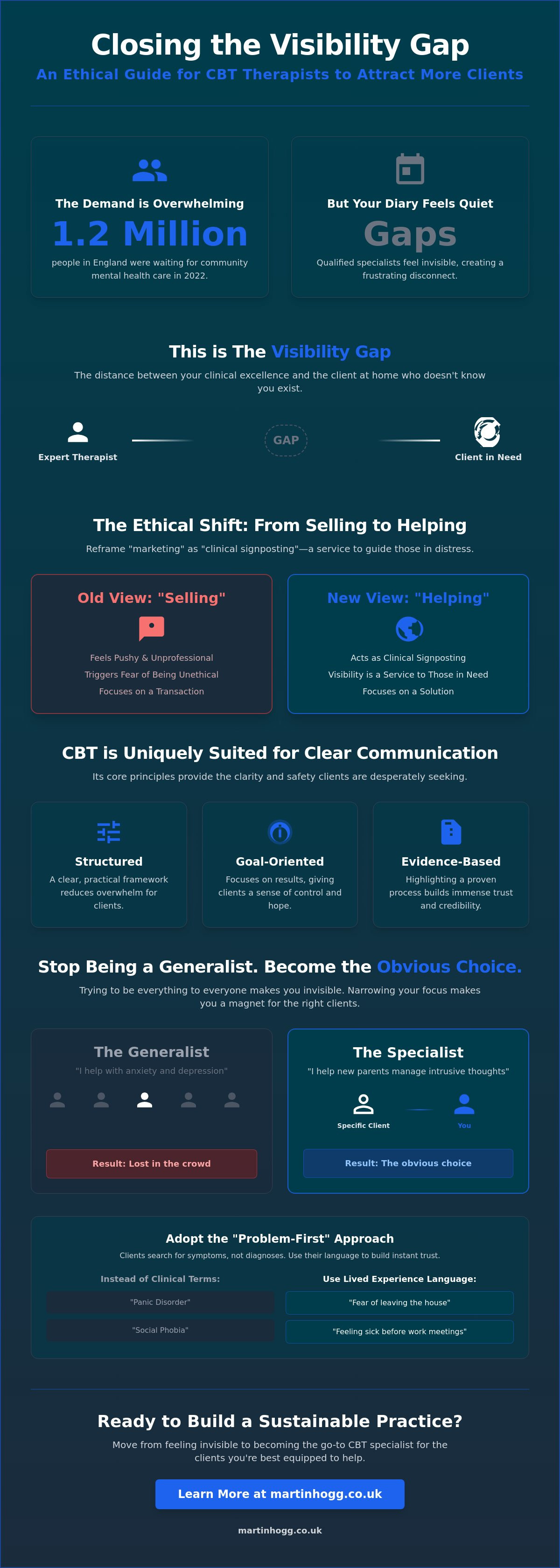
You have likely spent years honing your skills, yet there is a quiet frustration when the diary isn't as full as you'd like. This 'Visibility Gap' is the distance between your high level of qualification and the person sitting at home, struggling with anxiety, who simply doesn't know you exist. Many practitioners worry that learning how to attract more clients as a CBT therapist feels a bit too much like 'selling,' which can trigger a fear of appearing unprofessional or even unethical.
Instead of seeing marketing as a corporate intrusion, I want you to view it as clinical signposting. If a person is in distress, they need clear directions to reach the right specialist. Ethical therapy marketing is the bridge between a specific problem and a proven solution.
The Ethical Shift: From Selling to Helping
In 2022, the number of people waiting for community mental health care in England hit 1.2 million. Those people are often 'stuck,' searching for a way out of their current patterns. If you stay invisible because you're worried about being too 'commercial,' you are actually doing a disservice to the individuals who are desperately seeking evidence-based help. Your visibility is the first step in their recovery. When you understand how to attract more clients as a cbt therapist through this lens of service, the pressure to 'sell' disappears.
Why CBT is Uniquely Marketable
The structured, goal-oriented nature of Cognitive Behavioral Therapy (CBT) makes it incredibly well-suited for clear communication. Clients often feel overwhelmed by the abstract nature of 'talking,' so when you explain the practical, results-focused framework of CBT, it provides a sense of safety. You aren't making guaranteed claims; instead, you are highlighting a process that has been proven to work for millions of people. This clarity is exactly what a person in crisis is looking for when they begin their search for support.
Defining Your CBT Niche: Moving Beyond Anxiety and Depression
In the UK private practice market, the biggest risk you can take is trying to be everything to everyone. If your profile simply lists "anxiety and depression," you are competing with thousands of other practitioners. This makes you invisible to the very people who need your specific skills. Identifying how to attract more clients as a CBT therapist starts with narrowing your focus. This isn't about turning people away; it's about becoming the obvious choice for a particular person in distress.
One of the most effective ways to do this is by translating clinical terms into lived experience. A person struggling rarely searches for "Panic Disorder" or "Social Phobia." They are more likely to search for "fear of leaving the house" or "feeling sick before work meetings." When you use their language, you build immediate trust. For a more detailed look at building these foundations, you might find our guide on Starting and Growing a Private Practice: A Practical Guide for UK Counsellors useful.
The "Problem-First" Approach to Visibility
Clients search for symptoms, not modalities. They want to know if you understand the weight of their specific struggle. Effective client acquisition strategies for therapists rely on a clear "Specialist Statement." Instead of a generic introduction, try something like: "I help new parents manage intrusive thoughts so they can feel confident in their role again." This clarity reduces the friction for a client making that first, difficult contact.
CBT for Specific Demographics
There is a significant opportunity in serving specific groups, such as men facing workplace burnout or individuals dealing with health anxiety. Nearly one-third of adults in the UK sought help from a counsellor in the last 12 months, according to 2022 data, but many struggle to find a therapist who "gets" their specific situation. Investing in targeted CPD for Counsellors UK allows you to build a niche that is both personally rewarding and commercially sustainable. If you're ready to refine your focus with expert support, you can explore our Private Practice Success Membership for ongoing guidance.
Optimising Your Digital Front Door: Directories and Websites
Your website and directory profiles are often the first point of contact for someone in crisis. If these pages feel cold or academic, a potential client will simply keep scrolling. Learning how to attract more clients as a cbt therapist involves making this "digital front door" as welcoming and clear as your physical practice room. It's about making that first, difficult contact as easy as possible for a person who might already feel overwhelmed.
Start with a thorough audit of your directory presence. Most therapists spend too much time listing their training and not enough time addressing the reader's pain. You can improve your results by following these steps:
- Audit your language: Replace "I am an accredited practitioner" with "I help you break the cycle of panic attacks so you can get your life back on track."
- Clear Call to Action: Don't leave them guessing. Use a clear instruction like "Book a free 15-minute chat" or "Check my current availability."
- Ethical Social Proof: Display your BABCP or BACP logos clearly. These signify trust and professional standards in the UK, providing reassurance that you are a safe pair of hands.
- Local Visibility: Ensure your practice location is clear so you appear in local searches for your specific town or city in the West Midlands or beyond.
The Anatomy of a High-Converting Directory Profile
The first 20 words of your profile are your only chance to stop the scroll. On platforms like Psychology Today, those opening sentences are all a client sees before deciding whether to click. Avoid 'therapist-speak.' Instead of saying "I offer an integrative approach," try "If you feel like you're constantly on edge, I can help you find a practical way forward." This speaks directly to their internal struggle and offers immediate hope.
Reducing Friction in the Intake Process
A complicated booking process is a significant barrier to help. Many successful practitioners use a Practice Visibility Blueprint to streamline how they move a person from a simple enquiry to a confirmed first session. Offering a free 15-minute consultation is a practical way to lower the stakes for the client. It allows them to feel your presence and hear your voice, which often provides the reassurance they need to commit to the therapy process. If you're ready to professionalise your approach, you can find more tailored support in our Private Practice Success Membership.
Building a Sustainable Referral Loop Without Burnout
While a strong digital presence is vital, relying solely on directories can sometimes feel like waiting for the weather to change. To create a truly stable practice, you need a referral loop that doesn't depend on an algorithm. Understanding how to attract more clients as a cbt therapist involves building genuine professional relationships with people who already encounter your ideal clients. This might include local GPs, physiotherapists, or even other therapists whose books are currently full.
The most effective way to start is the "Give First" principle. Instead of asking for work, reach out to a colleague and ask if they are taking on new clients. When you send a referral their way, you demonstrate your professional standards and reliability. Over time, these practitioners will naturally return the favour because they know you are a safe, competent pair of hands. If you want to find a supportive community to help you build these connections, our Practice Visibility Blueprint & Membership is a great place to start.
Networking for the Introverted Therapist
You don't need to be an extrovert to build a referral base. In fact, the quiet, focused listening skills you use in the therapy room are your biggest asset. Networking isn't about "working the room" at large events; it's about having one-to-one conversations. A simple, honest email to a local counsellor explaining that you have space for "overflow" referrals can be incredibly effective. Most therapists are relieved to have a trusted colleague they can recommend when they are at capacity.
Managing Growth and Avoiding Burnout
As you master how to attract more clients as a cbt therapist, you will eventually face a new challenge: a full diary. It is essential to set firm boundaries early on to protect your own wellbeing. You might decide on a maximum number of clinical hours per week or specific days for admin. When you reach this point, you'll need to decide whether you want to remain a solo practitioner or explore Scaling a Therapy Practice. Whatever you choose, ensure the pace of your practice remains sustainable rather than stressful.
Taking Your Next Steps Toward a Sustainable Practice
You've seen that clinical excellence is only half the battle. By moving from a generalist approach to a clear niche and fixing your 'digital front door,' you make it much easier for people in distress to reach you. Building local referral loops then ensures your practice stays healthy without you needing to become a marketing expert or a pushy salesperson.
Refining how to attract more clients as a CBT therapist is simply about creating a bridge between your expertise and those who need it most. It's a practical, step-by-step process that mirrors the structure of the clinical work you already do every day. You have the tools to help people get their lives back on track; you just need to be visible enough for them to ask.
I've spent over 20 years in UK private practice, and I've turned that experience into a proven Practice Visibility Blueprint. If you want to stop feeling invisible and start building a more predictable stream of enquiries, join the Private Practice Success Membership to build your visibility today. Our BACP-endorsed workshops and supportive community are ready to help you grow. You have the skills to change lives; now let's make sure those lives can find you.
Frequently Asked Questions
How long does it take to see results from therapy marketing in the UK?
You should expect to see a steady increase in enquiries within 3 to 6 months of implementing a structured visibility plan. While a directory profile change might bring a call the next day, building a reputation and a reliable referral loop is a long-term commitment. Consistency in your messaging ensures that when a person is finally ready to seek help, you are the first name they remember.
Is it better to use paid ads or focus on organic growth for a CBT practice?
Organic growth is generally better for building a sustainable practice that doesn't rely on a constant advertising budget. Paid ads can provide a quick boost, but they often attract individuals searching for the lowest price rather than those seeking your specific expertise. Focusing on niche building and local networking creates a professional foundation that continues to work for you even when you aren't actively marketing.
How much should a CBT therapist spend on marketing each month?
A sensible starting point is to reinvest 5% to 10% of your monthly income back into your practice growth. This doesn't have to mean spending on flashy agencies or expensive software. For most UK therapists, this budget covers directory fees, professional memberships, and targeted CPD. The goal is to invest in tools that actually lower the barrier for clients to find you and book that first session.
Do I really need a website if I am already on a directory?
You absolutely need your own website because it is the only digital space you truly own and control. While directories are excellent for initial visibility, your website is where you demonstrate the depth of your empathy and expertise. If you are looking for how to attract more clients as a cbt therapist, your website is your most powerful tool for converting a casual click into a confirmed enquiry.
How can I attract private pay clients instead of relying on insurance work?
To attract private pay clients, you must speak directly to the specific, lived experience of the problem they are facing. In 2022, the number of people waiting for community mental health care in England rose to 1.2 million, which drives many to seek private support. These individuals aren't looking for a generalist; they want a specialist who understands their unique struggle, such as workplace burnout or health anxiety, and is worth paying for directly.

Article by
Martin Hogg
I help Private Practice counsellors in the UK set up and grow an ethical Private Practice they love, work with their ideal clients, and earn the income they deserve. All without guesswork and burnout. I have been a private practice counsellor myself for over 20 years, specialising in anger management. I set up a not-for-profit social enterprise, Citizen Coaching and Counselling, which delivers thousands of counselling sessions a year to adults and young people in Birmingham. I am a registered BACP Counsellor and the author of three books, My Anger Coach, My Anxiety Coach and My Relationship Coach. These are available on Amazon.
Disclaimer
The information provided on this blog is for general informational purposes only and is not intended to be a substitute for professional medical or mental health advice, diagnosis, or treatment. Reading this content does not create a therapist-client relationship.


