
How to Attract More Therapy Clients: A Practical Guide for UK Counsellors in 2026

Article by
Martin Hogg
I help Private Practice counsellors in the UK set up and grow an ethical Private Practice they love, work with their ideal clients, and earn the income they deserve. All without guesswork and burnout. I have been a private practice counsellor myself for over 20 years, specialising in anger management. I set up a not-for-profit social enterprise, Citizen Coaching and Counselling, which delivers thousands of counselling sessions a year to adults and young people in Birmingham. I am a registered BACP Counsellor and the author of three books, My Anger Coach, My Anxiety Coach and My Relationship Coach. These are available on Amazon.
What if the reason your inbox stays quiet isn't because you're a poor counsellor, but because you're struggling to attract more therapy clients in a world that's already moved on to 2026? I've been there, checking my email for the third time before lunch only to find another junk message instead of a new enquiry. It's draining to feel invisible on page ten of a directory or to face the tech-overwhelm of building a website from scratch. You want to help people, not spend your weekends wrestling with pixels and plugins.
I'll show you how to move from passive waiting to active visibility using a practical, British-focused framework that stays ethical and human. I'll walk you through the "skateboard model" for your site, how to handle the new BACP ethical updates, and why rough and ready content usually beats a polished corporate look. It's time to build a steady stream of private-pay clients using a simple system that works quietly in the background, so you can get back to the work that actually matters.
Key Takeaways
- Stop waiting for the phone to ring and learn how to become a visible lighthouse for clients who are already searching for help.
- Use the "skateboard model" to launch a simple, one-page website that gets you in front of people immediately without the usual tech-overwhelm.
- See why narrowing your focus to a specific niche is actually the fastest way to attract more therapy clients while keeping your marketing costs down.
- Learn how to fix your directory profiles using the "First Paragraph Rule" so you stand out on crowded platforms like Psychology Today and Counselling Directory.
Moving from Passive Waiting to Active Visibility
Most of us were taught that being a good therapist is enough. I call this the "wait and see" trap. In 2026, with an estimated one million people on waiting lists for mental health services (House of Lords, 2026), the demand is certainly there. However, if you're just sitting back and hoping for the best, you're effectively invisible to those who need you most.
You don't need to hunt for clients. The pain is already present in their lives. Your job is to be the lighthouse. While passive directory listings are a start, they often leave you blending into the crowd. Active content creation, like sharing helpful insights or practical tips, sets you apart. Active visibility is the ethical responsibility to be found by those in distress. It’s about moving from a "maybe they'll find me" mindset to a "here I am" reality.
The Myth of the "Perfect" Therapist Website
I see many counsellors stuck in "analysis paralysis," waiting for a polished website before they feel ready to attract more therapy clients. This delay is costing you. My "rough and ready" philosophy isn't about being sloppy; it's about being real. An authentic, simple page on Squarespace beats a cold, corporate site every time. Clients want to see a human, not a brochure.
Marketing as an Extension of Your Clinical Care
Think of your visibility as the first step in the therapeutic alliance. When you're clear about who you help, you're making it safer for a vulnerable person to reach out. Understanding what psychotherapy is reminds us that trust is the foundation of our work. If you can communicate your niche clearly, you've already started the supportive work of helping them find the right path forward.
The Skateboard Model: Building Your Minimum Viable Presence
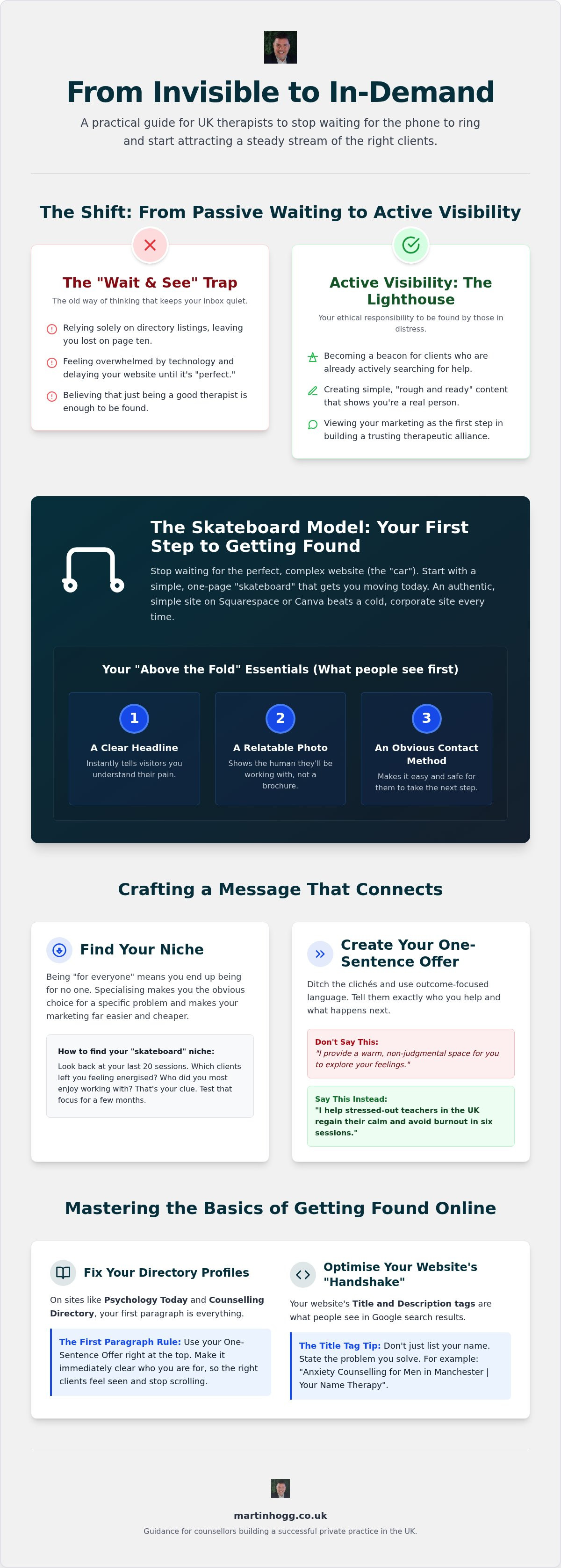
If you're waiting for a perfect website before you try to attract more therapy clients, you're stuck. I use the "skateboard model." Instead of waiting months to build a complex car, you start with a skateboard. It gets you moving today. Using simple tools like Squarespace or Canva, you can launch a one-page site that actually works without the tech headache.
The most critical part is "above the fold." That's the bit people see before they scroll. You have about three seconds to prove you understand their pain. You need three things: a clear headline, a relatable photo of yourself, and an obvious "Contact" button. It's about being a person, not a corporate entity. If you're feeling stuck on the tech, we simplify these steps in our Private Practice Success Membership.
Crafting Your One-Sentence Offer
Ditch the clichés like "warm, non-judgmental space." Everyone says that. Instead, use outcome-focused language. Tell them exactly who you help and what happens next. "I help stressed-out teachers regain their calm in six sessions" is far more effective. Adopting patient-centric marketing strategies means speaking their language, not clinical jargon.
Title and Description Tags for the UK Market
Your meta description is your first handshake. It's what people see in Google results. Use your title tag to state your niche clearly. Don't just list your name; list the problem you solve. This simple tweak helps you attract more therapy clients by making it obvious you're the right fit for their specific struggle. It's about being visible where it counts.
Niche Building: Why Being "For Everyone" Means Being for No One
Many counsellors fear that narrowing their focus means turning people away. I've found the opposite is true. When you try to speak to everyone, you end up speaking to no one. Specialising is the most effective way to attract more therapy clients because it makes you the obvious choice for a specific problem. It moves you from being a generic "counsellor" to a solution for someone's specific pain.
Marketing becomes easier and significantly cheaper when you aren't shouting into a void. If you focus on a niche like Anger Management or Working with Men, your message resonates deeply with people in those specific situations. If you're struggling to commit to a direction, my Niche Building Secrets guide can help you find your focus without the second-guessing.
Identifying Your Ideal Client Profile
Take a look back at your last twenty sessions. Which ones left you feeling energised? Who did you actually enjoy working with? That's your clue. You don't need to commit to a niche for life. Just pick a "skateboard" version, test it for a few months, and see if it feels right. This clarity is how you attract more therapy clients without feeling like a pushy salesperson.
Communicating Your Specialism Ethically
When you describe what you do, use the words your clients use. They don't search for "attachment theory" or "psychodynamic interventions." They search for "why do I keep picking the wrong partners?" Following the BACP guidelines on promoting your practice ensures you stay professional while remaining accessible. Positioning yourself as a specialist isn't about being arrogant; it's about being helpful. You're simply making it easier for the right person to find the right help.
Mastering UK Directories and Ethical Networking
Most therapists treat their Counselling Directory or Psychology Today profile like a static museum piece. Big mistake. In 2026, these platforms are more crowded than ever, so your listing needs to be a live document. If you want to attract more therapy clients, you must master the "First Paragraph Rule." The first two sentences are often all a client sees on a search results page. If those lines don't speak directly to their struggle, they'll just keep scrolling.
Networking often feels like a dirty word, especially if you're an introvert. You don't need to attend awkward business breakfasts or hand out glossy brochures. Instead, focus on building a referral base with local GPs or fellow counsellors who work in different niches. It's about human connection. When a colleague knows you're the go-to person for a specific issue, they'll happily pass your name along. This kind of ethical networking builds a practice on solid foundations.
Using the BACP and Professional Bodies
Your accredited status is a powerful trust signal for private-pay clients. Don't just hide it in a footer; use it to show you're committed to the highest standards. Staying updated with CPD for counsellors UK isn't just about ticking boxes for your annual audit. It keeps your practice fresh and your visibility high. It shows potential clients that you're an active, learning professional who takes their growth seriously.
Creating a Simple Content Rhythm
You don't need to be a full-time social media influencer. Follow the "one post a week" rule to stay visible without burning out. Use Canva to create simple, helpful tips that solve a tiny problem for your ideal client. This positions you as the expert before they even book a session. It’s a consistent way to attract more therapy clients while keeping your sanity intact. Rough and ready content always beats a polished, distant corporate image.
Building Your Future Practice Today
Building a thriving practice isn't about luck or waiting for the phone to ring. It's about being visible enough so the right people can find you. We've looked at how the skateboard model gets you moving without the tech headache and why a narrow niche actually widens your opportunities. By optimising your directory profiles and moving into active visibility, you create a system that works while you're in the therapy room.
I've spent over 20 years in the UK therapy sector. As a BACP-endorsed provider, I know the most successful counsellors are those who embrace being human over being perfect. You don't have to do this alone. Our community of hundreds of practitioners is already using these tools to grow. It's time to stop checking that empty inbox and start taking practical steps to attract more therapy clients. You have the skills to help; now let's make sure people can find you.
Common Questions About Growing Your UK Practice
How long does it take to attract more therapy clients using these methods?
It usually takes between three to six months to see a consistent shift in your enquiry levels. While a "skateboard" website can be live in a weekend; SEO and directory rankings take time to settle. I've found that counsellors who post one helpful tip a week see results much faster than those who wait for perfection. Consistency is your best friend. Start small, stay steady, and the results will follow.
Do I really need a niche to be successful in private practice?
Yes, because being a generalist makes you invisible in a crowded digital market. When you try to help everyone; your message becomes diluted and forgettable. Picking a niche, like working with men or anger management, allows you to speak directly to a client's specific pain. This clarity makes it much easier to attract more therapy clients who are already looking for your exact expertise. It's about being the right fit.
Is it ethical to use marketing tactics as a counsellor?
Marketing is entirely ethical when you view it as making your professional support accessible to those in distress. You aren't "selling" a product; you're ensuring that a person in pain can find the help they deserve. As long as you follow BACP guidelines on promoting your practice and avoid exaggerated claims; being visible is actually a supportive act. It is about being the lighthouse in someone else's storm.
What is the most effective directory for UK therapists in 2026?
Psychology Today and Counselling Directory remain the heavy hitters, but their effectiveness depends entirely on your profile's first paragraph. In 2026, many clients also use the BACP's own directory to verify credentials. I recommend testing one directory for six months with a niche-focused profile before deciding if it is worth the fee. Don't just set it and forget it; keep it updated to reflect your current practice and expertise.
How much should I spend on marketing my private practice?
You can attract more therapy clients on a very modest budget, often starting with less than £50 a month for basic tools. This might cover a Squarespace site and one directory listing. You don't need expensive ads or a PR firm. Focus your spending on tools that save you time; like Calendly for bookings, rather than flashy designs that don't actually bring in enquiries. Practicality always beats polish in private practice.
Disclaimer
The information provided on this blog is for general informational purposes only. It is also not intended to be a substitute for professional medical or mental health advice, diagnosis, or treatment. Reading this content does not create a therapist-client relationship.


