How to Avoid Perfectionism in Marketing Your UK Private Practice
What if the hours you spend agonising over a single comma are actually preventing the person who needs you most from finding your support? I know how it feels to worry if your peers will judge you or if you have met every requirement of the Data (Use and Access) Act 2025. When you learn how to avoid perfectionism in marketing, you can break the cycle of overthinking that leaves your practice quieter than it should be.
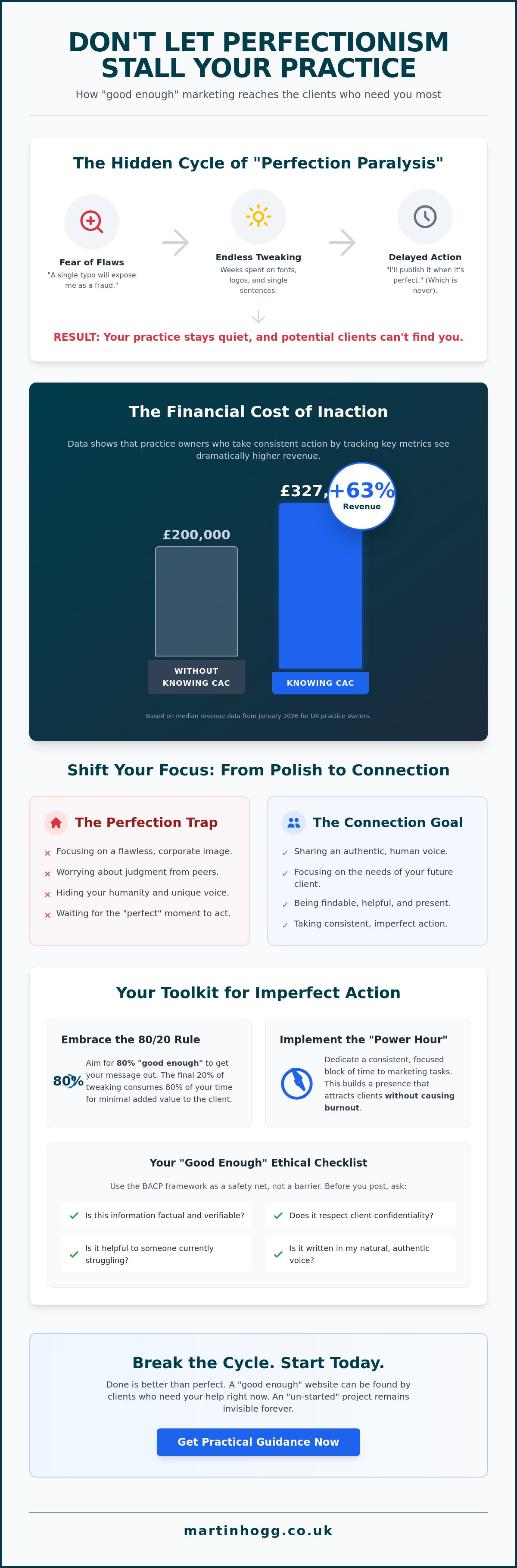
I want to help you move past this. We must embrace a practical approach that puts the needs of your future clients first. Data from January 2026 shows that practice owners who know their Cost Per Acquisition (CAC) see a median revenue of £327,500, compared to £200,000 for those who do not. This proves that taking consistent, imperfect action is what truly helps you grow your practice and reach more people who are searching for help.
In this guide, I will show you how to quiet your inner critic and develop a routine that feels grounded. We will look at how to maintain professional standards while finding the confidence to share your voice, helping you get your practice back on track so you can focus on the work that matters.
Key Takeaways
- Understand why "perfectionism" is often procrastination in disguise, and how it stops you from helping the clients who are looking for you.
- Learn how to avoid perfectionism in marketing by shifting your focus from a polished image to authentic, human connection.
- Discover how to use the BACP Ethical Framework as a helpful safety net that guides your communication rather than a reason to stay hidden.
- Create a "Minimum Viable Marketing" plan that allows you to be found easily without the mental drain of constant rechecking.
- Implement practical tools like the "Power Hour" to build a consistent presence that attracts clients without causing burnout.
Why Perfectionism is the Biggest Barrier to Your Practice Growth
Many of us hide behind the idea of "quality control" when we are actually just afraid. We spend weeks choosing the right shade of blue for a logo or rewriting a single paragraph on our "About Me" page. This isn't just being thorough. It is a form of procrastination. In the psychological definition of perfectionism, we see how setting impossibly high standards can lead to avoidance. When you try to avoid perfectionism in marketing, you realise that "good enough" is often exactly what a client in distress needs to see.
Perfection paralysis is the state where fear of a mistake outweighs the desire for progress.
In the UK, there is a quiet, heavy pressure on counsellors to appear perfectly "together". We worry that if our website isn't flawless, people will think our clinical work is messy too. Learning to avoid perfectionism in marketing means accepting that your humanity is a strength, not a weakness. While you are tweaking your font, someone in your local community is struggling with a crisis and cannot find you.
The "Wounded Healer" and the Fear of Visibility
Imposter syndrome often whispers that a single typo will expose us as frauds. We fear that a colleague or supervisor might see a social media post and find it "unprofessional". This fear of visibility keeps many gifted practitioners invisible. It is a barrier. You don't need a flawless digital presence to be a safe, effective therapist. You just need to be present.
Marketing as an Extension of Your Empathy
I like to think of marketing as a way to be helpful before the first session even begins. It isn't about "selling" or being pushy; it's about making sure your door is easy to find. If you want to understand how to get counselling clients uk residents can trust, you must start with authenticity. By showing up as a real person, you lower the barrier for those seeking support.
The Hidden Costs of Waiting for the Perfect Marketing Strategy
Waiting for the "right time" or a "perfect plan" often feels like a safe choice. In reality, it is a trap that costs you more than you might realise. Every week you spend tweaking a font or adjusting a sentence is a week where your diary remains empty. This isn't just about lost income. It is about the people who are currently searching for help and finding someone else because you haven't hit "publish" yet.
The mental load of checking and rechecking your work is a fast track to therapist burnout. It is the internal critic, not the clinical work, that often drains our energy. Research from Warwick Business School on the dangers of perfectionism for entrepreneurs shows that this fear of failure can paralyse growth. As a practice owner, you are running a business. Progress requires action, even when it feels messy. To truly avoid perfectionism in marketing, we must accept that our clients value our expertise and empathy over our design skills.
Done is always better than perfect. A "done" website can be improved based on real feedback. An "un-started" project stays invisible. If you find yourself stuck in a loop of overthinking, joining a supportive community like the Private Practice Success Membership can provide the accountability you need to move forward.
The Myth of the "Perfect" Website
Your potential clients are not looking for clinical perfection. They are looking for connection. They won't notice if your hex code colours are slightly off or if your logo is a bit small. They want to read your "About Me" section and feel that you understand their struggle. Most people search for a human being who can help them get their life back on track, not a polished corporate brand. Focus on being findable rather than being flawless.
How to Market Your Practice Ethically Without Being Perfect
Many counsellors feel a heavy ethical weight when they think about promotion. You might worry that being "visible" somehow conflicts with the humility of our profession. I want to suggest a different perspective. The BACP Ethical Framework isn't a barrier to your growth; it is actually a safety net. When you focus on being factual, honest, and helpful, you naturally meet your professional obligations. You don't need a polished sales pitch to be ethical. You just need to be clear about how you can help.
To truly avoid perfectionism in marketing, I recommend following the 80/20 rule. Aim for 80% "good enough" to get your message out into the world. That final 20% of tweaking usually provides no extra value to the client, but it consumes 80% of your time and energy. Instead of a 20-page marketing plan, use a simple Visibility Checklist before you post:
- Is this information factual and verifiable?
- Does it respect client confidentiality?
- Is it helpful to someone currently struggling?
- Is it written in my natural voice?
If the answer is yes, hit publish. If you need a supportive space to test your ideas, you can find practical guidance within our Private Practice Success Membership.
Setting Boundaries with Your Marketing
You don't have to "perform" for the internet or share your deepest personal stories to attract clients. Marketing is about sharing your expertise, not your private life. Set a firm boundary for your time too. Dedicate one hour a week to your visibility tasks so they don't bleed into your clinical preparation. This structure helps you stay grounded and prevents the overwhelm that leads to burnout.
Small Wins: The Power of the "Rough Draft"
I often encourage practitioners to write what I call a "shitty first draft." Get your thoughts down without any self-editing, then let it sit for 24 hours. When you return to it, you will likely find that it's much better than you thought. This approach aligns with the principles of Citizen Coaching. By showing up as a helpful, steady member of your community first, you build trust naturally. You aren't just a distant professional; you are a reliable guide helping people get their lives back on track.
Moving from Perfectionism to Practical Visibility
Moving to a practical approach helps you avoid perfectionism in marketing while ensuring your practice remains visible to those who need you. You don't need to be a digital expert to be successful. You just need to be findable. I recommend following these four steps to get your practice back on track without the heavy weight of overthinking.
- Step 1: Identify your "Minimum Viable Marketing". Focus only on the bare essentials you need to be found. This usually means a clear directory profile, a simple website, and an honest "About Me" page. Everything else is an optional extra.
- Step 2: Schedule a "Power Hour". Set a timer for sixty minutes once a week. During this time, you must write and publish one piece of content without going back to edit it. This is a powerful way to avoid perfectionism in marketing because it forces you to value completion over imaginary flaws.
- Step 3: Join a community. It helps to be part of a group that understands the specific challenges of running a counselling private practice uk practitioners face daily. Sharing the load makes the journey feel less lonely.
- Step 4: Use a proven system. Tools like the Practice Visibility Blueprint remove the guesswork. When you follow a map, you don't have to waste energy deciding which way to turn.
Why Structure Beats Willpower
Willpower is a finite resource. When you are tired after a long day of clinical work, you shouldn't have to fight "blank page" syndrome. A structured programme prevents the paralysis that often triggers perfectionism. I created the Private Practice Success Membership to provide that very structure. It offers a safe, grounded environment where you can take consistent action alongside peers who share your values.
Your Next Steps: Taking the Pressure Off
I invite you to check our training calendar for upcoming workshops where we focus on these practical steps together. Remember that your future clients are waiting for the real you, not a perfectly edited version of a therapist. Take the first step today. It doesn't have to be perfect; it just has to be done.
Take the First Step Toward a Thriving Practice
You have seen how the pressure to be perfect can actually keep you hidden from the very people you want to support. By choosing to avoid perfectionism in marketing, you are prioritising your future clients over your own fears. We have explored how a "good enough" approach, rooted in the 80/20 rule, allows you to maintain your ethical standards while building a sustainable diary.
I have spent over 15 years in UK private practice, and I know that a no-nonsense, practical strategy is what truly works. My BACP-endorsed workshops and coaching are designed to help you move past the overthinking that leads to burnout. You don't have to do this alone; there is a community waiting to support you.
Ready to stop overthinking and start growing? Join the Private Practice Success Membership today.
Your expertise is needed now, not when your website is perfect. Trust in the value you provide and take that next small step. I look forward to helping you get your practice back on track and reaching the people who need your help the most.
Frequently Asked Questions
Is it unprofessional to have a simple website for my therapy practice?
It is not unprofessional to have a simple website; in fact, clarity often builds more trust than a complex, flashy design. Most clients are searching for a human connection and a clear explanation of how you can help them get their life back on track. As of February 2026, 71% of people in the UK would consider using private healthcare, and they prioritising finding a therapist who feels accessible and easy to contact over one with a perfect corporate brand.
How do I know if my marketing is ethically sound according to the BACP?
Your marketing is ethically sound when it remains factual, honest, and focused on the well-being of the client. The Advertising Standards Authority (ASA) requires that all claims are verifiable and not misleading. By providing clear information about your qualifications and avoiding guaranteed cures, you can avoid perfectionism in marketing while still meeting your professional obligations. Honesty is always more important than a polished sales pitch.
What should I do if I feel imposter syndrome when posting online?
When imposter syndrome strikes, shift your focus away from yourself and onto the person who is currently struggling. Remember that your visibility is a form of service to your community, helping people find the support they need. You don't need to be a flawless expert to be helpful. If your words help one person feel less alone, your marketing has succeeded, regardless of how "perfect" the post feels to you.
How much time should I realistically spend on marketing each week?
You should realistically spend about one to two hours each week on your marketing activities. This is enough time to manage your directory profiles or write a helpful update without it becoming a drain on your clinical energy. Setting a strict time limit helps you avoid perfectionism in marketing because it forces you to focus on the most impactful tasks. Consistency in these small blocks of time is what leads to a full diary over the long term.
Can I grow my practice without using social media?
You can absolutely grow a thriving practice without using social media by focusing on search engine optimisation and local directories. Data from March 2026 shows that 64% of smaller private clinics use Google Ads to reach people who are actively searching for help. By making yourself findable on Google, you attract clients who are already looking for a therapist, which is often more effective than trying to build a following on social platforms.

Article by
Martin Hogg
I help Private Practice counsellors in the UK set up and grow an ethical Private Practice they love, work with their ideal clients, and earn the income they deserve. All without guesswork and burnout. I have been a private practice counsellor myself for over 20 years, specialising in anger management. I set up a not-for-profit social enterprise, Citizen Coaching and Counselling, which delivers thousands of counselling sessions a year to adults and young people in Birmingham. I am a registered BACP Counsellor and the author of three books, My Anger Coach, My Anxiety Coach and My Relationship Coach. These are available on Amazon.
Disclaimer
The information provided on this blog is for general informational purposes only and is not intended to be a substitute for professional medical or mental health advice, diagnosis, or treatment. Reading this content does not create a therapist-client relationship.


