How to Beat Isolation in Private Practice: A Practical Guide for UK Counsellors
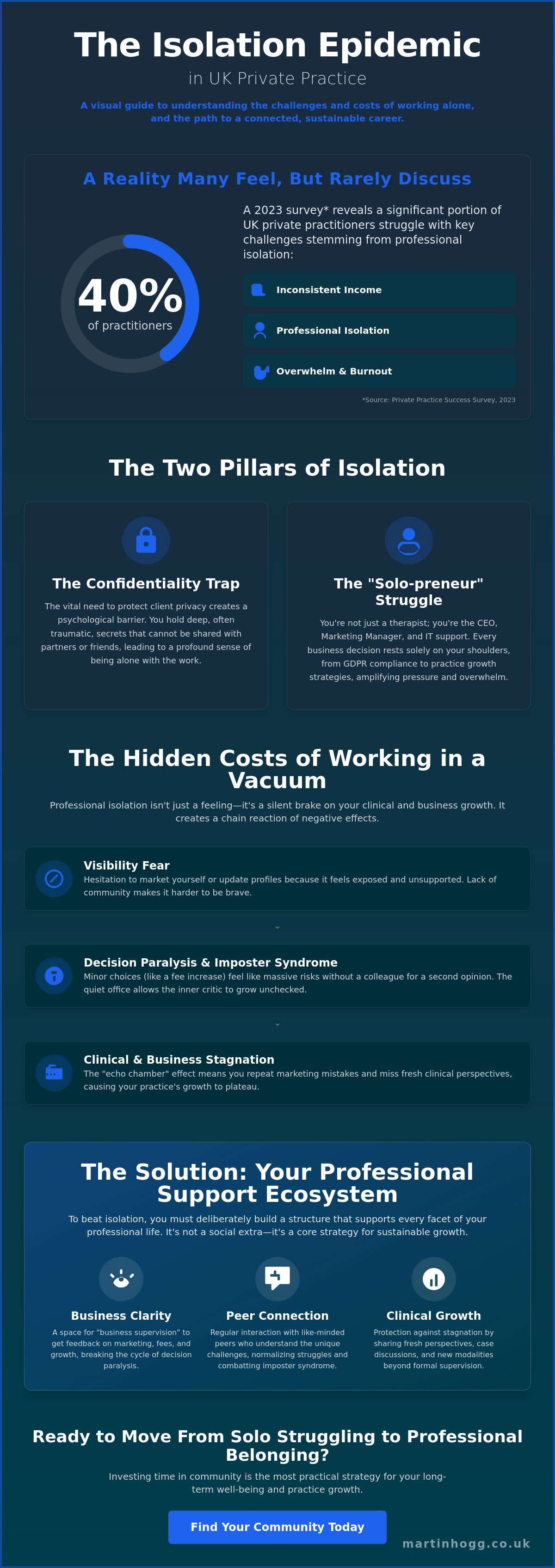
Did you know that over 40% of private practitioners in the UK struggle with inconsistent income, a challenge that often goes hand-in-hand with professional isolation and burnout? This statistic from a 2023 survey published by Private Practice Success in April 2026 highlights a reality many of us feel but rarely discuss. To beat isolation in private practice, we first have to acknowledge how heavy it feels to hold client secrets and make business decisions entirely on your own without a "water cooler" in sight.
I understand how that silence can weigh on you after a long day of clinical work. You want to grow your practice, but the lack of peer connection makes every hurdle feel twice as high. The good news is that you don't have to work in a vacuum to be successful. You can build a career that feels connected, supported, and sustainable.
In this guide, I'll share practical steps to help you move from solo struggling to professional belonging. We will look at how to build a support network that helps with both your clinical well-being and your business growth, ensuring you have the tools to get your professional life back on track.
Key Takeaways
- Identify why the "confidentiality trap" leaves many UK counsellors feeling alone and how to safely bridge that gap.
- Understand the link between professional loneliness and the fear of visibility that might be holding your practice back.
- Learn how to build a "Professional Support Ecosystem" to beat isolation in private practice and protect your clinical well-being.
- Explore the practical steps to finding a peer supervision group that offers the business and social support your supervisor cannot provide.
- Discover why investing time in community is a practical strategy for long-term growth rather than just a social extra.
Why private practice feels so isolated for UK counsellors
Many of us start our careers in the NHS or local agencies. In those environments, you have a team around you to share the load after a difficult session. When you move into solo work, that built-in support disappears overnight. You transition from a shared office to a quiet room, often in your own home, where the silence can become quite loud. Professional isolation is a natural byproduct of the solo practitioner model in the UK.
I define professional isolation as the lack of peer reflection and the absence of shared responsibility for the work we do. It isn't just about being alone in a room. It's about the psychological weight of being the only person who knows what happened in a session. While we value our independence, trying to beat isolation in private practice requires us to look at the structures we've left behind. Understanding What is social isolation? helps us see that this isn't just a "feeling." It is a state of being disconnected from the professional community that keeps us grounded.
The unique burden of clinical confidentiality
We often talk about the "confidentiality trap." You might spend your day holding deep, sometimes traumatic, secrets for your clients. When the working day ends, you cannot simply share these experiences with your partner or friends over dinner. This creates a psychological barrier between you and the people you love. You are holding a world they cannot enter. While your monthly supervision is vital for clinical safety, ninety minutes every four weeks isn't designed to provide the daily social connection or peer reflection we need to stay healthy.
The "solo-preneur" struggle
Then there is the business side. In private practice, you are the CEO, the marketing manager, and the IT department. Whether you are worrying about GDPR compliance or trying to figure out how to grow your practice, every decision rests on your shoulders. It's common to feel a sense of overwhelm or a fear of "getting it wrong" when there is no one in the next office to offer a second opinion. To beat isolation in private practice, we must first recognise that the weight of these solo decisions is a significant contributor to clinical burnout and professional stagnation.
The hidden cost of isolation on your practice growth
Professional isolation often acts as a silent brake on your business. When you are disconnected, you're more likely to experience "visibility fear." This is that nagging hesitation to update your directory profile or share a helpful post on social media. Without a supportive community to cheer you on, putting yourself out there feels exposed rather than professional. It is much harder to be brave when you feel you are standing alone.
This lack of connection also risks your clinical growth. Without regular peer interaction, we can inadvertently settle into a comfortable routine, missing out on the fresh perspectives that keep our work sharp. Over time, the heavy weight of loneliness begins to mimic therapist burnout. You might feel exhausted and cynical, not because you've lost your passion for helping people, but because you're trying to carry the entire professional load by yourself. To beat isolation in private practice, we have to recognise that our clinical health and business health are linked.
Finally, there's the "echo chamber" effect. When you work in a vacuum, you tend to repeat the same marketing mistakes. You might spend hours tweaking a website that isn't bringing in clients, simply because no one is there to provide honest, constructive feedback. Without an external perspective, your growth can easily plateau.
Decision paralysis and the solo practitioner
Have you ever spent weeks agonising over a fee increase or a small change to your website? That is decision paralysis. In an agency, you would have a manager or a colleague to bounce ideas off. Alone, every minor choice feels like a massive risk. This is why I often advocate for "business supervision." Having a space to discuss your practice growth is just as vital as discussing your clients. If you feel stuck, joining a community of like-minded professionals can provide the clarity you need to move forward.
Imposter syndrome in the quiet office
The silence of a solo office is the perfect breeding ground for imposter syndrome. Without peer feedback, your inner critic can grow unchecked. You might start to believe that you're the only one struggling with a difficult case or a quiet diary. In reality, these challenges are shared by almost every counsellor in the UK. When you realise your "unique" struggles are actually common professional hurdles, the weight of self-doubt starts to lift.
Practical strategies to beat isolation and stay connected
To beat isolation in private practice, we need a strategy that respects the unique nature of our work. Generic advice like "working from a coffee shop" often falls short because we cannot handle confidential client notes or sensitive admin in public spaces. Instead, I suggest building a "Professional Support Ecosystem." This is a deliberate structure that supports your clinical safety, your business growth, and your social well-being. It's about creating multiple layers of connection so that no single part of your practice feels like a lonely island.
One effective tool is the peer supervision group. While your formal supervisor ensures clinical safety, a peer group provides a "tribe" of equals. It's a space to share the day-to-day realities of running a practice without the power dynamic of a traditional supervisory relationship. For the admin side, try setting "digital co-working" dates. You and a colleague jump on a video call, keep the microphones muted, and simply work on your marketing or accounts together. The presence of another person, even virtually, can break the silence of a solo office and help you stay focused.
I also recommend creating a routine that forces you to leave the house for non-clinical reasons. This might be a regular gym class, a local business meet-up, or even just a walk at a set time each day. When your home is also your clinic, the boundaries between your professional and personal life can blur. Physical movement and a change of scenery are essential for maintaining your perspective.
Formal vs. informal networking
I often talk about networking for therapists as a way to build genuine relationships rather than just hunting for referrals. Networking should feel like a conversation between colleagues who share similar values. Look for UK-specific communities that understand the local landscape, from BACP ethical frameworks to the specific challenges of your local area. When you focus on connection over sales, the isolation begins to lift naturally.
The power of a structured membership
Free social media groups can sometimes offer more noise than actual support. They are often filled with conflicting advice that can leave you feeling more overwhelmed than when you started. Moving towards a curated community allows for focused practice growth. If you want to stop feeling like you're doing this all on your own, consider joining the Private Practice Success Membership. Having a dedicated space for business support ensures you aren't just surviving solo practice, but truly connecting with others who are on the same path.
Moving from solo practitioner to connected professional
Most of us were trained to be excellent clinicians, but very few counselling courses prepare you for the reality of running a small business. It's easy to feel like you're failing when you struggle with marketing or admin, but the truth is you simply weren't taught those skills. To beat isolation in private practice, you have to accept that you aren't supposed to do this alone. Reaching out for support isn't a sign of weakness. It's a sign that you are taking your professional longevity seriously.
Seeing community as an investment rather than a distraction is a major mindset shift. When you spend time connecting with peers, you aren't "wasting" time that could be spent with clients. You're building the foundation that makes your work sustainable. This sense of belonging and shared knowledge is what fuels a healthy counselling private practice UK model. It allows you to move away from the "echo chamber" of your own thoughts and into a space where your practice can actually breathe and grow.
The Private Practice Success Membership
Many therapists tell me they miss the "water cooler" chat of the agency world. Our community provides that space, but with a focus on your specific growth. You get to work through the Practice Visibility Blueprint alongside people who understand exactly what it's like to feel hesitant about putting yourself out there. It's a safe place to ask questions about software, GDPR, or fees without judgement. You can see what we're up to and find a session that fits your schedule by checking our calendar for upcoming community events.
Your next steps to connection
I want you to take the first step before you feel the heavy symptoms of burnout. Don't wait until you're exhausted to look for a tribe. Commit to making just one professional connection this week. This could be a quick message to a colleague or joining a group that understands the unique UK context of our work. If you're ready to stop being a solo practitioner and start being a connected professional, come and join us at Private Practice Success. Let's get your practice, and your professional well-being, back on track together.
Your path to a more connected practice
Running a solo practice shouldn't mean you have to be alone. We've seen that over 40% of private practitioners struggle with the professional isolation that leads to inconsistent income, according to the 2023 survey published by Private Practice Success in April 2026. By shifting your mindset and seeing community as a vital investment, you protect both your clinical well-being and your practice growth. It's time to move away from the echo chamber and start building a sustainable, connected career.
You have the tools to beat isolation in private practice. Whether it's through digital co-working or finding a dedicated peer group, taking that first step is what counts. You deserve a professional life that feels as supportive as the care you provide to your clients. There's no need to carry the weight of every business decision by yourself.
If you're ready to stop struggling in silence, I invite you to join a supportive UK-wide network of therapists. Within our community, you'll get access to the Practice Visibility Blueprint and our BACP Professional Development Workshops, all designed to help you grow with confidence. Join the Private Practice Success Membership and find your tribe. You've done the hard work of training; now let's work together to make your practice thrive.
Frequently Asked Questions
Is it normal to feel lonely when I see clients all day?
It is completely normal and very common. Therapy is an asymmetrical relationship where your focus is entirely on the client's world, which leaves your own need for professional connection unmet. This "one-way" emotional presence is quite different from the mutual interaction you get with a colleague, which is why you can feel lonely even in a busy clinic.
How can I network without feeling like I am "selling" myself?
Focus on building genuine relationships rather than hunting for referrals. When you aim to beat isolation in private practice, you should look for peers who share your values and interests. Think of it as creating a referral network where you can safely pass on clients who aren't a fit for your niche, which is a helpful service rather than a sales pitch.
What is the difference between clinical supervision and a peer support group?
Clinical supervision is a formal requirement focused on client safety and your professional standards. In March 2026, rates for individual supervision generally range from £55 to £80 per hour. A peer support group is a less formal space where you can discuss the "solo-preneur" struggles, share business tips, and find the social connection that a supervisor isn't designed to provide.
Can isolation in private practice lead to clinical errors?
Yes, because working in a vacuum can lead to "clinical drift" where your boundaries or perspectives shift without you noticing. Without regular peer reflection, you lose the healthy challenge that keeps your work sharp. Staying connected is a clinical safety measure that helps you avoid the blind spots that often grow in a quiet, solo office.
How do I find a UK-based therapist community that isn’t just on Facebook?
Look for structured professional memberships that use dedicated platforms for learning and connection. These spaces are often more private and focused than social media groups, allowing for deeper conversations about practice growth. Our own membership community is a great example of a space built specifically for UK counsellors who want to grow their practice while staying connected to their peers.

Article by
Martin Hogg
I help Private Practice counsellors in the UK set up and grow an ethical Private Practice they love, work with their ideal clients, and earn the income they deserve. All without guesswork and burnout. I have been a private practice counsellor myself for over 20 years, specialising in anger management. I set up a not-for-profit social enterprise, Citizen Coaching and Counselling, which delivers thousands of counselling sessions a year to adults and young people in Birmingham. I am a registered BACP Counsellor and the author of three books, My Anger Coach, My Anxiety Coach and My Relationship Coach. These are available on Amazon.
Disclaimer
The information provided on this blog is for general informational purposes only and is not intended to be a substitute for professional medical or mental health advice, diagnosis, or treatment. Reading this content does not create a therapist-client relationship.


