
How to choose a counselling niche that can grow with you

Article by
Martin Hogg
I help Private Practice counsellors in the UK set up and grow an ethical Private Practice they love, work with their ideal clients, and earn the income they deserve. All without guesswork and burnout. I have been a private practice counsellor myself for over 20 years, specialising in anger management. I set up a not-for-profit social enterprise, Citizen Coaching and Counselling, which delivers thousands of counselling sessions a year to adults and young people in Birmingham. I am a registered BACP Counsellor and the author of three books, My Anger Coach, My Anxiety Coach and My Relationship Coach. These are available on Amazon.
You don’t need to map out your whole counselling practice before choosing a niche. I’d start with the clients you work well with, the concerns they bring and the changes you can help them work towards. That’s more useful than picking a label just because it sounds impressive.
It’s understandable to worry that choosing a focus will shut the door on other clients, or that you need years of experience before you can be specific. I wouldn’t let either worry hold you back. A niche can give your marketing a clearer direction without becoming a rule that every client must fit.
I’d treat a niche as a practical starting point, not a lifetime contract. In this article, I’ll look at what a counselling niche can include, how you can spot a promising fit in your experience and interests, and how to test your focus in your website copy. I’ll also cover how your niche can change as your skills develop, and what to consider if you’re worried about choosing too soon or getting it wrong.
Key Takeaways
- I’d look for patterns in the clients and issues you work well with, then shape those into a clear focus for your practice.
- I’d treat your niche as something that can develop alongside your skills, interests and experience.
- You don’t need decades of experience to choose a focus, but I’d build the relevant skills before advertising work beyond your competence.
- When a specialism is popular, I’d make your offer more distinctive by clarifying who you help or what you help them with.
1. What is a niche for counsellors?
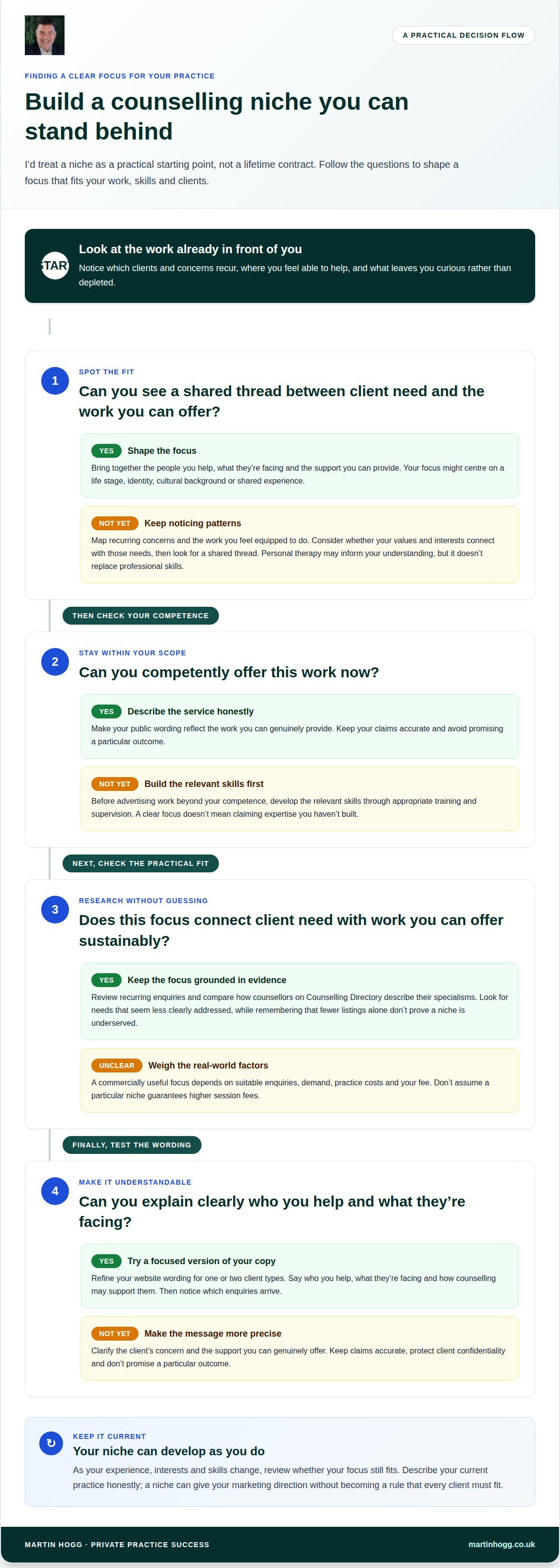
A counselling niche gives your private practice a recognisable focus: the people you help, their concerns, or both. It might centre on a life stage, identity, cultural background or shared experience. For example, you could focus on adults adjusting to parenthood. When deciding how to choose a counselling niche, look for a useful fit between client needs and the work you can offer, not just a catchy label.
Your experience can point towards that fit. Notice which clients and concerns recur, where you feel able to help, and what work leaves you curious rather than depleted. Map those patterns, then look for a shared thread. Personal therapy may inform your understanding of a client’s perspective, but it should complement your professional skills, not replace them.
Your values and interests matter too. If you often read about men’s mental health or supporting carers, consider whether those interests connect with your experience and the people you want to serve. Deciding how to choose a counselling niche becomes more practical when you can describe the client’s struggle and the support you can provide.
Training needs depend on the specialism and client group. Before advertising work beyond your competence, build relevant skills through appropriate training and supervision.
A commercially useful focus connects client need with work you can offer sustainably. Profitability depends on suitable enquiries, demand, practice costs and your fee, so don’t assume a particular niche guarantees higher session fees.
To research demand and competition, review recurring enquiries and compare how counsellors on Counselling Directory describe their specialisms. Look for needs that appear less clearly addressed, but remember that fewer listings alone don’t prove a niche is underserved.
Test your focus by refining your website copy for one or two client types, then notice which enquiries arrive. I’d make the message clear about who you help, what they’re facing and how counselling may support them. Practical niche-building guidance can help you shape that message.
Keep your public claims accurate, protect client confidentiality and describe your competence honestly. Your marketing should reflect the service you can genuinely provide, without promising a particular outcome.
2. Changing or evolving a niche over time
Your niche doesn’t have to stay fixed as your practice grows. With more experience, you may notice that the work you find most meaningful has shifted. Perhaps you began with general anxiety, then found yourself especially engaged by clients facing anxiety around work, leadership or returning after burnout. That pattern can suggest a clearer focus, not a reason to discard your earlier experience.
Treat niching as an ongoing decision, not a permanent label. Review your work: which concerns keep appearing, which clients are you passionate about supporting, and where are your skills developing? Notice whether your learning follows the same direction. If you’re regularly reading about men’s mental health, for example, that interest may be worth exploring alongside your client work.
Then identify what has changed. You might have completed relevant training, gained experience with a particular population, or found that your original focus no longer fits your values. A broad interest can also become more specific: supporting people with anxiety might develop into work with students managing academic pressure. Describe your current practice honestly rather than clinging to old website copy.
Make changes gradually. Adjust your one-sentence offer and the text at the top of your Squarespace site, then pay attention to the enquiries those words attract. Keep your existing services clear while you explore a developing focus. If new work requires skills you haven’t yet built, make learning part of the plan before advertising it.
Some therapists stop actively learning and keep approaching the same issues in the same way. I’d rather see your niche reflect thoughtful development. Your approach, interests and client group can change together, while your core commitment to useful counselling remains steady.
If you’d value a place to think through the business side of that change, the private-practice community can help you consider how your focus and visibility develop together.
3. Common concerns about choosing a niche
I wouldn’t wait until you have twenty years of experience before choosing a focus. Start with work you can competently offer now, then build relevant knowledge before advertising a specialism that stretches your skills. If you want to work with trauma, for example, seek appropriate training and supervision from someone with expertise before presenting yourself as equipped for that work.
A niche doesn’t mean turning away everyone outside your marketing focus. I’d describe your main focus clearly, while considering other enquiries individually. If your profile centres on anxiety in university students, an adult client dealing with work stress may still be a suitable fit. Base that decision on whether you can help them safely and effectively, not whether they match a sentence on your homepage.
Some counsellors worry that choosing a niche will make their practice too small. I’d separate a clear marketing focus from a rigid limit on your work. For instance, writing about supporting men with anger may help the right people recognise your practice, while your clinical decisions remain specific to each person’s needs. A niche should make your offer easier to understand, not reduce clients to a label.
Ethically, describe your experience and competence accurately, protect client confidentiality, and avoid promises such as “I can fix this”. I’d make sure your public wording reflects the service you can genuinely provide and the professional and legal obligations that apply to your UK practice. A client’s story is never marketing material without proper care and permission.
Marketing can feel exposing, particularly if you’re used to keeping attention on clients rather than yourself. I’d keep your message practical: explain who you help, what they may be facing, and how counselling might support them. For example, “I help new parents make sense of anxiety and changing relationships” says more than a list of qualifications alone. Refine that wording as you learn which enquiries fit your work.
If you’re still unsure, I’d test a clear description with a small change to your profile before rebuilding your whole practice around it. Notice whether it brings enquiries you’re equipped to help and whether the work feels sustainable. Treat that as useful evidence, not a permanent commitment.
4. Which counselling niches are in demand in the UK?
Demand means people are actively looking for support in a particular area. A niche with strong interest can also be highly competitive, so popularity alone isn’t enough reason to choose it. I wouldn’t point every UK practice towards the same specialism. Local population, online reach and the clients you can help all affect whether a focus makes sense for you.
I’d start by checking what potential clients in your area are asking for. Look at how people describe their difficulties in enquiries, then compare those themes with listings on Counselling Directory and Psychology Today. These directories can show how therapists present their specialisms, but they don’t tell you how many local clients need each service. Treat them as clues, not a league table.
Next, look for a useful overlap between demand and your capability. You might investigate support for anxiety, bereavement or relationship changes, then ask whether you have the skills and interest to work with those concerns. I’d consider the population too: “support for anxiety” is broad, while “support for students managing anxiety during university” speaks to a more specific group. Specificity can help people understand your offer, but it should reflect real competence.
If a popular focus feels crowded, I’d make your offer more distinctive by combining a concern with a population, life stage or approach you’re equipped to support. For example, clarify the kind of life transition you work with rather than claiming to help everyone experiencing stress. Check that your website explains the focus near the top of the page, and make your title and description tags match the language clients might use. Then watch which enquiries arrive and whether they fit your practice.
I’d use niche-building support for counsellors to turn your research into a clearer practice focus.
Anxiety, bereavement and relationship changes are potential areas to explore, especially when tailored to a population or life stage you’re equipped to support. I wouldn’t assume any niche is guaranteed to be profitable; local demand, competition and fit with your skills all matter.
Martin Hogg Private Practice Success: Niche building for counsellors
I help counsellors shape a clearer niche for private practice. If you’ve spotted a promising direction but aren’t sure how to turn it into a practical offer, I can help you describe it in your marketing.
Whether you’re refining who you help or working out what to say on your website, I’ll help you connect your experience and interests with a message potential clients can understand. If visibility is also a sticking point, I offer the Practice Visibility Blueprint as a structured way to think through how to present your practice.
You don’t need every detail settled before taking a next step. Contact me to discuss niche building for your counselling practice.
Give your next step room to develop
I wouldn’t expect your niche to need a grand reveal or a perfect website launch. Choose one practical step that makes your direction clearer, such as revising your one-sentence offer or drafting a short piece of content for the people you want to reach. In my experience, rough-and-ready content beats polished ideas that stay tucked away because of perfectionism.
I’d make a thoughtful starting choice, then stay open to what you learn. That’s a useful way to approach choosing a counselling niche. Your practice can grow without every decision being settled in advance. Keep your message honest, your learning active and your attention on the work you want to do.
For support with the business side, I offer the Practice Visibility Blueprint, Private Practice Success Membership and Anger Management CPD for Professionals through Martin Hogg’s Private Practice Success. Choose the next step that fits what you need to work on now.
You can build a practice that reflects both your skills today and the counsellor you’re becoming. I’d give yourself room to keep learning as you go.
Frequently Asked Questions
What is a niche for counsellors?
I think of a counselling niche as a focus that helps the right people recognise your practice as relevant to them. It can describe the clients you work with, the difficulties they bring, or the kind of support you provide. For example, “counselling for people adjusting to parenthood” gives a clearer picture than “counselling for everyone”. Your niche guides how you explain your work, rather than defining every client you can accept.
How do I identify my counselling strengths, interests and experience?
I’d look for evidence in your work, not just topics you enjoy reading about. Note which client conversations draw on skills you use confidently, what feedback clients offer, and what training informs your practice. Then compare those strengths with the work you’d like to do more often. If you’re interested in supporting carers, for instance, consider whether your experience helps you understand their pressures and goals.
How do I choose between adult, child, couples and family counselling?
I’d choose a client group that matches your training, experience and preferred way of working. Adult counselling centres on an individual’s concerns, while couples work involves the relationship between two people. Child and family work brings different developmental and relational considerations. Think about the conversations you’re prepared to hold, the setting you can offer, and the skills each client group requires before shaping your practice around it.
Should I specialise by client group, issue, therapy approach or service format?
I’d start with the detail that makes your work easiest for a potential client to understand. A client group, such as adults experiencing bereavement, may be more immediately meaningful than naming an approach alone. You can add your therapeutic approach or format where it clarifies what working with you involves. For example, online counselling for new parents describes both the audience and how sessions take place.
What are the risks of choosing a counselling niche that is too narrow?
I’d be cautious if a niche describes so few people that suitable clients struggle to recognise themselves, or if it relies on skills you haven’t developed. It may also make your marketing awkward if your actual work is broader. Use plain language and leave room for related concerns. For example, “support for new parents” can include anxiety, changing relationships and adjustment without promising expertise in every issue.
Disclaimer
The information provided on this blog is for general informational purposes only. It is also not intended to be a substitute for professional medical or mental health advice, diagnosis, or treatment. Reading this content does not create a therapist-client relationship.


