How to Find Your Niche as a Therapist in the UK: A Practical Guide
What if the very thing you're doing to attract everyone is actually making you invisible to the people who need you most? It's a common worry for many UK counsellors that narrowing your focus means turning away clients and watching your diary empty out. You might feel a sense of FOMO or even imposter syndrome when you think about claiming a specialism. But being a "jack of all trades" often leads to exhaustion and a practice that feels disconnected from your real clinical strengths. Learning how to find your niche as a therapist uk isn't about closing doors; it's about opening the right ones.
I've seen so many talented practitioners struggle to stand out in crowded directories, especially as the 2026 SCoPEd framework changes make the professional environment feel more complex. I agree that it feels safer to keep your options open, but that often leaves you competing on price rather than expertise. This guide will show you how to identify a rewarding niche that feels naturally aligned with who you are. We'll look at practical steps to move from feeling invisible to becoming the go-to expert for your ideal clients. By the end, you'll have a clear path to building a practice that brings you both steady work and a deep sense of professional confidence.
Key Takeaways
- Learn why narrowing your focus helps you avoid the "generalist trap" and makes you more visible on crowded UK therapist directories.
- Explore two practical ways to identify your ideal client by looking at your own professional history and the specific mental health needs in your local area.
- Discover how to find your niche as a therapist uk using a 90-day pilot strategy to test your ideas without the pressure of a full practice rebrand.
- See how to update your website copy to build an immediate connection with your perfect clients while keeping your professional integrity intact.
- Understand how specialist CPD can help you become a trusted authority and lead to more consistent referrals from your peers.
Understanding the Power of a Therapy Niche in the UK Market
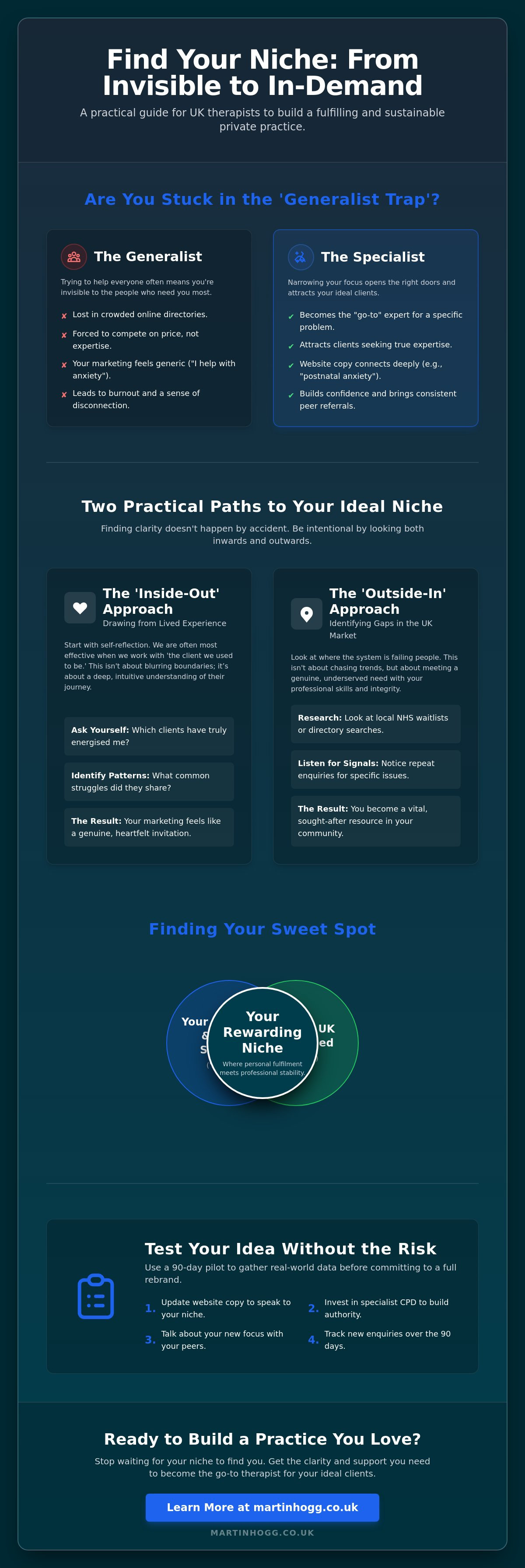
When you first start out in private practice, it's natural to want to help everyone. You've spent years training, and you have a genuine desire to support anyone who walks through your door. However, if you're looking at how to find your niche as a therapist uk, you've likely realised that being a generalist makes it incredibly hard for people to actually find you. A niche isn't a box that restricts your work. Instead, think of it as the sweet spot where your clinical skills, your lived experience, and a specific market need all meet.
Some colleagues suggest that you should wait for a niche to find you, but that passive approach can lead to months of an empty diary. It's much better to be intentional. While the British Association for Counselling and Psychotherapy (BACP) provides the essential ethical framework for our profession, how you present your services to the public requires a different mindset. Specialising is actually an ethical choice. It allows you to provide deep, focused expertise for a specific struggle rather than offering surface-level support for everything.
You might worry about "missing out" on clients, but the opposite is true. When you're a specialist, you become more attractive to "adjacent" clients too. If you're known for helping people with work-related burnout, you'll naturally attract people struggling with anxiety or relationship issues caused by that stress. You aren't closing doors; you're just making sure the right people can see your light.
Why 'Generalist' Often Means 'Invisible' Online
Search engines and directories like Psychology Today or Counselling Directory are crowded. If your profile says you work with "depression, anxiety, and stress," you're competing with thousands of others. Clients in distress don't search for broad terms. They look for someone who understands their specific pain, like "postnatal anxiety" or "perfectionism in the workplace." If you don't use those specific words, you stay invisible. They need to feel that you "get" them before they ever click the book button.
The Difference Between a 'Clinical Niche' and a 'Client Niche'
It helps to distinguish between what you do and who you do it for. A clinical niche focuses on a modality, such as CBT or Narrative Therapy. This is important for your professional development, but clients rarely search for modalities. A client niche focuses on a group or a specific struggle, such as working with men or managing anger. Combining the two is powerful. It shows you have both the right tools and a deep understanding of the person sitting across from you.
Two Practical Paths to Discovering Your Ideal Client
Finding clarity shouldn't be a passive process. While some suggest your niche will eventually find you, waiting for that to happen can lead to a lot of wasted time and empty slots in your diary. Instead, I suggest using two distinct methods to figure out how to find your niche as a therapist uk. By looking at both your internal motivations and the external reality of the UK mental health market, you can build a practice that is both personally fulfilling and financially stable.
The 'Inside-Out' Approach: Drawing from Lived Experience
This method starts with self-reflection. Think back to the clients who truly energised you. What did they have in common? Often, we are most effective when we work with "the client we used to be." This isn't about oversharing or blurring boundaries; it's about having a deep, intuitive understanding of a specific path because you've walked it yourself. When you align your practice with your lived experience, your marketing feels less like a sales pitch and more like a genuine invitation to heal. It's about finding that resonance that makes the work feel sustainable.
The 'Outside-In' Approach: Identifying Gaps in the UK
The second path involves looking at where the system is currently failing people. For example, men's mental health remains a significant area where demand often outstrips supply. You can look at local data or even the length of NHS waitlists in your area to see where people are struggling to find help. If you notice a high volume of enquiries for specific issues like adult neurodiversity or workplace stress, that's a clear signal from the market. This isn't about chasing trends, but about meeting a genuine need with professional integrity.
Combining these two views is the key to success. You might find that your personal interest in helping men aligns perfectly with a lack of local provision. To help signal this specialism, you can invest in targeted training, such as a working with men CPD course. This demonstrates your commitment to BACP professional standards while making you the obvious choice for those clients. If you're feeling stuck on which path to take, joining a supportive community like the Private Practice Success membership can provide the perspective you need to move forward with confidence.
Testing Your Niche Without Risking Your Current Practice
The fear of a quiet diary often stops people from specialising. When you're exploring how to find your niche as a therapist uk, you don't need to commit to a total rebrand overnight. Instead, I recommend a "Pilot" strategy. This is a 90-day test where you focus your marketing energy on one specific area while keeping your general practice running in the background. It allows you to gather real-world data without the pressure of an all-or-nothing transition.
A great way to start is by writing a single, clear sentence to test your focus: "I help [X] who are struggling with [Y] to achieve [Z]." For example, "I help new fathers who are struggling with postnatal depression to feel like themselves again." If that sentence feels clear and sparks a sense of purpose, you're ready to test it with your audience. This isn't about a permanent rebrand; it's a way to see which marketing messages actually get clicks and enquiries.
Running a 'Pilot' Marketing Campaign
You can gauge interest by creating a dedicated landing page on your website or a specific directory profile. Try a series of blog posts or social media updates focused entirely on your pilot topic. You'll know you're onto something when you start hearing, "I feel like you're talking just to me." This specific feedback is much more valuable than broad engagement because it shows a deep clinical resonance with your target group.
Refining Based on Real-World Connection
Sometimes a niche looks great on paper but feels draining once you're actually in the room. This is why a pilot phase is so helpful. If you find the work exhausting, it's okay to pivot and try a different angle. It's also vital to follow BACP guidance on competence and specialisms, ensuring you have the right training before you fully commit to a new area of expertise. Use your supervision to work through any imposter syndrome that crops up as you step into this new authority.
If you want a safe space to test these ideas with peers who understand the journey, our Private Practice Success membership offers the practical support you need to refine your focus and grow with confidence.
Building Your Practice Visibility Around Your Specialism
Once you've seen positive results from your pilot phase, you can start building your visibility with confidence. Knowing how to find your niche as a therapist uk is only half the battle; the next step is making sure your ideal clients can actually find you. This involves a shift in how you talk about your work. Instead of listing your qualifications first, you need to speak directly to the person sitting at home, searching for a solution to their specific pain.
Your website copy should focus on the results you help people achieve. If someone is struggling with anger, they don't want to read a long list of your certificates. They want to know that you understand why they're feeling so reactive and that you have a plan to help them find calm. Using "client-first" language builds immediate trust. It shows you're not just a professional, but a guide who has helped others overcome the same hurdles they are facing right now.
Building authority also comes through your professional development. BACP members need 30 hours of CPD annually, and choosing courses that align with your niche is a smart way to meet this requirement while growing your practice. When you consistently invest in a specific area, you become a natural point of referral for other therapists. A colleague who works with children will be happy to send an adult client to you if they know you're the local expert in that specific field. You can find targeted training to support this in our BACP Professional Development Workshops.
Communicating Your Value Without the Sales Pitch
Clarity is always more important than cleverness. You don't need to use pushy language or sound like a salesperson to be effective. In fact, being straight-talking and practical is often much more reassuring to someone in distress. Focus on the transformation. Describe the "before" and "after" of working with you. This clear communication is a core part of a wider growth strategy, much like the Practice Visibility Blueprint, which helps you move from being a generalist to a sought-after specialist.
Taking the Next Step with Private Practice Success
Trying to figure out your specialism in isolation can feel overwhelming. It's easy to get stuck in a loop of self-doubt and perfectionism. Joining a community of peers who are on the same journey can provide the perspective and encouragement you need to keep moving forward. It helps to have a supportive space where you can share what's working and what isn't as you refine your focus.
If you're ready to move past the "jack of all trades" stage, I invite you to explore the Private Practice Success Membership. It's a space designed to help you find your focus, build your confidence, and ultimately fill your practice with the clients you're best equipped to help.
Start Building a Practice That Truly Fits You
Finding your focus doesn't have to be a leap into the unknown. We've looked at how stepping away from the generalist trap actually makes you more visible to the people you're best equipped to help. By using the practical methods we've discussed and testing your ideas with a simple pilot phase, you can move forward without the fear of losing your current income. Clarity often comes through action rather than just thinking about it.
I've spent over 20 years in UK private practice, and I know that the most successful therapists are those who eventually claim their authority. Whether it's through our BACP-endorsed workshops or the structured Practice Visibility Blueprint system, there's a clear path you can follow. If you've been wondering how to find your niche as a therapist uk, remember that you don't have to figure this out in isolation.
You have unique skills and lived experiences that someone out there is searching for right now. It's time to make sure they can find you. Join the Private Practice Success Membership and find your niche today. I look forward to helping you build a practice that feels both rewarding and sustainable.
Common Questions About Choosing a Therapy Niche
Is it better to have one niche or can I have two?
Start with one. It makes your marketing much simpler and helps you learn how to find your niche as a therapist uk without feeling overwhelmed. If you have two passions, you can create separate landing pages for each focus on your website. Just ensure your main message doesn't become diluted, as clarity is what builds trust with a client in distress.
Will I get bored if I only work with one type of client?
It's a common fear, but the opposite is usually true. Specialising allows you to go much deeper into the complexities of a specific human struggle, which is often more intellectually and emotionally satisfying than being a generalist. Even within a niche, every person you work with is a unique individual with their own history, so the work stays fresh and engaging.
How do I describe my niche without sounding like I'm excluding people?
Focus your language on who you are for rather than who you are against. When you describe your niche, you're simply telling the right people that you've arrived. You don't need to explicitly exclude anyone. Most general clients will still contact you if they like your tone, but your ideal clients will feel a much stronger sense of relief and connection.
Do I need a special qualification before I can claim a niche?
You must be able to demonstrate competence, but a specific niche certificate isn't always a requirement. When you look at how to find your niche as a therapist uk, you should first check your professional body's ethical framework regarding specialisms. For some areas, like working with children or complex trauma, additional training is essential to ensure you're providing safe and effective support.
What if I choose the 'wrong' niche and nobody books?
Nothing in your private practice is set in stone. If you test a niche for a few months and it doesn't attract the right enquiries, you can simply pivot and try a different focus. It's rarely a total failure; usually, it's just a sign that your marketing copy needs to be more specific or that the local demand is actually in a different area.

Article by
Martin Hogg
I help Private Practice counsellors in the UK set up and grow an ethical Private Practice they love, work with their ideal clients, and earn the income they deserve. All without guesswork and burnout. I have been a private practice counsellor myself for over 20 years, specialising in anger management. I set up a not-for-profit social enterprise, Citizen Coaching and Counselling, which delivers thousands of counselling sessions a year to adults and young people in Birmingham. I am a registered BACP Counsellor and the author of three books, My Anger Coach, My Anxiety Coach and My Relationship Coach. These are available on Amazon.
Disclaimer
The information provided on this blog is for general informational purposes only and is not intended to be a substitute for professional medical or mental health advice, diagnosis, or treatment. Reading this content does not create a therapist-client relationship.


