
How to Find Your Niche as a Therapist UK: A Practical Guide to Practice Growth

Article by
Martin Hogg
I help Private Practice counsellors in the UK set up and grow an ethical Private Practice they love, work with their ideal clients, and earn the income they deserve. All without guesswork and burnout. I have been a private practice counsellor myself for over 20 years, specialising in anger management. I set up a not-for-profit social enterprise, Citizen Coaching and Counselling, which delivers thousands of counselling sessions a year to adults and young people in Birmingham. I am a registered BACP Counsellor and the author of three books, My Anger Coach, My Anxiety Coach and My Relationship Coach. These are available on Amazon.
What if I told you that trying to help everyone is the very thing keeping you invisible? It's a common trap. You've likely spent hours tweaking your Psychology Today profile, hoping to catch the eye of anyone who scrolls past, yet the enquiries just aren't landing. I know the fear of 'missing out' on generalist clients is real, but learning how to find your niche as a therapist UK isn't about shutting doors or limiting your practice. It's about turning on a lighthouse so the right people can actually find you through the digital noise.
You can find a specialist niche that attracts your ideal clients without 'boxing yourself in' or feeling like a pushy salesperson. This article will show you how to move past the marketing jargon and build a clear message that feels authentic rather than salesy. We'll explore practical, grounded steps to help you gain professional confidence and finally fill your diary with clients you genuinely look forward to meeting.
Key Takeaways
- Understand why being a "generalist" makes you invisible and how defining a niche based on specific client struggles helps you stand out in crowded directories.
- Learn how to find your niche as a therapist uk by exploring two distinct paths: leveraging your lived experience or identifying underserved gaps in the current market.
- Use the "Skateboard Model" to test your new focus with a simple, one-page site, allowing you to run a 90-day experiment without the pressure of a total rebrand.
- Align your specialist identity with your SEO and networking to create a clear marketing message that attracts the clients you actually enjoy working with.
Why 'Generalist' Often Means Invisible in the UK Therapy Market
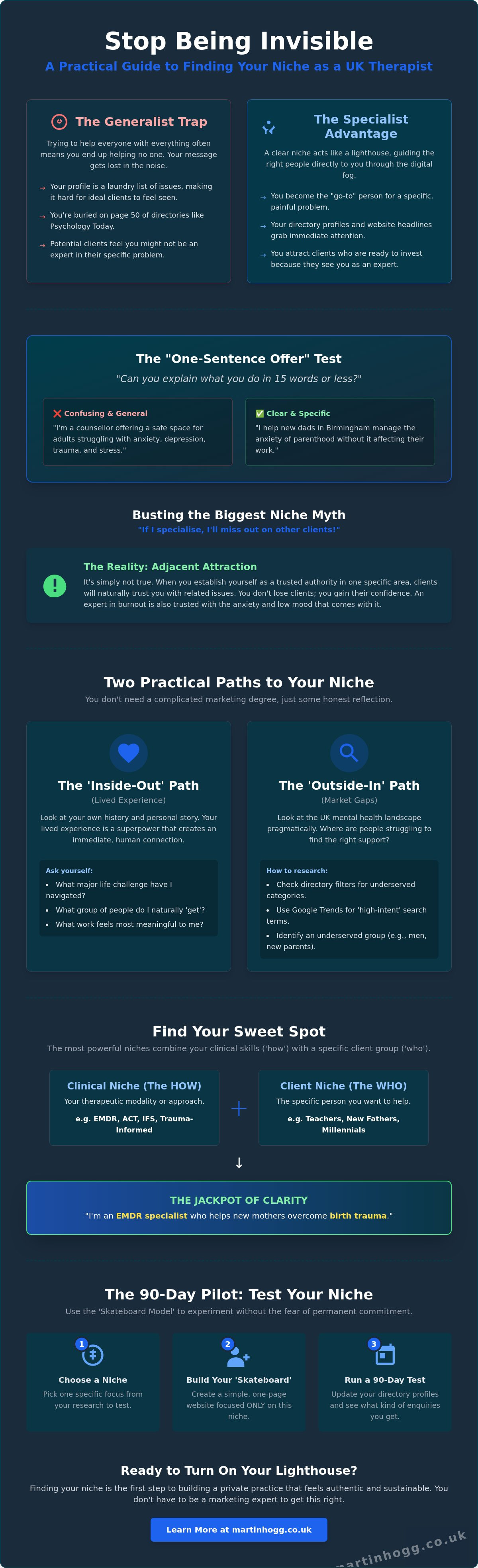
When you first start out, the urge to help everyone is overwhelming. You don't want to turn anyone away, so you list every possible issue on your Counselling Directory profile. But in the UK market, being a generalist is often a one-way ticket to invisibility. I see so many talented counsellors buried on page 50 of Psychology Today because their profile reads like a laundry list of every mental health condition known to man. It's a bit like going to a restaurant that serves sushi, pizza, and Sunday roasts; you probably wouldn't trust them to do any of it particularly well.
A true niche isn't just a label; it's the sweet spot where your specific clinical skills meet a very particular client struggle. Before we look at how to find your niche as a therapist uk, it's helpful to start by understanding what a niche market is in a broader sense. It is about being the "go-to" person for a specific problem. With the 2026 SCoPEd framework now in full effect, having a clear professional identity isn't just a marketing trick. It's becoming a standard for how we define our value and progress in our careers.
Can you explain what you do in 15 words or less? I call this your "One-Sentence Offer." If you can't explain it simply, you're likely confusing your potential clients. People don't buy "counselling"; they buy a solution to a problem that's keeping them awake at 3 am.
The Myth of the 'Missing Client'
I hear this all the time: "If I only talk about anxiety, I'll lose the depression and trauma clients." It's simply not true. I call this "adjacent attraction." When you're seen as an authority in one area, people naturally trust you with related issues. You won't end up with an empty diary. You'll end up with a diary full of people who actually value your expertise because you aren't just another generic name in a list.
Title Tags and Directory Visibility
Directories aren't just lists; they're search engines. If your title tag just says "Counsellor," you're competing with thousands. If it says "Counsellor for New Dads in Birmingham," you've already won the attention of the person who needs exactly that. You need to focus on your "above the fold" content. This is the first sentence people see before they even click your profile. If that first sentence doesn't speak directly to their pain, they've already scrolled past you.
Two Practical Paths to Finding Your Ideal Niche
I often find that therapists get stuck because they think they have to choose between their heart and their bank balance. When you're looking at how to find your niche as a therapist uk, there are really only two ways to play it. It doesn't have to be a complicated process, but it does require some honest reflection on what you actually want your working day to look like. With the 2026 SCoPEd standards bringing more structure to our profession, having a clear strategy helps you map your career progression to these new levels of accreditation with much more intention.
The first is the 'Inside-Out' path. This is where you look at your own history. Maybe you've navigated a difficult divorce, or you're a neurodivergent person who spent years feeling misunderstood. Your lived experience isn't a weakness; it's a superpower. It gives you an immediate, human connection with clients who are walking that same path. You don't need to be 'recovered' or perfect, you just need to be a few steps ahead of them.
The second is the 'Outside-In' path. This is more pragmatic. You look at the UK mental health landscape and ask, 'Where are people struggling to find help?' For example, there is a massive shortage of practitioners who know how to work effectively with men. By taking a specific Working with Men CPD, you bridge the gap between having a general interest and becoming a trusted authority in an underserved market.
Clinical Niche vs. Client Niche
It’s helpful to understand the difference between these two. A clinical niche is about the 'how'. You might specialise in ACT, EMDR, or trauma-informed care. A client niche is about the 'who'. This could be high-achieving millennials, new fathers, or teachers facing burnout. Ideally, you want a bit of both. If you're an EMDR specialist who focuses specifically on birth trauma, you've hit the jackpot of clarity. If you're struggling to choose, I've put together some resources in the Private Practice Success membership to help you narrow it down.
Researching the UK Market Gaps
Researching your local area is a vital part of how to find your niche as a therapist uk. Don't just guess. Use Google Trends to see what people are actually typing into their browsers. Look for 'high-intent' search terms. Someone searching for 'anger management for professionals' is much more likely to book a session than someone just looking for general 'stress tips'. You can also use directory filters on Psychology Today or Counselling Directory to see which categories are overcrowded in your town and which ones are strangely empty.
The 90-Day Pilot: Testing Your Niche the 'Skateboard' Way
One of the biggest hurdles in how to find your niche as a therapist uk is the fear of commitment. You worry that if you change your website today, you’re stuck with it forever. I want to offer you a different way: the 90-day pilot. Instead of a massive, expensive overhaul, we use the "Skateboard Model." Think of it as a Minimum Viable Practice. A skateboard gets you from A to B much faster than waiting three years to build a Rolls Royce. It’s about getting moving now, not later.
You don't need to change your BACP profile yet. You don't need to bin your existing business cards or delete your Counselling Directory listing. You just need a small, focused experiment. During these 90 days, your goal isn't just to get more enquiries; it's to track the quality of those enquiries. Are you talking to people you actually want to help? If the answer is yes, you're on the right track. This "safety first" transition allows you to test the waters without the anxiety of losing your current income stream.
Forget the £2,000 rebrand. Rough and ready content on Canva beats a polished, sterile site every time. People connect with people, not corporate logos. If you want a structured way to run this experiment and get your practice moving, you can find the step-by-step process in the Private Practice Success membership.
The One-Page Niche Site
Use Squarespace or a similar tool to build a simple, one-page site. Focus entirely on your "above the fold" message. This is the first thing people see before they even start scrolling. It should be your one-sentence offer and a single, clear call to action, such as a link to your Calendly. Don't clutter it with your entire CV or every training course you've ever attended. Keep it lean and focused on the client's problem.
Gathering Feedback and Refining
Treat every initial consultation as a research session. Listen to the specific words your niche clients use. Do they talk about "burnout" or "feeling like a fraud"? Do they mention "the 3 am dread"? Use their exact language to refine your marketing. Your niche isn't something you invent in a vacuum; it's something you discover through real-world conversations. If the feedback suggests you're slightly off target, you can pivot quickly because you haven't built a massive, rigid structure yet.
Turning Your Niche into a Practice Visibility Blueprint
Once you've tested your pilot and seen those first few enquiries land, it's time to build a permanent structure. Understanding how to find your niche as a therapist uk is a brilliant first step, but the real magic happens when you turn that niche into a Practice Visibility Blueprint. This isn't about complex marketing funnels; it's about making sure that when someone has the specific problem you solve, your name is the first one that comes to mind. It makes your networking feel less like "selling" and more like offering a solution.
There is a massive power in peer referrals that most generalists miss. Other therapists don't usually refer to "generalist counsellors" because they already know dozens of them. They refer to the person who specialises. If a colleague has a client struggling with something outside their expertise, they want to send them to a specialist they trust. Being the "go-to" person for a specific issue makes you the easiest person to recommend. This specialist focus is the foundation of a sustainable Counselling Private Practice UK structure, moving you away from the "directory trap" and into a position of professional authority.
Scaling Beyond One-to-One
A well-defined niche also protects you from burnout by allowing you to work smarter. When you're an expert in one area, you can easily create workshops, groups, or digital resources because you already know the common themes your clients face. It’s much easier to fill a "Stress Management for Teachers" workshop than a generic "Wellbeing" session. Have a look at my guide on Scaling a Therapy Practice to see how a niche becomes the engine for long-term growth.
Your Next Practical Steps
I don't want you to just read this and go back to scrolling. Here is how to actually start how to find your niche as a therapist uk today:
- Audit your current Psychology Today and Counselling Directory profiles. Be ruthless. Remove the laundry list of 50 different conditions and focus on the top three you actually enjoy.
- Draft your first "one-sentence offer." Aim for 15 words or less. Who do you help, and what is the outcome?
- Join the Private Practice Success Membership. You can get direct feedback on your niche and connect with a community of UK therapists who are doing exactly what you're doing.
Building a private practice can feel like a lonely climb, but it’s much easier when you have a clear map and a supportive group behind you. Let's get that diary full.
Ready to Stop Being the Best Kept Secret in Therapy?
Finding your focus doesn't mean you're turning your back on people who need help. It means you're finally making it possible for the right people to find you. We've looked at why the "directory trap" keeps so many talented counsellors invisible and how the "skateboard model" lets you test a new direction without risking your current practice. Mastering how to find your niche as a therapist uk is the single most effective way to move from a place of overwhelm to a full diary of clients you genuinely enjoy working with.
You don't have to figure this out on your own. If you want a structured path, my Practice Visibility Blueprint system is designed to take the guesswork out of your marketing. When you join the Private Practice Success community and nail your niche today, you'll get access to a supportive community of UK practitioners and BACP-endorsed workshops that focus on real-world results rather than abstract theory.
Your practice deserves to grow, and your future clients are waiting for someone with your specific expertise. Take that first small step today. You’ve got the tools; now it’s time to use them.
Frequently Asked Questions
Will I get bored if I only work with one type of client in my niche?
You won't get bored because every individual story remains unique. Even if you focus on a specific struggle like work-related burnout, the people sitting in your chair bring vastly different backgrounds and life experiences. Specialising actually allows you to do deeper, more rewarding clinical work. You stop repeating the basics and start noticing the subtle nuances that make you a true expert in your field.
Can I have more than one niche in my private practice?
You can certainly have more than one niche, but I wouldn't recommend putting them both on the same home page. If you want to work with both new mothers and corporate executives, keep their marketing messages distinct. You might use different landing pages or separate directory descriptions. The key is to avoid confusing a potential client who needs to feel like you are the specific person for them.
How do I know if a niche is 'too small' to be profitable in the UK?
A niche is rarely too small if you are working online, but you should always check the data first. Use Google Trends or look at the number of people searching for specific terms in your area. If you find a gap where people are clearly struggling but no one is listing it as a specialism, you've found a goldmine. Learning how to find your niche as a therapist uk involves balancing your passion with actual market demand.
Do I need extra qualifications before I can claim a niche?
You don't always need a new degree, but specific CPD can give you the professional confidence to claim your space. If you're moving into a niche like anger management, taking a focused course shows clients and the BACP that you've done the work. Often, your existing clinical skills and lived experience are already enough to start. You can always add more formal training as your practice grows and evolves.
What if I choose a niche and then realise I don't actually like it?
If you realise a niche isn't for you, you simply pivot. This is exactly why I advocate for the 90-day pilot. It isn't a permanent identity; it's a business experiment. If you find the work draining or uninspiring, you can change your "above the fold" message and try a different angle. Understanding how to find your niche as a therapist uk is about finding a sustainable fit, not a life sentence.
Disclaimer
The information provided on this blog is for general informational purposes only and is not intended to be a substitute for professional medical or mental health advice, diagnosis, or treatment. Reading this content does not create a therapist-client relationship.


