
How to Get Counselling Clients: A Practical UK Guide

Article by
Martin Hogg
I help Private Practice counsellors in the UK set up and grow an ethical Private Practice they love, work with their ideal clients, and earn the income they deserve. All without guesswork and burnout. I have been a private practice counsellor myself for over 20 years, specialising in anger management. I set up a not-for-profit social enterprise, Citizen Coaching and Counselling, which delivers thousands of counselling sessions a year to adults and young people in Birmingham. I am a registered BACP Counsellor and the author of three books, My Anger Coach, My Anxiety Coach and My Relationship Coach. These are available on Amazon.
It's a heavy feeling when you've done everything "right" but the phone stays silent. You might feel like a bit of a failure, or perhaps you're just tired of wasting money on directories that don't seem to work. If you're currently struggling with how to get counselling clients, I know that the ethical "ick" of marketing is real. Most of us didn't train for years just to become part-time social media managers or tech experts.
I want to show you that there's a better way to grow. We're going to move away from "post and pray" marketing and towards a reliable, grounded system for attracting private pay enquiries. I'll walk you through my "skateboard model" for a simple website and show you how a manageable routine can build your confidence and your caseload. We're going to turn your visibility into a bridge for the people who truly need your help, moving from being a hidden gem to a visible, trusted professional.
Key Takeaways
- Stop relying on "post and pray" marketing and learn why a simple directory listing isn't enough to keep your phone ringing.
- Use the "skateboard model" to launch a functional, one-page website quickly instead of getting stuck in a cycle of perfectionism.
- Discover how to get counselling clients by optimising your Psychology Today profile with specific title tags that help you stand out in Google searches.
- Move beyond random marketing tasks and implement a structured system that creates a steady stream of private pay enquiries for your practice.
Why Your Phone Isn’t Ringing: Moving Beyond Passive Directories
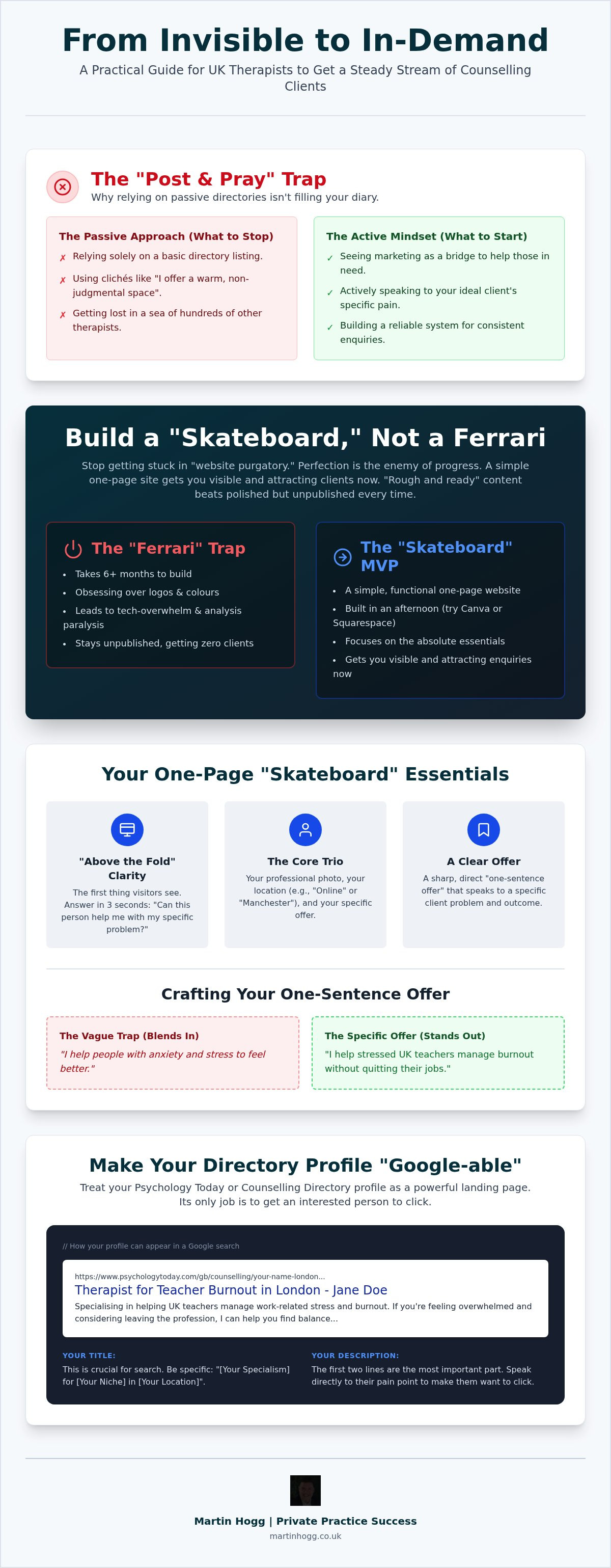
Many therapists fall into the trap of "passive marketing." This is essentially the act of listing your name on a directory and waiting for the magic to happen. It feels safe, but in a saturated UK market, it often leads to a trickle of enquiries rather than a steady stream. You've likely spent years learning what psychotherapy is and how to help people. Yet, nobody told you that being a great therapist isn't enough to fill a diary. If you're wondering how to get counselling clients, the first step is admitting that "post and pray" isn't a strategy. It relies on someone else’s platform to do the heavy lifting for you, which rarely works when the competition is so high.
The "Post and Pray" Trap
When you use phrases like "I offer a warm, non-judgmental space," you become invisible. It's a cliché that has lost its impact. Thousands of other profiles on the Counselling Directory say the exact same thing. Directories are incredibly crowded places. If your profile reads like a clinical CV or a dry list of qualifications, potential clients will just keep scrolling. They aren't looking for your certificates first; they're looking for a person who understands their specific pain. Relying solely on a basic BACP or Psychology Today profile without a clear strategy usually results in your name being buried under hundreds of others.
Shifting to an Active Mindset
Marketing often feels like a dirty word in our profession. I call this the "ethical ick." But if you want to grow, you have to see visibility as a service. Marketing is simply the bridge between someone’s suffering and your solution. If they can't find you, you can't help them. You need to start "creating" clients by speaking directly to their struggles rather than just listing your modalities. If you want to move forward, you should check out our niche building secrets to help you stand out. People connect with people, not clinical frameworks. It's about showing up where they are and proving you understand their world.
Building Your Skateboard: The MVP Approach to Visibility
I see many counsellors get stuck in "website purgatory." You want a Ferrari, but you don't have the engine yet. You spend six months worrying about hex codes and logos while the phone stays silent. Instead, I want you to build a skateboard. It's basic. It’s one page. But it gets you from A to B. This is the most practical way to figure out how to get counselling clients without losing your mind to tech-overwhelm.
Perfection is the enemy of progress here. As I mentioned earlier, clients are looking for a human connection, not a sterile medical portal. "Rough and ready" content beats clinical perfection every time because it feels real and accessible. Your "above the fold" content, which is the stuff visible before someone scrolls, needs to answer one question in three seconds: "Can this person help me?" If you can answer that immediately, you've already won half the battle.
The Essentials of a One-Page Site
You can use Canva or Squarespace to get a basic presence live by tea time. Don't overcomplicate the design. You just need your face, your location, and your specific offer. If you aren't sure how to phrase your message yet, checking out some niche building secrets will help you narrow down your focus. Once it's live, you're ahead of most of the competition who are still "planning" their launch while their diaries remain empty.
The One-Sentence Offer
Your offer needs to be a sharp tool, not a blunt instrument. Avoid the "I work with everyone" trap that makes you blend into the background. Try a one-sentence offer instead. For example: "I help stressed UK teachers manage burnout without quitting their jobs." It’s clear. It’s direct. It tells the reader exactly what they get. If you want a community to help you refine this, come and join our Private Practice Success Membership where we build these together.
Optimising Your Presence: Psychology Today and Search Visibility
If you're wondering how to get counselling clients, you need to stop treating your directory profiles like a dry academic CV. Whether it's the Counselling Directory or Psychology Today, your profile is a landing page. Its only job is to get someone to click. Your photo and the first two lines of your bio are the most important real estate you own. If those first few words don't resonate, the rest of your carefully written profile won't even be read.
I would focus heavily on your title and description tags. These are the bits of text that show up in Google search results. If you get these right, your profile becomes "Google-able," appearing right when someone is searching for help. Once the enquiries start landing, you'll need a way to stay organised. I recommend using the Counsellor Efficiency Bundle to manage the admin of new leads without feeling overwhelmed.
Directory Profile "Must-Haves"
The biggest mistake I see is writing about "I" instead of "you." Your profile should be a mirror for the client’s struggle. Instead of listing your certificates, describe the feeling of their Sunday night anxiety. Always include a clear Call to Action (CTA). Don't just hope they'll find your email; tell them exactly what to do next, like "Book a free 15-minute chat via my Calendly."
A Simple SEO Primer
SEO is simply being the answer to the question your client is typing into Google. It isn't dark magic; it’s about clarity and relevance. If you want to dive deeper into the technical side, have a look at our SEO for Therapists: A Beginner’s Guide. It breaks down the jargon into practical steps you can actually use.
Scaling Your Private Practice: Systems for Steady Growth
Most therapists treat marketing like a chore they only do when their diary is empty. That's the "post and pray" cycle we've been trying to break. To truly master how to get counselling clients consistently, you need a system. I call this the Practice Visibility Blueprint. It’s a structured path that takes the guesswork out of your working week. Instead of random, frantic acts of marketing, you follow a repeatable process that keeps your name in front of the right people.
When the enquiries start coming in, a new problem often appears: "enquiry anxiety." You might worry about saying the wrong thing or feeling "salesy" on the phone. Having a clear onboarding process, perhaps using tools like Calendly for automated bookings, removes that friction. You aren't just a solo therapist; you're building a professional organisation. Joining the Private Practice Success Membership helps with this transition. It stops the isolation of solo work and gives you a community of peers who understand the weight of the work.
Moving from Solo to CEO
You need to think about your practice as a business that serves you as much as it serves your clients. This mindset shift is vital for your long-term survival in the profession. If you're ready to look at the bigger picture and move beyond the one-to-one model, my guide on Scaling a Therapy Practice offers a deeper look at growing your impact without burning out.
Your Next Practical Steps
Start with a simple, 30-minute daily routine. Spend ten minutes engaging where your niche hangs out, ten minutes refining your "rough and ready" content, and ten minutes checking your search visibility. Learning how to get counselling clients doesn't have to be a full-time job. Consistency beats intensity every single time. If you're tired of the guesswork and want a proven map to follow, the Practice Visibility Blueprint is your next logical step.
Your Path to a Full Diary
Growing a practice doesn't require a marketing degree or a flashy website that takes months to build. It's about being visible enough for the right people to find you. We've looked at why passive directories often fail and how a "skateboard" approach gets you moving much faster. By treating your profiles like landing pages and focusing on your niche, you take back control of your enquiry stream. I’ve spent over 20 years in private practice, and as a BACP-endorsed training provider, I’ve seen hundreds of UK counsellors move from silence to a full diary by following a simple, grounded system. You don't have to figure out how to get counselling clients all by yourself.
Take that first small step today. Your future clients are already out there looking for the help only you can provide. You have the skills; now let's make sure the people who need you most can actually find you.
Frequently Asked Questions
How much time should I spend on marketing my counselling practice each week?
I would aim for about 30 minutes a day, or roughly three hours a week. Consistency is much better than a frantic eight-hour binge once a month when your diary is empty. You can spend this time updating your Psychology Today profile, engaging with your niche online, or refining your website’s "above the fold" content. Small, daily habits build a steady momentum that keeps the enquiries coming in.
Is it better to use Psychology Today or my own website to get clients?
You actually need both, but they serve different purposes. A directory like Psychology Today is great for immediate visibility because they already have high search rankings. However, your own "skateboard" website is where you truly own the narrative and build deeper trust. Think of the directory as the shop window and your website as the consultation room. Both are vital tools in how to get counselling clients.
Do I really need a niche to get counselling clients in the UK?
Yes, because trying to help everyone usually ends up helping no one. In a crowded UK market, being a "generalist" makes you blend into the background. When you have a clear niche, like working with stressed NHS staff or new dads, you become the obvious choice for those specific people. It makes your marketing much easier because you know exactly who you are talking to and what pain points to address.
What is the most effective way to get private pay therapy clients quickly?
The quickest route is often a combination of a sharp Psychology Today profile and a clear "one-sentence offer." Most therapists take months to launch a complex website, but you can update a directory profile in an afternoon. Focus on the first two lines of your bio and use a professional photo. This immediate visibility, paired with a direct call to action, is the fastest way to learn how to get counselling clients.
How do I market my practice without sounding like a salesperson?
Shift your mindset from "selling" to "serving." Marketing is just a bridge between a person’s struggle and your solution. If you speak directly to a client’s pain and offer a clear path forward, it won’t feel like a sales pitch; it will feel like an invitation to heal. Avoid clinical jargon and use everyday language that resonates with their lived experience. People connect with people, so just be your human self.
Disclaimer
The information provided on this blog is for general informational purposes only. It is also not intended to be a substitute for professional medical or mental health advice, diagnosis, or treatment. Reading this content does not create a therapist-client relationship.


