
How to Get Counselling Clients UK: A Practical Guide

Article by
Martin Hogg
I help Private Practice counsellors in the UK set up and grow an ethical Private Practice they love, work with their ideal clients, and earn the income they deserve. All without guesswork and burnout. I have been a private practice counsellor myself for over 20 years, specialising in anger management. I set up a not-for-profit social enterprise, Citizen Coaching and Counselling, which delivers thousands of counselling sessions a year to adults and young people in Birmingham. I am a registered BACP Counsellor and the author of three books, My Anger Coach, My Anxiety Coach and My Relationship Coach. These are available on Amazon.
What if I told you that being a brilliant therapist has almost nothing to do with how many people book a session with you? It's a bit of a kick in the teeth when you've spent years training, yet you're still staring at empty diary slots and feeling invisible on the Counselling Directory. You're likely wondering how to get counselling clients uk based, without feeling like a pushy salesperson or drowning in marketing jargon. That anxiety over financial stability is real when you feel like you're shouting into a void.
I've seen many gifted counsellors stall because they're waiting for the phone to ring. I'll show you how to move from that passive waiting game to building a visible, sustainable practice that attracts the right clients. We'll explore my "skateboard model" for a simple website and why "rough and ready" content usually beats a polished look. By the end of this guide, you'll have a repeatable system for enquiries that lets you focus on the work you actually love.
Key Takeaways
- Stop waiting for the phone to ring and start intentionally positioning yourself where your specific clients are already looking for help.
- Learn how to get counselling clients uk by using the Practice Visibility Blueprint to create a "one-sentence offer" that speaks directly to your client's pain.
- Save your money and your sanity by using the "skateboard model" to build a simple, effective one-page website on Squarespace or Wix.
- Build a sustainable practice by moving from "hunting" for every enquiry to "farming" a digital presence and referral network that works for you.
Why Waiting for the Phone to Ring Isn’t a Marketing Strategy
I've met so many gifted counsellors who are technically brilliant but struggling to pay the bills. They believe that being a "good enough" therapist is all they need to get found. It's a lovely thought, but it's rarely true. If you're wondering how to get counselling clients uk based, you have to realise that clinical excellence is your foundation, not your marketing department. You can be the best therapist in the world, but if nobody knows you exist, you can't help anyone.
Many fall into what I call the "passive trap." They set up a basic BACP directory listing, maybe a Psychology Today profile, and then they wait. They wait for the phone to ring. But when you rely solely on these directories, you're just one name in a sea of thousands. Active marketing involves:
- Identifying exactly who you want to help.
- Showing up where those people spend their time online.
- Speaking their language, not clinical jargon.
It's about intentionally positioning yourself where your specific client is already searching for relief, rather than hoping they stumble across your name by accident.
The Myth of the "Good Enough" Therapist
Clinical excellence is your foundation, but visibility is the bridge that brings clients across to your chair. Word of mouth is fantastic, but it's a slow burner. In 2026, you can't build a sustainable practice on it alone. You need a strategy that works while you're sleeping, not just when a former client happens to mention your name at a dinner party.
Overcoming the Fear of Being Seen
I know the worry. You feel that "marketing" is somehow unethical or unprofessional. Let's flip that perspective. If you have a skill that can change a life, staying hidden is what's truly unfair. You don't need a corporate gloss or a fake persona. I would always argue that "rough and ready" content builds more trust than a polished, clinical image. People connect with real people. It feels authentic, safe, and most importantly, approachable. You want to be a beacon for those in distress, not a distant medical professional.
Building Your Practice Visibility Blueprint
Moving from invisible to in-demand doesn't happen by accident. I recommend a structured approach I call the Practice Visibility Blueprint. It's a way to stop guessing and start being seen by the people who need you most. Learning how to get counselling clients uk based is often more about the clarity of your message than the size of your budget. You want to stop being a "best-kept secret" and start becoming the obvious solution for your ideal client.
Why Niche Building is Your Secret Weapon
The danger of being a "generalist" in a crowded UK market is that you become a commodity. On directories like Psychology Today, a generalist profile is often scrolled past because it feels vague. I have some niche building secrets that prove narrowing your focus actually fills your diary faster. Use your CPD to your advantage. If you've specialised in Anger Management or Working with Men, shout about it. It makes you the specialist choice for someone in that specific crisis.
Crafting Your One-Sentence Offer
You need to move away from therapist clichés like "I provide a safe, non-judgmental space." That is white noise to a client in distress. Instead, try a formula: "I help [who] overcome [what] so they can [result]." For example: "I help stressed professionals manage anxiety so they can reclaim their evenings." This stops the scroll because it addresses a specific outcome rather than a vague process.
Finally, audit your "above the fold" content. This is everything visible on your profile or website before someone has to scroll down. If your contact button or your core offer isn't immediately visible, you're losing enquiries. If you want to refine these steps with a supportive community, have a look at our private practice success membership for ongoing growth.
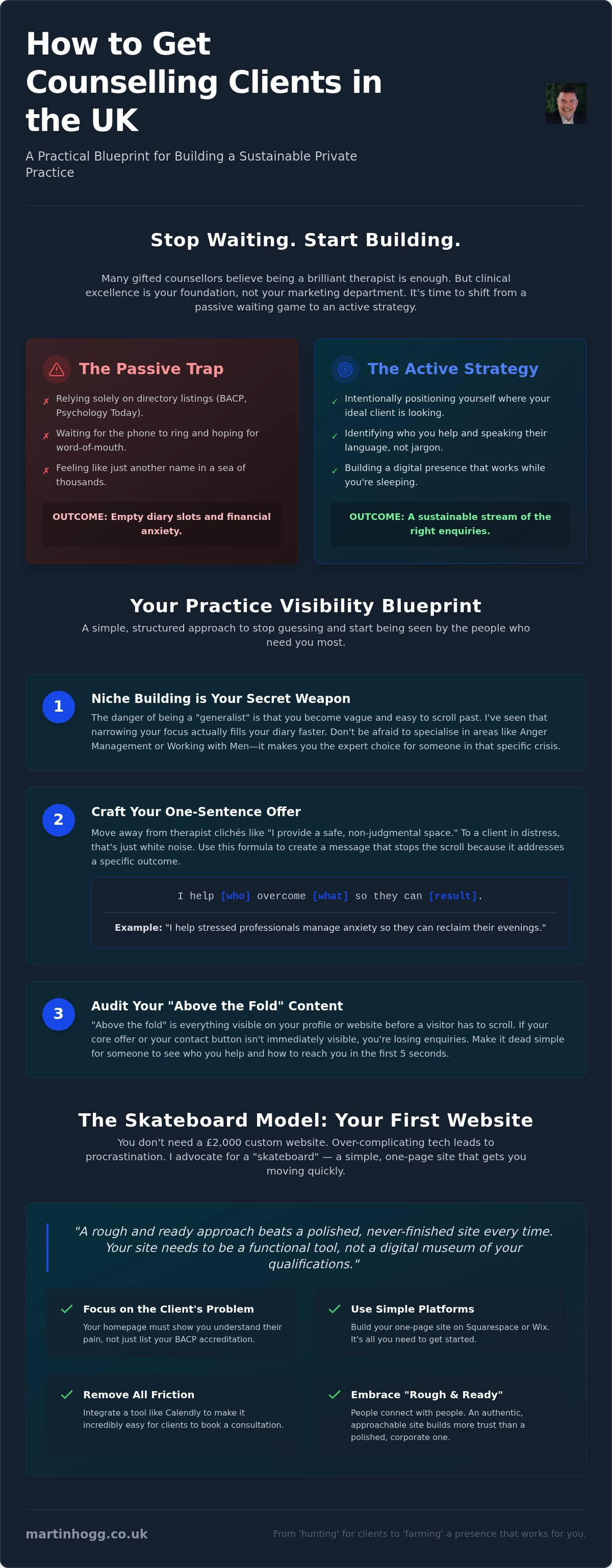
The Skateboard Model: Getting Your Website Right
You don't need a £2,000 custom website to get your first ten private clients. In fact, over-complicating your tech often leads to procrastination. I advocate for the "skateboard model." This is a one-page MVP site built on Squarespace or Wix that gets you moving quickly. It's a rough and ready approach that beats a polished, never-finished site every time. If you're figuring out how to get counselling clients uk based, your site needs to be a functional tool, not a digital museum of your qualifications.
Your homepage must focus on the client’s problem. When someone is in distress, they aren't looking for your BACP accreditation number first. They're looking for a sign that you understand their pain. I recommend integrating a tool like Calendly. It makes it incredibly easy for a person in distress to book a consultation without the back-and-forth of emails. It removes the friction between their struggle and your support. Mastering these basics is the fastest way to learn how to get counselling clients uk without burning out.
Essential "Above the Fold" Elements
Visitors decide to stay or leave in about three seconds. Everything "above the fold"—the part of the screen visible before scrolling—must work hard. You need a clear offer and a professional, warm headshot. This builds immediate human connection. People buy from people, so let them see the friendly face behind the practice. If they feel a connection in those first few seconds, they're much more likely to keep reading.
Optimising Your Directory Profiles
Your website is your home, but directories like Psychology Today are your shop windows. To get clicks, you need to master your title and description tags. These are the snippets people see in Google search results. If you want to skip the trial and error, the Counsellor Efficiency Bundle provides templates that save hours on this setup. A well-written profile can be the difference between a quiet phone and a full diary.
Creating a Sustainable Stream of Private Pay Clients
Getting clients is one thing; keeping a full practice without burning out is another. I often talk about moving from "hunting" to "farming." Hunting is exhausting. It's that frantic, constant search for the next enquiry when the diary looks thin. Farming is different. It’s about planting seeds through a referral network and a steady digital presence. If you're looking for how to get counselling clients uk based, you need to build a practice that eventually sustains itself through reputation and visibility.
You don't have to do this work in isolation. Isolation is a huge driver of burnout for private practitioners. Joining a community like the Private Practice Success Membership keeps you consistent. It’s much easier to stay on track when you’re surrounded by peers who understand the specific nuances of the UK market. We help each other stay focused on what actually works rather than getting distracted by the latest marketing fad or over-complicated tech.
Active Networking for UK Counsellors
Networking doesn't have to feel like a grubby sales pitch. I suggest building genuine relationships with people who already encounter your ideal clients. Consider connecting with local GP surgeries, local charities that don't have their own counselling provision, or other therapists who work in complementary niches. I frequently refer clients to colleagues when my diary is full or when a niche isn't quite the right fit for me. They do the same for me. It’s about being a helpful, visible part of your local mental health ecosystem.
The Power of Consistency Over Perfection
Sometimes, the most effective networking happens in relaxed, non-clinical environments. Attending creative social gatherings, such as those organized by Paint Chill Co, allows you to build organic connections within your local community while also prioritising your own creative outlet and well-being.
While the contexts may differ, looking at how providers like Mighty Mentors WA build trust through personalised mentoring and community access can inspire new ways to think about your own referral partnerships and community presence.
Similarly, following the business development strategies of experts like Jani Havunen can help you develop the entrepreneurial resilience needed to build a high-impact coaching or therapy practice.
Stop trying to write the perfect monthly newsletter. It usually ends up sitting in your drafts for six months. Instead, aim for "rough and ready" consistency. Posting one helpful tip a week on LinkedIn or a short blog post is far more effective for your visibility. It keeps your name in front of the right people. If you want to master how to get counselling clients uk, remember that showing up imperfectly every week beats staying hidden while you wait for perfection. This steady approach builds trust over time, ensuring your practice remains resilient and visible for the long term.
Take Control of Your Practice Visibility
Building a thriving practice is about shifting from waiting to acting. You've seen how a simple "skateboard" website and a clear one-sentence offer can change the trajectory of your business. It's not about being a sales expert; it's about being visible enough so that the people who need you can actually find you. I've spent over 20 years in the UK counselling sector, and if there's one thing I know, it's that people connect with people, not polished corporate facades.
When you stop over-complicating how to get counselling clients uk, you free up your mental energy for the clinical work you love. I've led BACP-endorsed workshops for years because I'm passionate about making professional support accessible to everyone. You don't have to figure this out in isolation. There is a whole community of therapists moving toward a more sustainable future together.
Your skills are far too valuable to stay hidden behind a quiet phone and an empty room. Take that first small step today, and let's turn your clinical excellence into a visible, thriving practice.
Common Questions About Growing a UK Practice
How long does it take to get my first counselling client in private practice?
It usually takes between two to six weeks to land your first client if your visibility tools are ready. This assumes you've set up your "skateboard" website and a solid directory profile. It’s rarely an overnight success, but you shouldn't be waiting months either. The key is being active rather than passive. Once that first enquiry drops, your confidence will grow and the process starts to feel much more natural.
Which directory is best for UK therapists: Psychology Today or Counselling Directory?
Both have merits, so I suggest trial runs on both to see which generates more enquiries for your specific niche. Psychology Today often has excellent search engine rankings, while the Counselling Directory is a trusted, UK-specific staple. Don't just list your name; use those title tags and a warm headshot to stand out. Most therapists find that one eventually outperforms the other based on their location and specialism.
Do I really need a niche to get therapy clients in the UK?
Narrowing your focus is the fastest way to learn how to get counselling clients uk because it stops you from being "white noise." When you try to help everyone, you end up appealing to no one. Being a specialist in something like Anger Management makes you the go-to person for that specific crisis. It’s much easier to fill a diary as an expert than as a generalist in a crowded market.
Is it ethical to use marketing tactics as a BACP registered counsellor?
Marketing is perfectly ethical if you remain honest and prioritise the client's wellbeing. As a BACP member, your visibility is actually a service to the public. If you’re hidden, people might end up with less qualified support. Think of marketing as a bridge between their distress and your expertise. It’s not about "selling" therapy; it’s about making sure the people who need help can actually find you.
How much should I spend on marketing my private practice each month?
You don't need a huge budget; most practitioners start with under £50 a month. This typically covers your directory listings and a basic website host. Avoid the temptation to buy expensive ads or complex software early on. Invest your time in "rough and ready" content and your money in the platforms where clients are already searching. Keep it simple, sustainable, and focused on the basics that actually bring people in.
Disclaimer
The information provided on this blog is for general informational purposes only. It is also not intended to be a substitute for professional medical or mental health advice, diagnosis, or treatment. Reading this content does not create a therapist-client relationship.


