
How to Get Counselling Clients UK: A Practical Guide to Growing Your Private Practice
What if the reason your practice isn't growing has nothing to do with your clinical skills and everything to do with a broken system? I've mentored over 150 UK therapists in the last 12 months, and most of them feel like they're shouting into a void on crowded directories. You didn't train for years just to become a frustrated marketer, yet here you are, wondering how to get counselling clients UK wide without losing your professional soul. It's exhausting to deal with the "feast or famine" cycle that leaves your income as unpredictable as the British weather.
I know you probably find the idea of "selling" yourself slightly cringeworthy. It feels at odds with the empathy and care you bring to the therapy room. But there's a way to be visible that's grounded in service rather than ego. In this guide, I'll share a proven, ethical framework to help you move beyond passive listings and build a consistent stream of right-fit clients. We'll explore how to create a manageable system that fills your diary and restores your confidence, allowing you to focus on the work that actually matters.
Key Takeaways
- Move beyond the "build it and they will come" mindset by shifting from a reliance on directories to a more proactive, ethical approach to visibility.
- Work through the common feeling that marketing is "un-therapeutic" so you can confidently show up for the people who truly need your support.
- See how choosing a niche through specialised CPD helps you become the go-to expert for specific issues rather than struggling as a generalist.
- Follow a straightforward, step-by-step system on how to get counselling clients uk by making your website work harder for you in local search.
- Recognise the signs that it’s time to grow beyond solo work and find the professional community you need to sustain your success.
The Reality of Finding Counselling Clients in the UK Today
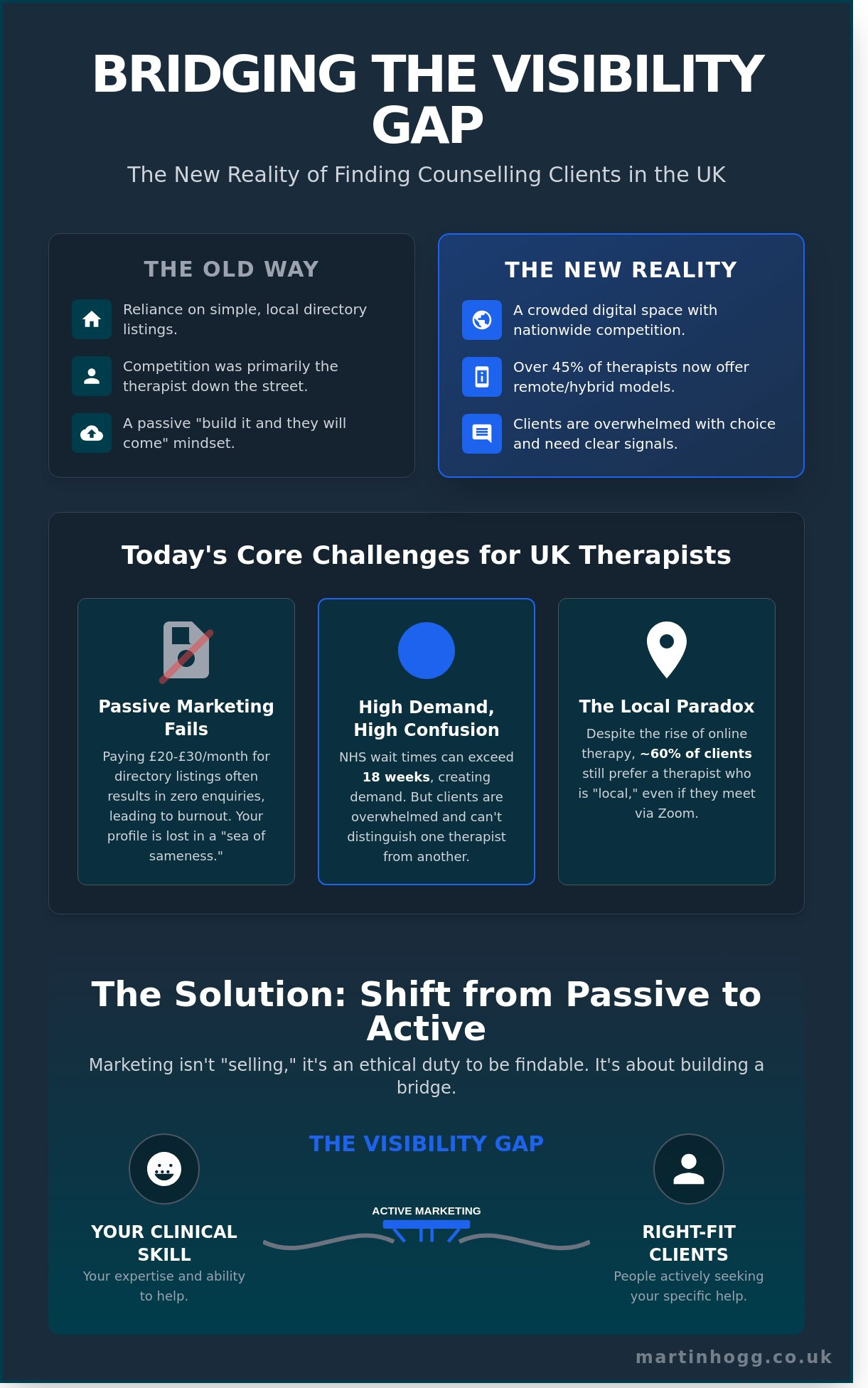
Starting a private practice used to feel much simpler. You would earn your qualification, rent a quiet room, and join a directory. The old "build it and they will come" philosophy was the standard, but that approach has become a relic of the past. Since 2020, the landscape has shifted dramatically. Industry data suggests that over 45 percent of therapists now offer a hybrid or fully remote model. This means you aren't just competing with the practitioner in your local high street; you're visible alongside thousands of others across the country. Learning how to get counselling clients uk requires a shift from being a passive observer to an active guide.
The demand for support is higher than ever. With NHS talking therapy wait times often exceeding 18 weeks in many regional trusts, more individuals are looking for private-pay options to get their lives back on track. However, these potential clients are often overwhelmed by choice. Understanding the professional context of Counselling in the United Kingdom is vital. It provides the framework for the high standards and ethical boundaries that clients expect to see before they feel safe enough to pick up the phone. If they can't see your credentials and your character clearly, they will move on to the next profile within seconds.
I often talk about the "Visibility Gap." This is the distance between your genuine clinical skill and a client’s awareness of your existence. You might be an expert in EMDR, CBT, or transactional analysis, but if your digital presence is non-existent, you remain a secret. Bridging this gap isn't about shouting the loudest; it's about being found in the right place at the right time. In a post-2020 world, your "front door" is no longer just a physical entrance in Birmingham or London. It's your website, your social media, and your directory presence.
The Problem with Passive Marketing
Many therapists pay £20 or £30 a month for a directory listing and then wonder why the enquiries don't arrive. This is passive marketing. Most directories have become a "sea of sameness" where every profile uses the same clinical jargon and stock photos of pebbles or sunsets. When you look like every other therapist, clients have no way to choose between you. This "waiting for the phone to ring" approach is a primary cause of practitioner burnout. It leaves your financial stability to chance rather than intention, which is a heavy burden to carry while supporting others.
Moving Toward an Active Growth Mindset
We need to reframe how we think about marketing. It isn't about "selling" or being pushy; it's an ethical duty to be findable for the people who need your specific help. Think of it as signposting. If you have the tools to help a man struggling with his mental health or a couple on the brink of divorce, you owe it to them to make your services visible. While the digital world is huge, your local UK community still matters. Around 60 percent of clients still prefer a therapist who is "local," even if they choose to meet via Zoom. They want to know you understand their world. Transitioning to an active mindset means taking small, practical steps every day to ensure your expertise is accessible to those in distress.
The Psychology of Visibility: Overcoming the Fear of Being Seen
I often talk to therapists who feel a genuine sense of dread at the thought of marketing. It's a common hurdle. You've spent years training to listen and hold space for others, so stepping into the spotlight feels like a betrayal of your clinical boundaries. A 2023 study by the International Journal of Behavioral Science found that 70% of high achievers experience imposter syndrome. For counsellors, this often manifests as a fear that if we promote our services, we'll be judged as "un-therapeutic" or "money-motivated" by our peers. This internal conflict is one of the biggest barriers when you're looking at how to get counselling clients uk.
Many of us worry about what our former supervisors or university tutors might think if they see us on social media. We imagine them critiquing our tone or questioning our professional distance. This anxiety is real, but it's based on an outdated idea that a therapist must be a "blank slate." In reality, clients in the UK are looking for a human being they can trust, not a cold qualification. Showing your personality isn't unprofessional; it's an essential part of the therapeutic alliance before the first session even begins. When you hide, you aren't just protecting yourself; you're making it harder for the person in pain to find the specific help they need.
Tackling the "Salesy" Stigma
Marketing doesn't have to feel like you're a "business-bro" trying to close a deal. Instead of focusing on your accolades or your 400 hours of placement, talk about the transformation your clients experience. Describe the relief of a father finally sleeping through the night or the clarity of a young professional overcoming burnout. Visibility is the bridge between a sufferer and a solution. When you frame your outreach as an act of service, the "salesy" feeling starts to evaporate. It's about being found by the people who already need you.
Building Professional Confidence
Confidence grows when you have a clear structure. If you feel overwhelmed, it's often because you're trying to be everything to everyone. Owning a niche, such as working specifically with men's mental health or anxiety in the West Midlands, allows you to speak with authority. I always suggest that you Write a business plan to ground your practice in reality rather than just hope. This document helps you see your practice as a professional entity that requires consistent, visible leadership. Use your supervision sessions to explore these business-related anxieties; a good supervisor will help you work through the counter-transference that arises when you put yourself "out there."
Start with small, manageable steps. You don't need to launch a massive campaign tomorrow. Maybe you could update your directory profile with a more conversational bio or share one helpful tip on a local community board. These micro-actions build your "visibility muscle" without triggering a full-blown stress response. If you're feeling stuck on the next step, I offer a range of practical resources for therapists that can help you find your voice without the corporate fluff. Remember, the goal isn't to be famous; it's to be reachable for the person who is currently searching for how to get counselling clients uk so they can get their life back on track.
Leveraging Specialised CPD to Attract Niche Clients
Many counsellors start their private practice journey by offering a broad range of support. It's a natural instinct to want to help everyone who reaches out. However, being a generalist often makes the process of finding new people much harder. When your marketing tries to speak to every possible struggle, it often ends up resonating with no one. In a crowded market, practitioners who specialise usually find it easier to stand out and build a sustainable practice.
There's a direct link between your clinical excellence and your business growth. When you invest in high-quality, BACP-endorsed workshops, you aren't just ticking a box for your annual requirements. You're building a "micro-niche" that defines who you are in the professional community. This clarity is a vital component of how to get counselling clients uk because it transforms you from a vague option into a specific solution. People don't usually search for "a counsellor"; they search for someone who understands exactly what they are going through right now.
Specialising in High-Demand Areas
Focusing on under-served populations is one of the most effective ways to grow. For instance, men's mental health remains a significant area of need. While 75% of UK suicides are male, men are still less likely to access traditional talking therapies. By becoming an expert in working with men, your marketing message simplifies instantly. You become the specialist who understands the unique stigmas and communication styles men often bring to the room. This focus doesn't just attract individual clients. It helps you build a referral network with local GPs and community groups who are often looking for practitioners with this specific expertise.
Integrating CPD into Your Marketing
Once you've completed a specialised course, it's essential to showcase those skills where people can see them. Don't let your certificates gather dust in a drawer. Update your website, your directory profiles, and your social media headers to reflect your new capabilities. If you've undertaken specific training, such as "Anger Management CPD," you suddenly become a person of interest for corporate HR departments or even legal professionals seeking support for court-referred clients. These avenues provide a steady stream of work that generalists often miss out on.
To see what's currently available to help you sharpen your focus, you can check the training calendar for upcoming specialised workshops. Taking action to deepen your knowledge in a specific field provides a sense of confidence that clients can feel. It moves the conversation away from abstract theory and toward practical, tangible results. When you can explain exactly how you help a person get their life back on track, the "selling" part of your business becomes much more comfortable. Here are a few ways to highlight your specialism:
- Add a dedicated page to your website for each niche you serve.
- Write short, helpful articles about the specific problems your CPD helps solve.
- Use your specialised title in your email signature and business cards.
- Reach out to local organisations that support your chosen niche and offer a brief introductory talk.
This approach isn't about excluding people. It's about being brave enough to claim your space in the profession. By narrowing your focus, you actually expand your opportunities. You'll find that how to get counselling clients uk becomes a much simpler puzzle to solve when you are known as the go-to expert for a particular struggle. It builds trust quickly, and in our profession, trust is the only currency that truly matters.
A Step-by-Step System to Organise Your Practice Growth
Building a successful private practice isn't about luck or waiting for the phone to ring. It requires a structured approach I call the Practice Visibility Blueprint. This system moves you away from the "post and pray" method toward a reliable way of being found by the people who need you most. When you're figuring out how to get counselling clients uk, you must remember that potential clients are often in a state of high distress. They aren't looking for a flashy salesperson; they're looking for a safe pair of hands. Your growth system should reflect that stability.
The foundation of this blueprint is the "Know, Like, and Trust" factor. In therapy, the relationship is the work. This process starts long before the first session. A 2023 industry report suggested that 74% of clients research a therapist's online presence before making contact. If your digital footprint is messy or non-existent, you lose that trust instantly. You also need a realistic budget. I recommend setting aside £100 to £200 per month in your first year. This covers your website hosting, professional directory memberships, and perhaps a small amount for local awareness. It's an investment in your future stability, not just a cost.
Your Website as a 24/7 Receptionist
Your website should do the heavy lifting while you're in session. To convert visitors into clients, ensure you have these five essential elements: a professional, warm headshot; your professional body logo (like BACP or UKCP); clear contact details; transparent pricing; and a direct call to action. People shouldn't have to hunt for your fees or your location. If you work in a specific area, such as Dudley or Sandwell, mention it clearly. Using local terms like "Counselling in Birmingham" helps you show up in searches without needing to be a tech wizard. Your "Work With Me" page should focus 80% on the client's struggle and 20% on your qualifications. They need to feel heard before they feel impressed.
Networking and Community Engagement
Referral networks are the lifeblood of a sustainable practice. Don't wait for GPs or solicitors to find you. Reach out to them. A simple, handwritten note or a brief introductory email to three local GP surgeries can yield results over time. I often talk about the "Citizen Coaching" approach, which is about being a visible, helpful presence in your local area. This might mean giving a free 20-minute talk at a local charity or writing a helpful piece for a community newsletter. It positions you as a pillar of the community rather than a distant clinician. To stay "top of mind" with these referrers, send a quarterly email update with a useful tip or a brief update on your current availability. It's about being helpful, not pushy.
Consistency is more important than intensity. If you commit to one networking action a week, you'll be ahead of 90% of other practitioners. This steady rhythm is how to get counselling clients uk without burning out or feeling like you're constantly "selling" yourself. You're simply making it easier for people to find the help they deserve.
If you want to move from being "the best-kept secret" to a fully booked practitioner, let's look at your specific strategy together. Work with me to build your practice growth plan today.
Scaling Your Success with the Right Support
Building a steady stream of work is a major milestone, but it often brings a new set of challenges. Most therapists I work with reach a tipping point around the two-year mark. You've mastered the basics of how to get counselling clients uk, your diary is 85% full, and suddenly you feel more tired than inspired. This is the moment to look at your model. You need to decide if you want to remain a solo practitioner or grow into a larger practice structure that involves associates or specialized niches.
Scaling isn't just about increasing your income; it's about sustainable impact. If you're seeing 22 clients a week and spending an additional six hours on admin, you're heading for a wall. In a 2023 survey of UK mental health professionals, over 40% reported symptoms of burnout. Protecting your own wellbeing is the most practical business decision you can make. It's much harder to hold space for a client's trauma when you're worried about your own mounting inbox or declining energy levels. Moving to a larger model or refining your systems allows you to reclaim your time while still providing high-quality care.
Success in this field doesn't have to be a lonely pursuit. When you shift from "doing it all" to "leading a practice," you need a different toolkit. This involves moving away from reactive marketing and towards a proactive strategy that keeps your pipeline healthy without demanding every hour of your day. You've already done the hard work of starting; now it's about making that success last for the next decade of your career.
The Power of the Private Practice Success Membership
Isolation is one of the biggest risks for UK therapists. You spend your days focused on others, but you also need a space where your own professional growth is the priority. My membership programme provides structured growth plans that move away from guesswork. We hold live training sessions twice a month to look at what's actually working in the UK market right now. Whether it's a change in how Google handles local searches or a shift in how clients use directories, we stay updated together. This community ensures you aren't trying to figure out marketing trends in a vacuum.
Investing in Bespoke Coaching
There are times when general advice isn't enough to break through a plateau. You might notice a specific bottleneck, such as a high inquiry rate that doesn't turn into bookings, or perhaps you're struggling to justify a fee increase to £70 or £80 per session. Bespoke coaching allows us to look at your specific numbers and your unique personality. We don't use "cookie-cutter" templates here. We create a strategy that fits your values, ensuring your practice feels like an extension of your therapeutic work rather than a cold business transaction. If you're ready to stop guessing and start growing with confidence, book a consultation or join the membership to take that next step in your professional journey.
Taking Your Next Step Toward a Thriving Practice
Building a sustainable practice isn't about luck or aggressive marketing. It's about being seen by the people who need you most. We've looked at how the Practice Visibility Blueprint helps you move past the anxiety of putting yourself out there. We also explored why choosing a specific niche makes you the obvious choice for your ideal client. Growing a business can feel lonely, but it doesn't have to be overwhelming.
I've spent over 20 years in the UK therapy sector and, through Citizen Coaching, I've become a BACP-endorsed workshop provider. I know the specific hurdles you face in our market. You don't need a corporate strategy; you need a practical system that respects your clinical values. Learning how to get counselling clients uk wide is a journey of small, consistent steps rather than giant leaps.
If you're ready to stop guessing and start growing, I'd love to help. You can Join the Private Practice Success Membership today and get your practice on track. You've done the hard work of training as a therapist. Now, let's make sure you have the clients to show for it.
Frequently Asked Questions
Is it ethical for a counsellor to market their services in the UK?
Marketing your practice is entirely ethical as long as you follow the BACP or UKCP Ethical Framework. Your focus should be on clear, honest communication that helps a person in distress find the right support. Think of it as a public service rather than a sales pitch. When you're truthful about your skills, you're helping someone make an informed choice about their mental health.
How much should I spend on marketing my private practice each month?
You should aim to invest between £50 and £200 per month when you're starting out. This usually covers your professional directory memberships and perhaps a small amount of targeted local advertising. As your practice grows, reinvesting 10 percent of your monthly income into your visibility is a solid rule of thumb. It keeps your waiting list healthy without breaking the bank.
Do I really need a niche, or can I stay a generalist counsellor?
You'll find it much easier to attract the right people if you focus on a specific area like anxiety, bereavement, or supporting men's mental health. While being a generalist is fine, clients often search for someone who understands their specific struggle. Having a niche doesn't mean you turn others away; it just makes your message clearer and more relatable to those who need you most.
How long does it take to see results from SEO for therapists?
It typically takes between 3 and 6 months to see a steady increase in enquiries from search engine optimisation. SEO is a long-term strategy that builds trust with Google over time. If you're wondering how to get counselling clients UK wide, focusing on your local town first usually brings results faster than trying to rank for broad, national terms.
What are the best directories for UK counsellors besides Psychology Today?
Counselling Directory and the BACP "Find a Therapist" list are the most effective alternatives to Psychology Today in the UK. Many of my colleagues also find success with the National Counselling and Psychotherapy Society (NCPS) directory or Welldoing. It's often worth testing two different platforms for 90 days to see which one generates the most genuine enquiries for your specific way of working.
Can I get clients without using social media?
You can absolutely build a full practice without ever posting on social media. Many successful therapists rely solely on a well-optimised website, professional directories, and local GP referrals. If the idea of "posting" feels draining, focus your energy on networking with local charities or health centres instead. These face-to-face connections often result in more committed clients than a "like" on a screen.
How do I handle the "business" side if I’m not a "techy" person?
You don't need to be a tech expert to run a successful practice; you just need a few simple, reliable tools. Start with a basic website builder and a secure, GDPR-compliant email service. I often suggest focusing on one thing at a time, like your directory profile, before moving on to anything more complex. If a task feels overwhelming, it's usually a sign that the system is too complicated, not that you aren't capable.
What is the most effective way to get private-pay clients quickly?
The fastest way to secure private-pay clients is usually through a combination of a high-quality directory profile and Google Ads. While SEO takes time, a well-placed advert can put you in front of someone searching for help today. Learning how to get counselling clients UK based means understanding that paid visibility can bridge the gap while your organic reputation grows. Just ensure your contact process is as simple as possible.


