
How to Get Counselling Clients: UK Therapist Guide

Article by
Martin Hogg
I help Private Practice counsellors in the UK set up and grow an ethical Private Practice they love, work with their ideal clients, and earn the income they deserve. All without guesswork and burnout. I have been a private practice counsellor myself for over 20 years, specialising in anger management. I set up a not-for-profit social enterprise, Citizen Coaching and Counselling, which delivers thousands of counselling sessions a year to adults and young people in Birmingham. I am a registered BACP Counsellor and the author of three books, My Anger Coach, My Anxiety Coach and My Relationship Coach. These are available on Amazon.
What if the reason your diary is empty has nothing to do with your clinical skills and everything to do with being invisible? I've spoken to hundreds of talented therapists who feel that same knot of anxiety when looking at a week of blank spaces. You want to help people, yet you're stuck wondering how to get counselling clients without sounding like a pushy salesperson or getting lost in the technical weeds of SEO. It's a common struggle, and honestly, it's one you don't have to face alone.
I'm going to show you exactly how to move from an invisible practice to a steady stream of enquiries using my Practice Visibility Blueprint. We'll swap the "salesy" fear for a simple, repeatable system that actually feels human. I'll walk you through the practical steps of using tools like the Counselling Directory and making your website work for you, even if you aren't a tech person. We're aiming for a full diary of private-pay clients and the professional confidence you deserve.
Key Takeaways
- Stop relying on unpredictable word-of-mouth and start showing up where proactive clients are searching for help right now.
- Discover how to get counselling clients using the Practice Visibility Blueprint, starting with a simple one-page site that gets the phone ringing.
- Use a clear "one-sentence offer" to help you stand out from the crowd on directories like Psychology Today and the Counselling Directory.
- Focus on being human rather than clinical, because "rough and ready" content that shows your personality builds far more trust than a polished corporate facade.
The Referral Trap: Why Waiting Isn’t a Strategy in 2026
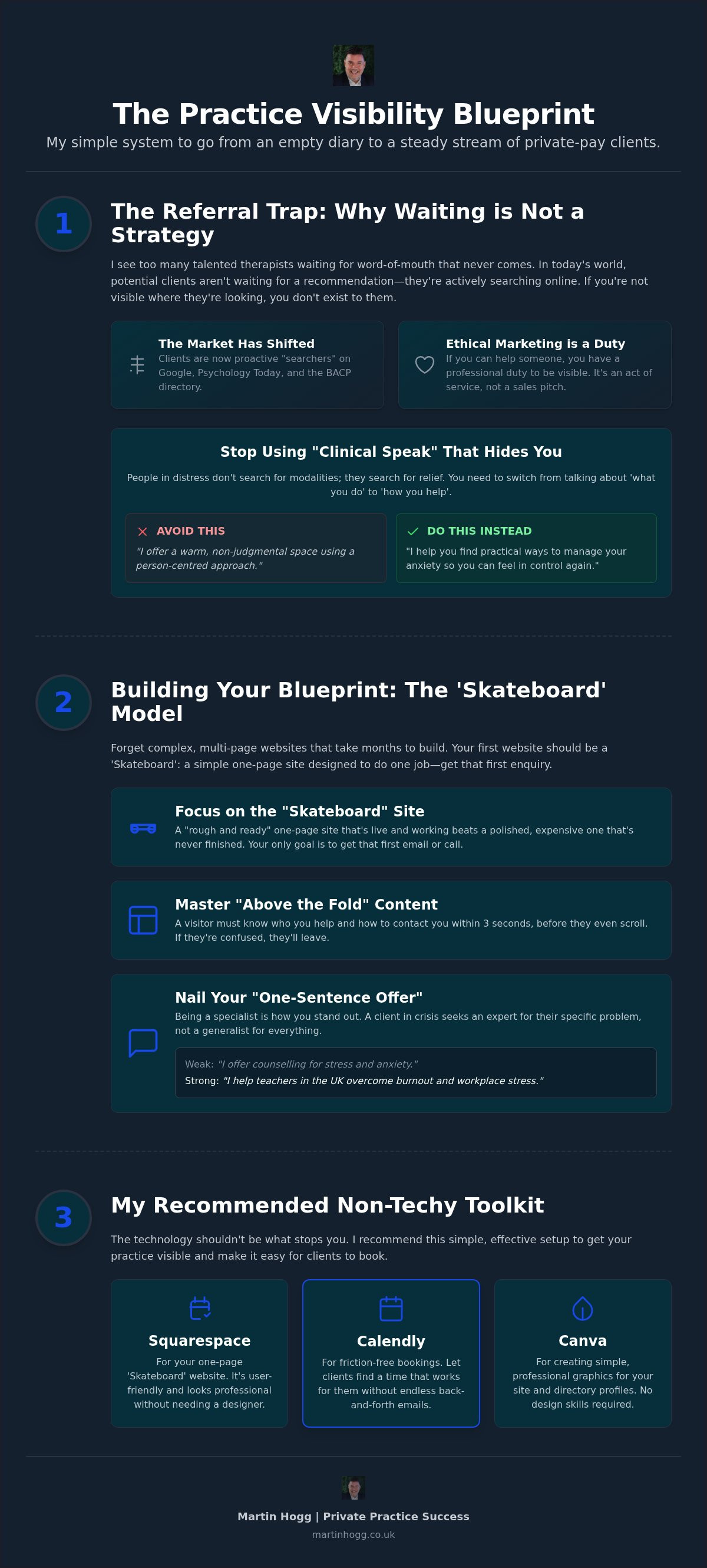
I've met so many gifted counsellors who believe that being a great therapist is enough to fill a diary. They wait for word-of-mouth referrals that, quite frankly, never arrive. In 2026, the UK therapy market looks very different. Potential clients are no longer waiting for a GP referral or a whisper from a friend; they are proactive "searchers" on Google and directories like the BACP or Psychology Today. If you aren't visible there, you simply don't exist to them.
Relying on clinical excellence alone won't keep your lights on. While understanding psychotherapy and its various modalities is essential for the work, it doesn't help with the "business" of being found. You need to know how to get counselling clients by meeting them where they are. If you want to move beyond the struggle, looking at Starting and Growing a Private Practice as a structured journey is the best way to begin.
The Problem with "Clinical Speak"
Most therapist websites are full of academic jargon. Using phrases like "warm, non-judgmental space" or "person-centred approach" has become a cliché that actually loses you clients. People in distress don't search for modalities; they search for relief. Learning how to get counselling clients effectively means moving from "what I do" to "how I help you" to truly connect with someone's struggle.
The Ethical Marketing Mindset
I believe that if you have the skills to help someone, you have a professional duty to be visible. Marketing isn't about being "salesy" or pushy. It's an act of service. By providing a clear, grounded path to your door, you're helping a person in pain find the right support. Overcoming the fear of visibility starts with focusing on the client’s need for clarity rather than your own discomfort.
Building Your Practice Visibility Blueprint: The Skateboard Model
I always recommend starting with what I call the "Skateboard Model". Think of it as a one-page site that works immediately rather than a complex twenty-page brochure that takes months to build. Your website's job is to do one thing: get that first email or call. I've seen too many therapists spend thousands on polished sites that never launch because of perfectionism. I promise you that "rough and ready" content beats a polished, expensive site every time.
The "Above the Fold" rule is vital here. This is the content people see before they even start scrolling. If a visitor can't tell who you help and how to contact you within three seconds, they'll leave. Just as an official government business plan guide helps you structure your finances, this blueprint structures your visibility so you can stop being the best-kept secret in your town.
SEO Basics for the Non-Techy Therapist
You don't need to be a coder to understand how to get counselling clients through Google. Focus on your title tags and description tags; these are the snippets people see in search results. Use Canva to create professional visuals without needing a designer. Most importantly, your "About Me" page should actually be about the client. They want to know you understand their pain, not just where you got your diploma.
The Technical Toolkit
When you are learning how to get counselling clients, the tech shouldn't be the thing that stops you. My preferred setup is Squarespace for the site, Calendly for bookings, and Canva for graphics. This combination makes it incredibly easy for clients to take that first step without any friction. If you want to see these systems in action, come and join our Private Practice Success community where we build these foundations together.
Mastering the One-Sentence Offer and UK Directories
The "One-Sentence Offer" is the backbone of your practice. If you can't explain what you do in ten words, you'll struggle to sell it. I often see therapists falling into the "generalist" trap; they fear that narrowing their focus will limit their income. In reality, being a specialist is exactly how to get counselling clients in a crowded market. When someone is in crisis, they don't look for a generic therapist. They look for someone who understands their specific pain.
Crafting Your Niche
Narrowing your focus allows you to speak directly to the pain points of your ideal client. Whether you're working with burnout or relationship issues, your messaging needs to be sharp. I suggest using my Niche Building Secrets to move away from being a "jack of all trades." A strong niche in the UK market might look like "I help mid-career professionals manage high-functioning anxiety," whereas "I offer counselling for everyone" is weak and forgettable.
Optimising Directory Profiles
Platforms like Psychology Today and the Counselling Directory are the high streets of our industry. You have about three seconds to grab attention. Your first sentence shouldn't be your name or your qualifications. It should be a reflection of the client's problem. Interestingly, your directory photo is about 70% of the decision-making process. People connect with people, so a warm, approachable headshot is essential.
To really stand out, you should look at various ways to Promote Your Counselling Practice beyond just the basics. I recommend A/B testing your profile. Change your opening line for a month and see if your enquiries increase. Keep your profile updated regularly, as most directories reward active members with better search rankings.
Turning Visibility into Enquiries: The Human Connection
Visibility gets them to the door, but your humanity gets them into the room. I've always advocated for a "people connect with people" approach rather than hiding behind a wall of corporate professionalism. When someone reaches out, they're often at their most vulnerable. They don't want a clinical response; they want to know a real person is on the other end of the line.
Handling that first enquiry is where many therapists stumble. You need to respond quickly and effectively. If you leave it two days, they've already moved on to the next person on the list. I use the Counsellor Efficiency Bundle to manage the heavy lifting of admin. It lets you focus on the therapy while the system handles the boring bits.
Rough and Ready Content Strategy
Stop worrying about writing the "perfect" blog post. It doesn't exist. Instead, start being useful. Use simple videos or short posts to show your face and voice. This builds trust before the first session even happens. Being a "real person" in a clinical world is a superpower. It's a key part of learning how to get counselling clients who actually want to work with you.
Next Steps for Your Practice
Consistency is the only real "secret" to how to get counselling clients. You can't just do this for a week and expect a full diary. It takes a bit of time and a lot of showing up. If you want ongoing support and a community that gets it, come and join the Private Practice Success Membership. We'll help you build a sustainable, profitable practice you actually love. You've got the skills; now let's make sure people can find you.
Taking the First Step Toward a Full Diary
Moving from an invisible practice to a steady stream of enquiries doesn't require a marketing degree. It requires a shift in mindset. We've looked at why waiting for referrals is a trap and how a simple "Skateboard Model" website can start working for you today. By refining your one-sentence offer and showing your human side on directories, you'll finally understand how to get counselling clients who truly value your expertise.
I've spent over 20 years in the UK therapy sector building practical, no-fluff business strategies. As a BACP-endorsed training provider, I know that the most successful therapists are the ones who stop overthinking and start doing. You don't need to be perfect; you just need to be findable.
You have the clinical skills to change lives. Now it's time to build the visibility that allows you to do that work consistently. I'm here to help you turn those blank diary slots into a thriving practice you're proud of.
Common Questions About Growing Your Practice
How long does it take to get my first private counselling client in the UK?
You can usually expect your first enquiry within 4 to 12 weeks of launching a focused visibility strategy. It depends on how quickly you set up your BACP directory profile and whether you've defined a clear niche. Using a structured system like the Practice Visibility Blueprint helps remove the guesswork, making it much easier to understand how to get counselling clients without waiting months for word-of-mouth.
Do I really need a website to get therapy clients, or is a directory enough?
A directory listing is a brilliant starting point, but a website is what builds real trust. Think of a directory as a busy high street and your website as your own private consultation space. A simple, one-page "skateboard model" site allows you to show your personality and explain how you work. This human connection is often what tips a person from just browsing to actually booking a session.
Which directory is best for UK counsellors: Psychology Today or Counselling Directory?
Both platforms are highly effective, and I often recommend being on both eventually. Psychology Today has a massive global reach and excellent search filters, while the Counselling Directory is a trusted UK staple. Rather than worrying about which is "best," focus on writing a compelling profile that speaks to a specific pain point. A well-written profile on either site will outperform a generic one on both.
How much should I spend on marketing my private practice each month?
Most solo practitioners can manage a successful marketing strategy for under £100 a month. This budget typically covers one or two directory listings and your basic website hosting fees. You don't need to spend a fortune to learn how to get counselling clients consistently. Investing your time in creating useful, "rough and ready" content is often more effective than throwing money at expensive, polished campaigns that lack a personal touch.
What is a "one-sentence offer" and why do therapists need one?
A one-sentence offer is a clear, jargon-free statement that tells a potential client exactly how you can help them. It usually follows a simple structure: "I help [specific group] with [specific problem]." You need one because it makes you instantly relatable. When a person is in distress, they aren't looking for a list of your diplomas; they are looking for someone who understands their struggle.
Disclaimer
The information provided on this blog is for general informational purposes only. It is also not intended to be a substitute for professional medical or mental health advice, diagnosis, or treatment. Reading this content does not create a therapist-client relationship.


