
How to Get More Counselling Clients: A Practical UK Checklist for 2026

Article by
Martin Hogg
I help Private Practice counsellors in the UK set up and grow an ethical Private Practice they love, work with their ideal clients, and earn the income they deserve. All without guesswork and burnout. I have been a private practice counsellor myself for over 20 years, specialising in anger management. I set up a not-for-profit social enterprise, Citizen Coaching and Counselling, which delivers thousands of counselling sessions a year to adults and young people in Birmingham. I am a registered BACP Counsellor and the author of three books, My Anger Coach, My Anxiety Coach and My Relationship Coach. These are available on Amazon.
Did you know that over 60% of therapy enquiries in the UK now result in a booking with the first practitioner who responds within four hours? In the busy landscape of 2026, being a brilliant therapist isn't enough if the people who need you most simply can't find you. If you are wondering how to get more counselling clients without feeling like a pushy salesperson, you aren't alone. It's common to feel a genuine ethical discomfort with "selling" your services, especially when the technical side of building a website feels like a mountain you aren't ready to climb.
I understand that tension. This guide provides a straight-talking, step-by-step checklist to increase your professional visibility by focusing on human connection rather than gimmicks. We will explore how to master the "skateboard" website model, navigate the post-SCoPEd directory landscape, and create a simple marketing routine that fits into your week. You can move from feeling invisible to building a steady stream of right-fit clients who truly value your support, all while staying rooted in your clinical integrity and professional purpose.
Key Takeaways
- Define your "one-sentence offer" to move away from being an invisible generalist and start speaking directly to the specific problems your ideal clients are facing.
- Prioritise a "skateboard" website model that focuses on a single, clear call-to-action rather than getting stuck in the over-complication of a multi-page site.
- Discover how to get more counselling clients by auditing your directory profiles to remove overused clichés and highlight your unique professional niche.
- Build a sustainable weekly visibility routine that fosters genuine connections with referrers and ensures a steady flow of enquiries without feeling like a salesperson.
Your Foundation Checklist: Clarity and the One-Sentence Offer
Many therapists believe that casting a wide net is the best way to fill a diary. In reality, being a generalist in the UK market is the fastest way to stay invisible. When potential clients search for help, they aren't looking for a "jack of all trades." They are looking for someone who understands their specific pain. Understanding how to get more counselling clients starts with a fundamental mindset shift; marketing isn't about being pushy, it's an ethical duty to help the right people find you. If they can't find you, they can't get the support they need.
Finding Your Profitable Niche
You need to identify the demographics you actually enjoy working with. Whether it's "men in sheds" or parents of neurodivergent children, specificity creates an immediate connection. You can explore how to narrow your focus with Martin Hogg’s Niche Building Secrets. Before committing, check if people are actually searching for these terms in your area or online. Aim for a niche that feels both authentic to your experience and active in the market. Learning how to get more counselling clients requires you to stop listing modalities and start listing outcomes.
The Problem-Solution Framework
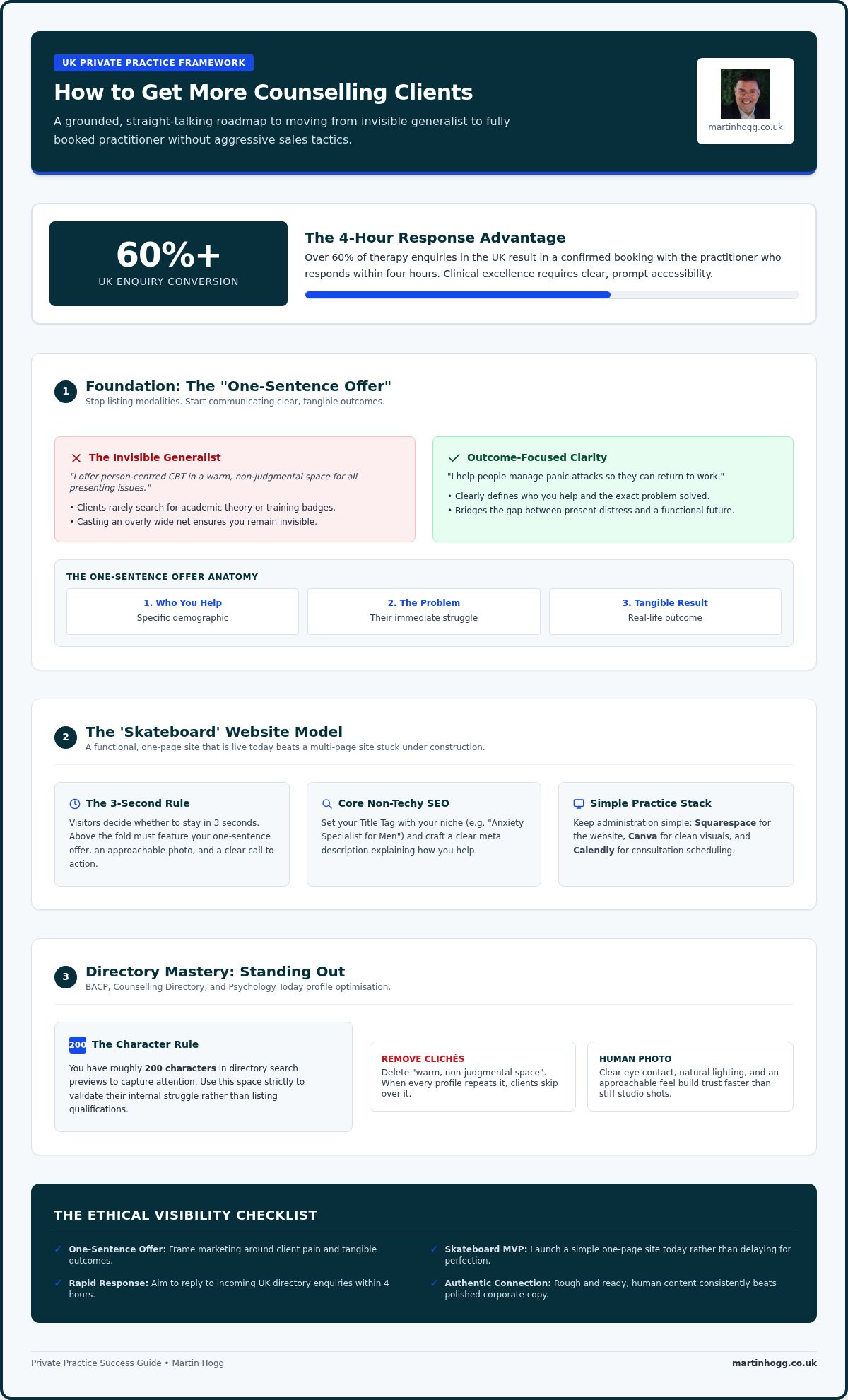
Your clients rarely care about your therapeutic modality. While the British Association for Counselling and Psychotherapy (BACP) ensures we are trained in specific frameworks, your marketing should speak plain English. Move away from "I offer CBT" and try "I help people manage panic attacks so they can return to work." This is your one-sentence offer. It identifies who you help, the problem you solve, and the tangible result they get. Use active language that bridges the gap between their current distress and a more functional, fulfilling future.
The 'Skateboard' Website: A Visibility Checklist
Many therapists get stuck in tech overwhelm, trying to build a complex multi-page website that stays "under construction" for months. When considering how to get more counselling clients, a simple, one-page "skateboard" site that is live today beats a perfect site that doesn't exist. This rough-and-ready approach focuses on the bare essentials needed to start helping people. It's about being functional and findable, not perfect.
The 3-Second Rule for Therapist Sites
Visitors decide whether to stay on your page within three seconds. They aren't looking for your degree certificates first; they're looking for hope. Your "above the fold" area, the part seen without scrolling, needs your one-sentence offer and a clear "Book a Call" button. Use a photo that looks professional but approachable. Avoid stiff, clinical shots. Instead, aim for a look that suggests a safe, private conversation. Potential clients often follow the NHS guide to counselling recommendations to find registered professionals, so ensure your accreditation is visible but secondary to your message of help.
SEO Basics for the Non-Techy
You don't need to be a developer to improve your visibility. Focus on these simple steps:
- Write a title tag that includes your niche, such as "Anxiety Specialist for Men."
- Create a meta description that briefly explains how you help.
- Place a clear Call to Action (CTA) in every section of the page.
Tools like Squarespace for your site, Canva for graphics, and Calendly for bookings make the process manageable. If you feel stuck on the technical details, joining the Private Practice Success Membership offers a supportive environment to help you launch with confidence. By prioritising action over perfection, you ensure that people searching for how to get more counselling clients find a practitioner who is ready and available to help.
Directory Mastery: Standing Out in a Sea of Sameness
Most directory profiles look identical. If you want to understand how to get more counselling clients, you must stop blending in. The "First Paragraph" rule is vital; you have roughly 200 characters to capture attention in the search results. Lead with the client's internal struggle, not your degree. Delete phrases like "warm, non-judgmental space" immediately. These are clichés that potential clients skip over because every profile says the same thing. Use that space to validate their specific experience instead.
Your photo acts as your first handshake. Ensure you have clear eye contact and natural lighting. A "human" feel builds trust faster than a stiff, clinical headshot. The BACP Private Practice division provides excellent resources on maintaining professional standards while presenting an approachable image. When your profile feels like a real person talking to another real person, the barrier to reaching out drops significantly.
Optimization Tips for Psychology Today
Ticking every "Area of Expertise" tag makes you look like a generalist. Select only the tags that align with your specific niche to show you truly understand those issues. A short, "rough and ready" video introduction can be a game-changer for your visibility. It allows a nervous client to hear your voice and see your mannerisms before they book. This builds massive trust in a way that text alone cannot, making it a key part of how to get more counselling clients in a competitive market.
Tracking Your Enquiries
Don't just pay your monthly fees and hope for the best. Track every enquiry by asking new clients exactly where they found you. This helps you see which directories are actually sending "private pay" clients your way. If a directory isn't performing after six months, cull it. Reinvest those funds into your own site or specialised training to further refine your niche.
The Weekly Visibility Routine: Keeping the Pipeline Full
Building a thriving practice requires more than a one-off effort; it demands a steady, unhurried rhythm. Many therapists feel overwhelmed by the idea of "marketing," but the secret to how to get more counselling clients lies in small, manageable actions. Instead of a daunting "marketing day," focus on a weekly consistency checklist. This might include updating one directory profile, reaching out to a professional contact, or sharing a helpful tip on social media. These tiny steps prevent the "feast or famine" cycle that often plagues private practice.
Building a Referral Network
Networking doesn't have to mean awkward room-mingling. For introverted practitioners, building a referral network is about offering value first. Look beyond other counsellors to professionals like physiotherapists, HR managers, or local charities. You might say, "I've created a simple guide on managing workplace stress; would your team find it useful?" This positions you as a helpful guide rather than a salesperson. To help manage these connections without the stress, the Counsellor Efficiency Bundle provides the tools you need to stay organised.
The 15-Minute Marketing Habit
You don't need polished, academic articles to be visible. One "rough and ready" post about a common client struggle is worth ten clinical papers. People connect with your humanity and your ability to understand their pain. Dedicate just 15 minutes a day to intentional visibility work. This habit ensures you stay top-of-mind for potential referrers and clients alike. If you're looking for a deeper dive into sustainable growth strategies, see our guide on marketing for therapists in the UK. By staying consistent, you'll find that how to get more counselling clients becomes a natural outcome of your professional presence.
Taking Your Next Steps Toward a Thriving Practice
Building a sustainable private practice doesn't require complex marketing degrees or expensive agencies. By refining your one-sentence offer and launching a simple "skateboard" website, you remove the barriers that keep you invisible to those in distress. You now have a practical framework for how to get more counselling clients through intentional, 15-minute daily habits rather than overwhelming "hustle" culture. This grounded approach ensures your clinical integrity remains front and centre while your diary begins to fill with right-fit enquiries.
With over 20 years of experience in the UK private practice landscape, I provide BACP-endorsed training and jargon-free business coaching designed for therapists who value human connection over sales tactics. You don't have to navigate these professional hurdles alone. There is a community of practitioners ready to support your growth and help you restore your personal trajectory toward a fulfilling career.
Your expertise is needed now more than ever. Take that first small step today, and trust that your visibility is the bridge to someone else's transformation.
Frequently Asked Questions
Do I really need a website to get counselling clients in the UK?
A website is essential for building trust, but it doesn't have to be a complex project. A simple "skateboard" site allows you to be findable while you develop your practice. It acts as a digital home where you control the narrative, unlike directory profiles. This professional presence helps you stand out and provides a clear place for potential clients to book a call without navigating through a sea of competitors.
How long does it typically take to get your first private practice client?
Most therapists see their first private client within four to eight weeks if they focus on active visibility. If you rely solely on word-of-mouth, it can take much longer. By optimising your directory profiles and launching a basic website immediately, you significantly shorten this lead time. Consistency in your weekly routine is the key to ensuring that initial enquiry turns into a steady stream of bookings for your new practice.
Is Psychology Today worth the monthly fee for UK therapists?
Psychology Today is often worth the £19.95 monthly fee because it is one of the most visited therapist directories in the UK. Many practitioners find that just one client booking per month covers the cost multiple times over. However, it only works if you avoid clichés and use a niche-focused bio. Without a clear "one-sentence offer," your profile may remain buried regardless of the subscription fee you pay.
How can I get more private pay clients instead of relying on EAPs?
To attract more private pay clients, you must shift your marketing from listing modalities to solving specific problems. People are more willing to pay privately when they feel a therapist truly understands their unique pain. Using niche-building strategies is a proven way for how to get more counselling clients who value your expertise over a generic EAP referral. This approach builds a practice based on "right-fit" clients rather than volume alone.
What is the most effective way for a new counsellor to get clients quickly?
The quickest way is to combine an optimised directory profile with a clear, result-oriented message. Stop trying to help everyone and focus on one specific demographic. When you speak directly to a person's struggle, you build immediate trust. Learning how to get more counselling clients quickly often involves refining your "one-sentence offer" so that a visitor knows exactly how you can help them within seconds of landing on your page.
Disclaimer
The information provided on this blog is for general informational purposes only. It is also not intended to be a substitute for professional medical or mental health advice, diagnosis, or treatment. Reading this content does not create a therapist-client relationship.


