
How to Get Therapy Clients: A Practical UK Guide to Growing Your Practice

Article by
Martin Hogg
I help Private Practice counsellors in the UK set up and grow an ethical Private Practice they love, work with their ideal clients, and earn the income they deserve. All without guesswork and burnout. I have been a private practice counsellor myself for over 20 years, specialising in anger management. I set up a not-for-profit social enterprise, Citizen Coaching and Counselling, which delivers thousands of counselling sessions a year to adults and young people in Birmingham. I am a registered BACP Counsellor and the author of three books, My Anger Coach, My Anxiety Coach and My Relationship Coach. These are available on Amazon.
Marketing isn't a dirty word. In fact, if you're a brilliant counsellor but nobody knows you exist, you're actually doing a disservice to the people who need your help. I talk to so many therapists who feel completely invisible on Psychology Today or spend hours worrying about what to post on Instagram. You probably didn't spend years training just to become a part-time social media manager. If you're wondering how to get therapy clients without feeling like a pushy salesperson, you're in the right place.
I agree that the traditional 'salesy' approach feels wrong for our profession. You want a full diary of private-pay clients, but you want to get there ethically. I'll show you how to build a simple system that brings a steady stream of the right people to your door. We'll move past the fear of visibility and look at practical tools like the 'skateboard' website model. I'll help you stop wasting money on over-complicated tech and start building a practice that feels as good as the work you do in the room.
Key Takeaways
- Stop sitting by a silent phone and learn why shifting from passive waiting to active visibility is the only way to protect your practice.
- Forget the expensive "Ferrari" websites; I'll show you how a one-page "skateboard" site gets the job done much faster.
- Stand out on directories like Psychology Today and learn how to get therapy clients by ditching the clichés and writing titles that actually stop the scroll.
- Build a repeatable system for growth using the Practice Visibility Blueprint to ensure a steady stream of the right enquiries.
Why 'Waiting for Referrals' is a Risky Strategy for Your Practice
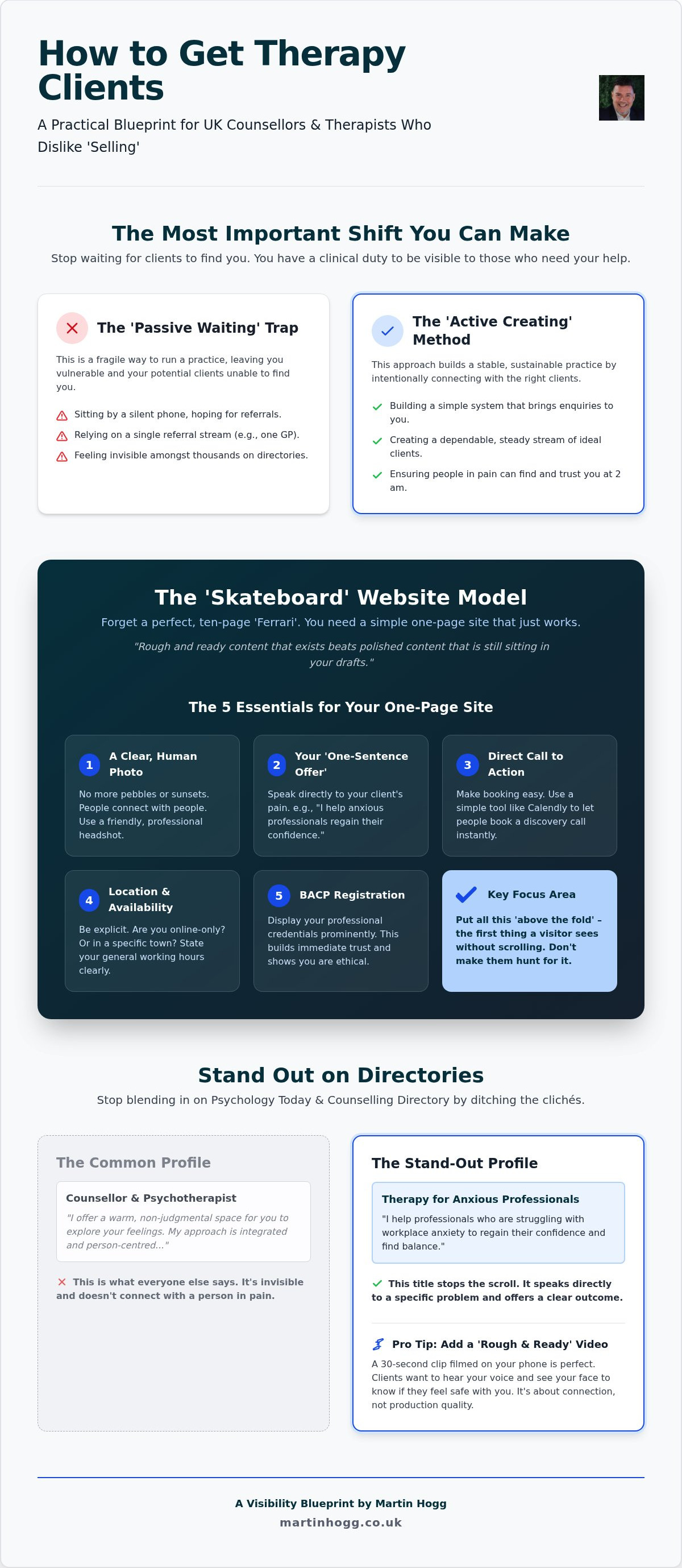
I see so many talented counsellors sitting by a silent phone, hoping the BACP directory or a single local GP will do all the heavy lifting. It's a common trap. You've put in the years of training to provide Psychotherapy, but now you're stuck in 'passive' mode. This makes your practice incredibly fragile. If that one referral stream dries up or a directory algorithm changes, your income can vanish overnight. You deserve more stability than that.
There's a massive difference between 'passive' responding and 'active' creating. When you're active, you're intentional about how to get therapy clients who are the right fit for your skills. If you aren't visible, the person in pain simply cannot find you. When someone is struggling at 2 am and searches for help, they need to see a real human being they can trust. If you're hidden away, you're unintentionally denying them the support they need. I view visibility as a clinical duty, not just a business one.
The Ethical Dilemma of 'Selling' Therapy
Many therapists I coach feel 'icky' about the idea of 'selling.' We've been taught to be humble. But people don't connect with a dry list of clinical qualifications or tired clichés. They connect with people. Your marketing is just a bridge. It's a way to guide someone from their current state of overwhelm into the safety of your room. In my Private Practice Success Membership, we focus on making this process feel natural rather than forced. It's about being helpful before they've even booked.
The Skateboard Model: Building Your Minimum Viable Presence
I often see counsellors get stuck in 'website procrastination'. They think they need a perfect, ten-page digital masterpiece before they can start seeing people. I advocate for the 'skateboard model' instead. A skateboard is simple, but it gets you from A to B. You don't need a Ferrari; you need a one-page site that works. This lean approach is the fastest way to figure out how to get therapy clients without getting bogged down in technical jargon or expensive developers.
The most valuable real estate you own is 'above the fold'. This is the space on the screen people see before they even think about scrolling. If a visitor has to hunt for your contact details or guess what you actually do, they'll click away in seconds. You can build a professional presence in a single weekend using simple tools like Squarespace or Canva. It doesn't have to be a work of art. In my Private Practice Success Membership, we lean into the philosophy that 'rough and ready' content that exists beats 'polished' content that is still sitting in your drafts. When you look into digital marketing for therapists, remember that simplicity is your greatest ally.
The 5 Essentials for Your Skateboard Site
To make your one-page site effective, focus on these five pillars:
- A clear, human photo: Please, no more pictures of pebbles, sunsets, or empty chairs. People connect with people. Use a friendly, professional headshot.
- Your 'One-Sentence Offer': This should speak directly to your client's pain. For example, 'I help anxious professionals regain their confidence in the workplace.'
- A direct call to action: Use a tool like Calendly to let people book a discovery call immediately. Reducing friction is key to booking.
- Your location and availability: Be clear if you are online-only or have a room in a specific town.
- BACP Registration: Displaying your professional credentials builds immediate trust and meets ethical guidelines.
Optimising Your Directory Profiles (Psychology Today & Counselling Directory)
Most directory profiles are a sea of sameness. If I see one more counsellor claim to offer a 'warm, non-judgmental space,' I might actually scream. While those traits are essential, they don't help a client choose you over the fifty other people saying the exact same thing. To understand how to get therapy clients from these platforms, you must stop writing for your peers and start writing for the person in distress. Your title and description tags are the only things that stop the scroll; they need to be punchy and problem-focused.
I also recommend a 'rough and ready' profile video. A 30-second clip filmed on your phone is infinitely better than a polished, corporate production. Clients want to hear your voice and see your face to check if they feel safe with you. It’s about human connection, not cinematic excellence. Just ensure you follow the BACP membership promotion guidelines to keep things professional and ethical.
Crafting Your One-Sentence Offer
Being a generalist is the hardest way to grow a practice in the UK. When you try to help everyone, you end up helping no one because your message is too diluted. Use a simple formula: 'I help [niche] to [outcome] so they can [benefit].' This clarity makes it easy for a client to say, 'That’s for me.' If you’re struggling to narrow it down, my guide on niche-building secrets will help you find your focus.
Directory 'Hacks' That Actually Work
Directories often use 'last updated' filters. I suggest logging in once a week just to tweak a sentence or change a photo. This small action keeps you near the top of the search results. Also, think about the keywords clients actually type into Google, like 'anxiety help Birmingham' or 'work stress counselling,' rather than academic terms they’ve never heard of.
Building a Sustainable Referral Engine with the Practice Visibility Blueprint
Marketing shouldn't be something you do only when your diary is empty. That leads to panic and 'salesy' desperation. Instead, think of it as a consistent pulse in your business. I developed the Practice Visibility Blueprint to help therapists move away from the 'feast or famine' cycle. It's about shifting your mindset from being just a solo practitioner to becoming a business owner with a reliable system. When you have a system, you stop worrying about how to get therapy clients and start focusing on the work you love.
Building a referral network with other professionals like GPs, solicitors, or fellow therapists doesn't have to feel forced. It's simply about being a known, helpful presence in your local community. If you're clear about who you help, people will naturally think of you when a relevant case crosses their desk. For a broader look at setting up your foundations, check out my guide on starting-and-growing-a-private-practice.
Niche Building as a Growth Accelerator
I'm a firm believer that having a specific focus, like 'Working with Men' or 'Anger Management', makes you the obvious choice over a generalist. It positions you as the expert who truly 'gets' the problem. Once you've narrowed your focus, you'll likely see a sudden influx of interest. I recommend the counsellor-efficiency-bundle to help you manage those new enquiries without getting buried in admin.
Your Next Steps for Practice Growth
Private practice can be an isolating journey. The lack of a water cooler or a team to bounce ideas off can lead to self-doubt and stagnation. That's why the Private Practice Success Membership is such a vital antidote to that loneliness. It's a community of peers who understand the specific nuances of the UK therapy market. Don't let overwhelm stop you. Pick just one 'skateboard' action from this article and commit to finishing it today.
Take the First Step Toward a Full Diary
Growing a practice doesn't have to feel like a second full-time job. We've looked at why sitting by a silent phone is too risky and how the 'skateboard' model can get you online in a single weekend. By ditching the clichés on your directory profiles and focusing on a clear, one-sentence offer, you make it easy for the right people to find you. I've spent over 20 years in the UK therapy sector; I know the most successful counsellors are those who treat their visibility as a clinical duty.
You don't have to figure out how to get therapy clients on your own. Through my BACP-endorsed workshops and the Practice Visibility Blueprint, I've helped hundreds of therapists build ethical systems that work. It's about moving past the fear of 'selling' and simply becoming findable for those in pain. You've done the hard work of training. Now it's time to let the world know you're here.
I'm here to guide you through it. Pick one small action today and watch how it shifts your practice's momentum.
Frequently Asked Questions
Do I really need a website to get therapy clients in the UK?
Yes, you absolutely need an owned presence to stand out. Relying solely on directories means you're just another profile in a sea of sameness. A simple one-page site, or what I call the 'skateboard model', gives you a home where you can control the narrative. It builds trust before the first enquiry even arrives. You don't need a complex site; you just need to be findable on your own terms.
How much should I spend on marketing my private practice?
You don't need a massive budget to start. In fact, I'd suggest keeping your wallet closed when it comes to fancy branding or 'clever' logos. Focus your spending on high-impact areas like a basic Squarespace subscription or your BACP and directory fees. Most of your growth will come from consistency rather than throwing thousands at ads. Focus on low-cost visibility first and only scale your spending when you have a system that converts.
Is Psychology Today worth the monthly fee for UK therapists?
For most UK therapists, the £19.95 monthly fee for Psychology Today is a solid investment. It is often the first place people look. However, it's only worth it if you actually put the work in. If your profile is full of therapist clichés, you're wasting your money. Update it weekly and use a clear, human photo. If it brings in just one private client, the fee pays for itself many times over.
How do I get private pay clients without relying on EAPs or insurance?
The key to how to get therapy clients who pay full price is building a direct bridge between you and the person in pain. You need to niche down so you become the obvious specialist for their specific struggle. When you stop being a generalist, you stop being a commodity. By using a structured system, you can create a repeatable flow that bypasses the low rates and admin headaches of EAP work entirely.
What is the fastest way to get my first 5 therapy clients?
The fastest way is to combine a professional directory presence with direct outreach to your existing network. Tell everyone you know exactly who you help. Don't wait for a perfect website; get your one-page 'skateboard' site live this weekend using Canva or Squarespace. Combine this with an optimised Counselling Directory profile. Being proactive and clear about your niche is always faster than waiting for the phone to ring on its own.
Disclaimer
The information provided on this blog is for general informational purposes only. It is also not intended to be a substitute for professional medical or mental health advice, diagnosis, or treatment. Reading this content does not create a therapist-client relationship.


