
How to Get Therapy Reviews: The Ethical UK Guide

Article by
Martin Hogg
I help Private Practice counsellors in the UK set up and grow an ethical Private Practice they love, work with their ideal clients, and earn the income they deserve. All without guesswork and burnout. I have been a private practice counsellor myself for over 20 years, specialising in anger management. I set up a not-for-profit social enterprise, Citizen Coaching and Counselling, which delivers thousands of counselling sessions a year to adults and young people in Birmingham. I am a registered BACP Counsellor and the author of three books, My Anger Coach, My Anxiety Coach and My Relationship Coach. These are available on Amazon.
Did you know that 84% of patients now check online reviews before they even consider booking an appointment? It's a staggering figure that often leaves UK counsellors feeling caught between a rock and a hard place. You want to help more people, and you know that visibility matters, but the thought of asking a vulnerable client for a "five-star rating" feels deeply uncomfortable. I understand that hesitation because your primary duty is to the therapeutic relationship, not a marketing algorithm. You're likely wondering how to get reviews for your therapy practice without crossing professional boundaries or losing sleep over your ethical standing.
The good news is that building social proof doesn't have to feel salesy. With the BACP Ethical Framework 2026 moving toward a principles-based approach, there's a clear, respectful way to manage your digital reputation. In this guide, I'll show you how to create a passive feedback system that satisfies both Google and your conscience. We'll explore the nuances of the new framework, how to handle your Google Business Profile, and why peer endorsements are often your most powerful tool for growth.
Key Takeaways
- Understand the BACP 2026 Ethical Framework updates and how a principles-based approach allows you to gather feedback without compromising the therapeutic relationship.
- Learn how to get reviews for your therapy practice using a passive system that invites feedback without putting pressure on your current clients.
- Discover the power of professional peer endorsements as a high-integrity alternative to client testimonials for building specialist authority.
- Build a simple, one-page feedback policy using the "Skateboard Model" to manage your online reputation with confidence and clarity.
The Ethical Dilemma: Can UK Therapists Ask for Reviews?
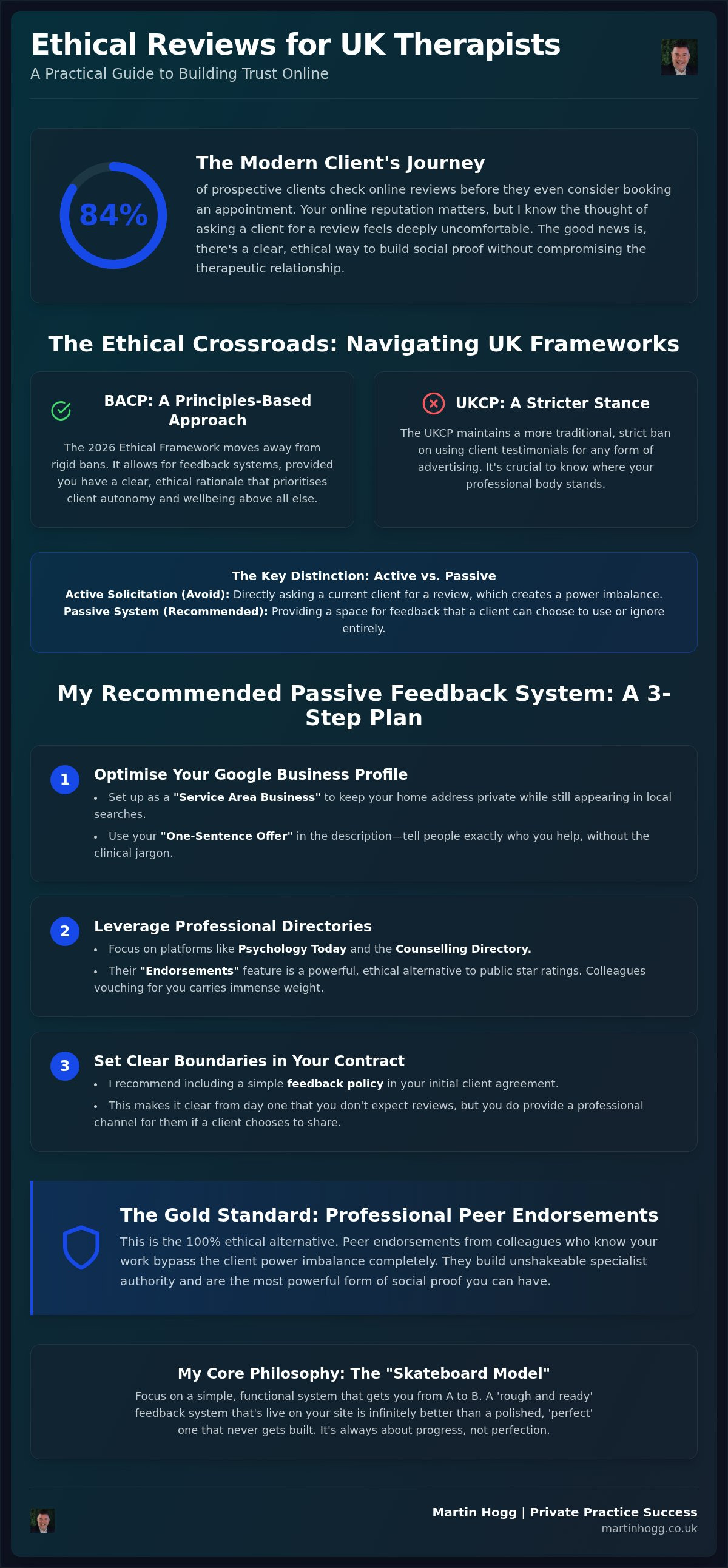
People often tell me they feel a knot in their stomach at the mere mention of marketing. In our world, the idea of "social proof" feels like it clashes with the sacred space of the therapy room. However, the rough and ready truth is that prospective clients are looking for reassurance before they reach out. With 84% of patients checking online reviews in 2026, your visibility on Google often depends on these digital signals. The challenge isn't just about how to get reviews for your therapy practice; it's about doing it without creating a power imbalance that compromises the work.
The core of the dilemma lies in the difference between active and passive solicitation. Active solicitation involves directly asking a current client for a review, which can feel like an obligation they can't refuse. Passive systems provide a space for feedback that the client can choose to use or ignore entirely. This distinction is vital for maintaining "above the fold" credibility on search engines while protecting the therapeutic alliance. When considering how to get reviews for your therapy practice, your focus should always remain on the client's autonomy.
Understanding BACP and UKCP Ethical Frameworks
The UK regulatory landscape is nuanced. While the UKCP maintains a strict ban on using client testimonials for advertising, the BACP's 2026 Ethical Framework encourages a principles-based approach. The BACP allows professional bodies to regulate themselves through clear rationales rather than rigid bans. I recommend including a feedback policy in your initial contract. This sets clear boundaries from day one: you don't expect reviews, but you provide a professional channel for them if the client chooses to share their experience.
Ethical social proof in 2026 is defined as the transparent reflection of your professional standing that prioritises client autonomy over promotional gain. By focusing on systems rather than individual requests, you can scale your practice with a clear conscience.
Setting Up a Passive Feedback System for Your Practice
Setting up a system that works while you sleep is the most effective way to manage how to get reviews for your therapy practice. You don't need a complex marketing machine or high-pressure sales tactics to build your reputation. I advocate for the "Skateboard Model"; a simple, functional setup that gets you from A to B without the friction of a "Ferrari" website. It's about creating a quiet, digital space where feedback can live without you ever having to push for it in the room.
The Google Business Profile: Your First Port of Call
Many therapists worry that a Google profile requires publishing their home address. You can verify your practice as a "Service Area Business" to keep your private location hidden from the public. This allows you to appear in local searches while maintaining your personal boundaries. In your profile description, avoid clinical jargon. Use your "One-Sentence Offer" to tell people exactly who you help and the transformation you provide. This clarity builds immediate rapport before they even click your link.
Directory Reviews: Psychology Today and Beyond
Don't overlook the power of established directories. Platforms like Psychology Today and the Counselling Directory often rank higher in search results than individual websites. While they may not use a five-star system, their "Endorsements" feature acts as a safer, professional alternative to public reviews. These platforms allow colleagues to vouch for your expertise, which is a powerful form of social proof that carries immense weight with prospective clients.
Aligning these tools with BACP's Ethical Framework ensures you remain compliant while growing. You can also use Canva to create gentle, non-hypey prompts for your website's feedback page. This focus isn't on chasing praise; it's about making the process accessible for those who want to share their story. If you find these technical steps overwhelming, joining a community like the Practice Visibility Blueprint can provide the step-by-step guidance you need to get these systems running smoothly.
Professional Social Proof: The 100% Ethical Alternative
While many struggle with the ethics of client feedback, professional endorsements provide a robust and safe alternative. They are the gold standard for specialists because they bypass the power imbalance of the therapeutic room. Unlike the UKCP Code of Ethics, which strictly limits client testimonials in advertising, peer reviews focus on your professional competence. These testimonials from colleagues are safe, effective, and carry significant weight with potential clients who want to know you are respected by your peers.
You can proactively ask supervisors or former colleagues for a "Professional Review." This focuses on your clinical skills, reliability, and specific expertise rather than a client's emotional outcome. Displaying BACP or UKCP accreditation logos acts as a form of institutional review, signalling that you've met rigorous national standards. Your authority also grows through your training. Completing CPD like Anger Management or Working with Men demonstrates a commitment to excellence. This is a vital part of how to get reviews for your therapy practice that don't rely on vulnerable clients for validation.
Networking for Reviews: A Peer-to-Peer Strategy
LinkedIn is a powerful tool for gathering professional recommendations. When you position yourself as a straight-talking expert in a specific niche, you naturally attract peer referrals. These colleagues are often happy to leave a public recommendation on your profile because they value your specific skill set. Being known for a particular area makes it easier for peers to vouch for you. For deeper insights into building these connections, see my guide on marketing for therapists uk.
Implementing Your Review Strategy Without the Overwhelm
I know that the technical side of marketing can feel like a mountain to climb. But when you're looking at how to get reviews for your therapy practice, simplicity is your best friend. I recommend a "One-Page MVP" approach to your feedback policy. This is a single document that outlines how you handle reviews, protecting both your clinical boundaries and your professional reputation. Remember, "done is better than perfect" when it comes to your online visibility. Waiting for the perfect system often means staying invisible to those who need you most.
Negative reviews are a common fear, but they don't have to be a disaster. If you receive one, respond with grace and maintain strict clinical confidentiality. A calm, professional response often builds more trust than a perfect record ever could. Integrating these steps into a wider Private Practice Success Membership growth plan ensures you aren't just chasing stars, but building a sustainable business.
A 30-Day Social Proof Action Plan
- Week 1: Audit your current "Above the Fold" content to see what prospective clients see first.
- Week 2: Set up your Google and directory "passive" links so feedback can happen naturally.
- Week 3: Reach out to three colleagues for professional endorsements to build your peer-to-peer authority.
Handling the "Fear of Being Seen"
Marketing anxiety is real. It's that feeling that you're being too "salesy" or pushy. Shift your mindset from promotion to service; you're simply making it easier for people to find the help they need. Having a clear Practice Visibility Blueprint gives you a structured path to follow, making the process feel less like a performance and more like a professional duty. By breaking it down into small, manageable steps, you can restore your personal trajectory and build a practice that serves your community effectively.
Building Your Ethical Reputation with Confidence
Finding the right balance between professional ethics and modern visibility doesn't have to be a source of stress. By shifting from high-pressure requests to a passive feedback system, you protect your clients while allowing your practice to thrive. We've explored how professional peer endorsements and a clear understanding of the BACP 2026 framework can transform your approach to social proof. You now have a practical roadmap for how to get reviews for your therapy practice that feels authentic and safe. This journey is about more than just numbers on a screen; it's about making your vital support accessible to those who need it most.
I provide a practical, UK-focused mentor approach to help you scale without losing your clinical heart. Through my BACP-endorsed training and the Practice Visibility Blueprint, you can gain the tools to grow a sustainable, visible practice that reflects your values.
Take that first small step today. Your future clients are already looking for you, and with these tools, you'll be much easier to find.
Frequently Asked Questions
Is it ethical to ask therapy clients for Google reviews in the UK?
Directly asking a current client for a review is generally considered unethical because of the inherent power imbalance in the therapeutic relationship. It can make clients feel pressured to provide positive feedback to please you. Instead, I recommend setting up passive systems where clients can choose to leave feedback independently. This approach helps you learn how to get reviews for your therapy practice without compromising your clinical integrity or the client's autonomy.
Can I use anonymous testimonials on my therapy website?
You can use anonymous testimonials, but they must be genuine and verifiable if challenged by the Advertising Standards Authority. However, if you are a UKCP member, their code explicitly prohibits using client testimonials in any form of advertising. For BACP members, the 2026 framework requires you to have a clear ethical rationale for your decision. I often suggest focusing on professional peer endorsements instead, as they provide high-quality social proof without the risks.
How do I respond to a negative review without breaking confidentiality?
When responding to a negative review, your priority is protecting client confidentiality. Never confirm that the person is or was a client in your public response. Instead, provide a standard professional reply that invites them to contact you directly to discuss their concerns in private. A calm, respectful response shows prospective clients that you are composed and professional, even when facing criticism. It demonstrates that you value feedback while maintaining strict clinical boundaries.
What should I do if a client leaves a review without me asking?
If a client leaves a review spontaneously, you aren't required to have it removed, as it's an exercise of their own autonomy. However, you should avoid using that specific review in your own marketing materials if your professional body prohibits it. It's helpful to discuss the review in supervision if the client is still in therapy. This ensures the therapeutic work remains the primary focus rather than your online reputation or marketing efforts.
Do reviews actually help my therapy practice rank higher on Google?
Yes, reviews are a significant ranking factor for local SEO and your Google Business Profile. They signal to Google that your practice is active, trusted, and relevant to searchers. While you shouldn't chase reviews at the expense of ethics, having a steady stream of feedback helps your practice appear more prominently in search results. This visibility is a core part of the Practice Visibility Blueprint, helping you reach more people who need your support.
Disclaimer
The information provided on this blog is for general informational purposes only. It is also not intended to be a substitute for professional medical or mental health advice, diagnosis, or treatment. Reading this content does not create a therapist-client relationship.


