
How to grow a UK counselling practice online and offline

Article by
Martin Hogg
I help Private Practice counsellors in the UK set up and grow an ethical Private Practice they love, work with their ideal clients, and earn the income they deserve. All without guesswork and burnout. I have been a private practice counsellor myself for over 20 years, specialising in anger management. I set up a not-for-profit social enterprise, Citizen Coaching and Counselling, which delivers thousands of counselling sessions a year to adults and young people in Birmingham. I am a registered BACP Counsellor and the author of three books, My Anger Coach, My Anxiety Coach and My Relationship Coach. These are available on Amazon.
A bigger online presence won’t fix a practice that isn’t clear about who it helps. If you’re working out how to grow your counselling practice in the UK, I’d start with a clear offer and a plan that joins up your online visibility with the way you work in person.
It’s understandable to feel pulled in several directions: building a website, choosing directories, improving search visibility and deciding whether to offer online sessions. I’d start with the basics, then build steadily. Useful, simple content is better than polished content that never gets published.
In this guide, I’ll cover the practical benefits of taking your practice online, how directories and a simple website can help people find you, and why a clear specialisation matters. I’ll also look at planning a sustainable private practice, so you can choose next steps that fit your work instead of chasing every marketing idea.
Key Takeaways
- I’d start with a simple website that makes your one-sentence offer clear. You can improve it as you learn what prospective clients need.
- I’d use therapist directories alongside local search visibility, giving people more than one way to find your practice.
- Choose a specialisation and audience that fit your skills. I’d then shape your services and social media around the people you want to reach.
- Before expanding your marketing, build a sound foundation for private practice, including clear client agreements and careful record-keeping.
What are the benefits of taking your counselling business online?
Online sessions let therapists work with clients beyond their immediate area and offer another way to meet. You can combine them with sessions at home or in rented rooms. Choose a format that supports privacy, accessibility and the kind of therapeutic work you offer, rather than assuming one setup suits every client.
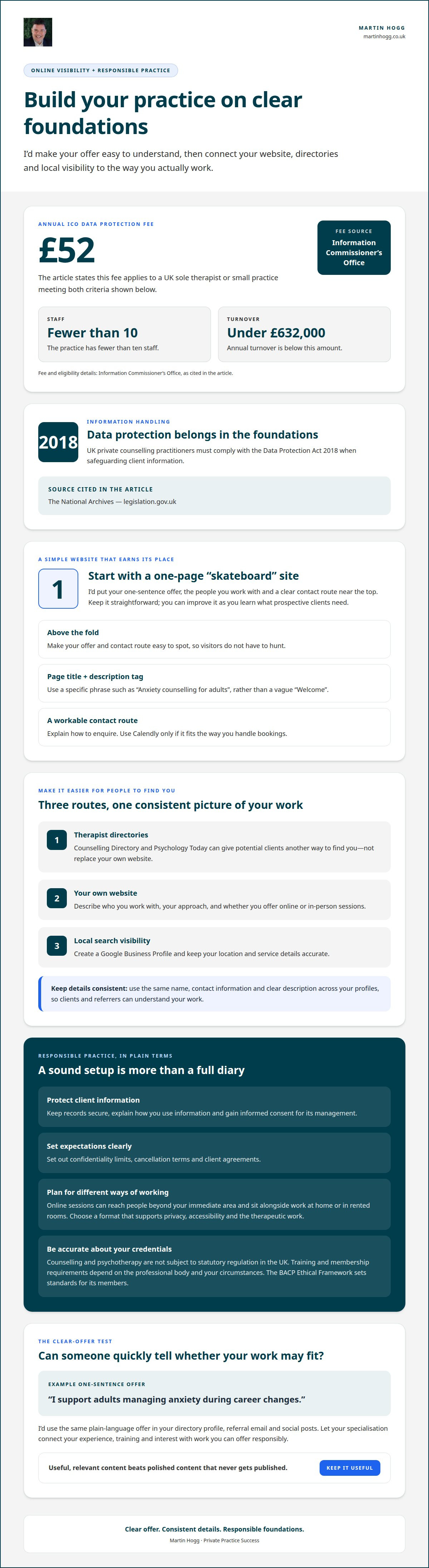
Before taking bookings, plan your business structure, tax records and data protection. UK private counselling practitioners must comply with the Data Protection Act 2018 when safeguarding client information, according to The National Archives (legislation.gov.uk). A UK sole therapist or small practice with fewer than ten staff and turnover under £632,000 pays an annual ICO data protection fee of £52, according to the Information Commissioner's Office.
Keep client records secure, explain how you use information and gain informed consent for its management. Set out confidentiality limits, including serious-harm and child-protection concerns. Put cancellation terms in your contract; 48 hours’ notice is described as a standard period for waiving a full cancellation fee. Professional indemnity and a simple plan for illness or other disruption also support responsible practice.
Counselling and psychotherapy are not subject to statutory regulation in the UK, so there is no single legally mandated qualification or professional registration for counsellors. Training and membership requirements depend on the professional body and your circumstances. For example, the BACP Ethical Framework sets out standards for its members. Be clear about your qualifications and membership, and let ethical practice guide decisions about online sessions.
Online visibility can support local enquiries too. Create a Google Business Profile, keep your location and service details accurate, and make your contact route easy to find. Couples and relationship therapy rates are typically 20 to 50 per cent higher, with sessions often lasting 75 to 90 minutes. Use those differences when planning your offer and workload.
Directories, websites and search visibility
I’d treat a profile on Counselling Directory or Psychology Today as another way for potential clients to find your practice, not as a substitute for your own website. Use the same name, contact details and description across profiles. State who you work with, your approach and whether you offer online or in-person sessions. Consistent information helps clients and referrers understand your work.
Directories can support referrals when your profile gives people a clear reason to get in touch. I’d describe your specialism in plain language and include relevant professional membership or accreditation details accurately. You don’t need to list every issue you’ve encountered in training. A focused profile helps someone seeking support with anxiety, for example, judge whether your work may suit them.
For your website, I’d start with a simple one-page site: the skateboard model. Put your one-sentence offer, the clients you work with and a contact route near the top, so visitors don’t have to hunt. Squarespace can help you create a straightforward page. Write a specific page title and description tag, such as “Anxiety counselling for adults”, rather than a vague phrase like “Welcome”.
Then make the next step obvious. Add a short explanation of how to enquire, and use Calendly only if it fits your booking process. Share useful, relevant posts on social media, perhaps a short Canva graphic explaining what a first session involves. I’d rather see rough and ready content than polished content that never appears. If you want a more structured approach to visibility and practice development, the Private Practice Success Membership may be a useful fit.
Planning services, specialisations and target markets
First decide what your practice can offer consistently: individual psychotherapy, couples work or online sessions. Then write a one-sentence offer that names who you help and what they’re facing. For example: “I support adults managing anxiety during career changes.” Use that sentence in your directory profile, referral email and social posts. If you’re considering how to grow a counselling practice in the UK, clarity about your offer is a useful starting point.
A specialisation should connect your experience, training and interest with a need you can work with responsibly. You might focus on men experiencing relationship difficulties, or adults adjusting to a career change. Be specific, but don’t claim expertise beyond your competence. I’d use a thoughtful niche-building process to define the people you want to reach and the services you can offer appropriately. That focus can also help you decide which enquiries fit your work.
Choose marketing activities that suit your audience and your energy. If you support parents, a short post about returning to work after parental leave may be more useful than general mental health advice. Share practical content on LinkedIn or Instagram, and use Canva to make a simple graphic. Growing a counselling practice in the UK partly depends on showing up consistently, not producing perfect content. Keep posts informative and never turn someone’s personal struggle into a sales opportunity.
Build referrals through genuine professional relationships. Introduce your work to relevant health professionals or community organisations, and explain who you’re equipped to support. Keep a simple record of where enquiries come from and review it regularly. Factor in professional indemnity cover and the time needed for marketing, administration and sessions. This gives you a clearer basis for deciding what to continue, change or set aside as your practice develops.
Establishing and developing a private practice
I’d treat private practice as a small business with clinical responsibilities, not simply a diary of sessions. Before opening, map your working hours, setting, administration and likely gaps between clients. A basic cash-flow plan can show whether your proposed caseload supports those commitments. More than 30,000 BACP members work in private practice in some capacity, so you’re not alone in building this kind of working life.
How much does it cost to start a counselling practice in the UK? First list the costs your setup involves, such as room hire, professional indemnity insurance, secure records, a website and business administration. Online work may avoid regular room hire, while rented rooms add an ongoing overhead. The total depends on the setting and systems you choose, so build your plan around your actual needs rather than guessing at a headline figure.
There’s no single legally mandated qualification or registration for counsellors in the UK. Choose training suited to your intended work, then understand the standards attached to any professional membership or recognised accreditation. Consider whether professional accreditation is relevant to your intended work. Make your qualifications, membership status and scope of practice clear to prospective clients, and keep your work within your training.
Before sessions begin, agree a contract covering fees, cancellations, confidentiality and how clients can contact you. Keep secure records of enquiries, agreements and clinical work, with access limited to appropriate people. The UKCP Code of Ethics and Professional Practice also requires registrants to have arrangements for informing clients and providing support, where appropriate, if the therapist becomes ill or dies. Review your procedures as your caseload changes.
Martin Hogg Private Practice Success: One-to-One Practice Growth Coaching
I can help if you know your practice needs attention but aren’t sure what to tackle first. You might have regular enquiries but no clear specialism, or a useful service that people struggle to find. In One-to-One Practice Growth Coaching, I’ll give you space to work through your goals and decide on practical next steps.
I’d start with the part that feels most stuck. That could mean clarifying your offer, reviewing how you reach potential clients or planning how to develop your practice without taking on more than you can manage. I offer One-to-One Practice Growth Coaching to counsellors who want focused support with these business decisions, rather than another long list of marketing tasks.
If visibility is the main issue, I can help you focus on how your practice presents itself and reaches prospective clients with the Practice Visibility Blueprint. For broader support with building your practice, I offer the Private Practice Success Membership, with structured growth plans, live training and a community of private practice owners. I’d choose a starting point based on the question you’re trying to answer, rather than trying to do everything at once.
You may also have a professional development need alongside business planning. I offer Anger Management CPD for Professionals if you want to develop your knowledge in that area. It has a different focus from practice growth, so I’d choose it for the learning need, not simply because you’re looking for more enquiries.
You don’t need a perfect plan before asking for support. Bring me the challenge you’re working on, whether that’s clearer positioning, a more manageable growth plan or better visibility. We can discuss whether One-to-One Practice Growth Coaching or another offering fits your needs. If you’d like to discuss your practice, contact me.
Choose one useful next step
I don’t think growing a practice means adding another marketing task every week. Choose one change that fits your current capacity, give it proper attention, then review whether it helps you connect with the people you’re equipped to support. I find that steady approach is a practical way to work out how to grow a counselling practice in the UK without losing sight of your clinical values.
If you’d value help deciding what to focus on, I offer the Practice Visibility Blueprint and Private Practice Success Membership through Martin Hogg (Private Practice Success) for practice development. Anger Management CPD for Professionals supports a different need: developing your professional knowledge in anger management. I’d choose the option that fits the question you’re working through, rather than trying to do everything at once.
I believe your practice can develop at a pace that respects both your working life and the care you offer. Start with the next step that feels clear and manageable.
Frequently Asked Questions
What are the steps to set up a counselling practice in the UK?
I’d start by defining the work you’re trained and prepared to offer, then plan how clients will enquire, book and pay. Choose a business structure, arrange suitable insurance and prepare a client contract before taking bookings. Set up secure systems for appointments and accounts, then test the whole process yourself, from an enquiry email to sending a receipt. I’d build your caseload at a pace your working plan can support.
What insurance and legal requirements apply to private counselling practices in the UK?
Counselling and psychotherapy aren’t regulated by law in the UK, but I’d still take professional and legal responsibilities seriously. The Equality Act 2010 applies to private counselling practices and prohibits discrimination based on protected characteristics including age, race and gender. I advise private practitioners to have professional indemnity cover; UKCP registrants must have appropriate indemnity insurance or employer cover under its Code of Ethics and Professional Practice. I’d also follow your membership body’s ethical standards.
How can counsellors attract clients and market a private practice ethically in the UK?
I’d describe your experience and approach accurately, and make clear who your service may suit. Avoid promising outcomes or implying that one approach works for everyone. For example, a post about anxiety can explain what your work involves without suggesting that readers should diagnose themselves. I’d keep clients’ personal disclosures private and make promotional material consistent with your professional body’s ethical framework.
How do counsellors get referrals from GPs, charities, EAPs and directories in the UK?
I’d make it straightforward for a referrer to understand your work and pass on your details. Prepare a concise referral note covering your specialism, how to enquire and your contact method, without sharing client information. For a charity or EAP, clarify how referrals are received and what information is needed before sessions begin. I’d also reply promptly and professionally to directory enquiries, explaining the next step plainly.
What are the tax, business structure and accounting options for self-employed UK counsellors?
Self-employed counsellors commonly consider operating as a sole trader or through a limited company, each with different administrative and financial responsibilities. I’d keep clear records of income and allowable business expenses, using accounting software or an accountant to organise them. Counselling and psychotherapy services are standard-rated for VAT rather than exempt, according to the supplied UK market facts, so I’d include VAT treatment in your financial planning.
Disclaimer
The information provided on this blog is for general informational purposes only. It is also not intended to be a substitute for professional medical or mental health advice, diagnosis, or treatment. Reading this content does not create a therapist-client relationship.


