
How to Help Someone with a Panic Attack: A Practical, Calm Guide for Supporters
Imagine you are in a quiet Birmingham park on a Sunday afternoon when your friend suddenly stops, their breathing turns into shallow gasps, and they look at you with genuine terror. It is a situation that roughly 11% of people in the UK will experience at some point this year, yet most of us feel completely out of our depth when it happens. You might worry they are having a heart attack or fear that your words will only escalate their distress. Learning how to help someone with a panic attack doesn't require a medical degree. It requires a calm, steady presence and a few reliable, practical tools.
I understand how helpless it feels to watch someone you care about struggle to catch their breath. You want to fix the situation, but you don't want to crowd them or say the wrong thing. In this guide, I will share the immediate steps we use at Martin Hogg (Private Practice Success) to defuse the situation safely while keeping your own composure. We will look at the physical reality of what is happening in their body, the grounding techniques that actually work, and the specific markers that indicate when it is time to seek professional support.
Key Takeaways
- Recognise the physical warning signs of a sudden surge in fear, allowing you to identify a crisis before it escalates.
- Understand the 'false alarm' response in the brain and why your own calm presence is the most powerful tool you have.
- Learn the practical, step-by-step communication skills for how to help someone with a panic attack using short, clear, and reassuring directions.
- Identify the common mistakes and dismissive phrases that can unintentionally increase distress during a high-pressure moment.
- Support the recovery process by managing the physical exhaustion that follows an attack and helping the person get their life back on track.
Recognising the Signs: How to Tell if Someone is Having a Panic Attack
Knowing how to help someone with a panic attack starts with being able to identify exactly what is happening. A panic attack isn't just a moment of high stress or a bit of worry. It is a sudden, intense surge of overwhelming fear or physical discomfort that often arrives without an obvious trigger. It can feel like a tidal wave hitting someone who was, moments ago, standing on dry land.
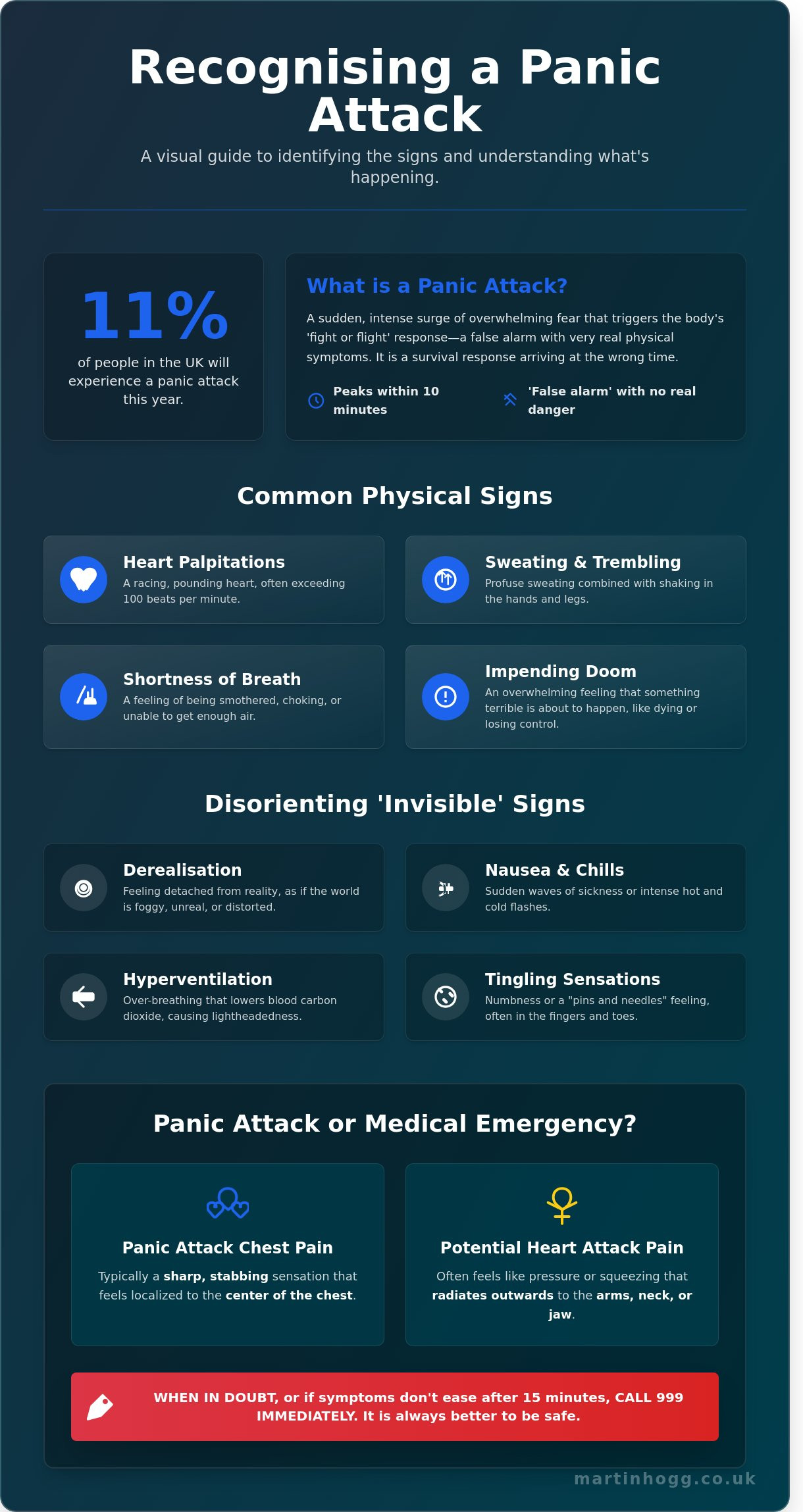
To understand what a panic attack is, we have to look at the body's internal alarm system. During an attack, the 'fight or flight' response fires off at full volume, even though there is no immediate danger. This surge usually peaks within 10 minutes, though for the person experiencing it, those minutes can feel like hours. While a standard anxiety attack might build up slowly over several days, a panic attack is a sharp, sudden event.
You will likely notice several distinct physical symptoms if you are with someone having an attack:
- Heart palpitations or a racing pulse, often exceeding 100 beats per minute.
- Profuse sweating and trembling or shaking in the hands and legs.
- Shortness of breath or a feeling of being smothered.
- A powerful sense of 'impending doom,' where the person feels they are about to die or lose their mind.
Is it a Panic Attack or a Medical Emergency?
This is the most common concern I hear from people in my Birmingham practice. Because the physical symptoms are so violent, it is very common for the person to believe they are having a heart attack. You can often tell the difference by looking at the nature of the pain. Panic-related chest pain is typically localised to the centre of the chest and feels like a sharp, stabbing sensation. Heart attack pain, however, often radiates outwards towards the arms, neck, or jaw.
If you are in any doubt at all, especially if the person has a history of heart disease or the symptoms don't begin to ease after 15 minutes, call 999 immediately. It's always better to err on the side of caution and let a medical professional make the assessment. If you are a practitioner looking to discuss how to manage these crises with your own clients, you can find a time to talk on my calendar.
The 'Invisible' Symptoms You Might Miss
Not every sign of a panic attack is as obvious as gasping for air. Some symptoms are internal and can be incredibly disorienting. Many people experience derealisation, which is a feeling that the world around them is 'unreal' or that they are detached from their own body. They might look at you but seem like they are looking through you, trapped in a foggy or distorted version of reality.
You might also see signs that look like a sudden physical illness, such as extreme nausea or sudden, intense chills. Hyperventilation is a key factor here; when someone breathes too quickly, it lowers the carbon dioxide in their blood. This leads to tingling in the fingers and toes, which often makes the person feel even more terrified because it mimics the signs of a stroke or other serious conditions. Recognising these 'invisible' signs is a vital part of knowing how to help someone with a panic attack effectively.
The Science of the 'False Alarm': Why the Body Reacts This Way
Understanding the mechanics of anxiety makes the experience less intimidating for everyone involved. When you're learning how to help someone with a panic attack, it’s useful to view the body as a sophisticated machine that is simply responding to a glitch in its software. The brain has a tiny, almond-shaped part called the amygdala. Its job is to keep us safe by spotting danger. Think of it as a smoke alarm that has become far too sensitive. It does not distinguish between a house fire and a bit of burnt toast; it just screams at the top of its lungs regardless.
When this alarm triggers, the body is flooded with adrenaline. This is the physical rush the person feels. It is a survival mechanism designed to give us the strength to fight a predator or the speed to run away. Because there is no actual physical danger to fight or flee, that energy has nowhere to go. It stays trapped inside, causing the heart to race and the chest to tighten. While it feels dangerous, it is important to remember that the body is actually trying to protect the person. It is a survival response that has simply arrived at the wrong time.
The Role of the Nervous System
The human body operates using two main settings within the autonomic nervous system. The sympathetic nervous system acts like an accelerator, revving the body up for action. The parasympathetic nervous system acts like the brakes, helping us rest and digest. During a panic attack, the accelerator is pushed to the floor. However, the body is physically incapable of staying in this high-alert mode forever. NHS guidelines state that most panic attacks peak within 10 minutes and then begin to subside as the parasympathetic system naturally takes over. A panic attack is a physical response to a perceived, not actual, threat.
Common Triggers vs. Spontaneous Attacks
Sometimes the cause is obvious. External triggers might include:
- Crowded public transport or busy shopping centres.
- Receiving stressful news or facing a difficult confrontation.
- Being in a confined space where escape feels difficult.
Other times, attacks happen out of the blue while someone is relaxing at home. This spontaneity can be particularly distressing. Searching for a logical reason in the middle of the crisis often increases anxiety because the brain struggles to find an answer. When you are supporting a friend, knowing how to help someone with a panic attack involves accepting that there might not be a clear trigger. If you are looking for how you can help, it is better to focus on the physical sensations rather than the cause. If these experiences are starting to interfere with daily life, you might find it helpful to book a brief chat to explore some practical tools for getting things back on track.
Step-by-Step Guidance: What to Do in the Moment
When someone is in the grip of a panic attack, their nervous system is screaming that they're in immediate danger. You become their external regulator. Your first job is to stay calm. If your heart rate stays steady and your posture remains relaxed, theirs is more likely to follow. Keep your sentences short and direct. Their brain is currently too busy processing fear to handle complex instructions or long explanations.
Try to move them to a quiet, open space if the environment is crowded. Don't force them though. Physical touch can sometimes feel threatening during high anxiety, so always ask before reaching out. Acknowledge that they feel terrible. Say something like, "I know this feels scary, but you're safe." You aren't lying to them; you're reminding their brain of the current reality. Crucially, stay with them. Statistics from the NHS suggest a typical attack peaks within 10 minutes, but it feels like an eternity to the person suffering. Don't leave them alone until the physical symptoms have clearly subsided.
Effective Grounding Techniques to Try
Learning how to help someone with a panic attack means having a toolkit of practical actions ready to go. The 5-4-3-2-1 technique is a classic for a reason. Ask them to name five things they can see, four they can touch, three they can hear, two they can smell, and one they can taste. This forces the brain to shift from internal fear to the external environment.
- Box breathing: Guide them to inhale for 4 seconds and exhale for 6. That longer exhale tells the parasympathetic nervous system to kick in.
- The Ice Cube trick: Handing them an ice cube or splashing cold water on their face provides a sensory shock that can break the loop of a panic spiral.
Communicating with Compassion
Your voice is a powerful instrument. Keep it low, steady, and unhurried. Avoid high-pitched or frantic tones that might escalate the situation. Instead of standing over them, sit down nearby. This non-verbal cue shows you're a safe presence rather than a threat. Use phrases that offer reassurance without being dismissive. "I'm right here," "This will pass," and "You're doing well" are all effective. These simple words provide a tether back to reality when they feel like they're losing control. Understanding how to help someone with a panic attack is often about being a grounded witness to their experience.
Common Mistakes: What Not to Say or Do During an Attack
When you are learning how to help someone with a panic attack, your natural instinct is to fix the problem quickly. You want the person to feel better, so you might reach for phrases that seem reassuring. However, well-meaning words can often increase the pressure the person feels. According to 2023 NHS data, 1 in 10 people in England will experience a panic attack at some point, and most report that dismissive comments are the biggest barrier to recovery during the crisis.
Avoid telling someone to "just calm down" or "don't worry about it." These phrases suggest the person has a choice in the matter. They don't. A panic attack is a physical hijacking of the nervous system. Telling someone to relax when their heart is racing at 140 beats per minute is like telling a person with a broken leg to just walk it off. It doesn't work, and it usually makes them feel like they are failing at "being normal."
- Don't ask "why": The person likely doesn't know the trigger in the moment. Asking for a logical explanation forces them to use a part of the brain that is currently offline.
- Don't crowd them: Physical space is vital. Unless they specifically ask for a hug, keep a respectful distance of at least two metres.
- Don't take it personally: If they snap at you or seem angry, it's the adrenaline talking. It is a survival response, not a reflection of your relationship.
Why 'Calm Down' Never Works
During a panic attack, the amygdala takes over and the prefrontal cortex, the logical part of the brain, shuts down. This happens in milliseconds. Commands like "calm down" require logical processing that the person simply cannot access. When you force a "calm" state, you often increase their internal sense of failure. Instead of emotional commands, focus on physical anchors. Suggest they feel their feet on the floor or count five blue things in the room. This moves the focus from the internal chaos to the external environment without the pressure of "fixing" an emotion.
Understanding Male-Specific Panic Responses
In my experience at Citizen Coaching, I've seen that men often express panic differently. Instead of visible trembling, a man might show intense frustration or a sudden, urgent need to "get out" of the room. This is the "fight or flight" response in its purest form. If a man becomes irritable or paces the floor, don't try to restrain him or demand he sit down. Allow him the space to move safely. Many men feel a deep sense of shame after an attack, often linked to outdated ideas of "strength." Reassure them that a panic attack is a physiological event, like a sneeze or a cramp, and has nothing to do with their character.
If you or someone you care about is struggling to manage these episodes, you can book a consultation to discuss professional support and get things back on track.
Moving Forward: Supporting Recovery and Professional Next Steps
Once the peak of the crisis passes, the person you are supporting won't immediately return to their usual self. A panic attack is a massive physical event. It floods the body with adrenaline and cortisol, leaving the individual feeling what many describe as a "panic hangover." This exhaustion can last for several hours or even a full day. Their muscles might ache, and they may feel mentally foggy or tearful. It's a heavy weight to carry, and they need time to let the dust settle.
Encourage them to prioritise rest. It's tempting to try and "power through" back to work or social commitments, but the body needs time to recalibrate. Suggest they drink a glass of water and find a quiet space. If you want to know how to help someone with a panic attack in the long term, suggest they keep a simple diary. Recording the date, time, and what was happening just before the attack helps identify triggers. Patterns often emerge that make the experience feel less random and more manageable. Data from 2023 suggests that tracking triggers can reduce the perceived "unpredictability" of attacks for 45 percent of sufferers.
When to Suggest Therapy or Coaching
Professional support is a practical way to get life back on track. If these episodes happen more than once a month, or if the person starts avoiding certain places for fear of another attack, it is time to talk about professional help. Around 1.2 million people in the UK are currently accessing talking therapies for similar issues, so they are certainly not alone. It's about finding the right tool for the job.
Bring this up gently when they are calm. You might say, "I've noticed these attacks are happening more often, and I want to help you find a way to stop them from limiting your life." Mention that evidence-based techniques like Cognitive Behavioural Therapy (CBT) or EMDR are highly effective. Research indicates that 60 percent of people with panic disorder see significant recovery after a structured course of 6 to 20 CBT sessions.
Professional Development for Those Who Support Others
If you are frequently the person people turn to in a crisis, you might find it helpful to build your own toolkit. Learning how to help someone with a panic attack is a valuable skill, but formal training provides the confidence to handle deeper issues. Understanding the "why" behind these behaviours is a core part of my approach to citizen coaching and professional counselling.
I regularly run workshops designed for people who want to support their community, colleagues, or family members more effectively. You can find details of upcoming sessions on the Martin Hogg training calendar. These sessions focus on practical, real-world tools that move beyond theory and into action, helping you become a steady, capable presence for those who need it most.
Moving From Panic to Practical Support
Supporting someone through a sudden crisis doesn't require a medical degree, but it does require a steady hand and a clear head. You've now seen that these episodes are essentially a "false alarm" in the body's nervous system. By staying calm, avoiding dismissive phrases, and focusing on simple grounding techniques, you provide the safety they need to return to the present. Learning how to help someone with a panic attack is a vital skill that turns a frightening experience into a manageable one.
I've spent over 20 years in clinical practice helping individuals get their lives back on track. My approach is always practical and no-nonsense because I know that when you're supporting others, you need tools that work in the real world. If you're ready to build your confidence, I've developed BACP-endorsed workshops that translate complex mental health issues into actionable steps. These sessions are grounded in two decades of experience and are designed to help you provide the best possible care for your clients or loved ones.
Ready to deepen your understanding of mental health support? View our upcoming CPD workshops and training events
You have the capacity to make a real difference. Keep learning and remember that your calm presence is often the most powerful tool in the room.
Frequently Asked Questions
How long does a typical panic attack last?
Most panic attacks reach their peak intensity within 10 minutes and usually subside completely within 30 minutes. While the most distressing physical symptoms are relatively brief, the person might feel physically drained or "on edge" for several hours afterwards. I've found that many people need a quiet space to recover once the initial surge of adrenaline has left their system.
Can someone actually die from a panic attack?
No, you cannot die from a panic attack, even though the physical sensations often feel like a life-threatening emergency. During an episode, the heart rate can jump to 150 beats per minute, which is the body's natural "fight or flight" response working exactly as it should. Understanding this biological safety mechanism is a key part of how to help someone with a panic attack and regain a sense of control.
Should I give someone a paper bag to breathe into?
You should not use a paper bag, as this practice is no longer recommended by UK health professionals. It can be quite dangerous if the person is actually experiencing an asthma attack or a different medical issue. Instead, encourage them to try "box breathing" or simply focus on making their exhales longer than their inhales. This helps to naturally reset the nervous system without any external equipment.
What is the best thing to say to someone having a panic attack?
The most helpful thing you can say is a simple, grounding phrase like "You are safe, I am right here, and this will pass." It's best to avoid telling them to "calm down" or "don't be silly," as these phrases can make the person feel dismissed. Use a low, steady voice and keep your sentences short. Your calm presence often speaks much louder than the specific words you choose.
Is it okay to touch someone or hug them during an attack?
You should always ask for permission before touching someone, as physical contact can feel quite intrusive or even frightening during a crisis. While about 50% of people might find a firm hand on the shoulder grounding, others need a clear physical space to feel safe. If they pull away or say no, just stay close enough so they know they aren't alone. Respecting their boundaries helps them feel more in control of their environment.
How can I tell if it is a panic attack or just high stress?
A panic attack is a sudden, overwhelming surge of terror that comes on quickly, whereas high stress tends to be a lingering feeling of being under pressure. According to clinical guidelines, a panic attack usually involves at least 4 of 13 specific physical symptoms, such as heart palpitations, sweating, or shaking. Stress is often tied to a specific problem, but panic can sometimes seemingly appear out of nowhere.
What should I do if the panic attack doesn't stop after 20 minutes?
If the symptoms haven't started to fade after 20 minutes, or if the person is experiencing severe chest pain, you should call 999 for advice. While most attacks are harmless, it's important to be safe, especially if this is the first time they've experienced these sensations. UK emergency services are well-trained to distinguish between anxiety and other medical issues. It's always better to get a professional opinion when you're unsure.
How can I help someone who has frequent attacks but refuses professional help?
You can help by being a steady, non-judgmental support and gently sharing information when they're feeling calm. Many people, particularly men, avoid seeking help because of the stigma, but mentioning that 1 in 4 people in the UK struggle with mental health each year can make it feel more normal. Suggesting a "citizen coach" or a local counsellor can feel less intimidating than a clinical setting. Helping them see that they can get their life back on track is a powerful motivator.


