How to Position Your Counselling Niche to Attract More Clients
What if the fear of turning people away is actually the very thing keeping your diary empty? It is a common worry for many UK therapists that narrowing your focus means losing out on income. However, learning how to position your counselling niche to attract more clients isn't about closing doors. It is about making sure the people who need your specific help can actually see you through the noise of crowded professional directories.
I understand the pressure to be a generalist, especially when you are trying to build a stable career. But trying to speak to everyone often means your message doesn't land with anyone. This article will help you define your special interest so the right clients can find you with ease. We will look at how to move past the overwhelm of marketing and build a practice that feels both sustainable and deeply fulfilling.
Key Takeaways
- Understand why being a generalist often leads to feeling invisible and how a clear focus helps you stand out in the crowded UK market.
- Discover a practical way to review your past cases to find out how to position your counselling niche to attract more clients.
- Learn how to translate your clinical expertise into a 'bridge' that speaks directly to the outcomes your clients are looking for.
- Identify the common 'therapist-speak' phrases that might be accidentally pushing potential clients away from your website.
- See how a defined niche makes networking easier by giving colleagues a clear reason to refer the right people to your practice.
Why Your Counselling Niche is the Key to Professional Visibility
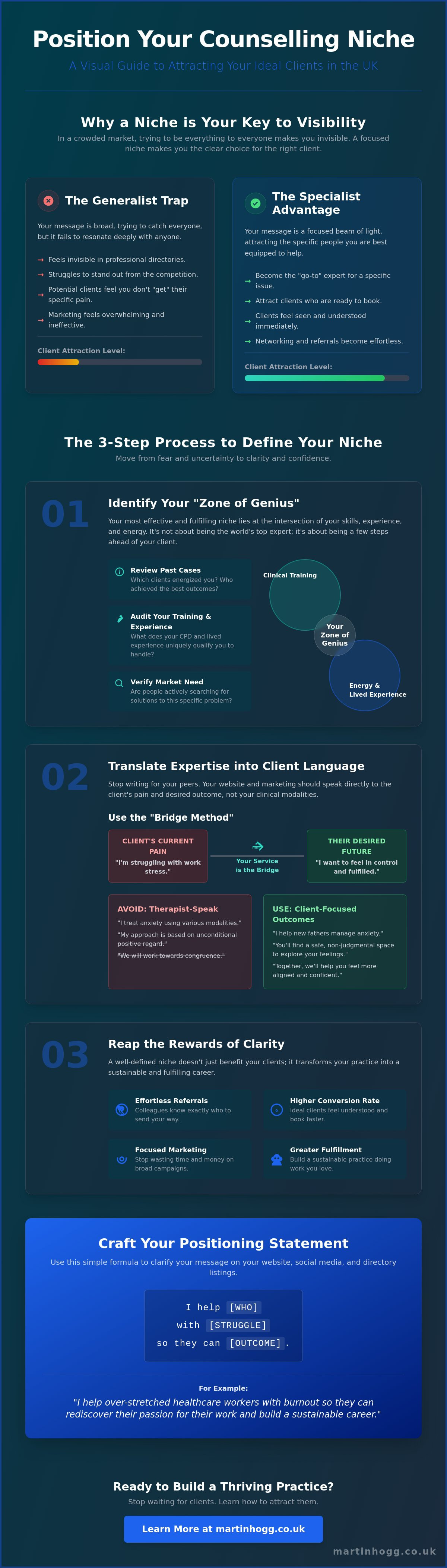
Positioning is simply the mental space you occupy in a potential client’s mind. When someone thinks, "I need help with my relationship," or "I'm struggling with work stress," whose name pops up? If you are seen as a generalist, the answer is likely "no one in particular." In a crowded UK market, being a jack-of-all-trades often makes you invisible. While it feels safe to say you can help with any issue, it actually makes it harder for people to trust that you are the right fit for their specific pain.
Choosing a niche is actually an act of service. When a person is in distress, they aren't looking for a list of qualifications or a generic understanding of mental health; they are looking for someone who "gets" them. By being specific about who you help, you make it much easier for a person in crisis to find the right support quickly. This clarity also means you can stop relying so heavily on expensive, passive directory listings. When you are the go-to specialist for a certain issue, you become the primary search result in the client's mind.
Moving from Generalist to Specialist Without the Fear
Many counsellors I talk to struggle with a scarcity mindset. There is a very real fear that by narrowing your focus, you will lose out on potential income. However, the opposite is usually true. Knowing how to position your counselling niche to attract more clients allows you to speak directly to the people you are best equipped to help. A clear, focused niche ensures that when a potential client reads your profile, they feel so understood that they are significantly more likely to book that first session immediately.
If you are feeling overwhelmed by the idea of "niching down," it might be helpful to look at Marketing for Therapists in the UK as a foundational step for your practice. This shift in perspective helps you move from "trying to find anyone" to "being found by the right someone." It is a much more sustainable way to work, and it builds a practice that feels personally fulfilling rather than just a list of appointments.
How to Identify Your Area of Special Interest
Identifying your niche is as much about your own well-being as it is about your clients'. Working with people who drain your energy is a fast track to burnout. Take a moment to review your past cases. Which clients gave you the most energy? Who achieved the best outcomes? Your "Zone of Genius" usually sits right at the intersection of your clinical training and your lived experience. It is that sweet spot where you feel most competent and connected.
Once you have an idea, you need to verify it. Researching the market need is a vital step in learning how to position your counselling niche to attract more clients. Are people in the UK actually searching for help with this specific struggle? Marketing a therapy practice becomes much easier when you know there is a genuine demand for your focus area. You should also audit your current training. Think about how your recent learning, such as CPD for Counsellors UK, supports this direction. If you find a gap, you can choose future workshops that specifically strengthen your chosen niche.
Overcoming Imposter Syndrome in Your Niche
It is very common to feel like a bit of a fraud when you first claim a niche. You might ask yourself, "Who am I to call myself an expert?" The truth is, you don't need to be the world’s leading authority. You just need to be a few steps ahead of your client and have the right tools to guide them. Try thinking of your niche as a "special interest" rather than a restrictive label. This shift in language can help you feel more comfortable and confident as you grow your practice. If you would like some support with this transition, joining our Private Practice Success community can provide the encouragement you need.
Translating Your Niche into Copy That Attracts Clients
Once you have identified your area of interest, the next hurdle is communicating it. Many therapists struggle here because they write for their peers rather than their potential clients. If your website is full of clinical terms like "modalities," "congruence," or "unconditional positive regard," you might be accidentally alienating the very people you want to help. Most people in distress don't search for a specific therapeutic framework. They search for a solution to a feeling that is keeping them awake at night.
A helpful way to think about your writing is the "Bridge Method." Your copy should position your service as the bridge between a client's current pain and their desired future. When you are specific about the struggle you help with, you build instant trust. For example, instead of saying you "treat anxiety," saying you help with "anxiety in new fathers" tells a specific man that you truly understand his world. This is how to position your counselling niche to attract more clients; you speak their language so clearly they feel you are already in the room with them.
To get started, try writing a simple positioning statement using this formula:
- I help [Who] with [Struggle] so they can [Outcome].
For example: "I help over-stretched healthcare workers with burnout so they can rediscover their passion for helping others without sacrificing their own health." This clarity makes it incredibly easy for a person to decide if you are the right fit for them.
Writing for the Client, Not Your Peers
It is a common trap to write copy that you think will impress a supervisor or a BACP assessor. While professional standards are vital, your marketing copy needs to reflect the "internal monologue" of your client. Think about the words they use when they are whispering to themselves at 3 AM. Use those words. Your goal is to make them feel seen, heard, and understood before they even pick up the phone. Keep your call to action supportive and clear. Instead of a pushy "Book Now," try something like "Let’s have a brief, no-pressure chat to see if I’m the right person to help."
If you want to refine your messaging with a group of like-minded professionals, you can join our Private Practice Success community for feedback and support.
Building Your Practice Visibility Blueprint Around Your Niche
Once you have done the internal work of choosing a focus, it's time to let the world know. A well-defined niche simplifies your networking efforts immensely. It is much easier for a GP, a colleague, or a local organisation to refer a person to a specialist than to a generalist. When you are known as the person who helps with a specific issue, you become a clear solution in their mind. This clarity is a core part of learning how to position your counselling niche to attract more clients.
Your niche should inform every part of your local and national visibility strategy. Locally, this might mean connecting with specific community groups or charities that align with your interest. Nationally, it allows you to tailor your online presence so you aren't competing with every therapist in the UK. Instead, you are standing out to a specific group of people who truly need your help. This targeted approach makes your marketing efforts much more efficient and less overwhelming.
The long-term benefits of this approach are significant. Specialisation often leads to higher fees and better clinical outcomes because you are working within your "Zone of Genius." Most importantly, it helps prevent therapist burnout. When you work with clients who energise you, your practice becomes a source of professional fulfilment rather than a drain on your resources. It allows you to build a career that is both sustainable and impactful.
From Solo Practitioner to Authority
Having a niche allows you to move beyond the traditional one-to-one model. You might find yourself creating workshops, running groups, or even providing training for other professionals. This transition shifts your role from a solo practitioner to a trusted authority within a specific community. It turns your practice into a growing business that serves a clear purpose. It gives you the freedom to impact more lives while also protecting your own energy.
If you are ready to take these steps, your niche serves as the foundation for your Practice Visibility Blueprint. For those who want consistent, practical support as they grow, our Private Practice Success Membership offers a space to learn and collaborate with others on the same journey. Focusing your practice isn't about limiting yourself; it is about giving yourself the space to truly excel.
Start Building a Practice That Works for You
Choosing to focus your practice is a significant shift in mindset. It moves you away from the exhaustion of trying to be everything to everyone and towards a career built on your genuine strengths. By identifying your area of special interest and speaking directly to your client’s internal monologue, you create a bridge that makes it easy for the right people to reach out. Learning how to position your counselling niche to attract more clients is not just a marketing tactic; it is the foundation of a practice that remains fulfilling for years to come.
I've spent over 20 years in private practice and, as a BACP-endorsed workshop provider, I’ve seen how this clarity transforms a therapist's confidence. I created the Practice Visibility Blueprint to help counsellors like you bridge the gap between clinical excellence and business success. You don't have to figure this out alone. Ready to fill your diary? Join the Private Practice Success community and get the support you need to grow.
Building a visible, trusted practice takes time, but it starts with a single decision to be seen for what you do best. You have the skills to help; now it's just about making sure the right people can find you.
Frequently Asked Questions
Will I lose clients if I choose a niche for my private practice?
You won't lose the clients you are meant to help; you'll simply stop being invisible to them. While it feels like you are narrowing your pool, you are actually becoming the obvious choice for a specific group of people. A generalist often gets lost in crowded directory searches, but a specialist stands out as the most trusted solution for someone in specific distress.
How do I know if my chosen counselling niche is too small?
Your niche is only too small if there is no documented need for that specific support in your target area. You can verify this by checking local search trends or speaking with local organisations to see if they have waiting lists for that issue. In most cases, what therapists fear is "too small" is actually a healthy, underserved market that desperately needs your unique expertise.
Can I have more than one niche in my therapy practice?
You can certainly have more than one niche, provided they don't confuse your potential clients. It is usually best to have separate pages on your website for each area, such as one for "Working with Men" and another for "Bereavement." This ensures that when a person arrives at your site, they feel you are speaking directly to their unique situation rather than trying to be everything to everyone.
Do I need extra CPD training before I can claim a niche?
You don't always need new qualifications to claim a niche, as your current clinical training and lived experience are often enough to get started. However, targeted learning can boost your confidence and refine your skills. Part of knowing how to position your counselling niche to attract more clients involves recognising the value you already bring while identifying any specific gaps you would like to fill with future workshops.
What if I change my mind about my niche later on?
Your niche isn't a life sentence, and you can absolutely change your focus as your practice evolves. Many therapists start with one area and find that their interests naturally shift after a few years of clinical work. The process of learning how to position your counselling niche to attract more clients is a skill you can apply again whenever you decide to move in a new professional direction.

Article by
Martin Hogg
I help Private Practice counsellors in the UK set up and grow an ethical Private Practice they love, work with their ideal clients, and earn the income they deserve. All without guesswork and burnout. I have been a private practice counsellor myself for over 20 years, specialising in anger management. I set up a not-for-profit social enterprise, Citizen Coaching and Counselling, which delivers thousands of counselling sessions a year to adults and young people in Birmingham. I am a registered BACP Counsellor and the author of three books, My Anger Coach, My Anxiety Coach and My Relationship Coach. These are available on Amazon.
Disclaimer
The information provided on this blog is for general informational purposes only and is not intended to be a substitute for professional medical or mental health advice, diagnosis, or treatment. Reading this content does not create a therapist-client relationship.


